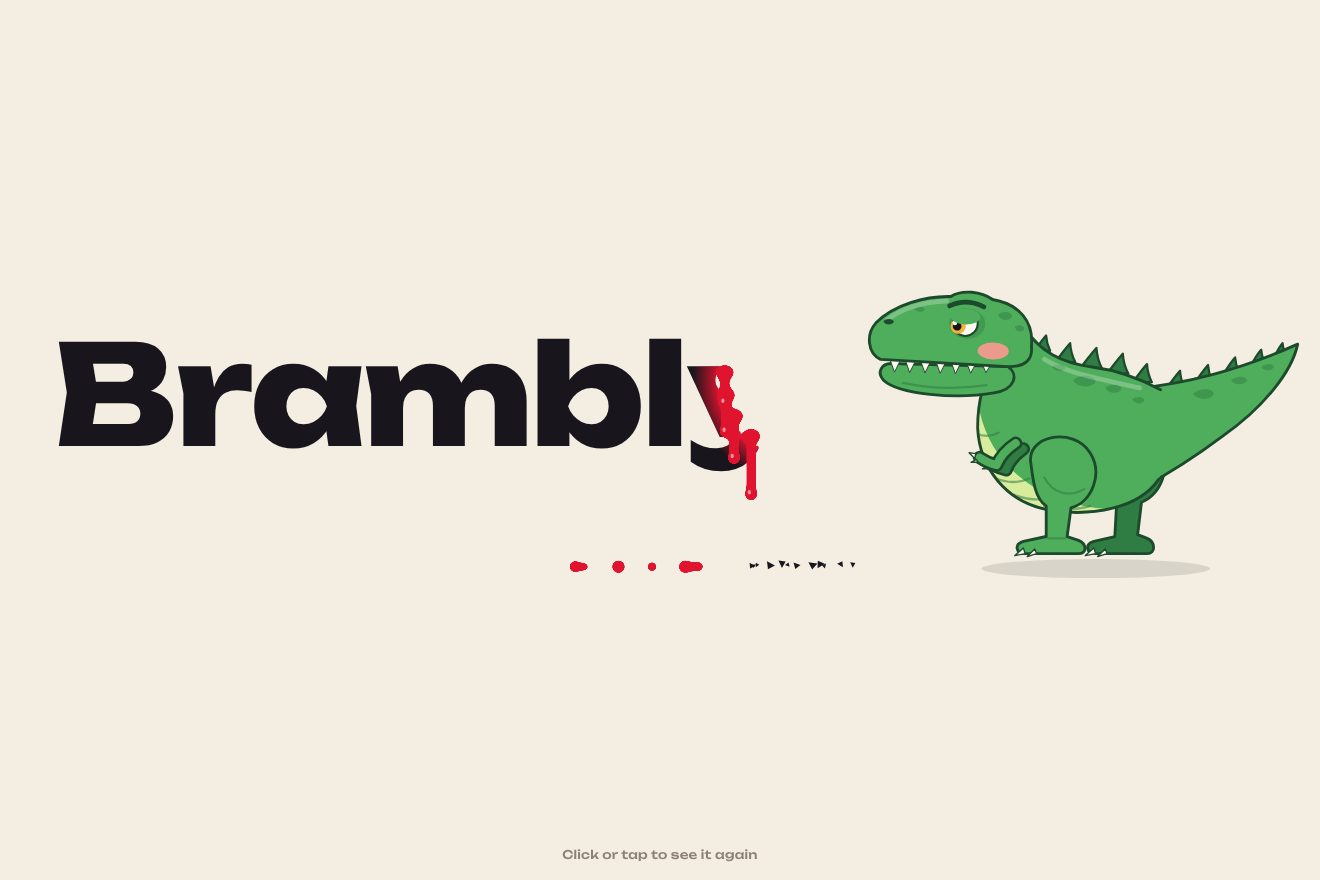
The dinosaur-bitten logo
Intro, SVG, Text
NewFree
A minimal-style logo intro: the letters of the brand are the tiles of a sliding puzzle, mixed up, in a thin frame. They slide one at a time into the empty cell, a pixel too far and back, until the name reads; then the missing piece, a red square, swells into the empty cell, the tiles lose their edges and close up into a two-line mark. A different puzzle every time.
A folder that runs on its own: index.html, style.css, script.js and the libraries from a CDN. The React and Vue tabs hold the same demo as a ready component, which switches its animations off when it leaves the page.
<!doctype html>
<html lang="en">
<head>
  <meta charset="utf-8">
  <meta name="viewport" content="width=device-width, initial-scale=1">
  <title>The sliding puzzle logo</title>
  <link rel="stylesheet" href="https://cdn.jsdelivr.net/npm/@fontsource-variable/bricolage-grotesque@5.3.0/standard.css">
  <link rel="stylesheet" href="style.css">
</head>
<body>
  <main class="scena" data-scene>
    <!-- the stage: the script draws the frame and the tiles, then slides them until the name reads -->
    <svg class="palco" data-stage role="img" aria-label="HALFWAY" xmlns="http://www.w3.org/2000/svg">
      <g data-board>
        <rect class="cornice" data-frame />
        <g data-tiles></g>
        <rect class="tassello" data-piece />
      </g>
    </svg>
    <button class="ancora" type="button" data-replay>Replay</button>
  </main>

  <script src="https://cdn.jsdelivr.net/npm/gsap@3.15.0/dist/gsap.min.js"></script>
  <script src="script.js"></script>
</body>
</html>Change values, colours and text with the controls and watch the animation respond live. Or write in the code yourself. Then download the folder with your changes.
16 values to change
With the Animorio connector, Claude Code takes it from here, guide included, and fits it into your project. Paste this request:
Take “The sliding puzzle logo” from Animorio and fit it into my siteThe puzzle is mixed starting from the finished name: the empty cell takes MOVES random steps, never stepping straight back, and the list of cells it touched is the solution read backwards. So the moves are the ones a hand would really make, the puzzle always solves, and every Replay is different.
The whole intro is one GSAP timeline built before it starts: for every move we know which tile goes where, so every slide is a tween in its place (with the labels solve, piece, close and rest). The pace changes along the puzzle with a small parabola on the duration: the first and last moves slow, the middle ones quick. One function writes all the positions, after every frame.
Each tile goes with power3.inOut to a point SETTLE pixels past its cell and comes back with elastic.out(1, 0.35). Meanwhile the letter, an SVG text in Bricolage Grotesque, changes its variable axes: wght drops to 470 and wdth narrows while it slides, then rises past its weight as it lands and comes back. The tile right after it in the same direction, if there is one, moves a pixel and back: it looks as if it felt the knock.
At the end the name is set again as real type: the letter widths are measured on a canvas in the same face, the rows are set flush left with TRACK and LEADING, and every tile goes where its letter would sit in a set word. The red square shrinks to the height of a capital and lands at the end of the second row, a pixel low and then in its place. Edges and frame vanish with fill-opacity and stroke-opacity.
| Name | File | Default | What it changes |
|---|---|---|---|
WORD | script.js | 'HALFWAY' | The logo: its letters fill the tiles row by row, the last cell is the red square. |
ROWS | script.js | 2 | How many rows of tiles (and of lines in the finished mark). |
MOVES | script.js | 12 | How many slides it takes to solve the puzzle. |
SLIDE | script.js | 0.32 | The seconds of one slide in the middle of the puzzle (the first and last ones are slower). |
SETTLE | script.js | 1.2 | How many pixels a tile passes its cell before the spring pulls it back. |
GAP | script.js | 0.08 | The space between the tiles, in tile sizes. |
TRACK | script.js | 0.06 | The letter spacing of the finished mark, in em. |
LEADING | script.js | 1.3 | The distance between the lines of the finished mark, in capital heights. |
SPEED | script.js | 1 | The speed of the whole intro: 2 is twice as fast, 0.5 half as fast. |
REPLAY | script.js | true | The small Replay button that appears at the end (a click anywhere on the page restarts the intro anyway). |
For the opening of a playful site: a design or game studio, a brand with a two-word name, an agency that wants to say “the missing piece”, a portfolio, the holding page of a launch. It suits short names, from five to eleven letters.
The same puzzle with the same moves, with smaller tiles so that the frame fits the width of the screen. A tap restarts it.
Nothing slides: the finished mark, with its red square, fades in.
GSAP 3.15.0, Bricolage Grotesque (font variabile) 5.3.0.
Compressed with gzip, the three demo files weigh 6.6 KB; the libraries: GSAP 28 KB.
Tested on 19 October 2026
Use it in your own projects and in your clients’ projects. Do not resell it or redistribute it as is. GSAP stays under its own Standard license. Full license.
With your account’s email and password.
or with your email
You’re signed in as .
With your account, you can download the zip of every animation and every pack, for free.