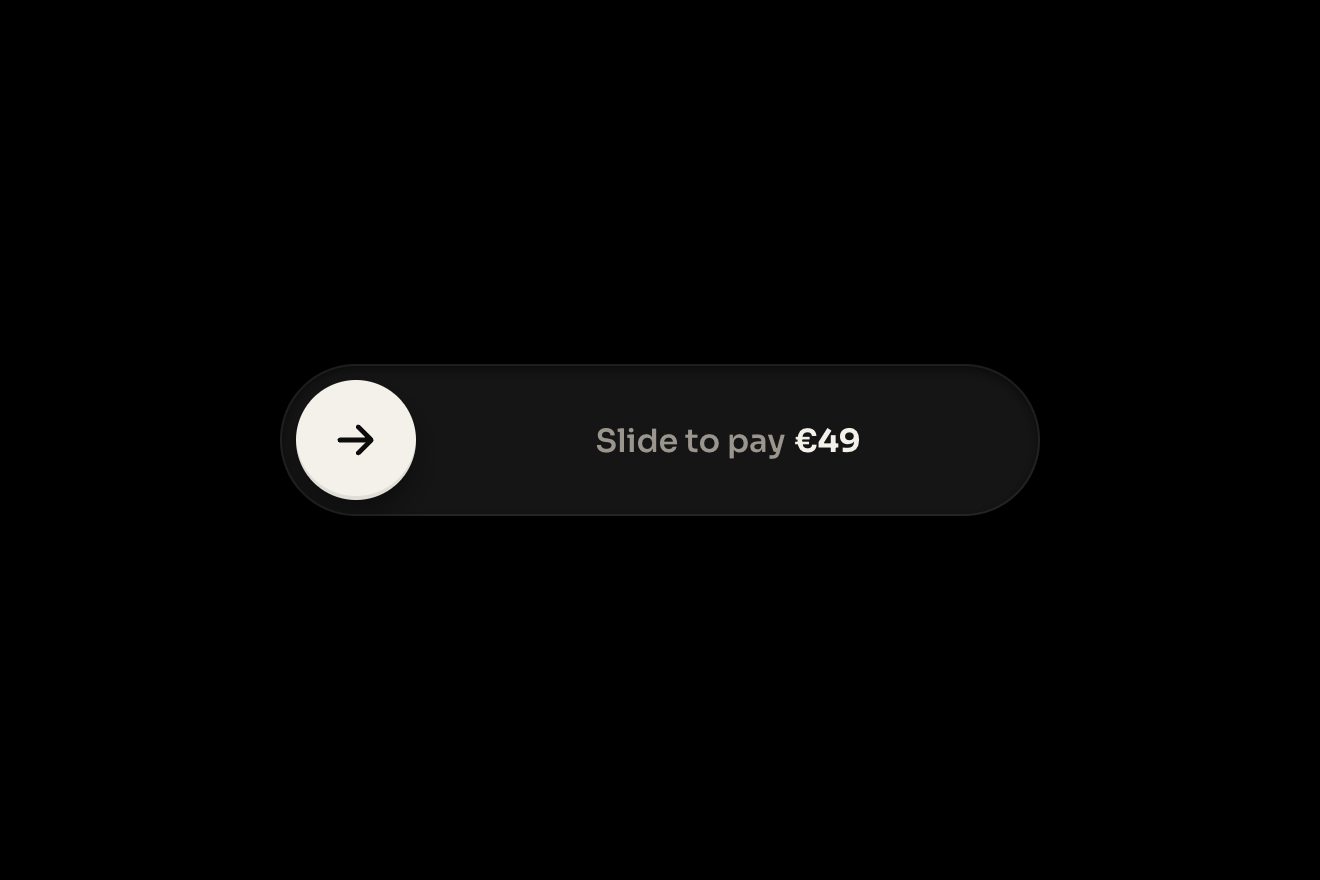
The slide-to-confirm button
Buttons, Physics, Transitions
NewFree
Three columns of cards to do, doing and done: a card picked up comes away and tilts with the speed of the hand as if it had weight, and where it would land a gap opens while the others move aside; let go, it flies into it and settles, and in Done its tick draws itself.
A folder that runs on its own: index.html, style.css, script.js and the libraries from a CDN. The React and Vue tabs hold the same demo as a ready component, which switches its animations off when it leaves the page.
<!doctype html>
<html lang="en">
<head>
  <meta charset="utf-8">
  <meta name="viewport" content="width=device-width, initial-scale=1">
  <title>The task board</title>
  <link rel="stylesheet" href="https://cdn.jsdelivr.net/npm/@fontsource-variable/epilogue@5.3.0/index.css">
  <link rel="stylesheet" href="style.css">
</head>
<body>
  <main class="stage">
    <!-- the task board: three columns of cards. A card picked up tilts with the speed of the hand, a gap opens
         where it would land and the other cards slide to make room; dropped, it settles in its place, and in Done
         it gets its tick -->
    <section class="board" aria-label="Tasks for the weekend" data-board data-autoclic></section>
    <p class="sr" id="board-help">Press space to pick a card up, the arrows to move it, space again to put it down, escape to put it back.</p>
    <p class="sr" aria-live="assertive" data-live></p>
  </main>
  <div class="layer" aria-hidden="true" data-layer></div>

  <script src="https://cdn.jsdelivr.net/npm/gsap@3.15.0/dist/gsap.min.js"></script>
  <script src="script.js"></script>
</body>
</html>Change values, colours and text with the controls and watch the animation respond live. Or write in the code yourself. Then download the folder with your changes.
26 values to change
With the Animorio connector, Claude Code takes it from here, guide included, and fits it into your project. Paste this request:
Take “The task board” from Animorio and fit it into my sitePicked up, the card moves onto a layer over the page (position fixed) exactly where it was, and in its place a gap of the same height keeps the space; it grows by LIFT.
On every frame the card follows the hand (x and y with GSAP) and its sideways speed, smoothed, tilts it: rotation = speed × TILT, up to MAX_TILT degrees, smoothed too, so it sways like something with weight.
The column under the hand comes from elementFromPoint (the layer lets the pointer through), the place from the middle of the cards; the gap goes there, and the cards of the two columns, measured before, slide from their old places to the new ones in SLIDE seconds.
Let go, the card flies into the gap (0.32 seconds, power3.out), takes its place in the list and settles with a squash (scaleY from 0.94 to 1, elastic.out); in Done the tick’s little square pops out (back.out) and the tick draws itself with stroke-dashoffset; the counts roll up or down.
Space picks a card up, the arrows move it between columns and places (the others slide), space puts it down and Esc puts it back where it was; an aria-live region says where it is. On a phone the card is picked up with a long press (0.3 seconds), so the page can still scroll, and while it is carried the page stays still. A click from a script (the library’s preview) carries a card along a curve into another column; four moves bring the board back as it was.
| Name | File | Default | What it changes |
|---|---|---|---|
TILT | script.js | 0.015 | How much a card tilts with the speed of the hand. |
MAX_TILT | script.js | 9 | The most it tilts, in degrees. |
LIFT | script.js | 1.04 | How much bigger a card is while it is carried. |
SLIDE | script.js | 0.32 | The seconds the other cards take to make room. |
COLUMNS | script.js | [['To do', [['Fresh towels in room 4', 'Rooms'], …]], …] | The columns and their cards: words and part of the house (the last column is the one of things done). |
For a team’s tasks, a restaurant’s orders, the cleaning of the rooms, the work on a project, the applications to a job: anywhere things go from one state to the next.
The columns go one under the other; a card is picked up with a long press, so the finger can still scroll the page, and while it is carried the page stays still.
The card does not tilt or grow, it lands in its place at once without flying or squashing, the others move without sliding and the tick appears already drawn; the gap follows the hand as always.
GSAP 3.15.0, Epilogue (font variabile) 5.3.0.
Compressed with gzip, the three demo files weigh 7.2 KB; the libraries: GSAP 28 KB.
Tested on 3 October 2026
Use it in your own projects and in your clients’ projects. Do not resell it or redistribute it as is. GSAP stays under its own Standard license. Full license.
With your account’s email and password.
or with your email
You’re signed in as .
With your account, you can download the zip of every animation and every pack, for free.