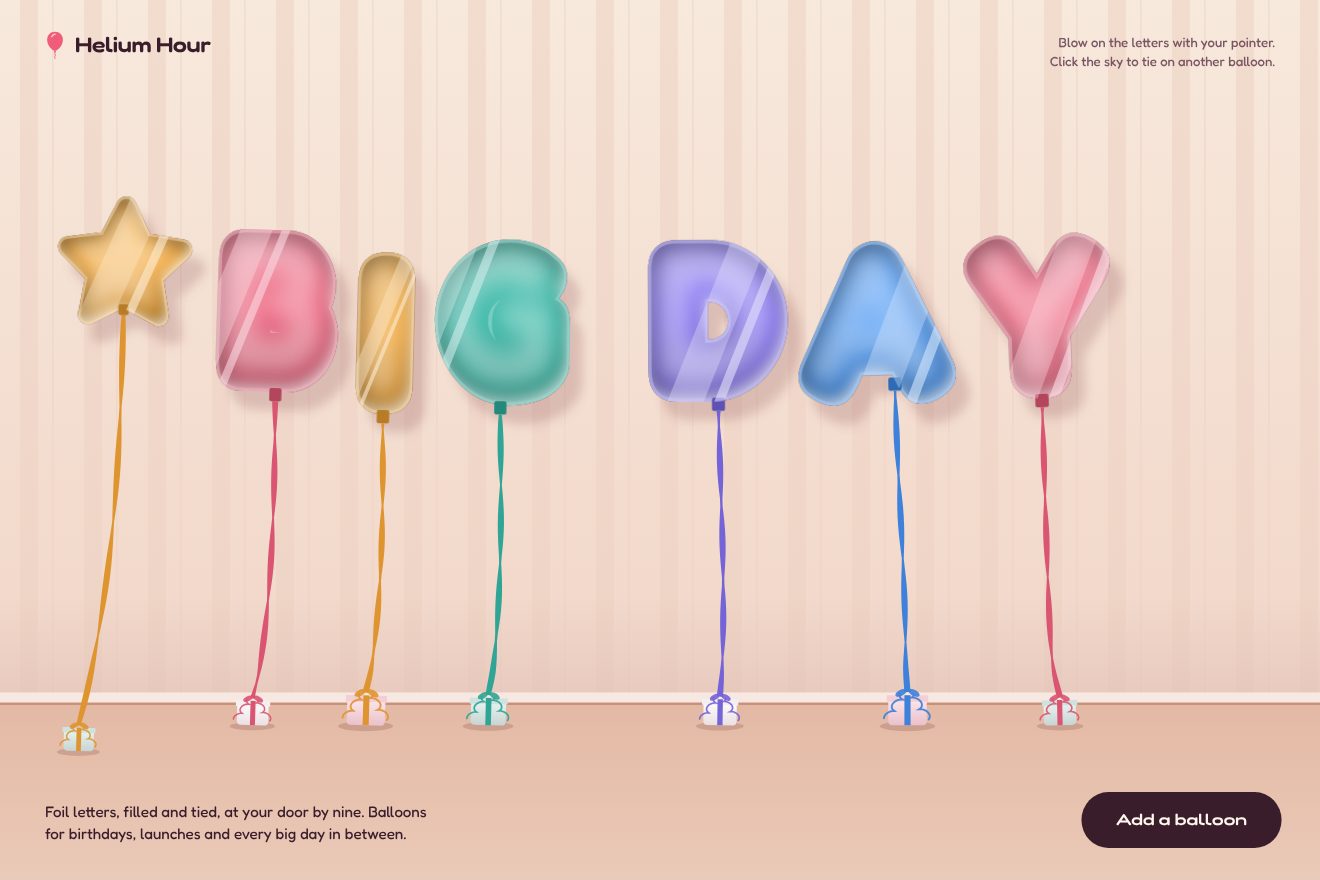
The balloon headline
Physics, Text, Hover
NewFree
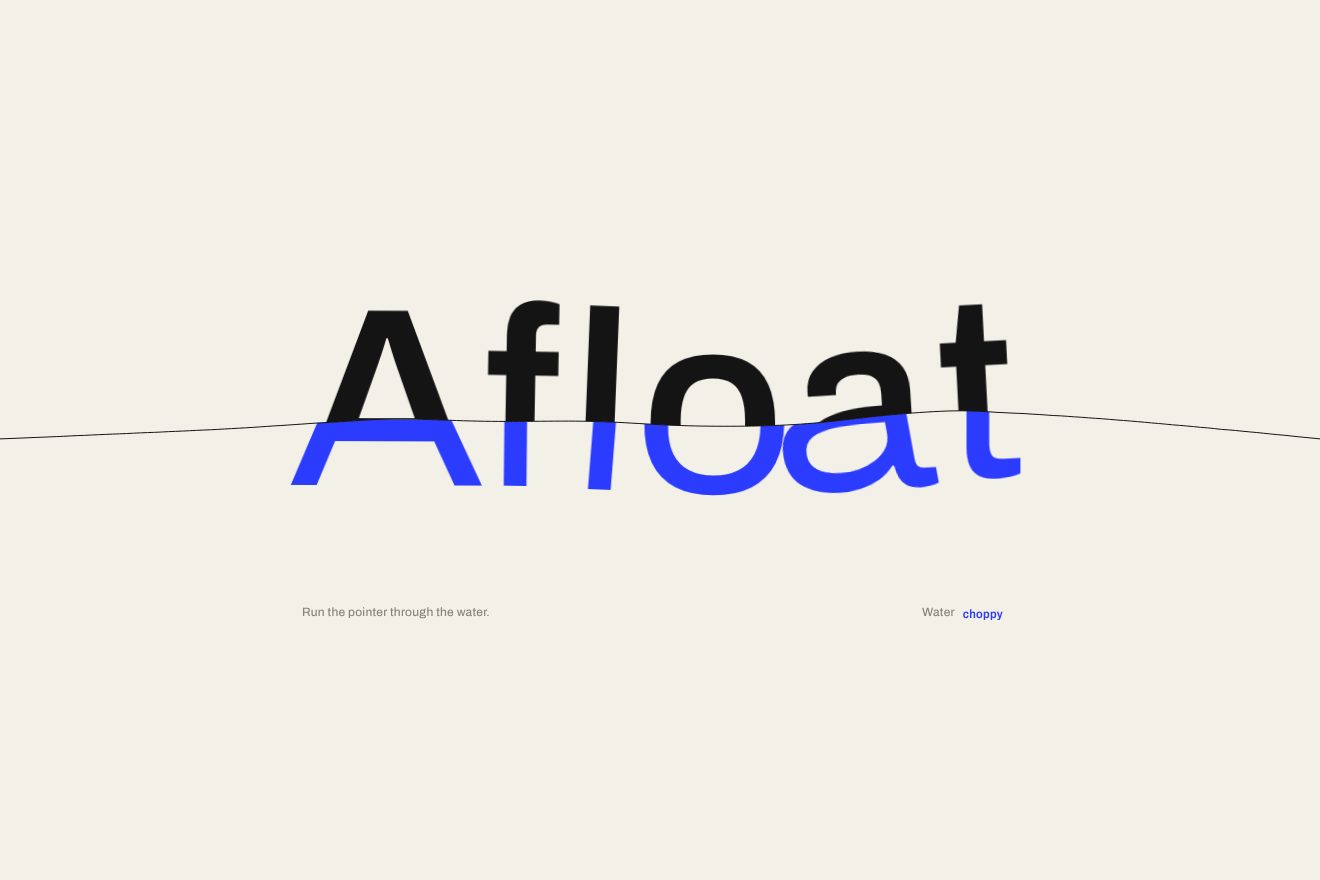
In the minimal style: a big word on a thin line, every letter tied to the line by an invisible rubber band. The pointer catches the letter it touches and pulls it out of the row, the neighbours follow a little, the letter thins out and blushes and the line bends under it. Too far and the band gives: the letter snaps back into the row with a hard knock and a little tremble.
A folder that runs on its own: index.html, style.css, script.js and the libraries from a CDN. The React and Vue tabs hold the same demo as a ready component, which switches its animations off when it leaves the page.
<!doctype html>
<html lang="en">
<head>
  <meta charset="utf-8">
  <meta name="viewport" content="width=device-width, initial-scale=1">
  <title>Tensile</title>
  <link rel="stylesheet" href="https://cdn.jsdelivr.net/npm/@fontsource-variable/anybody@5.3.0/wdth.css">
  <link rel="stylesheet" href="style.css">
</head>
<body>
  <!-- one word on one hairline: every letter is tied to the line by an invisible rubber band -->
  <main class="stage" data-stage>
    <svg class="lines" data-lines aria-hidden="true">
      <path class="line" data-line d="" />
    </svg>
    <h1 class="word" data-word aria-label="Tensile"></h1>
    <p class="hint" data-hint>Catch a letter and pull it off the line.</p>
    <p class="read" data-readout aria-hidden="true"><span class="read__label">Tension</span> <span class="read__win"><b class="read__value" data-read>slack</b></span></p>
  </main>

  <script src="https://cdn.jsdelivr.net/npm/gsap@3.15.0/dist/gsap.min.js"></script>
  <script src="script.js"></script>
</body>
</html>Change values, colours and text with the controls and watch the animation respond live. Or write in the code yourself. Then download the folder with your changes.
19 values to change
With the Animorio connector, Claude Code takes it from here, guide included, and fits it into your project. Paste this request:
Take “The word on the elastic line” from Animorio and fit it into my siteEvery letter is a box with its width at rest, measured once and then fixed in pixels, holding a second element with the real letter. The script moves and deforms only the inner one: so when a letter narrows or widens on the axes of the variable typeface (font-stretch and font-weight, driven by two CSS variables) the word does not reflow and the neighbours do not shift. The box is a centred flex, so a letter that widens spills out evenly on both sides.
Every frame looks for the letter under the pointer, inside an oval as tall as the letter around its resting point: that is the caught letter, and a new catch lets the old one go. The target of the caught letter is the distance to the pointer times PULL, a little less as the distance grows (the band stiffens); the neighbours get the same pull times NEIGHBOURS once for every letter in between. When the pointer goes further than REACH letter heights from the resting point, the catch breaks.
Every letter has a position, a lean and a stretch, moved by springs with a frequency and a damping, in fixed steps of a two-hundred-and-fortieth of a second inside gsap.ticker. While it is pulled it uses a soft, nearly critical spring that chases the hand; let go, a hard spring (SNAP, in hertz) with little damping (TREMBLE), which is the knock. Below the line the letter finds a floor nine times stiffer than the band: it does not sink, it hits. At the moment of the knock the stretch gets a push backwards, so the letter squashes wide and heavy and comes back, and the lean gets a kick that makes the tremble.
The line is an SVG path redrawn every frame: two fixed ends and one point under every letter, joined by a smooth curve (Catmull-Rom turned into Bezier curves). Every point is a light, lightly damped spring that follows a share (LINE) of its letter's movement, so the line rises under the pulled letter and, when the letter hits, takes the blow and quivers like a string. The colour and thickness of the line and the colour of the letter come from color-mix with a tension variable, so the colours stay in :root.
The entrance is a GSAP timeline: the line draws itself with expo.out, then every letter, held up high and already stretched, is let go with a staggered delay and the same physics knocks it into the row. The tension reading changes word by rolling through a little window (back.out for «snap», with a shake of a few pixels). After IDLE seconds with no pointer a timeline moves an invisible hand: it slowly pulls a letter, holds it for a breath, gives a last tug and the band gives; a real pointer sends it away.
| Name | File | Default | What it changes |
|---|---|---|---|
WORD | script.js | 'Tensile' | The word on the line (up to 16 letters; a short one stays big). |
PULL | script.js | 0.62 | How far the caught letter follows the pointer: 0.3 is a stiff band, 0.9 a loose one. |
REACH | script.js | 1.25 | How far the pointer can go, in letter heights, before the band gives. |
NEIGHBOURS | script.js | 0.36 | How much the neighbouring letters are dragged along with the caught one (0 = not at all). |
SNAP | script.js | 6.5 | How hard the letter snaps back, in hertz: 3 is a soft rubber band, 12 a steel spring. |
TREMBLE | script.js | 0.13 | How long the tremble lasts after the knock: 0.05 a long shiver, 0.6 almost none. |
LINE | script.js | 0.34 | How much the line bends with the letters (0 = it stays straight and only changes colour). |
THIN | script.js | 1 | How much a stretched letter thins out on the width and weight axes of the typeface. |
IDLE | script.js | 2.2 | After how many seconds without a pointer the invisible hand plucks a letter (0 = never). |
--taut | style.css | #e0462a | The colour of tension, on the line and on the stretched letter. |
--weight | style.css | 640 | The weight of the word's typeface, from 100 to 900. |
--width | style.css | 112 | The width of the word's typeface, in percent (from 60 to 140). |
For a heading you can touch: the opening of a portfolio or a studio, a brand name in a landing page, the 404 page, the cover of a type project. It works with any short word.
The same physics with the sizes adapted: the word fills almost the whole width and the distance at which the band gives is measured in letter heights, so it works small too. You catch a letter with a finger and drag it; lifting the finger lets the band go. The hint changes to «Drag a letter off the line.» and hides if there is no room beside the tension reading.
Nothing moves: the line and the letters fade in and stay still. The caught letter and the line only change colour, fading towards red the harder you pull, and fade back when the band gives.
GSAP 3.15.0, Anybody (font variabile) 5.3.0.
Compressed with gzip, the three demo files weigh 8.3 KB; the libraries: GSAP 28 KB.
Tested on 14 October 2026
Use it in your own projects and in your clients’ projects. Do not resell it or redistribute it as is. GSAP stays under its own Standard license. Full license.
With your account’s email and password.
or with your email
You’re signed in as .
With your account, you can download the zip of every animation and every pack, for free.