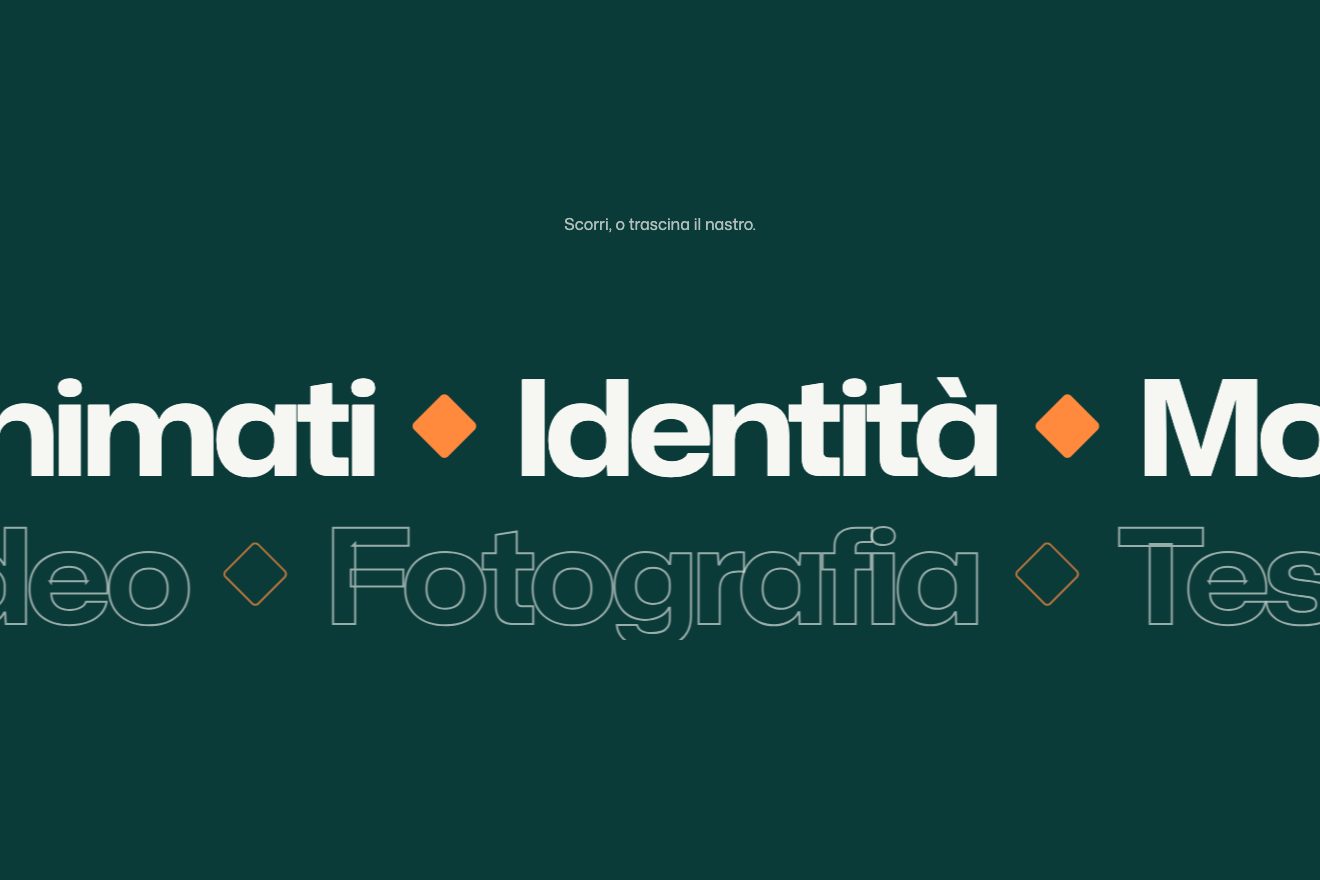
Marquee that speeds up with scroll
Scroll, Text, Hover
Free
A big word on the horizon line and its long, flat shadow made of hairlines: the pointer is the sun and the shadow turns round the word like the light of a whole day, long towards the right at dawn, short and straight down at noon, long towards the left at sunset. The letters follow the sun one after the other: wide and light when the sun is low, narrow and heavy at noon. Minimal style.
A folder that runs on its own: index.html, style.css, script.js and the libraries from a CDN. The React and Vue tabs hold the same demo as a ready component, which switches its animations off when it leaves the page.
<!doctype html>
<html lang="en">
<head>
  <meta charset="utf-8">
  <meta name="viewport" content="width=device-width, initial-scale=1">
  <title>The word with the day's shadow</title>
  <link rel="stylesheet" href="https://cdn.jsdelivr.net/npm/@fontsource-variable/anybody@5.3.0/wdth.css">
  <link rel="stylesheet" href="style.css">
</head>
<body>
  <!-- one big word and its long, flat shadow drawn in hairline hatching. The shadow turns round the word like the
       light of a whole day: long at dawn, short at noon, long again at sunset. The pointer moves the sun -->
  <main class="stage" role="slider" tabindex="0" aria-label="Time of day" aria-valuemin="5" aria-valuemax="19"
        aria-valuenow="9.5" aria-valuetext="09:30" data-stage>
    <header class="top">
      <p class="time" aria-hidden="true">
        <span class="time__digits" data-digits>09:30</span>
        <span class="time__phase"><span class="time__word" data-phase>Morning</span></span>
      </p>
      <p class="top__note">Shade, all day long</p>
    </header>

    <!-- the sky: a hairline arc with the hours, the ground at its two feet and the sun -->
    <svg class="scene" aria-hidden="true" data-scene>
      <defs>
        <clipPath id="above">
          <rect data-above></rect>
        </clipPath>
      </defs>
      <path class="arc" data-arc></path>
      <g class="ticks" data-ticks></g>
      <path class="ground" data-ground></path>
      <g clip-path="url(#above)">
        <g class="sun" data-sun>
          <circle r="9"></circle>
        </g>
      </g>
    </svg>

    <!-- the long shadow, drawn in hairlines on a canvas -->
    <canvas class="shade" aria-hidden="true" data-shade></canvas>

    <!-- the word: it stands on the horizon, and below the horizon it is cut off -->
    <div class="horizon" aria-hidden="true" data-horizon>
      <div class="word" data-word></div>
    </div>
    <h1 class="sr-only" data-label></h1>

    <p class="hint">Move the sun across the page</p>
  </main>

  <script src="https://cdn.jsdelivr.net/npm/gsap@3.15.0/dist/gsap.min.js"></script>
  <script src="script.js"></script>
</body>
</html>Change values, colours and text with the controls and watch the animation respond live. Or write in the code yourself. Then download the folder with your changes.
24 values to change
With the Animorio connector, Claude Code takes it from here, guide included, and fits it into your project. Paste this request:
Take “The word with the day's shadow” from Animorio and fit it into my siteThe pointer's horizontal position becomes the hour, from just after five to just before seven in the evening, and the hour shown follows it on a spring (SUN_SPRING) integrated by hand on GSAP's ticker, with the step capped at 1/30 of a second. The hour becomes an angle on the arc, π at six in the morning and 0 at six in the evening, and the sun sits on the ellipse centred on the word; the sun's height is 62 degrees times the sine of the fraction of the day, negative before six and after eighteen. Below the horizon the sun is cut by a clipPath and the shadow fades away.
The shadow goes from the sun through the word and beyond: its direction is the one from the sun to the middle of the word, its length is SHADOW times the letter size divided by the tangent of the sun's height, so it is very long at dawn and short at noon. The letters are drawn on a canvas, which is then copied onto a second canvas twice, the second time moved along the light; this is repeated nine times doubling the shift, and the copies become 511, a solid shape with no gaps. Only the rectangle holding the letters and the shadow is worked on, and that is what makes it fast.
The letters themselves are cut out of the shape (destination-out), then a gradient along the light fades it towards its tip (destination-in). On the visible canvas, at screen resolution, the hairlines (HATCH) are drawn at ANGLE degrees to the light, counted from the middle of the page so they do not slide; the shape keeps them only where there is shadow. Lines parallel to the light would not read as a shape, only as streaks.
Each letter is a span with font-variation-settings: a single number from 0 to 1, the sun's height, becomes width (WIDTH) and weight (WEIGHT). Each letter reads the height as it was STAGGER seconds earlier for every place between it and the side of the sun, from a short memory of the last second, and gets there on a spring of its own. On the canvas the letters are drawn again with the same weight, the nearest of the widths the canvas knows and the measured box of the real letter.
A GSAP timeline draws the arc with stroke-dasharray on pathLength 1, pops the ticks up with back.out as the drawing reaches them, raises the letters from under the horizon (a container with hidden overflow that ends exactly on the baseline) and brings the sun to the hour START. After 2.4 seconds with nobody there a repeating timeline takes the sun from dawn to sunset in DAY seconds; when it starts again the sun jumps under the horizon without the spring, so it never runs back across the sky.
| Name | File | Default | What it changes |
|---|---|---|---|
WORD | script.js | 'Umbra' | The word on the horizon: short is better, the size fits the page by itself. |
START | script.js | 9.5 | The hour the opening lands on, from 5 to 19 (9.5 is half past nine). |
DAY | script.js | 11 | How many seconds the sun takes from dawn to sunset when it goes by itself. |
SHADOW | script.js | 0.5 | How long the shadow is: higher, longer shadows at every hour. |
HATCH | script.js | [6, 1] | The lines of the shadow: the distance between them and their thickness, in pixels. |
ANGLE | script.js | 62 | The angle between the lines and the light: 90 sets them across, under 30 they turn into streaks. |
SUN_SPRING | script.js | [120, 15] | The spring the sun follows the pointer on: how stiff, and how much it is held back. |
WIDTH | script.js | [146, 70] | The width of the letters with a low sun and at noon (50 to 150). |
WEIGHT | script.js | [250, 820] | The weight of the letters with a low sun and at noon (100 to 900). |
STAGGER | script.js | 0.07 | How many seconds pass between one letter and the next as they follow the sun. |
For a name or a word about light, sun and shade: the title of a holiday home or a seaside hotel, the sign of a bar with a terrace, a brand of parasols, sun cream or sunglasses, the page of a photographer who works with natural light. It works where there is a single scene and the word is the message; it does not suit a heading among lots of other content.
The same animations with the sizes adapted: the word takes up almost the whole width, the arc of the sky is taller than it is wide, the texts at the top and bottom are a little smaller. The sun follows the finger while it drags anywhere on the page (the page does not scroll there, it is a single scene) and stops when it lifts; then the day starts again by itself.
No springs, no rising letters, no kicking ticks and no day going by itself: the scene fades in already in place at half past nine, and with the pointer or the arrow keys the shadow and the letters go straight to the chosen hour.
GSAP 3.15.0, Anybody (font variabile) 5.3.0.
Compressed with gzip, the three demo files weigh 9.3 KB; the libraries: GSAP 28 KB.
Tested on 15 October 2026
Use it in your own projects and in your clients’ projects. Do not resell it or redistribute it as is. GSAP stays under its own Standard license. Full license.
With your account’s email and password.
or with your email
You’re signed in as .
With your account, you can download the zip of every animation and every pack, for free.