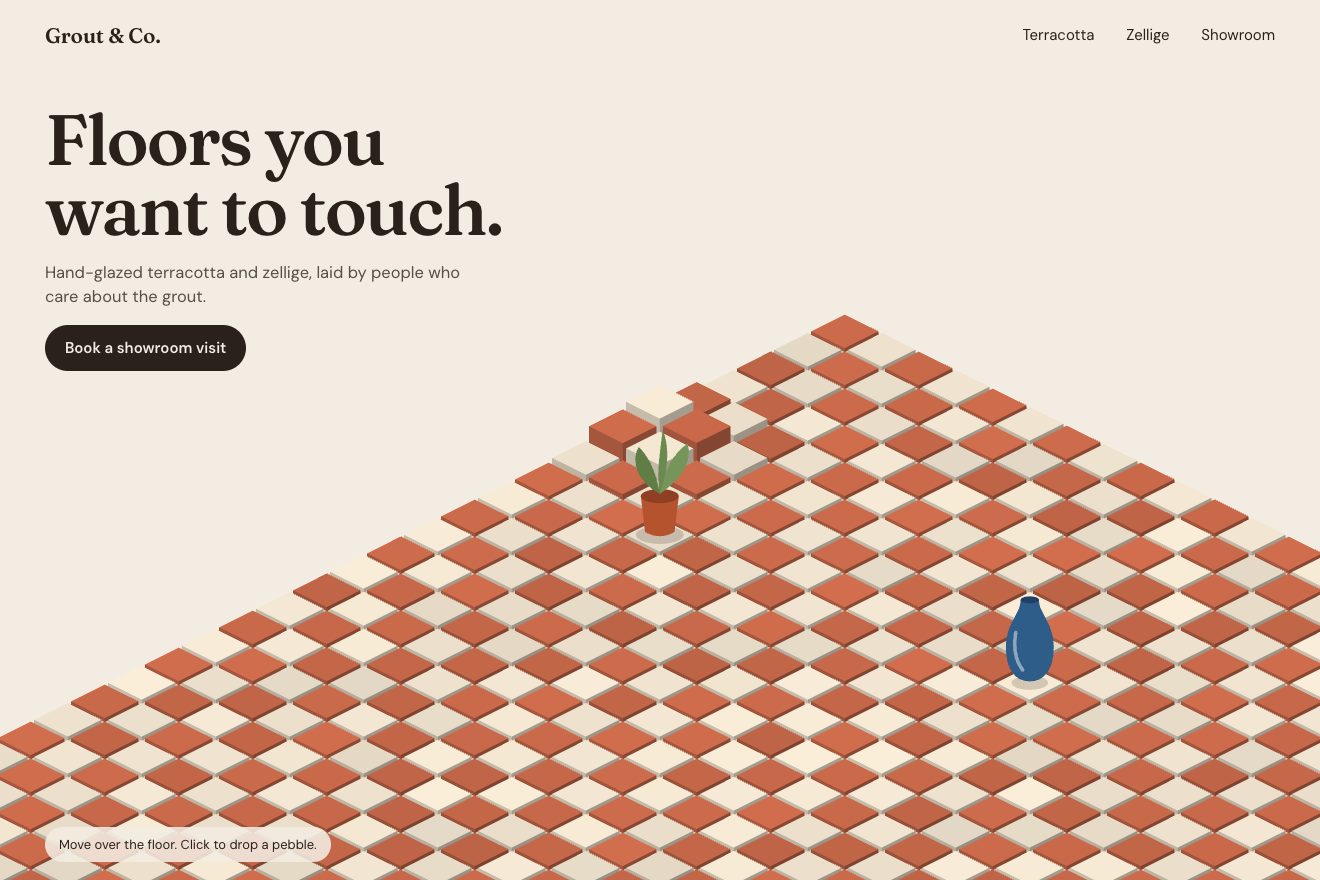
Tiles that rise
SVG, Hover, Physics
NewFree
In the minimal style, with real physics: two thin tracks run from the same rim to the same rim, one straight through the bottom and one a cycloid. Two beads start together from rest and the one on the curve always arrives first, even though its way is longer; the times stop and in the headline the word curve takes the accent.
A folder that runs on its own: index.html, style.css, script.js and the libraries from a CDN. The React and Vue tabs hold the same demo as a ready component, which switches its animations off when it leaves the page.
<!doctype html>
<html lang="en">
<head>
  <meta charset="utf-8">
  <meta name="viewport" content="width=device-width, initial-scale=1">
  <title>The cycloid race</title>
  <link rel="stylesheet" href="https://cdn.jsdelivr.net/npm/@fontsource-variable/mona-sans@5.3.0/wdth.css">
  <link rel="stylesheet" href="style.css">
</head>
<body>
  <main class="stage" data-stage aria-label="Swale couriers: the fastest way down is a curve. Click to race again.">
    <h1 class="head" data-head>The fastest way down is a <span class="head__key" data-key>curve</span>.</h1>

    <!-- two tracks from the same rim to the same rim: two straight lines through the bottom, and a cycloid -->
    <svg class="scene" data-scene aria-hidden="true">
      <path class="track track--line" data-line d="" />
      <path class="track track--curve" data-curve d="" />
      <line class="ledge" data-ledge-l />
      <line class="ledge" data-ledge-r />
      <circle class="bead bead--line" data-bead-line r="7" />
      <circle class="bead bead--curve" data-bead-curve r="7" />
    </svg>

    <dl class="times" data-times>
      <div class="times__row times__row--curve" data-row-curve>
        <dt>Curve</dt>
        <dd data-t-curve>0.00 s</dd>
      </div>
      <div class="times__row times__row--line" data-row-line>
        <dt>Straight</dt>
        <dd data-t-line>0.00 s</dd>
      </div>
    </dl>

    <p class="brand">Swale <span>couriers</span></p>
  </main>

  <script src="https://cdn.jsdelivr.net/npm/gsap@3.15.0/dist/gsap.min.js"></script>
  <script src="script.js"></script>
</body>
</html>Change values, colours and text with the controls and watch the animation respond live. Or write in the code yourself. Then download the folder with your changes.
17 values to change
With the Animorio connector, Claude Code takes it from here, guide included, and fits it into your project. Paste this request:
Take “The cycloid race” from Animorio and fit it into my siteOn a cycloid x = r(θ − sin θ), y = r(1 − cos θ) a bead starting from rest at the cusp has the wheel's angle growing evenly: θ = t·√(g/r). On the straight lines the acceleration is constant, g·sin α, down and then up. g is chosen so the curve takes RACE seconds from rim to rim; the straight way then comes out √(π² + 4)/π times slower, about 18.5% more.
The timeline tweens a single number, the race time, with ease none; one function puts the beads in place with the formulas and writes the two times, stopping each at its arrival time. Since the arrival times are known in advance, the ledge sliding in, the orange time and the headline word are placed in the timeline at exactly those moments.
On the far rim each bead has zero speed (all the energy is back in height): the right moment for a ledge to slide in under it with back.out, with no trick at all. The two beads are different sizes, a ring and a smaller disc, so when they rest together one sits inside the other instead of covering it.
The word curve in the headline is a span whose font-stretch is tied to the --w variable (Mona Sans runs from 75 to 125 in width): when the curve arrives it takes the accent colour, its weight goes from 360 to 640 and its width from 88 to 100 with elastic.out, and on the next race it goes back.
After the entrance (the tracks draw with stroke-dashoffset, the beads appear on a spring) the timeline runs two races, there and back, then starts again from the loop label. The measures (the wheel's radius, the beads, the headline and the times) are taken again on every resize. With reduced motion the finished race, with both times and the word in orange, fades in.
| Name | File | Default | What it changes |
|---|---|---|---|
RACE | script.js | 2.4 | The seconds the bead on the curve takes from rim to rim (gravity is set to match). |
HOLD | script.js | 1.6 | The seconds the beads rest on the rim before the race back. |
BEAD | script.js | 7 | The radius of the beads in pixels (it grows a little on large screens). |
WORD | script.js | 'curve' | The word of the headline that lights up when the curve wins. |
As the opening of a landing page that wants to say «the shortest way is not the fastest»: a delivery or courier service, a routing or logistics app, a physics or maths course, a popular science article; or as the animated picture for a «how it works» section.
The same animation with the sizes adapted: the cycloid takes the whole width of the screen (it is π times as wide as it is tall, so it stays low), the headline goes onto two lines and the times sit underneath.
Nothing runs: the finished race, with the beads on the right rim, both times and the word curve in orange, fades in and stays.
GSAP 3.15.0, Mona Sans (font variabile) 5.3.0.
Compressed with gzip, the three demo files weigh 4.9 KB; the libraries: GSAP 28 KB.
Tested on 19 October 2026
Use it in your own projects and in your clients’ projects. Do not resell it or redistribute it as is. GSAP stays under its own Standard license. Full license.
With your account’s email and password.
or with your email
You’re signed in as .
With your account, you can download the zip of every animation and every pack, for free.