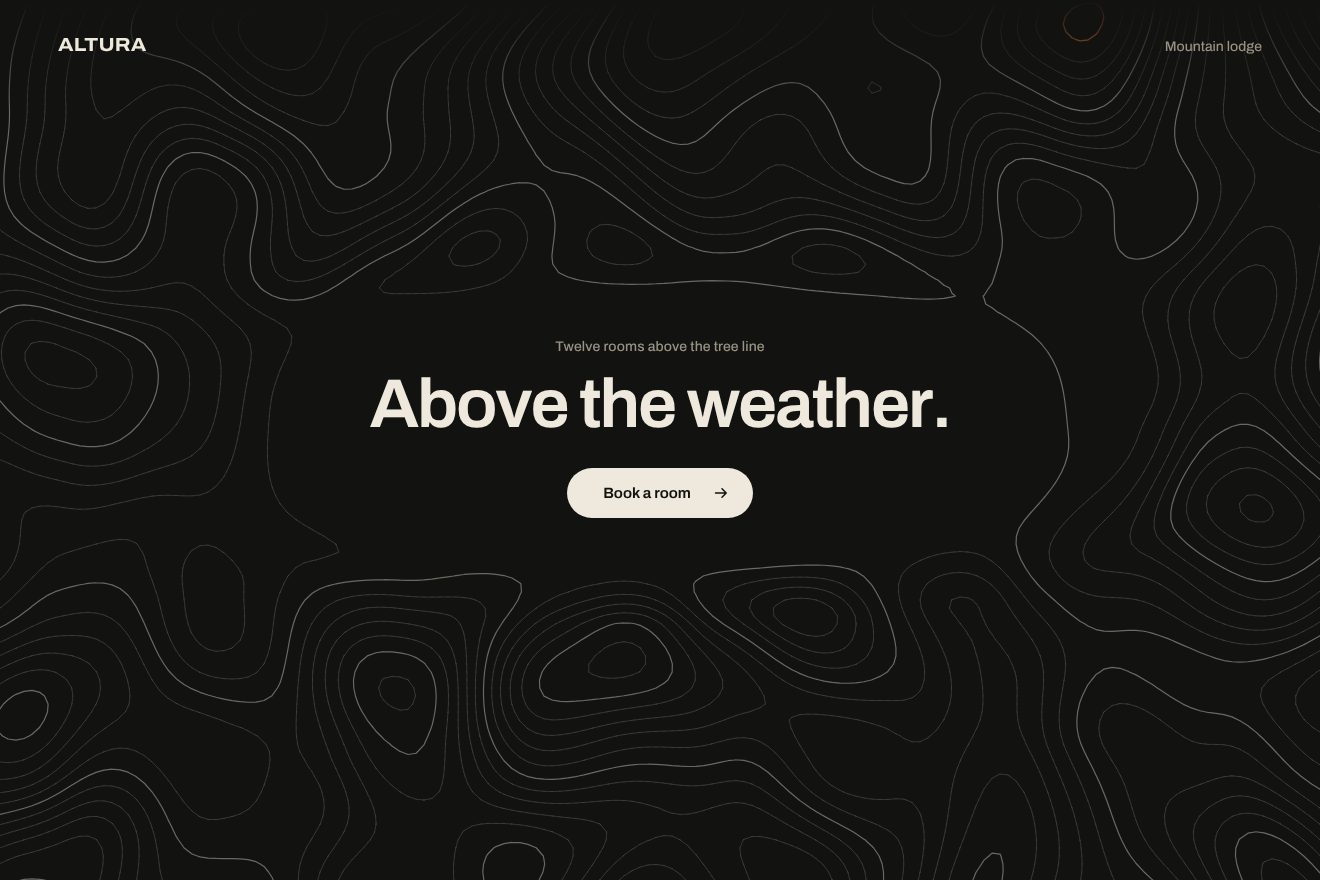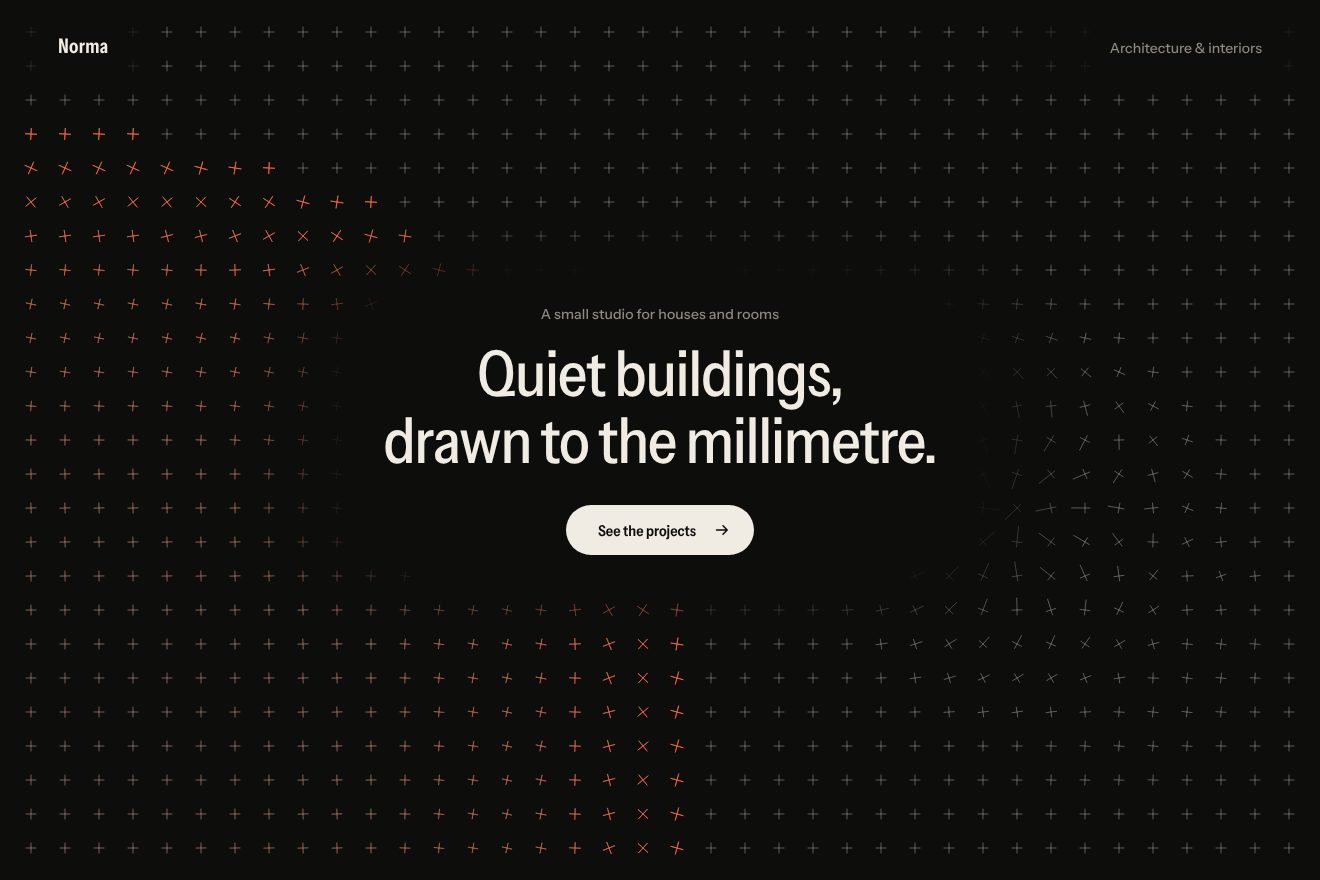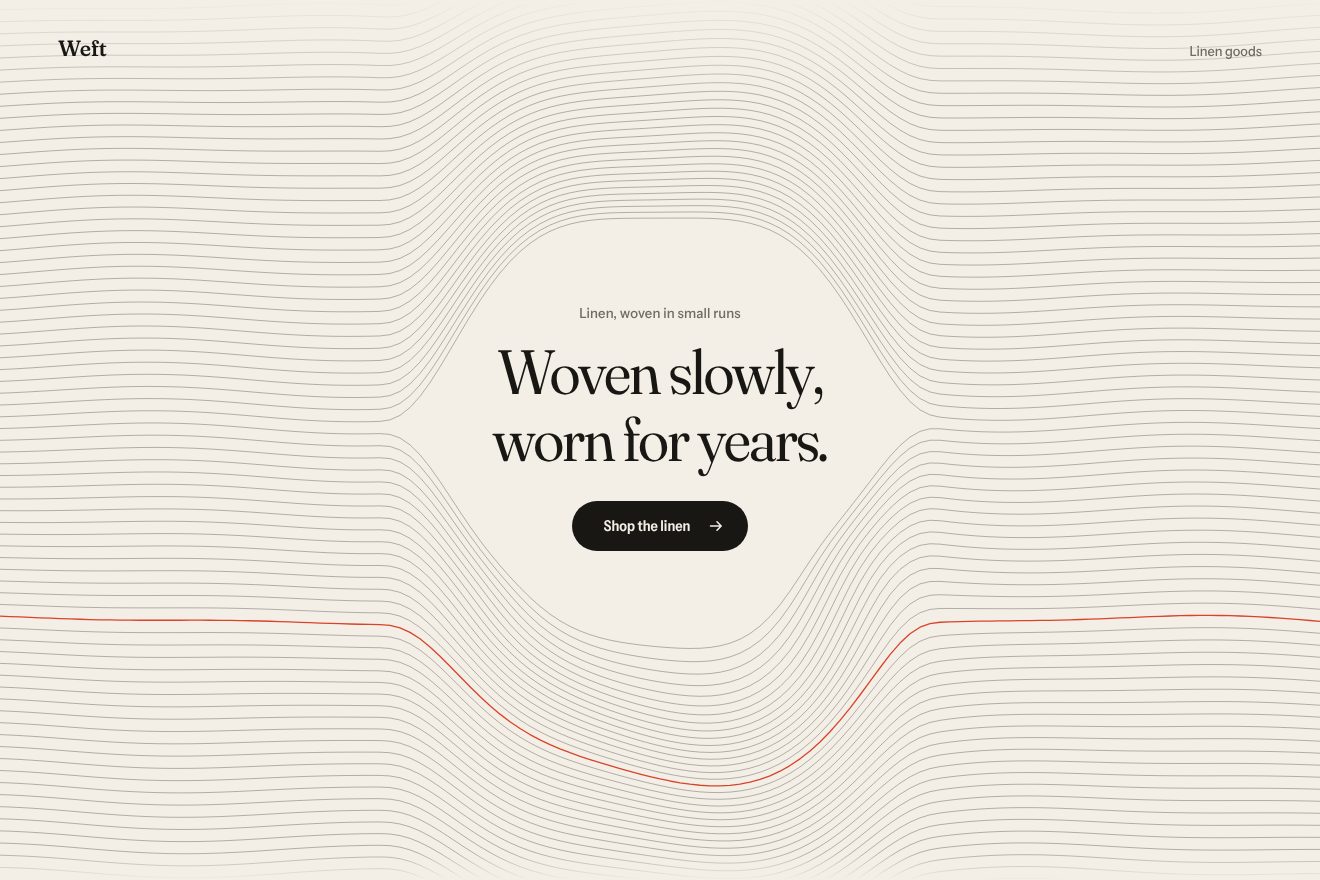
The woven thread background
Backgrounds, Hover
NewFree
An animated background to put behind a heading or a section: two families of hairline concentric rings in ink on warm white paper. The centre of the first drifts slowly, the centre of the second follows the pointer on a spring, and where the rings cross, moiré fringes appear, fanning out and sweeping across the paper. Minimal style.
A folder that runs on its own: index.html, style.css, script.js and the libraries from a CDN. The React and Vue tabs hold the same demo as a ready component, which switches its animations off when it leaves the page.
<!doctype html>
<html lang="en">
<head>
  <meta charset="utf-8">
  <meta name="viewport" content="width=device-width, initial-scale=1">
  <title>Loupe</title>
  <link rel="stylesheet" href="https://cdn.jsdelivr.net/npm/@fontsource-variable/newsreader@5.3.0/opsz.css">
  <link rel="stylesheet" href="https://cdn.jsdelivr.net/npm/@fontsource-variable/newsreader@5.3.0/opsz-italic.css">
  <link rel="stylesheet" href="https://cdn.jsdelivr.net/npm/@fontsource-variable/archivo@5.3.0/wdth.css">
  <link rel="stylesheet" href="style.css">
</head>
<body>
  <!-- the background: two families of hairline concentric rings on a canvas behind the page; one drifts slowly, the
       other follows the pointer, and where they overlap the moire fringes bloom and sweep across the paper -->
  <main class="pagina" data-pagina>
    <canvas class="fondo" aria-hidden="true" data-fondo></canvas>

    <header class="testa">
      <p class="marchio">Loupe</p>
      <p class="testa__nota">Opticians since 1984</p>
    </header>

    <section class="eroe">
      <div class="blocco" data-blocco>
        <p class="occhiello" data-entra>Eyewear, fitted by hand</p>
        <h1 class="titolo">
          <span class="riga"><span class="riga__dentro" data-riga>Look <em class="accento">twice,</em></span></span>
          <span class="riga"><span class="riga__dentro" data-riga>then see clearly.</span></span>
        </h1>
        <div class="azione" data-entra>
          <a class="pillola" href="#">
            <span class="pillola__scritta" data-testo="Book an eye test">Book an eye test</span>
            <svg class="pillola__freccia" viewBox="0 0 16 16" aria-hidden="true"><path d="M2.5 8h10.5M9 3.8 13.2 8 9 12.2" /></svg>
          </a>
        </div>
      </div>
    </section>
  </main>

  <script src="https://cdn.jsdelivr.net/npm/gsap@3.15.0/dist/gsap.min.js"></script>
  <script src="script.js"></script>
</body>
</html>Change values, colours and text with the controls and watch the animation respond live. Or write in the code yourself. Then download the folder with your changes.
22 values to change
With the Animorio connector, Claude Code takes it from here, guide included, and fits it into your project. Paste this request:
Take “The moiré rings background” from Animorio and fit it into my siteOn a full-page canvas (devicePixelRatio capped at 2) each family is a series of concentric circles, one every PASSO pixels, out to the furthest corner. The moiré is not programmed: it appears by itself where two regular sets of thin lines overlap with their centres slightly apart, because the rings now coincide and now fall into the gaps of the other family.
Towards the edges the rings fade: from half of LONTANO (a fraction of the diagonal) to LONTANO the opacity drops to zero. To avoid changing globalAlpha for every ring, the rings go into twelve Path2D objects by opacity and each group is drawn with one stroke: twenty-four strokes per frame in all.
The centre of the second family follows the pointer on a spring (MOLLA) integrated by hand on GSAP's ticker; the spacing of its rings changes by RESPIRO per cent with a sine tied to the round's phase. Moving a centre by a few pixels makes the fringes travel a long way: moiré is a magnifying glass for movement.
After the rings the context switches to destination-out and fills an oval with a radial gradient (the context stretched with scale), solid in the middle and clear at the edge: behind the words the rings lighten by CALMA with no hard edge.
A timeline takes the largest radius of the two families from 0 to 1, the second half a second later, with the last ninety pixels faded like the edge of a ripple. The heading lines rise with back.out while the weight goes from 250 to 400. After 2.4 seconds without the real pointer the centre follows a Lissajous curve tied to the round; IntersectionObserver and visibilitychange stop everything when the page is not visible.
| Name | File | Default | What it changes |
|---|---|---|---|
PASSO | script.js | 9 | The distance between rings, in px (a little less on a phone). |
SPESSORE | script.js | 1 | The thickness of the rings, in px. |
GIRO | script.js | 24 | How many seconds the drifting centre takes to come round to the same place. |
DERIVA | script.js | 0.14 | How far that centre strays from the middle of the page, as a fraction of the page. |
RESPIRO | script.js | 0.035 | How much the second family widens and narrows (0.035 means 3.5%). |
MOLLA | script.js | [55, 12] | The spring of the centre that follows the pointer: how stiff and how damped. |
LONTANO | script.js | 0.52 | How far the rings reach before fading out, as a fraction of the page diagonal. |
CALMA | script.js | 0.9 | How much the rings lighten behind the heading (0 not at all, 1 they vanish). |
As the background of the first screen of an optician or an eyewear brand, a design studio, a kinetic art gallery, a recording studio or an electronic music festival; in general behind a short heading when you want a light sheet that barely moves and surprises you when the mouse moves. The colour of the rings and the accent are set in the CSS.
The same animations with the sizes adapted: the rings are a little closer and the heading smaller, with the eraser following it. The finger moves the centre of the second family while it touches and drags; when it lifts the fake pointer comes back.
The rings are still, already spread, with the fringes in place: no drift, no spring, no opening. The heading, the small line and the pill fade in.
GSAP 3.15.0, Newsreader (font variabile) 5.3.0, Archivo (font variabile) 5.3.0.
Compressed with gzip, the three demo files weigh 5.8 KB; the libraries: GSAP 28 KB.
Tested on 19 October 2026
Use it in your own projects and in your clients’ projects. Do not resell it or redistribute it as is. GSAP stays under its own Standard license. Full license.
With your account’s email and password.
or with your email
You’re signed in as .
With your account, you can download the zip of every animation and every pack, for free.