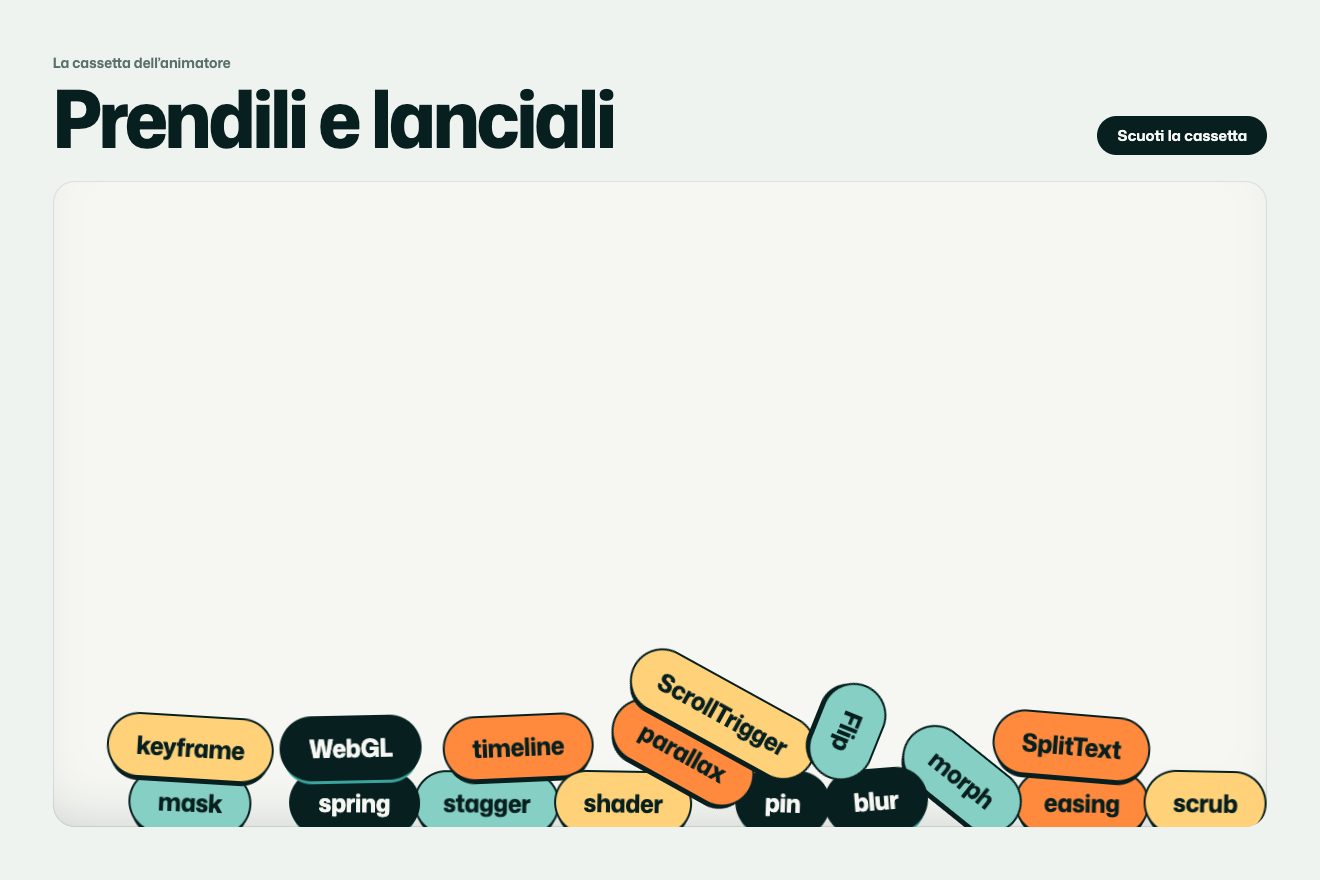
Falling tools
Physics, Hover
The Integrations section of the landing page of a made-up software, Tidewell, on a pale ground like still water: in the middle its mark, a blue glass square with two waves, and around it eleven frosted glass tiles with abstract icons of made-up apps, on two soft orbits turning slowly in opposite directions. The physics is written by hand: every tile hangs on a spring towards its place, pushes the nearby ones away and loses speed to friction. The pointer parts them like a finger in water and leaves small rings; a tile can be grabbed, dragged and flung, it flies, slows against the soft edges and comes back to its place with a settle. Over a tile its name shows and a thin thread pulls taut from the mark with a twang, then a bead of light runs along it into the middle, which answers with a beat. Premium style.
A folder that runs on its own: index.html, style.css, script.js and the libraries from a CDN. The React tab holds the same demo as a ready component, which switches its animations off when it leaves the page.
<!doctype html>
<!--
  "Floating glass integrations" from Animorio · https://animorio.com
  License: free on your own sites and your clients’ sites, paid work included.
  Not for resale, redistribution, templates or code collections · https://animorio.com/en/license/
-->
<html lang="en">
<head>
  <meta charset="utf-8">
  <meta name="viewport" content="width=device-width, initial-scale=1">
  <title>Glass integrations that float and can be flung</title>
  <link rel="stylesheet" href="https://cdn.jsdelivr.net/npm/@fontsource-variable/mona-sans@5.3.0/wdth.css">
  <link rel="stylesheet" href="style.css">
</head>
<body>
  <main class="stage" data-stage>
    <!-- the Integrations section of a made-up workflow tool, Tidewell. In the middle its mark, around it eleven glass
         tiles of made-up apps floating on two soft orbits. Every tile hangs on a hand-written spring towards its place,
         pushes the others away and loses speed to friction: the pointer parts them like a finger in water, a tile can
         be grabbed and flung, and it comes back with a settle. Over a tile its name shows and a thin thread pulls taut
         from the mark -->
    <header class="head" data-head>
      <p class="eyebrow">Integrations</p>
      <h2 class="title">Tidewell plays well with your stack</h2>
      <p class="sub">Eleven apps, one click each. Push them around, they always drift back.</p>
    </header>

    <div class="field" data-field>
      <canvas class="water" data-water aria-hidden="true"></canvas>
      <svg class="rings" data-rings aria-hidden="true">
        <ellipse class="ring" data-ring="0" />
        <ellipse class="ring ring--outer" data-ring="1" />
      </svg>
      <svg class="threads" data-threads aria-hidden="true">
        <path class="thread" data-thread pathLength="1" />
        <path class="glint" data-glint pathLength="1" />
      </svg>

      <div class="core" data-core>
        <span class="core__halo" aria-hidden="true"></span>
        <span class="core__face" data-core-face>
          <svg class="core__mark" viewBox="0 0 40 40" aria-hidden="true">
            <path class="core__wave" d="M8.5 23.2c3.4-5.6 7.2-5.6 11.5 0s8.1 5.6 11.5 0" />
            <path class="core__wave core__wave--soft" d="M8.5 15.6c3.4-5.6 7.2-5.6 11.5 0s8.1 5.6 11.5 0" />
          </svg>
        </span>
        <span class="sr">Tidewell</span>
      </div>

      <div class="tiles" data-tiles></div>

      <div class="tag" data-tag aria-hidden="true">
        <span class="tag__name" data-tag-name>Ledgerly</span>
        <span class="tag__meta">
          <svg class="tag__check" viewBox="0 0 12 12"><path d="M2.6 6.3l2.2 2.2 4.6-4.9" /></svg>
          <span data-tag-meta>Billing</span>
        </span>
      </div>

      <svg class="pointer" viewBox="0 0 24 24" aria-hidden="true" data-pointer>
        <path d="M5 3.5 18.5 12 12.4 13.6 9.4 19.6z" />
      </svg>
    </div>
    <p class="sr" aria-live="polite" data-live></p>
  </main>

  <template data-icons>
    <svg data-icon="ledger" viewBox="0 0 24 24"><rect class="i-acc" x="4" y="13" width="11" height="5.5" rx="2.75" /><rect class="i-ink" x="9" y="5.5" width="11" height="5.5" rx="2.75" /></svg>
    <svg data-icon="quarry" viewBox="0 0 24 24"><path class="i-acc" d="M12 13.4l7 3.6-7 3.6-7-3.6z" /><path class="i-line" d="M5 12.6l7 3.6 7-3.6M12 3.4l7 3.6-7 3.6-7-3.6z" /></svg>
    <svg data-icon="pinwheel" viewBox="0 0 24 24"><path class="i-ink" d="M12 12V4.5a7.5 7.5 0 017.5 7.5z" /><path class="i-acc" d="M12 12h-7.5a7.5 7.5 0 017.5-7.5z" opacity=".55" /><path class="i-acc" d="M12 12v7.5a7.5 7.5 0 01-7.5-7.5z" /><path class="i-ink" d="M12 12h7.5a7.5 7.5 0 01-7.5 7.5z" opacity=".35" /></svg>
    <svg data-icon="halyard" viewBox="0 0 24 24"><path class="i-line" d="M4.5 15a6 6 0 0112 0" /><path class="i-acc-line" d="M7.5 10.5a6 6 0 0112 0" /></svg>
    <svg data-icon="fernly" viewBox="0 0 24 24"><path class="i-line" d="M7 19.5V9M12 19.5V5M17 19.5v-7" /><path class="i-acc-line" d="M12 11.5c2.6-.2 4.6-1.8 5.4-4.6" /></svg>
    <svg data-icon="sable" viewBox="0 0 24 24"><path class="i-line" d="M18.6 8.4A7.5 7.5 0 1012 19.5" /><circle class="i-acc" cx="12" cy="12" r="3.2" /></svg>
    <svg data-icon="mosaic" viewBox="0 0 24 24"><rect class="i-ink" x="4.5" y="4.5" width="6.5" height="6.5" rx="1.8" /><rect class="i-ink" x="13" y="4.5" width="6.5" height="6.5" rx="1.8" opacity=".3" /><rect class="i-ink" x="4.5" y="13" width="6.5" height="6.5" rx="1.8" opacity=".3" /><rect class="i-acc" x="13" y="13" width="6.5" height="6.5" rx="3.25" /></svg>
    <svg data-icon="brindle" viewBox="0 0 24 24"><path class="i-faint" d="M4.5 8h15M4.5 12h15M4.5 16h15" /><path class="i-acc-line" d="M4.5 15.5c2.5 0 3-6 5.5-6s2.5 5 5 5 2.5-3.5 4.5-3.5" /></svg>
    <svg data-icon="northdesk" viewBox="0 0 24 24"><path class="i-ink" d="M12 4.6l6.6 11.4H5.4z" /><rect class="i-acc" x="5.4" y="17.6" width="13.2" height="2.2" rx="1.1" /></svg>
    <svg data-icon="cobalt" viewBox="0 0 24 24"><path class="i-line" d="M5 7.5l7 5 7-5" /><path class="i-acc-line" d="M5 12.5l7 5 7-5" /></svg>
    <svg data-icon="kiln" viewBox="0 0 24 24"><path class="i-line" d="M12 3.8l7.1 4.1v8.2L12 20.2l-7.1-4.1V7.9z" /><path class="i-acc" d="M12 8.6l3 1.7v3.4l-3 1.7-3-1.7v-3.4z" /></svg>
  </template>

  <script src="https://cdn.jsdelivr.net/npm/gsap@3.15.0/dist/gsap.min.js"></script>
  <script src="script.js"></script>
</body>
</html>Change values, colours and text with the controls and watch the animation respond live. Or write in the code yourself. Then download the folder with your changes.
24 values to change
With the Animorio connector, Claude Code, ChatGPT, Cursor or VS Code take it from here, guide included, and fit it into your project. Paste this request:
Take “Floating glass integrations” from Animorio and fit it into my siteThe orbits are two ellipses measured on the field (up to 1.55 times as wide as they are tall, so they also fit the low, wide phone box), the small one at 56% of the large one. Every tile has its starting angle; its place turns with time, at ORBIT_SPEED radians a second, one way inside and the other way outside, plus a bob of two or three pixels at a frequency of its own.
Each tile has a position and a velocity. At every fixed step of 1/120 s the acceleration is SPRING times the distance from its place minus FRICTION times its velocity (a spring damped just under critical, which passes the mark by a pixel and comes back), plus the pushes, integrated with semi-implicit Euler: velocity first, then position.
Every pair closer than 1.22 tile sizes gets a linear push along the line between them, and there is a stronger one around the mark: a flung tile makes room by itself and moves the others, which then come back. The edges of the field are soft walls (a spring and a brake only outwards) with a hard limit a little past them: nothing leaves at the sides.
The pointer speed is smoothed between moves and fades when it stops. Within PUSH_RADIUS tiles the push grows with the square of closeness and with speed: held still the pointer hardly pushes, so you can rest on a tile; moving it also drags the tiles a little in its wake. Behind a fast pointer a canvas draws small rings; a click on empty space sends a wave at 520 px a second that nudges each tile as it arrives.
Pressing on a tile grabs it with the offset of the point touched; it follows the pointer on a stiff spring, so it lags a hair behind and sways when you stop. Letting go hands it the pointer’s velocity (at most 2600 px a second, times THROW) and the spring of its place brings it back. Scale and tilt have a small spring each, and the sheen on the glass slides against the velocity.
The thread is a quadratic curve from the mark to the tile with its control point moved to the side: how much it sags is a lightly damped spring, slack at first and taut after a few twangs, kicked by the tile’s sideways speed. It is drawn with pathLength 1 and stroke-dasharray; a second identical curve carries the bead of light into the middle, where the mark beats on an elastic spring.
| Name | File | Default | What it changes |
|---|---|---|---|
SPRING | script.js | 26 | The spring that pulls every tile back to its place: higher is quicker. |
FRICTION | script.js | 5.4 | The friction of the water: lower lets a tile pass its place and swing around it. |
ORBIT_SPEED | script.js | 0.05 | How fast the two orbits turn, in radians a second (0 = still). |
PUSH | script.js | 1 | How hard the pointer parts the tiles as it moves. |
PUSH_RADIUS | script.js | 2 | How far the push reaches, in tile sizes. |
REPEL | script.js | 1 | How hard the tiles push each other away. |
THROW | script.js | 1 | How far a flung tile flies: 2 = twice as far. |
TENSION | script.js | 1 | How quickly the thread pulls taut: lower lets it twang longer. |
SPEED | script.js | 1 | The speed of the walk on its own: 2 = twice as fast, 0.5 = half. |
LOOP | script.js | true | The drawn pointer plays with the tiles again and again. |
For the integrations section of a software, an app or an AI tool, when the connected apps should feel alive and touchable rather than a still grid of logos: on a landing page, a pricing page or a product page. It also works for partners, the tools of a studio or the services of a platform.
The same animation with adapted sizes: the tiles are measured on the shorter side of the field and the orbits widen into ellipses, so all of them fit the low, wide box; everything is measured again on resize, even mid-throw. The finger pushes, grabs and flings like the mouse; touching a tile shows the name and the thread, which close when the finger lifts.
The tiles already rest in their places and the orbits do not turn; no pushes, throws, waves or drawn pointer. Over a tile the name and the thread, already taut, fade in.
GSAP 3.15.0, Mona Sans (font variabile) 5.3.0.
Compressed with gzip, the three demo files weigh 12 KB; the libraries: GSAP 28 KB.
Tested on 11 November 2026
Use it in your own projects and in your clients’ projects. Do not resell it or redistribute it as is. GSAP stays under its own Standard license. Full license.
Support Animorio
Animorio stays free thanks to the people who support it. If you like, buy us a coffee: it helps us make the next animations.
You asked for
We made it for you: it’s in the library, with the preview, the Playground and the code to copy.
An animation you can’t find, or a site to take apart in the journal: tell us which. We pick the next ones from here.
With your account’s email and password.
or with your email
You’re signed in as .
With your account, you can download the zip of every animation and every pack, for free.