The interference waves background on scroll
Scroll, Backgrounds
NewFree
Scroll inside the preview
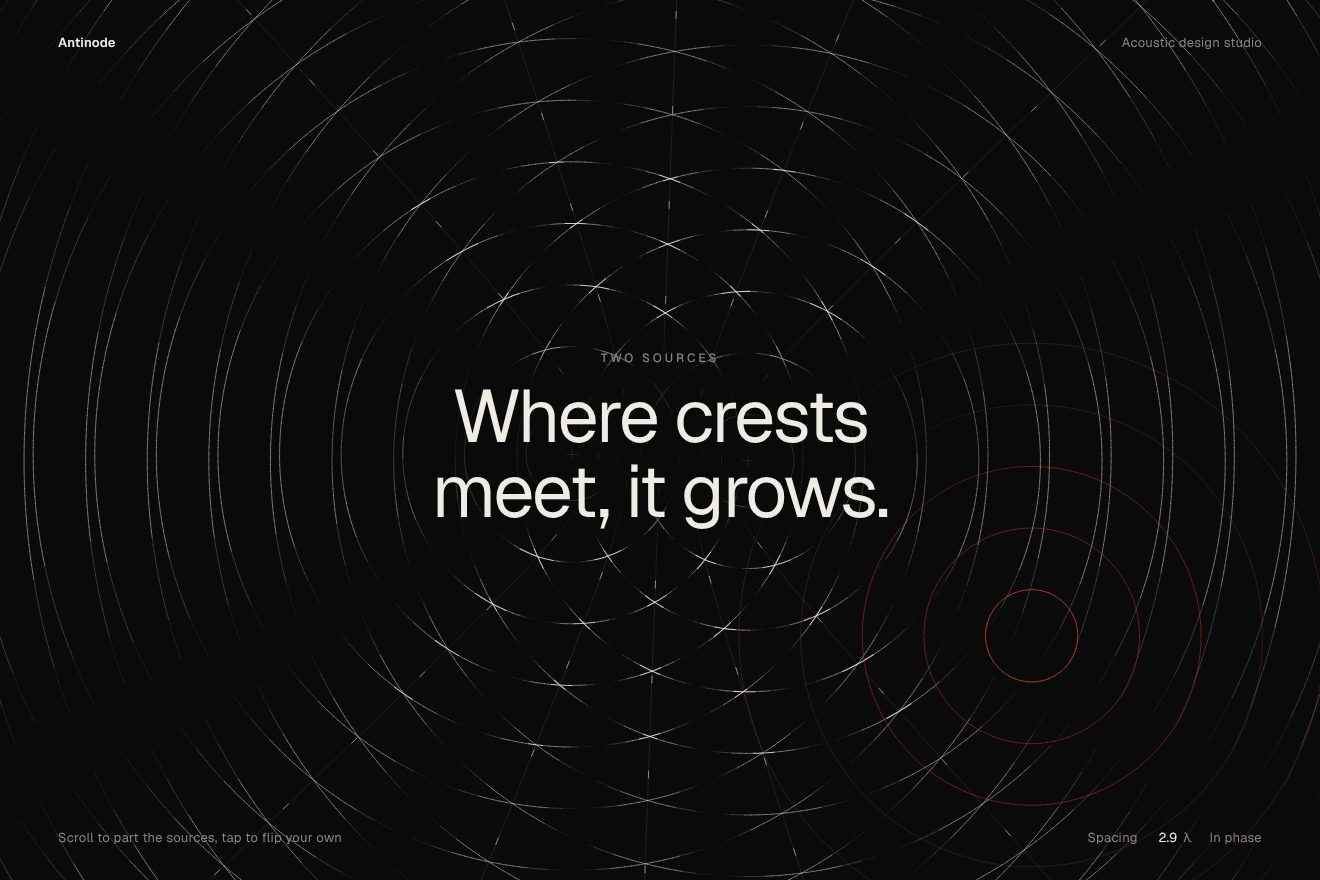
An animated background for a scrolling page: a sheet of graph paper in its brick orange, pinned at the edges behind the page. When you scroll, the middle of the sheet lags behind and the lines curve like paper being pulled, the more the faster you scroll; when you stop they spring back straight. Now and then a soft swell runs across it. Minimal style.
A folder that runs on its own: index.html, style.css, script.js and the libraries from a CDN. The React and Vue tabs hold the same demo as a ready component, which switches its animations off when it leaves the page.
<!doctype html>
<html lang="en">
<head>
  <meta charset="utf-8">
  <meta name="viewport" content="width=device-width, initial-scale=1">
  <title>Quire</title>
  <link rel="stylesheet" href="https://cdn.jsdelivr.net/npm/@fontsource-variable/martian-mono@5.3.0/wdth.css">
  <link rel="stylesheet" href="style.css">
</head>
<body>
  <!-- the background: a sheet of graph paper on a canvas behind the page, pinned at its edges; when the page scrolls the
       sheet lags behind and sags like paper, then springs back, and now and then a soft swell runs down it -->
  <canvas class="fondo" aria-hidden="true" data-fondo></canvas>

  <main class="pagina" data-pagina>
    <header class="testa">
      <p class="marchio">Quire</p>
      <p class="testa__nota">Paper goods</p>
    </header>

    <section class="eroe" data-calma>
      <div class="blocco">
        <p class="occhiello" data-entra>Notebooks for people who draw</p>
        <h1 class="titolo">
          <span class="riga"><span class="riga__dentro" data-riga>Paper that keeps</span></span>
          <span class="riga"><span class="riga__dentro" data-riga>its measure.</span></span>
        </h1>
        <div class="azione" data-entra>
          <a class="pillola" href="#">
            <span class="pillola__scritta" data-testo="Shop notebooks">Shop notebooks</span>
            <svg class="pillola__freccia" viewBox="0 0 16 16" aria-hidden="true"><path d="M2.5 8h10.5M9 3.8 13.2 8 9 12.2" /></svg>
          </a>
        </div>
      </div>
    </section>

    <section class="seconda" data-calma>
      <div class="blocco">
        <p class="occhiello" data-dopo>Ruled in one millimetre</p>
        <h2 class="sotto">
          <span class="riga"><span class="riga__dentro" data-dopo-riga>Ninety grams,</span></span>
          <span class="riga"><span class="riga__dentro" data-dopo-riga>sewn by hand.</span></span>
        </h2>
      </div>
    </section>
  </main>

  <script src="https://cdn.jsdelivr.net/npm/gsap@3.15.0/dist/gsap.min.js"></script>
  <script src="https://cdn.jsdelivr.net/npm/gsap@3.15.0/dist/ScrollTrigger.min.js"></script>
  <script src="script.js"></script>
</body>
</html>Change values, colours and text with the controls and watch the animation respond live. Or write in the code yourself. Then download the folder with your changes.
24 values to change
With the Animorio connector, Claude Code takes it from here, guide included, and fits it into your project. Paste this request:
Take “The graph paper background” from Animorio and fit it into my siteThe canvas is fixed, 100lvh tall (so on Safari for iPhone it does not change size when the bar appears). Each frame the horizontal lines are redrawn at n·MILLIMETRO − scrollY, so they scroll with the page; every fifth and every tenth line goes into a separate, stronger Path2D. The vertical lines stay still and centred. If scrolling, spring and swell have not changed, the frame is not redrawn.
A point moves by S · sin(πx/W) · sin(πy/H) vertically and by a sixth of S · sin(2πx/W) · sin(πy/H) horizontally: zero at the edges, most in the middle. The lines are drawn as polylines with a point every 14 px, moved that way.
On GSAP's ticker the scroll speed is measured (new scrollY minus old, divided by time) and softened a little. S wants to be speed · PIEGA, at most PIEGA_MAX px, and reaches it on a spring (MOLLA): when scrolling stops, S goes back to zero a hair too far and back.
A timeline repeating every ONDA seconds takes a front from top to bottom; the swell's displacement is a sine times a bell round the front, ALTEZZA_ONDA px. The texts (the blocks of both sections and the header) are measured in page coordinates and, each frame, an oval eraser (destination-out with a radial gradient) lightens the grid behind them by CALMA.
When the page opens each horizontal line grows from the left with a delay increasing from top to bottom, then the vertical ones from the top with a delay from left to right. The heading lines rise with back.out while font-stretch goes from 112% to 75%; those of the second section start with ScrollTrigger.create when the section reaches 70% of the screen.
| Name | File | Default | What it changes |
|---|---|---|---|
MILLIMETRO | script.js | 7 | The distance between two thin lines, in px (the strong ones every five and every ten). |
PIEGA | script.js | 0.07 | How much the sheet curves for every px per second of scrolling. |
PIEGA_MAX | script.js | 46 | The most it curves, in px. |
MOLLA | script.js | [90, 9] | The sheet's spring: how stiff and how damped (less damped, more wobble). |
ONDA | script.js | 7 | How many seconds between swells. |
ALTEZZA_ONDA | script.js | 12 | How tall the swell is, in px. |
CALMA | script.js | 0.88 | How much the grid lightens behind the texts (0 not at all, 1 it vanishes). |
As the background of a long page for a stationery shop or a notebook brand, an architecture or engineering practice, a technical drawing course, a note-taking app or a product for designers; in general behind short headings when you want the page to feel like a real sheet reacting to scroll. The three oranges are set in the CSS (with a light blue it becomes engineering paper).
The same animations with the sizes adapted: the lines are a little closer, the headings smaller. The finger scrolling curves the sheet like the wheel does, and scroll momentum keeps it curved until the page stops.
The sheet is straight and still: the lines only scroll with the page, with no dip, no spring, no swell and no ruling pen. The texts fade in, those of the second section as they come on screen.
GSAP 3.15.0, ScrollTrigger 3.15.0, Martian Mono (font variabile) 5.3.0.
Compressed with gzip, the three demo files weigh 6.4 KB; the libraries: GSAP + ScrollTrigger 45 KB.
Tested on 19 October 2026
Use it in your own projects and in your clients’ projects. Do not resell it or redistribute it as is. GSAP stays under its own Standard license. Full license.
With your account’s email and password.
or with your email
You’re signed in as .
With your account, you can download the zip of every animation and every pack, for free.