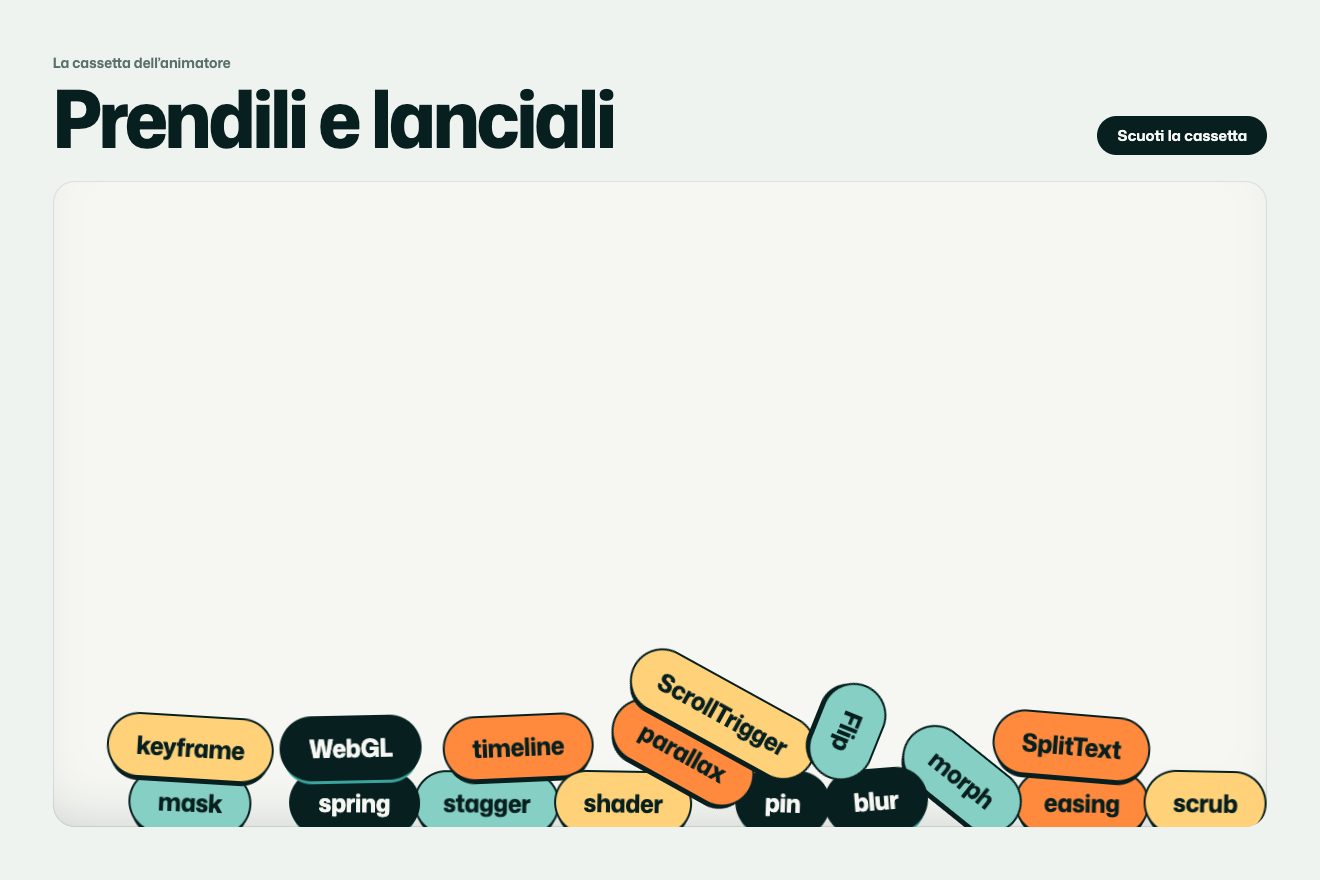
Falling tools
Physics, Hover
The filters of Nestwell, a made-up home search, on white, in the style of real product interface pieces: a filter picked from the list flies up in an arc and lands in the bar, where the chips are real bodies on a barely tilted tray: they slide, bump into each other in a chain, tilt and settle. Removing one closes the row, and when there is room the first chip of the second row hops up; the number of homes rolls with every choice.
A folder that runs on its own: index.html, style.css, script.js and the libraries from a CDN. The React and Vue tabs hold the same demo as a ready component, which switches its animations off when it leaves the page.
<!doctype html>
<!--
  "Pushing search filters" from Animorio · https://animorio.com
  License: free on your own sites and your clients’ sites, paid work included.
  Not for resale, redistribution, templates or code collections · https://animorio.com/en/license/
-->
<html lang="en">
<head>
  <meta charset="utf-8">
  <meta name="viewport" content="width=device-width, initial-scale=1">
  <title>The home search filters that land and push each other in the bar</title>
  <link rel="stylesheet" href="https://cdn.jsdelivr.net/npm/@fontsource-variable/mona-sans@5.3.0/wdth.css">
  <link rel="stylesheet" href="style.css">
</head>
<body>
  <main class="stage" data-stage>
    <!-- the filters of a made-up home search, Nestwell: a filter picked below flies up in an arc and lands in the bar,
         where the chips are bodies on a barely tilted tray: they slide, bump into each other in a chain, tilt and
         settle; removing one closes the gap, and when there is room the first chip of the second row hops up -->
    <section class="card" data-card aria-label="Home search filters">
      <header class="head">
        <div class="head__txt">
          <span class="head__kicker">Nestwell · Buy</span>
          <h1 class="head__title">Homes in <span data-city>Lisbon</span></h1>
        </div>
        <button class="clear" type="button" data-clear>Clear all</button>
      </header>

      <div class="tray" data-tray aria-label="Active filters">
        <span class="tray__ph" data-ph>Pick a filter below</span>
      </div>

      <p class="label">Popular filters</p>
      <div class="opts" data-opts></div>

      <button class="show" type="button" data-show aria-label="Show 128 homes">
        <span class="show__in" data-show-in>Show <span class="count" data-count aria-hidden="true"></span> homes</span>
      </button>

      <div class="layer" data-layer></div>
    </section>

    <svg class="cursor" data-cursor viewBox="0 0 24 24" aria-hidden="true"><path d="M5 2.8v16.4l4.2-4 2.8 6.2 2.9-1.3-2.8-6.1h5.9Z"/></svg>
  </main>

  <script src="https://cdn.jsdelivr.net/npm/gsap@3.15.0/dist/gsap.min.js"></script>
  <script src="script.js"></script>
</body>
</html>Change values, colours and text with the controls and watch the animation respond live. Or write in the code yourself. Then download the folder with your changes.
28 values to change
With the Animorio connector, Claude Code, ChatGPT, Cursor or VS Code take it from here, guide included, and fit it into your project. Paste this request:
Take “Pushing search filters” from Animorio and fit it into my siteThe chip is born on top of the chosen filter and flies to its place in the line, twenty-six pixels further right, in FLIGHT seconds under the gravity GRAVITY: the launch speed is worked out from the distance and the time, so the arc lands exactly on the bar. In flight the chip leans the way it is going, on a spring.
When it reaches the bar, the downward speed becomes a squash that springs back, and the sideways one becomes a push to the left, KICK, plus a third of what it had: the chip slides into the others.
In the bar each chip is pushed left by SLOPE and slowed by FRICTION. Collisions are solved four times per step, row by row: overlapping chips separate and swap speed like two equal bodies, with BOUNCE of restitution; the hit tilts them slightly, and a spring straightens them again.
A chip that does not fit in the first row lands in the second. When room opens up in the first and the first chip of the second is still, it hops up in a shorter arc, forty-two hundredths of a second, and joins the line.
Each filter narrows the search by its own share; the rounded total rolls in the button with one column of digits per position, as wide as its digit, with back.out and five hundredths between columns. The physics runs in GSAP’s ticker in fixed steps of a hundred-and-twentieth of a second.
| Name | File | Default | What it changes |
|---|---|---|---|
CITY | script.js | 'Lisbon' | The city of the search, in the title. |
GRAVITY | script.js | 2600 | The gravity of the flight from the filter to the bar: higher and the arc is taller and sharper. |
FLIGHT | script.js | 0.52 | The seconds a filter takes to fly to the bar. |
KICK | script.js | 340 | The push to the left with which a filter lands and hits the ones already in the bar. |
SLOPE | script.js | 700 | How hard the bar pushes the filters to the left, like a barely tilted tray. |
FRICTION | script.js | 5 | The bar’s friction: higher and the filters stop sooner. |
BOUNCE | script.js | 0.35 | How much the filters bounce when they collide (0 none, 1 fully). |
TILT | script.js | 1 | How much the filters tilt in collisions and in flight (0 not at all). |
HOLD | script.js | 1 | The drawn pointer’s pauses between one gesture and the next, in seconds. |
For the search of a property site, a marketplace, a shop with many filters or a booking app: wherever the chosen filters gather in a bar, the physics shows where the choice went and makes removing and adding them pleasant.
The same animation with adapted sizes: the card is almost as wide as the screen, the chips and the button get shorter on short screens, and fewer filters fit in the first row, so the second is used sooner; everything works with a finger.
No flights, collisions or tilting: the chips fade in already in their place in the line, and removing one makes the others jump into place; the number changes without rolling and there is no pointer.
GSAP 3.15.0, Mona Sans (font variabile) 5.3.0.
Compressed with gzip, the three demo files weigh 9.0 KB; the libraries: GSAP 28 KB.
Tested on 30 October 2026
Use it in your own projects and in your clients’ projects. Do not resell it or redistribute it as is. GSAP stays under its own Standard license. Full license.
Support Animorio
Animorio stays free thanks to the people who support it. If you like, buy us a coffee: it helps us make the next animations.
You asked for
We made it for you: it’s in the library, with the preview, the Playground and the code to copy.
An animation you can’t find, or a site to take apart in the journal: tell us which. We pick the next ones from here.
With your account’s email and password.
or with your email
You’re signed in as .
With your account, you can download the zip of every animation and every pack, for free.