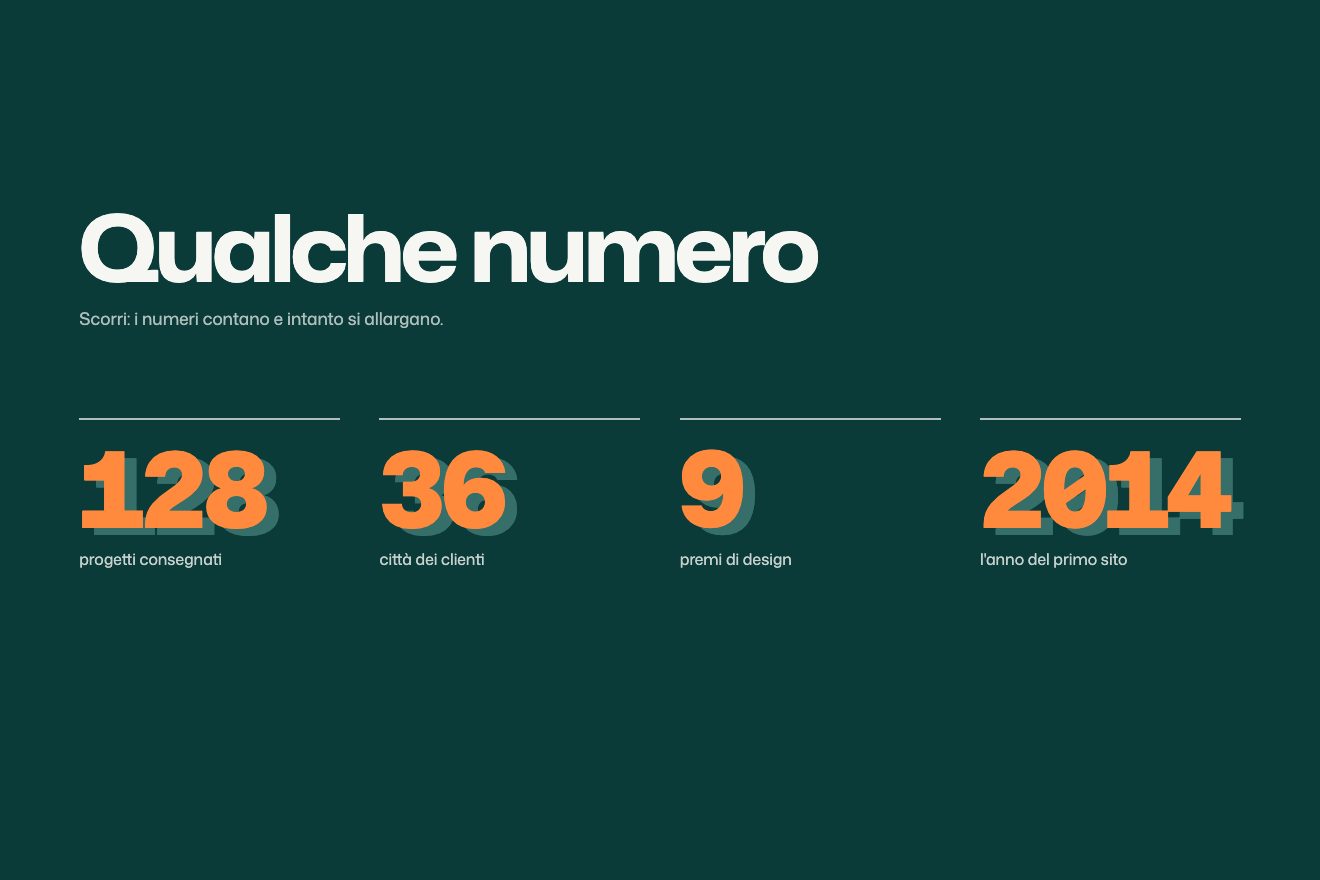
Long shadow letters
Text, Scroll, 3D
Scroll inside the preview
The numbers section of a made-up tool for teams, Ferrow, in the clean style of product interfaces: the stage stays put and holds one big number only. First it counts up to 12,400 teams, then as you scroll it rolls from one stat to the next like an odometer, digit by digit from the right: the columns it no longer needs close, new ones open, the comma and the point slide into place, the word beside it rolls, the thin line underneath pulls back and draws itself again, and the rating brings five stars that fill up.
A folder that runs on its own: index.html, style.css, script.js and the libraries from a CDN. The React and Vue tabs hold the same demo as a ready component, which switches its animations off when it leaves the page.
<!doctype html>
<!--
  "Rolling stats counter" from Animorio · https://animorio.com
  License: free on your own sites and your clients’ sites, paid work included.
  Not for resale, redistribution, templates or code collections · https://animorio.com/en/license/
-->
<html lang="en">
<head>
  <meta charset="utf-8">
  <meta name="viewport" content="width=device-width, initial-scale=1">
  <title>Ferrow in numbers</title>
  <link rel="stylesheet" href="https://cdn.jsdelivr.net/npm/@fontsource-variable/mona-sans@5.3.0/wdth.css">
  <link rel="stylesheet" href="style.css">
</head>
<body>
  <!-- the numbers section of a made-up planning tool, Ferrow. The stage sticks while you scroll and holds one big
       number only: it counts up to the first stat, then rolls from one stat to the next like an odometer, digit by
       digit from the right, while columns open and close, the comma and the point slide to their new places, the unit
       word rolls, the thin line under it redraws and the grey label changes. The rating brings five drawn stars. -->
  <main>
    <section class="corsa" data-corsa>
      <div class="palco" data-palco>
        <header class="testa">
          <p class="testa__nota">Ferrow in numbers</p>
          <h1 class="testa__titolo">Trusted by teams <span>in every time zone</span></h1>
        </header>

        <div class="dato" data-dato>
          <div class="misura" data-misura>
            <div class="numero" data-numero aria-hidden="true">
              <span class="numero__cifre" data-cifre></span>
              <span class="numero__unita" data-unita></span>
            </div>
            <span class="filo"><span class="filo__pieno" data-filo></span></span>
          </div>
          <p class="riga riga--etichetta" data-etichetta aria-hidden="true"></p>
          <div class="riga riga--nota" aria-hidden="true">
            <span class="stelle" data-stelle>
              <svg viewBox="0 0 92 16" data-stelle-svg>
                <defs>
                  <clipPath id="pieno-stelle"><rect data-riempi x="0" y="0" width="0" height="16" /></clipPath>
                </defs>
                <g class="stelle__contorni" data-contorni></g>
                <g class="stelle__piene" data-piene clip-path="url(#pieno-stelle)"></g>
              </svg>
            </span>
            <span class="riga__testo" data-nota></span>
          </div>
          <p class="voce" aria-live="polite" data-voce></p>
        </div>

        <div class="schede" role="tablist" aria-label="Ferrow stats" data-schede>
          <span class="schede__pillola" data-pillola aria-hidden="true"></span>
        </div>
      </div>
    </section>

    <footer class="piede">
      <p>Figures as of October 2026. Uptime measured across all regions.</p>
    </footer>
  </main>

  <script src="https://cdn.jsdelivr.net/npm/gsap@3.15.0/dist/gsap.min.js"></script>
  <script src="https://cdn.jsdelivr.net/npm/gsap@3.15.0/dist/ScrollTrigger.min.js"></script>
  <script src="https://cdn.jsdelivr.net/npm/lenis@1.3.26/dist/lenis.min.js"></script>
  <script src="script.js"></script>
</body>
</html>Change values, colours and text with the controls and watch the animation respond live. Or write in the code yourself. Then download the folder with your changes.
42 values to change
With the Animorio connector, Claude Code, ChatGPT, Cursor or VS Code take it from here, guide included, and fit it into your project. Paste this request:
Take “Rolling stats counter” from Animorio and fit it into my siteEvery digit is a column one line tall with hidden overflow, holding a strip of thirty digits, 0 to 9 three times. The wheel’s position is a number that grows without end: the strip shows its part between 10 and 20 (pos modulo 10 plus 10), so a wheel can make as many turns as it likes, forward or backward, without ever reaching the end of the strip and without jumps, because the three copies are identical.
The number is read in places: p for what comes before, i0, i1, i2 for the whole digits counted from the point leftwards, f for the point and the decimals, s for what comes after, like the %. Going from 12,400 to 99.98% the wheels i0 and i1 stay and turn, i2, i3 (the comma), i4 and i5 leave, f0, f1, f2 and s0 come in: whatever leaves keeps its place until it has closed, sorted with the others, so the comma closes where it was.
Every wheel always turns in the direction of the scroll: the step is the distance forward (or backward) to the new digit, plus ten for each extra turn. The two right-hand wheels make TURNS extra turns, the next ones one fewer, and the first time, when the number counts up from 0, one more for all of them. They start from the right with RIPPLE seconds between them and land with back.out, a hair past and back.
Mona Sans draws its tabular figures like a typewriter, with a slashed zero: the wheels use the normal figures and every column takes the width of its own digit, measured once in ems when the font is ready. While the wheel turns the width moves from the old one to the new one in a separate tween, and whatever comes in or leaves multiplies it by a factor from 0 to 1: all in ems, so it is right at every screen size.
The line is a child scaled with scaleX: it pulls back with its origin on the right and draws again from the left. The words roll inside a window one line tall, with the width going from the old one to the new one. The stars are outlines with pathLength 1 plus a filled copy cut by a clipPath that widens to 4.9. The pill has its two edges animated separately: the front one on a spring, the back one a moment later, so it stretches as it runs.
| Name | File | Default | What it changes |
|---|---|---|---|
STATS | script.js | [{ tab: "Teams", value: "12,400", unit: "teams", … }, …] | The stats, one per tab: the tab name, the number with commas, point and % as they should read, the word beside it, the label, the note and the stars (0 for no stars). |
RIDE | script.js | 1 | How much scroll it takes to go through all the stats: 2 is twice as long. |
ROLL | script.js | 0.9 | How long a digit takes to roll, in seconds. |
TURNS | script.js | 1 | How many extra turns the right-hand digits make before they settle, as on an odometer. |
RIPPLE | script.js | 0.05 | The delay between a digit and the one to its left, in seconds. |
BOUNCE | script.js | 1.5 | How far a digit overshoots its place before settling (0 = none). |
--accento | style.css | #2f5bff | The colour of the line over the headline, of the tip of the thin line and of the focus ring. |
--stella | style.css | #f2b01e | The colour of the filled stars. |
For the numbers section of the landing page of a SaaS, an app or a service, when there are a few strong figures: one number at a time, large, read while scrolling, instead of four small numbers in a row. It also works for an annual report or an about page.
The same animation with adapted sizes: the number is sized on both width and height and fits the box even at 12,400 with its word, the tabs stay on one row at the bottom and the headline goes on two lines.
The number changes without wheels: it appears already at its value with a fade, the words and the stars fade in, the line is already drawn and the pill jumps to the new tab without running.
GSAP 3.15.0, ScrollTrigger 3.15.0, Lenis 1.3.26, Mona Sans (font variabile) 5.3.0.
Compressed with gzip, the three demo files weigh 9.5 KB; the libraries: GSAP + ScrollTrigger 45 KB, Lenis 5.3 KB.
Tested on 27 October 2026
Use it in your own projects and in your clients’ projects. Do not resell it or redistribute it as is. GSAP stays under its own Standard license. Full license.
Support Animorio
Animorio stays free thanks to the people who support it. If you like, buy us a coffee: it helps us make the next animations.
You asked for
We made it for you: it’s in the library, with the preview, the Playground and the code to copy.
An animation you can’t find, or a site to take apart in the journal: tell us which. We pick the next ones from here.
With your account’s email and password.
or with your email
You’re signed in as .
With your account, you can download the zip of every animation and every pack, for free.