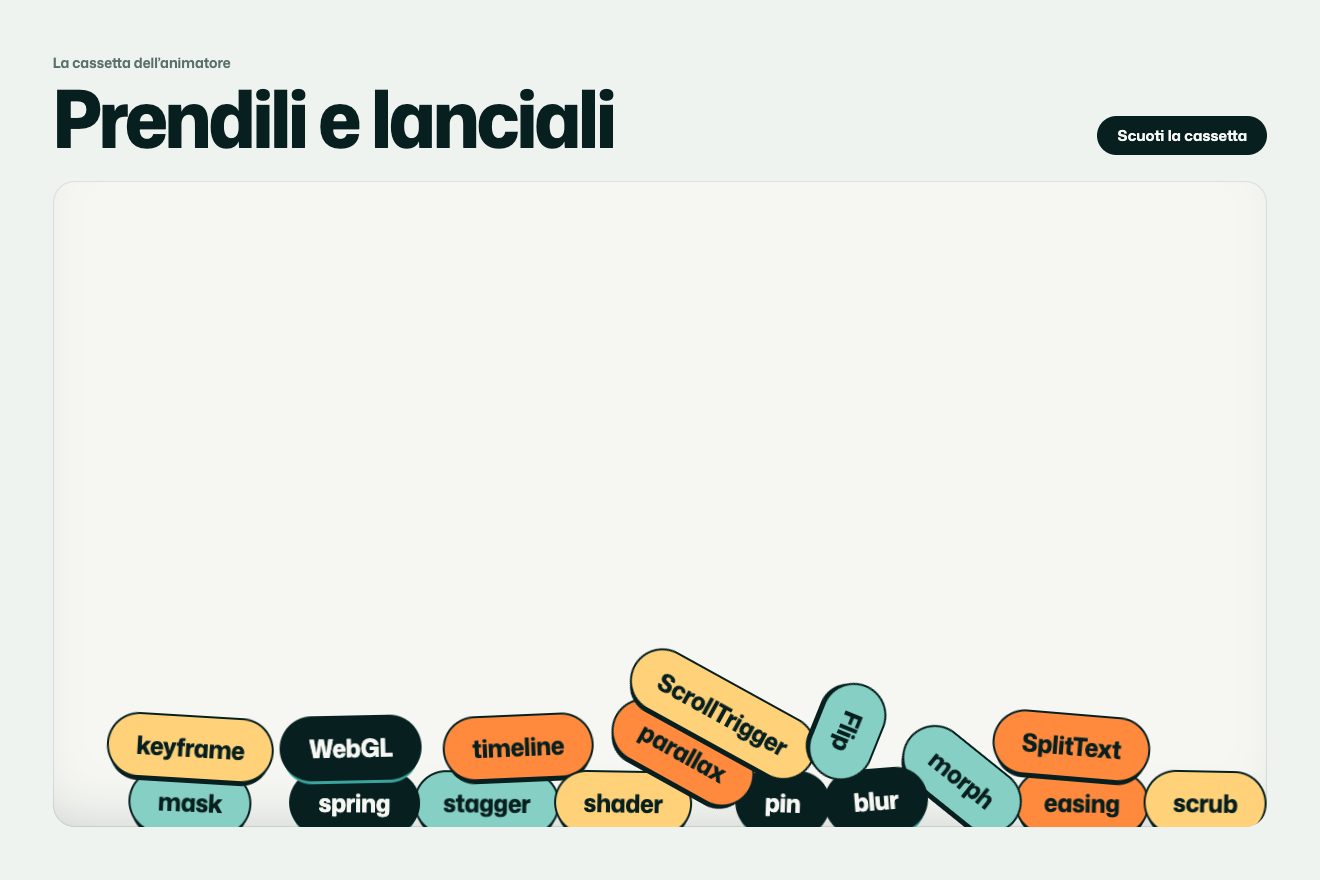
Falling tools
Physics, Hover
The storage card of a made-up file and backup app, Cubby, on a warm light ground: 48.2 of 64 GB used, and each group of files (photos, apps, messages, cache) is made of small bricks with weight inside a glass tray. On arrival they drop one after the other into the lowest gap, land with a slight squash and settle, with hand-written physics (Verlet steps of 1/120 s, never more than 1/30 s a frame, box collisions and friction). The pointer in the tray stirs them, a row of the legend makes its own bricks hop and dims the others, Clean up throws the hatched cache bricks out of the top with a line of light and the rest fall into the gaps while the numbers go down; then the cache builds up again.
A folder that runs on its own: index.html, style.css, script.js and the libraries from a CDN. The React and Vue tabs hold the same demo as a ready component, which switches its animations off when it leaves the page.
<!doctype html>
<!--
  "Storage card" from Animorio · https://animorio.com
  License: free on your own sites and your clients’ sites, paid work included.
  Not for resale, redistribution, templates or code collections · https://animorio.com/en/license/
-->
<html lang="en">
<head>
  <meta charset="utf-8">
  <meta name="viewport" content="width=device-width, initial-scale=1">
  <title>Cubby, Storage: the files stacked in the tray</title>
  <link rel="stylesheet" href="https://cdn.jsdelivr.net/npm/@fontsource-variable/mona-sans@5.3.0/wdth.css">
  <link rel="stylesheet" href="style.css">
</head>
<body>
  <main class="stage">
    <!-- the storage card of a made-up phone and cloud app, Cubby. Every file is a small brick in a glass tray, a body
         with weight that falls, bumps and settles; the pointer stirs them, a row of the legend makes its files hop,
         Clean up throws the cache out and the rest drop into the gaps -->
    <section class="card" aria-label="Storage" data-card>
      <header class="head">
        <div class="brand">
          <svg class="brand__mark" viewBox="0 0 20 20" aria-hidden="true">
            <rect x="2.5" y="4.5" width="15" height="12" rx="3.5"/>
            <path d="M6.5 4.5V3.6a1.1 1.1 0 0 1 1.1-1.1h4.8a1.1 1.1 0 0 1 1.1 1.1v.9"/>
            <path d="M7 10.5h6"/>
          </svg>
          <span class="brand__name">Cubby</span>
        </div>
        <span class="device">Alba's phone</span>
      </header>

      <div class="title">
        <h1 class="title__h">Storage</h1>
        <p class="title__used"><b data-used>48.2</b> GB of 64 GB used</p>
      </div>

      <div class="cap" aria-hidden="true" data-cap>
        <i data-seg="photos"></i><i data-seg="apps"></i><i data-seg="messages"></i><i data-seg="cache"></i>
      </div>

      <div class="tray" data-tray aria-hidden="true">
        <div class="tray__glass"></div>
        <div class="tray__bricks" data-bricks></div>
        <div class="tray__sweep" data-sweep></div>
        <div class="tray__lip"></div>
      </div>

      <ul class="legend" data-legend>
        <li class="leg" data-cat="photos"><span class="leg__name">Photos</span><span class="leg__gb"><b data-gb>21.4</b> GB</span><span class="leg__bar"><i></i></span></li>
        <li class="leg" data-cat="apps"><span class="leg__name">Apps</span><span class="leg__gb"><b data-gb>12.8</b> GB</span><span class="leg__bar"><i></i></span></li>
        <li class="leg" data-cat="messages"><span class="leg__name">Messages</span><span class="leg__gb"><b data-gb>6.1</b> GB</span><span class="leg__bar"><i></i></span></li>
        <li class="leg" data-cat="cache"><span class="leg__name">Cache</span><span class="leg__gb"><b data-gb>7.9</b> GB</span><span class="leg__bar"><i></i></span></li>
      </ul>

      <footer class="foot">
        <p class="foot__note" data-note>Cache rebuilds as you use apps</p>
        <button class="btn" type="button" data-btn>
          <span class="btn__bg" aria-hidden="true"></span>
          <span class="btn__label" data-label>
            <span class="btn__a">Clean up</span>
            <span class="btn__b"><svg viewBox="0 0 16 16" aria-hidden="true"><path d="M3.5 8.4l2.9 2.9 6.1-6.6"/></svg>Freed 7.9 GB</span>
          </span>
        </button>
      </footer>
    </section>
  </main>

  <script src="https://cdn.jsdelivr.net/npm/gsap@3.15.0/dist/gsap.min.js"></script>
  <script src="script.js"></script>
</body>
</html>Change values, colours and text with the controls and watch the animation respond live. Or write in the code yourself. Then download the folder with your changes.
42 values to change
With the Animorio connector, Claude Code, ChatGPT, Cursor or VS Code take it from here, guide included, and fit it into your project. Paste this request:
Take “Storage card” from Animorio and fit it into my siteEach group has its GB and the tray is nine units wide: each group is split into bricks one, two or three units wide with a fixed random (always the same stack), and the order they fall in is shuffled. Brick width and height are measured from the tray, so they fit the phone box too.
Every brick keeps its position and the one before: the speed is their difference. A frame lasts at most 1/30 s and is split into steps of 1/120 s; each step adds gravity and the pointer’s push, then seven rounds of constraints: the walls, the floor and overlapping pairs, pushed apart along the side where they overlap least, in proportion to their width.
A brick resting on another keeps only part of its sideways speed (FRICTION), measured against the one below. Resting on less than 42% of its width it slides towards the open side and drops into the gap. When a fast fall stops, a spring squashes the body from the bottom and lets it come back with a pixel of bounce; the lean follows the sideways speed.
Before a brick drops the height of the stack under each column is measured and the place where it lands lowest, leaving the least gap underneath, is chosen with a little randomness: the stack stays compact like a tidy disk without losing its physical feel.
Clean up takes the cache out of the physics world and carries it away with GSAP (up, spinning, fading, 0.035 s apart) while a line of light crosses the glass; the others, with nothing under them, fall by themselves. The numbers are an object GSAP takes from 48.2 to 40.3, and the button measures its width before and after the label changes and goes from one to the other on back.out.
| Name | File | Default | What it changes |
|---|---|---|---|
GRAVITY | script.js | 2400 | Pixels per second squared pulling the bricks down. |
FRICTION | script.js | 0.4 | How much a resting brick stops sliding (0 slides, 1 sticks). |
SQUASH | script.js | 1 | How much a brick squashes on landing (0 none). |
STIR | script.js | 1 | How hard the pointer pushes the bricks (0 not at all). |
STIR_RADIUS | script.js | 44 | Pixels around the pointer that push. |
HOP | script.js | 260 | Speed of the hop when its legend row is under the pointer. |
DROP_STAGGER | script.js | 0.045 | Seconds between one brick and the next dropping in. |
CLEAN_STAGGER | script.js | 0.035 | Seconds between one cache brick and the next leaving. |
REFILL_AFTER | script.js | 3.2 | Seconds before the cache builds up again. |
MAX_TILT | script.js | 3 | Degrees a brick leans while sliding. |
SPEED | script.js | 1 | Speed of the pilot: 2 twice as fast, 0.5 half. |
LOOP | script.js | true | Left alone, the pilot plays again and again. |
For the storage or settings page of a files, photos or backup app, the dashboard of a cloud service or the account area of a product with a storage limit: when an abstract number (GB used) should become something you see and touch, and freeing space should feel as satisfying as a physical gesture.
The same animation with adapted sizes: the tray takes its height from the screen (104 to 172 px) and the bricks are measured from it, even if the window changes halfway. A finger in the tray stirs the stack like the mouse, a tap on the legend turns a row on or off.
No falling or pushing: the stack is worked out silently and appears already at rest; cleaning the cache its bricks fade and the settled stack fades back in, the numbers change at once, no hops.
GSAP 3.15.0, Mona Sans (font variabile) 5.3.0.
Compressed with gzip, the three demo files weigh 9.6 KB; the libraries: GSAP 28 KB.
Tested on 10 November 2026
Use it in your own projects and in your clients’ projects. Do not resell it or redistribute it as is. GSAP stays under its own Standard license. Full license.
Support Animorio
Animorio stays free thanks to the people who support it. If you like, buy us a coffee: it helps us make the next animations.
You asked for
We made it for you: it’s in the library, with the preview, the Playground and the code to copy.
An animation you can’t find, or a site to take apart in the journal: tell us which. We pick the next ones from here.
With your account’s email and password.
or with your email
You’re signed in as .
With your account, you can download the zip of every animation and every pack, for free.