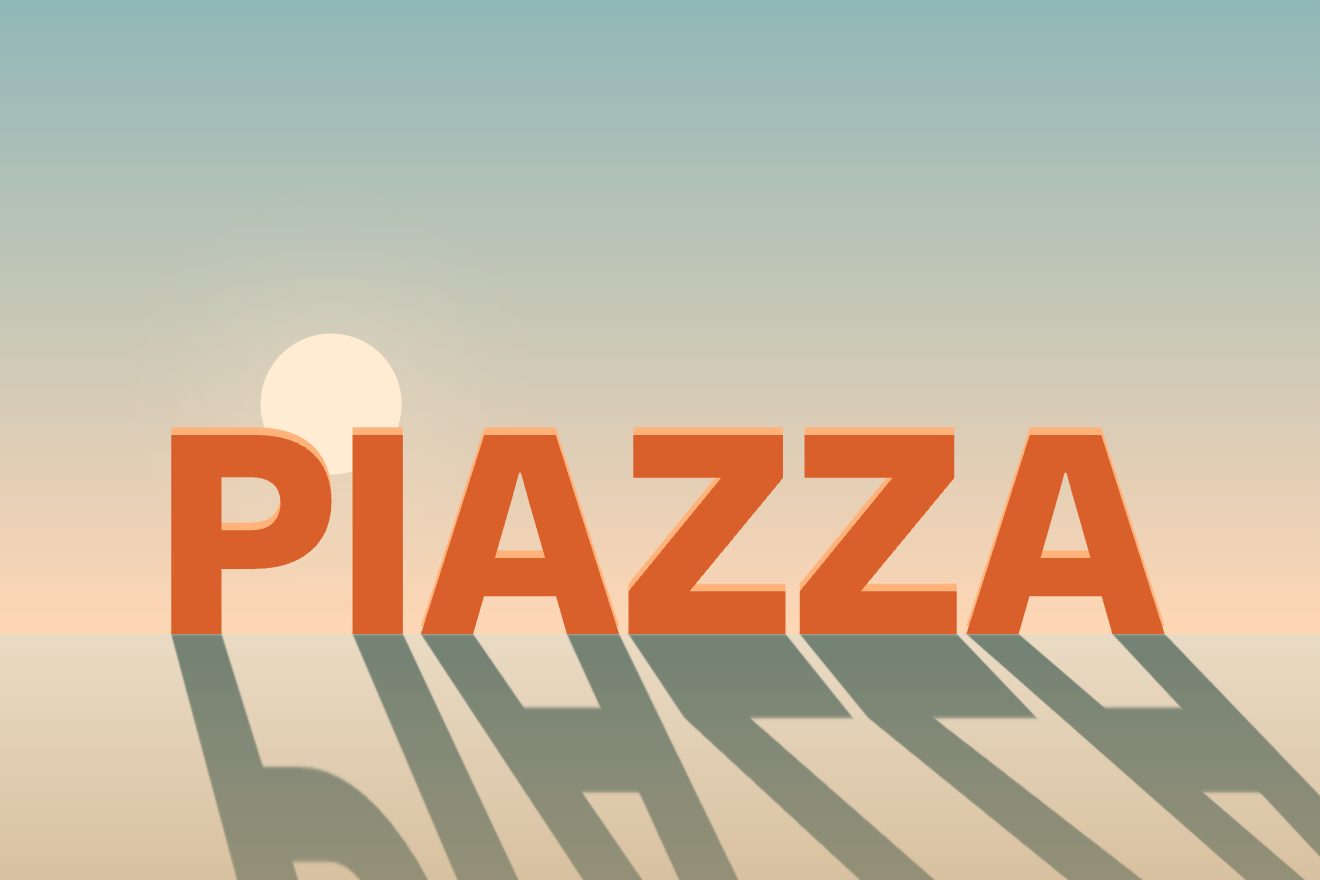
Long shadow letters
Text, Scroll, 3D
Scroll inside the preview
The about us section of Pellwick, a made-up studio that makes digital products, on a warm white. The stage stays put and the big paragraph is read with the scroll: the words go from grey to ink, and when the reading reaches a key word a small rounded tile opens right next to it, from zero width, with a spring that pushes the words around aside. Inside each tile there is a real piece of interface in miniature that enters with its own gesture: the chart that draws itself, the cursor that clicks a button, the status pill that goes from «Building» to «Live», the switch that turns on. Scrolling back the tiles close again; under the pointer the piece does its gesture once more.
A folder that runs on its own: index.html, style.css, script.js and the libraries from a CDN. The React and Vue tabs hold the same demo as a ready component, which switches its animations off when it leaves the page.
<!doctype html>
<!--
  "Studio manifesto tiles" from Animorio · https://animorio.com
  License: free on your own sites and your clients’ sites, paid work included.
  Not for resale, redistribution, templates or code collections · https://animorio.com/en/license/
-->
<html lang="en">
<head>
  <meta charset="utf-8">
  <meta name="viewport" content="width=device-width, initial-scale=1">
  <title>Pellwick, about us</title>
  <link rel="stylesheet" href="https://cdn.jsdelivr.net/npm/@fontsource-variable/mona-sans@5.3.0/wdth.css">
  <link rel="stylesheet" href="https://cdn.jsdelivr.net/npm/@fontsource-variable/geist-mono@5.3.0/index.css">
  <link rel="stylesheet" href="style.css">
</head>
<body>
  <!-- the about us section of a made-up studio that makes digital products, Pellwick. The stage sticks while you
       scroll and the paragraph is read: the words go from grey to ink, and when the reading reaches a key word a small
       rounded tile opens in the text next to it, pushing the words aside with a spring. Inside each tile a real piece
       of interface in miniature makes its own little gesture: a chart draws, a cursor clicks a button, a status pill
       goes live, a switch turns on. Over a tile (or tapping it) the piece does it again. -->
  <main>
    <section class="corsa" data-corsa>
      <div class="palco" data-palco>
        <div class="alone" aria-hidden="true"></div>
        <div class="grana" aria-hidden="true"></div>

        <div class="cornice" data-cornice>
          <header class="testa" data-testa>
            <p class="marchio">
              <svg class="marchio__segno" viewBox="0 0 24 24" aria-hidden="true"><path d="M5 4.5h9.5a4.5 4.5 0 0 1 0 9H9.5V19.5H5z"/><path class="marchio__piega" d="M9.5 13.5 14.5 8.5"/></svg>
              <span>Pellwick</span>
            </p>
            <p class="etichetta">About us</p>
          </header>

          <p class="manifesto" data-manifesto>Pellwick is a studio of eleven people making digital products<span class="tessera" data-tessera="grafico" tabindex="0" aria-label="A small growth chart"><span class="tessera__corpo"><span class="tessera__ogg">
            <svg class="grafico" viewBox="0 0 72 34" aria-hidden="true">
              <defs><linearGradient id="area" x1="0" y1="0" x2="0" y2="1"><stop offset="0" stop-color="var(--accento)" stop-opacity=".28"/><stop offset="1" stop-color="var(--accento)" stop-opacity="0"/></linearGradient></defs>
              <path class="grafico__rete" d="M4 9.5h64M4 17.5h64M4 25.5h64"/>
              <path class="grafico__area" data-area fill="url(#area)"/>
              <path class="grafico__linea" data-linea/>
              <path class="grafico__mira" data-mira d="M0 4v26"/>
            </svg>
          </span></span></span> that grow, quietly, week after week. We test every idea with a real click<span class="tessera" data-tessera="cursore" tabindex="0" aria-label="A cursor clicking a button"><span class="tessera__corpo"><span class="tessera__ogg">
            <span class="bottone" data-bottone><span class="bottone__onda" data-onda></span><span class="bottone__testo">Try</span></span>
            <svg class="freccia" data-freccia viewBox="0 0 16 20" aria-hidden="true"><path d="M2 1.6v14.6l3.7-3.5 2.5 5.6 2.5-1.1-2.4-5.4h5.1z"/></svg>
          </span></span></span> instead of a slide, ship<span class="tessera" data-tessera="stato" tabindex="0" aria-label="A status pill that says live"><span class="tessera__corpo"><span class="tessera__ogg">
            <span class="stato" data-stato>
              <svg class="stato__segno" viewBox="0 0 14 14" aria-hidden="true"><circle class="stato__giro" data-giro cx="7" cy="7" r="5.2"/><path class="stato__spunta" data-spunta d="M4.3 7.2 6.2 9.1 9.9 5.2"/></svg>
              <span class="stato__righe"><span class="stato__riga" data-riga>Building</span><span class="stato__riga" data-riga>Live</span></span>
            </span>
          </span></span></span> small and often, and keep turning the details<span class="tessera" data-tessera="interruttore" tabindex="0" aria-label="A switch that turns on"><span class="tessera__corpo"><span class="tessera__ogg">
            <span class="interruttore" data-interruttore><span class="interruttore__pomello" data-pomello></span></span>
          </span></span></span> until they feel obvious.</p>

          <footer class="piede" data-piede>
            <p class="piede__nota">Eleven people, one room, since 2016</p>
            <a class="squadra" href="#" data-squadra>
              <span class="squadra__testo">Meet the team</span>
              <svg class="squadra__freccia" viewBox="0 0 16 16" aria-hidden="true"><path d="M3 8h10M9 4l4 4-4 4"/></svg>
            </a>
          </footer>
        </div>
      </div>
    </section>
  </main>
  <script src="https://cdn.jsdelivr.net/npm/gsap@3.15.0/dist/gsap.min.js"></script>
  <script src="https://cdn.jsdelivr.net/npm/gsap@3.15.0/dist/ScrollTrigger.min.js"></script>
  <script src="https://cdn.jsdelivr.net/npm/lenis@1.3.26/dist/lenis.min.js"></script>
  <script src="script.js"></script>
</body>
</html>Change values, colours and text with the controls and watch the animation respond live. Or write in the code yourself. Then download the folder with your changes.
25 values to change
With the Animorio connector, Claude Code, ChatGPT, Cursor or VS Code take it from here, guide included, and fit it into your project. Paste this request:
Take “Studio manifesto tiles” from Animorio and fit it into my siteThe paragraph is written in HTML with the four tiles already in place, attached with no space to their key word. The script splits the text nodes into .parola spans and leaves the tiles as they are; then it puts the key word and its tile in a span with white-space: nowrap, because an inline-block creates a point where the line can wrap and the tile would end up alone at the start of the next line.
The section is 320vh tall with a sticky stage at 100lvh; Lenis updates ScrollTrigger, which gives the progress. Every frame the reading follows the progress with a lerp (SMOOTH) and becomes a position r among the words: word i has light (r − i) / SOFTNESS, from 0 to 1, and the colour is interpolated between --spento and --inchiostro. The colour is written only when it changes by a hundredth.
Every tile has a threshold: its key word nearly black. When r passes it, a tween takes the --a variable from 0 to 1 with elastic.out; in the CSS the width is calc(var(--w) * var(--a)) and the left margin grows with it, so the words after move with the same spring. The tile body (another element, for GSAP) rises 0.12em and goes from 0.82 to 1 with back.out, and a glint in --luce crosses it. Below the threshold minus half a word the tile closes again: the gap keeps it from flickering on the edge.
Each has close, enter, gesture and final. The chart is a curved path built from eight values, drawn with stroke-dashoffset and a dashed marker following it; the gesture takes the values to another series with endArray and elastic. The cursor arrives with xPercent and yPercent (percentages, so right at every size) and clicks: arrow and button give and spring back with elastic, the ripple spreads. The pill spins an arc, swaps the «Building» and «Live» lines and draws the tick. The switch stretches the knob with scaleX, moves it by xPercent 100 and settles it.
With a mouse the gesture starts on pointerenter, with a finger on pointerdown, and the pressed tile gives to 0.93 and springs back; with the keyboard Enter or space. If nobody scrolls for IDLE seconds, one open tile at a time replays its gesture, counted in the GSAP ticker and not with setTimeout.
| Name | File | Default | What it changes |
|---|---|---|---|
RIDE | script.js | 1 | How much scroll the whole paragraph takes: 2 is twice as long. |
SOFTNESS | script.js | 3.5 | How many words light up together at the reading front. |
SMOOTH | script.js | 0.12 | How softly the reading follows the scroll: 1 sticks to it, 0.05 floats behind. |
SPRING | script.js | 1.1 | How much the tile bounces when it opens: 0 no bounce. |
OPEN_TIME | script.js | 0.9 | Seconds a tile takes to open. |
IDLE | script.js | 4.5 | Seconds between two gestures replayed on their own by the open tiles: 0 never. |
For the about us page or the manifesto of a studio, an agency, a software house, a startup: a paragraph meant to be read, where the key words show at once what the team does. The tiles can hold any piece of the product’s interface (a chart, a notification, a switch, an avatar).
The same animation with adapted sizes: the paragraph is sized on width and height (min of vw and vh), the tiles are in em and grow with the text, the key word always stays attached to its tile. On tap the tile gives and the piece replays its gesture.
The paragraph is already all ink, the tiles already open with their pieces in their final pose (chart drawn, «Live» pill, switch on); everything fades in, with no smooth scroll and no gestures.
GSAP 3.15.0, ScrollTrigger 3.15.0, Lenis 1.3.26, Mona Sans (font variabile) 5.3.0, Geist Mono (font variabile) 5.3.0.
Compressed with gzip, the three demo files weigh 8.9 KB; the libraries: GSAP + ScrollTrigger 45 KB, Lenis 5.3 KB.
Tested on 13 November 2026
Use it in your own projects and in your clients’ projects. Do not resell it or redistribute it as is. GSAP stays under its own Standard license. Full license.
Support Animorio
Animorio stays free thanks to the people who support it. If you like, buy us a coffee: it helps us make the next animations.
You asked for
We made it for you: it’s in the library, with the preview, the Playground and the code to copy.
An animation you can’t find, or a site to take apart in the journal: tell us which. We pick the next ones from here.
With your account’s email and password.
or with your email
You’re signed in as .
With your account, you can download the zip of every animation and every pack, for free.