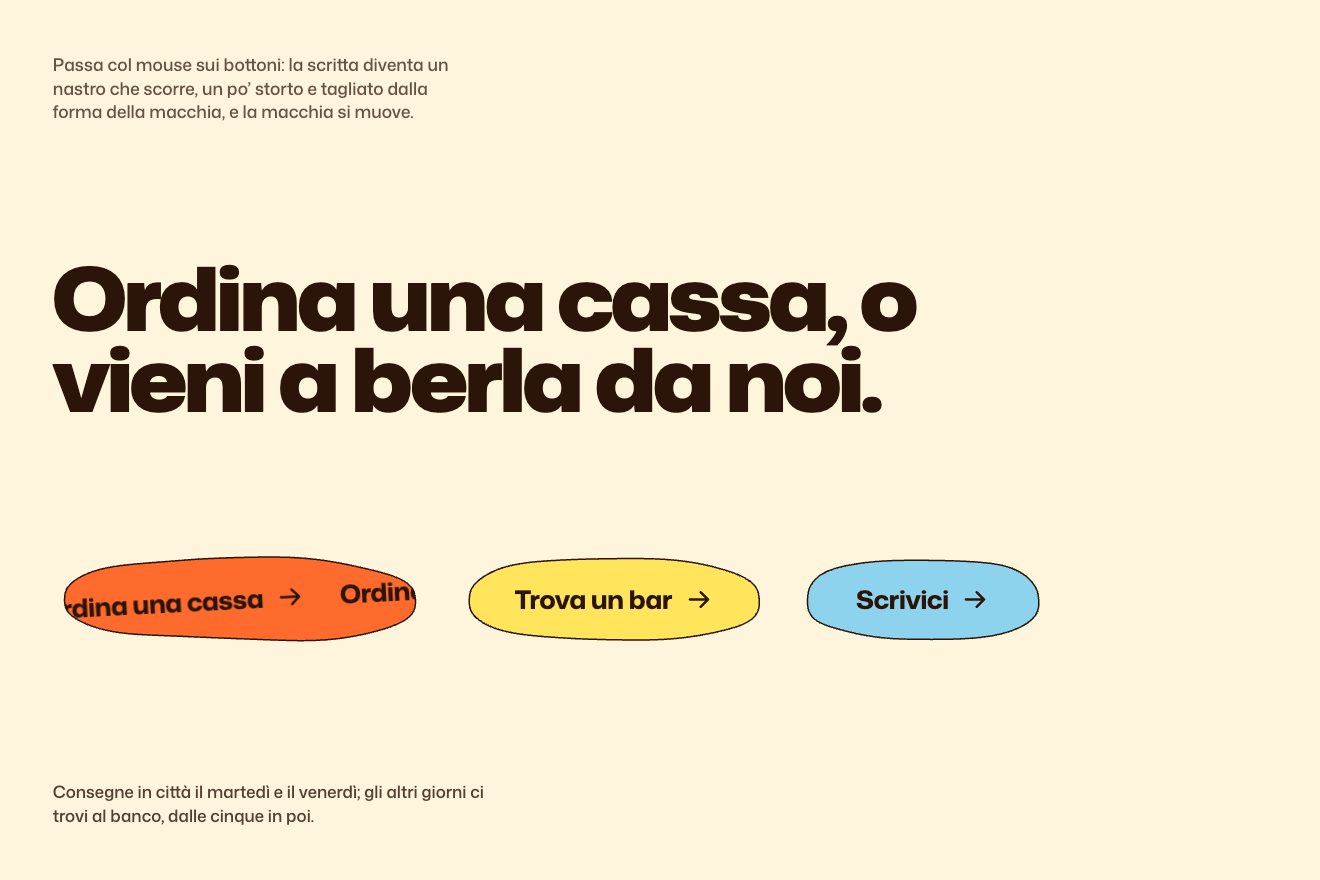
The ticker in the button
Hover, SVG, Text
NewFree
In the minimal style: one word, and under every letter a thin tappet, a rod with a head, resting on its own egg-shaped cam drawn in a hairline. The cams sit on one belt, each turned a step further on: running the pointer along the word turns them and the letters rise one after another like a scale, take weight at the top and drop back onto the cam with a small knock. Hold the pointer still and the letter stays up and lights up red.
A folder that runs on its own: index.html, style.css, script.js and the libraries from a CDN. The React and Vue tabs hold the same demo as a ready component, which switches its animations off when it leaves the page.
<!doctype html>
<html lang="en">
<head>
  <meta charset="utf-8">
  <meta name="viewport" content="width=device-width, initial-scale=1">
  <title>Tappet</title>
  <link rel="stylesheet" href="https://cdn.jsdelivr.net/npm/@fontsource-variable/archivo@5.3.0/wdth.css">
  <link rel="stylesheet" href="style.css">
</head>
<body>
  <!-- one word on a row of tappets, each pushed up by its own cam: the pointer turns the cams -->
  <main class="stage" data-stage>
    <h1 class="sr" data-name>Tappet</h1>
    <svg class="machine" data-machine aria-hidden="true">
      <g data-belt-group>
        <path class="belt" data-belt d="" pathLength="1" />
        <path class="teeth" data-teeth d="" />
      </g>
      <path class="rail" data-rail d="" />
      <g data-bushes></g>
      <g data-cams></g>
      <g data-tappets></g>
    </svg>
    <p class="hint" data-hint>Run the pointer along the word.</p>
    <p class="read" data-readout><span class="read__label">Shaft</span> <b class="read__value" data-read>0°</b></p>
  </main>

  <script src="https://cdn.jsdelivr.net/npm/gsap@3.15.0/dist/gsap.min.js"></script>
  <script src="script.js"></script>
</body>
</html>Change values, colours and text with the controls and watch the animation respond live. Or write in the code yourself. Then download the folder with your changes.
18 values to change
With the Animorio connector, Claude Code takes it from here, guide included, and fits it into your project. Paste this request:
Take “The word on the cams” from Animorio and fit it into my siteThe stage is an SVG whose viewBox is as big as the window, so one unit is one pixel. Every letter is measured with getBBox twice, at the lightest and at the heaviest weight: the widest sets the pitch between the letters, which must also let the cams turn without touching. Then everything is counted in letter heights: the head of the tappet below the letters' descent, the guide rail, the top of the cam at rest, the hub. The type size is chosen so the word and the cams fit the window, across and down.
The cam is a base circle and a small circle for the nose, joined by two straight tangents: the egg shape of real cams, always convex. The tangents leave the base circle at an angle that can be worked out (the arc cosine of the difference of the radii over the distance between the centres): outside it the cam lifts nothing. The tappet touches it at the top, so the lift is how far the outline reaches up above the base circle: it is read once from the drawing into a table of 1440 angles, so the rod always touches the line you see.
Every letter has an angle at which the nose of its cam is at the top, one step after another; before the first and after the last there is a rest as wide as a flank of the cam, so at rest no cam touches its tappet and from one margin to the other the cams make exactly one turn. The x of the pointer becomes the angle to reach, and the belt chases it on a spring (SPIN and SETTLE) with a top speed. Coming in, the pointer takes the turn the cams are on, so they never spin a whole turn to catch up.
Every tappet is a real body, on a fixed step of 1/240 of a second: a spring pushes it down and the cam can only push it up. If the cam falls away faster than the tappet can drop, the tappet stays in the air and lands on it later: the knock makes it bounce (BOUNCE) and squashes it for an instant on a damped spring. If it flies too high, the collar under the head stops against the guide. The weight and the width of the letter follow the lift along a soft curve, between THIN and HEAVY.
If the pointer stays on a letter, the cam has stopped with its nose under the rod and the tappet is resting on it, a clock runs: after HOLD seconds the letter lights up, with a small push upwards, like a key catching. The colour comes in quickly and leaves slowly. With no pointer, after IDLE seconds a GSAP timeline moves a fake pointer along the word, with a stop on the middle letter. The opening is one timeline too: the belt and the rail draw themselves with stroke-dashoffset, the cams open with back.out, the letters are dropped one at a time and the cams make their first turn.
| Name | File | Default | What it changes |
|---|---|---|---|
WORD | script.js | 'Tappet' | The word on the tappets: up to ten letters, spaces are dropped. Every letter gets its own cam. |
LIFT | script.js | 0.25 | How high the cams lift a letter, in letter heights: more lift means bigger cams and letters further apart. |
SPIN | script.js | 2.6 | How quickly the cams follow the pointer, in hertz: 1 is lazy, 6 is tight. |
SETTLE | script.js | 0.62 | How the cams come to rest: 0.3 swings past and back, 1 stops dead. |
BOUNCE | script.js | 0.32 | How much a letter bounces when it lands back on its cam (0 = it just lands). |
HOLD | script.js | 0.5 | The seconds the pointer has to rest on a letter before it lights up. |
THIN | script.js | 230 | The weight of a letter at rest (100 to 900). |
HEAVY | script.js | 780 | The weight of a letter at the top of its lift (100 to 900). |
IDLE | script.js | 2.4 | The seconds without a pointer before an invisible hand runs along the word (0 = never). |
For a name you play by running over it: the opening of a portfolio or an industrial design studio, the wordmark of a workshop, a watchmaker or an instrument maker, the page of an engineering project, the 404. It works with any short word.
The same machine with the sizes adapted: the word and the cams take almost the whole width and everything is measured in letter heights, so the proportions stay the same. You slide a finger along the word; holding it still on a letter, the letter lights up. The hint becomes «Drag a finger along the word.».
Nothing moves: the belt, the cams and the word fade in and stay still at rest. The letter under the pointer takes weight and turns red with a fade, without rising, and thins out again when the pointer leaves.
GSAP 3.15.0, Archivo (font variabile) 5.3.0.
Compressed with gzip, the three demo files weigh 9.8 KB; the libraries: GSAP 28 KB.
Tested on 16 October 2026
Use it in your own projects and in your clients’ projects. Do not resell it or redistribute it as is. GSAP stays under its own Standard license. Full license.
With your account’s email and password.
or with your email
You’re signed in as .
With your account, you can download the zip of every animation and every pack, for free.