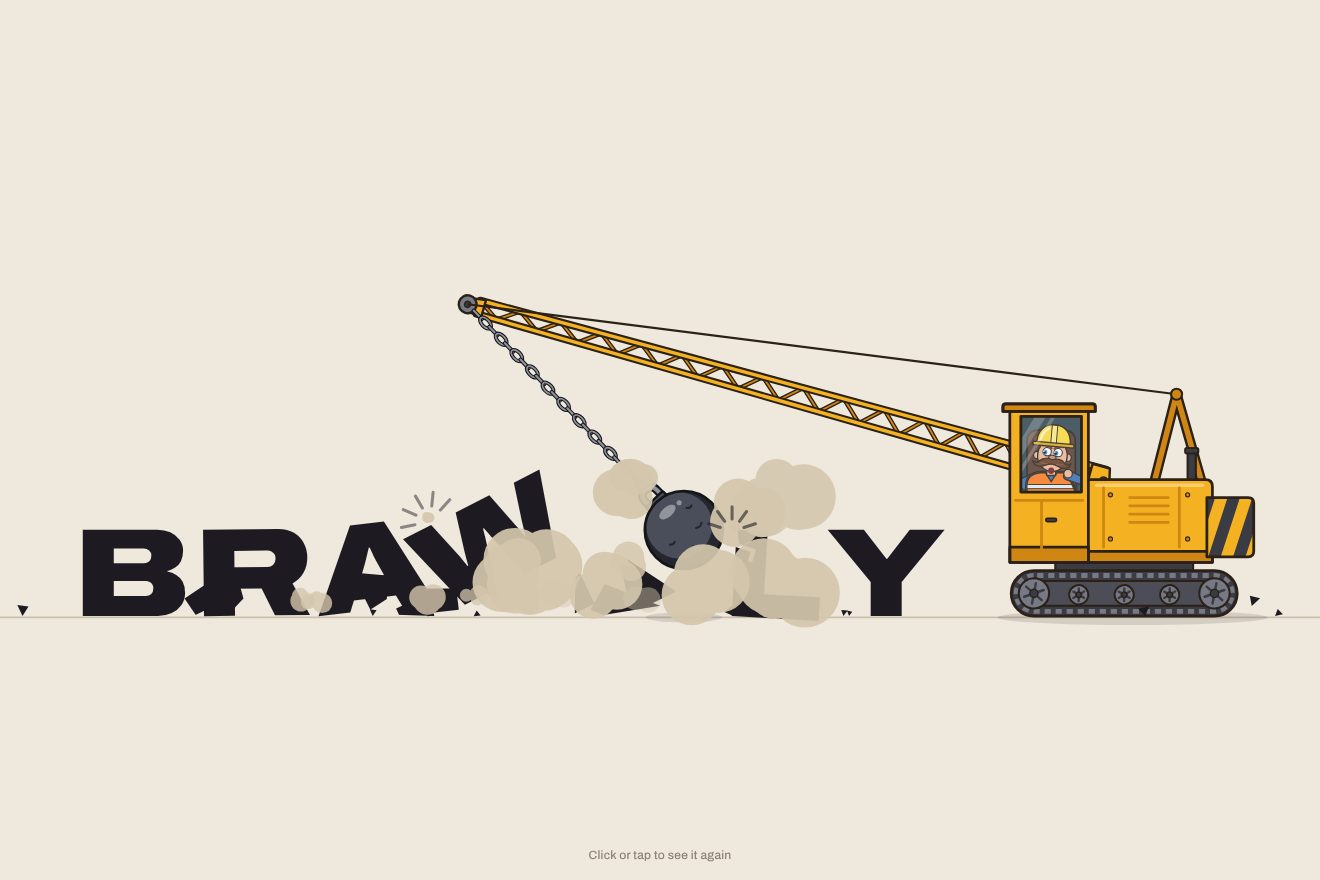
The wrecking-ball logo
Intro, Physics, SVG, Text
NewFree
In the minimal style, with real friction: the tablecloth trick. A serif word stands on a vermilion cloth, a thin line hanging over the edge of a table drawn in hairlines. Pulled slowly, the cloth takes the word with it; whipped away, it slips out from under it and the letters stay nearly still, slide a few pixels, rock and gain weight as it passes. The hem can be pulled with the mouse or a finger, and whoever insists drags the word off the table.
A folder that runs on its own: index.html, style.css, script.js and the libraries from a CDN. The React and Vue tabs hold the same demo as a ready component, which switches its animations off when it leaves the page.
<!doctype html>
<html lang="en">
<head>
  <meta charset="utf-8">
  <meta name="viewport" content="width=device-width, initial-scale=1">
  <title>Mise</title>
  <link rel="stylesheet" href="https://cdn.jsdelivr.net/npm/@fontsource-variable/newsreader@5.3.0/opsz.css">
  <link rel="stylesheet" href="style.css">
</head>
<body>
  <!-- the whole room is the button: a click whips the cloth away, or lays it again; the hem can be pulled by hand -->
  <main class="stage" data-stage tabindex="0" role="button" aria-label="A word standing on a tablecloth. Press to whip the cloth away from under it.">
    <header class="top">
      <span class="top__brand">Mise</span>
      <span class="top__note">Dinner club, Thursdays at eight</span>
    </header>

    <svg class="room" data-svg aria-hidden="true">
      <path class="table" data-table d="" />
      <path class="cloth" data-cloth d="" />
      <path class="hem" data-hem d="" />
    </svg>

    <!-- the word: the script splits it, and every letter slides, leans and falls on its own -->
    <h1 class="word" data-word>dinner</h1>

    <p class="hint" data-hint>Pull the hem down slowly, or click to whip the cloth away.</p>
    <p class="read" data-readout><span class="read__label">The word moved</span> <b class="read__value" data-read>0 px</b></p>
  </main>

  <script src="https://cdn.jsdelivr.net/npm/gsap@3.15.0/dist/gsap.min.js"></script>
  <script src="script.js"></script>
</body>
</html>Change values, colours and text with the controls and watch the animation respond live. Or write in the code yourself. Then download the folder with your changes.
17 values to change
With the Animorio connector, Claude Code takes it from here, guide included, and fits it into your project. Paste this request:
Take “The word on the tablecloth” from Animorio and fit it into my siteThe word is split into letters, each a span with its own position and speed. At every physics step (a twelve-hundredth of a second inside gsap.ticker, with the frame never over a thirtieth of a second) the script checks whether the letter is still on the cloth. On the cloth: if the difference in speed can be cancelled by static friction (GRIP times gravity times the step), the letter goes with the cloth; otherwise kinetic friction (SLIDE) only tugs it a little. On the bare wood friction stops it. Gravity in pixels follows the size of the type: a letter is about six centimetres tall.
The cloth is a single number, how far it has been pulled: the line lies on the top from its end to the edge and hangs from there, and pulled far enough it only hangs and slides down out of the room. GSAP moves the target (a slow pull on sine.inOut, a whip that reaches its speed in two hundredths of a second and keeps it), and inside every frame the physics interpolates the cloth step by step, so its speed is continuous.
The acceleration of each letter's feet, over gravity, is the angle the letter wants to lean to: back when the cloth pulls it, forward when the wood brakes it. A stiff damped spring chases that angle, so on a slow pull the letters stay upright (a third of a degree) and on the whip they rock by a few degrees and settle. The letter gains weight on Newsreader's wght axis the instant the cloth's end passes beneath it.
A GSAP timeline brings the cloth back: the line rises over the edge and runs along the top to the left; as its head passes under a letter, the letter hops (half a sine) and meanwhile goes home on power2.inOut. Letters that fell off the table fade back in at their places. Every pull starts with the physics clock reset, so the loop on its own always comes back the same.
Near the hem the pointer becomes a hand: pulling down (or to the right) draws the cloth over the edge as far as the finger moves, and it never goes back, because a cloth cannot be pushed. Slowly, the word follows; letters that pass the table's edge fall with gravity, turning the way they were going. Once the hem is let go, the whip comes a few seconds later.
| Name | File | Default | What it changes |
|---|---|---|---|
GRIP | script.js | 0.45 | Static friction between cloth and letters: more and a slow pull carries them more firmly. |
SLIDE | script.js | 0.15 | The friction while the cloth slips underneath: more and the letters are dragged further. |
WHIP | script.js | 0.08 | How many seconds the whipped cloth takes to slip out from under the word: less is a cleaner trick. |
DRIFT | script.js | 70 | How many pixels the slow pull carries the word before the whip. |
LEAN | script.js | 1 | How much a letter leans when the cloth tugs at its feet (0 = not at all). |
HOLD | script.js | 1.6 | How many seconds the word stands on the bare table before the cloth comes back. |
--accent | style.css | #e5432a | The colour of the tablecloth. |
--weight | style.css | 380 | The weight of the word’s typeface, from 200 to 700. |
For the opening of a restaurant, a dinner club, a bistro or a caterer, for the booking or menu page, for a magician or a show. It works with any short word, best without letters that drop below the line (dinner, menu, table), because the letters stand on the table top.
The same physics, with gravity measured on the size of the type, so the whip leaves the word nearly still on a narrow screen too. The table takes almost the whole width, the hem is pulled with a finger (with a larger area), a tap gives the whip.
Nothing moves before your eyes: a click fades the cloth out and shows the word again where the whip leaves it, worked out silently to the end, with the pixels it moved; another click puts the cloth back and the word home, again with fades.
GSAP 3.15.0, Newsreader (font variabile) 5.3.0.
Compressed with gzip, the three demo files weigh 8.4 KB; the libraries: GSAP 28 KB.
Tested on 19 October 2026
Use it in your own projects and in your clients’ projects. Do not resell it or redistribute it as is. GSAP stays under its own Standard license. Full license.
With your account’s email and password.
or with your email
You’re signed in as .
With your account, you can download the zip of every animation and every pack, for free.