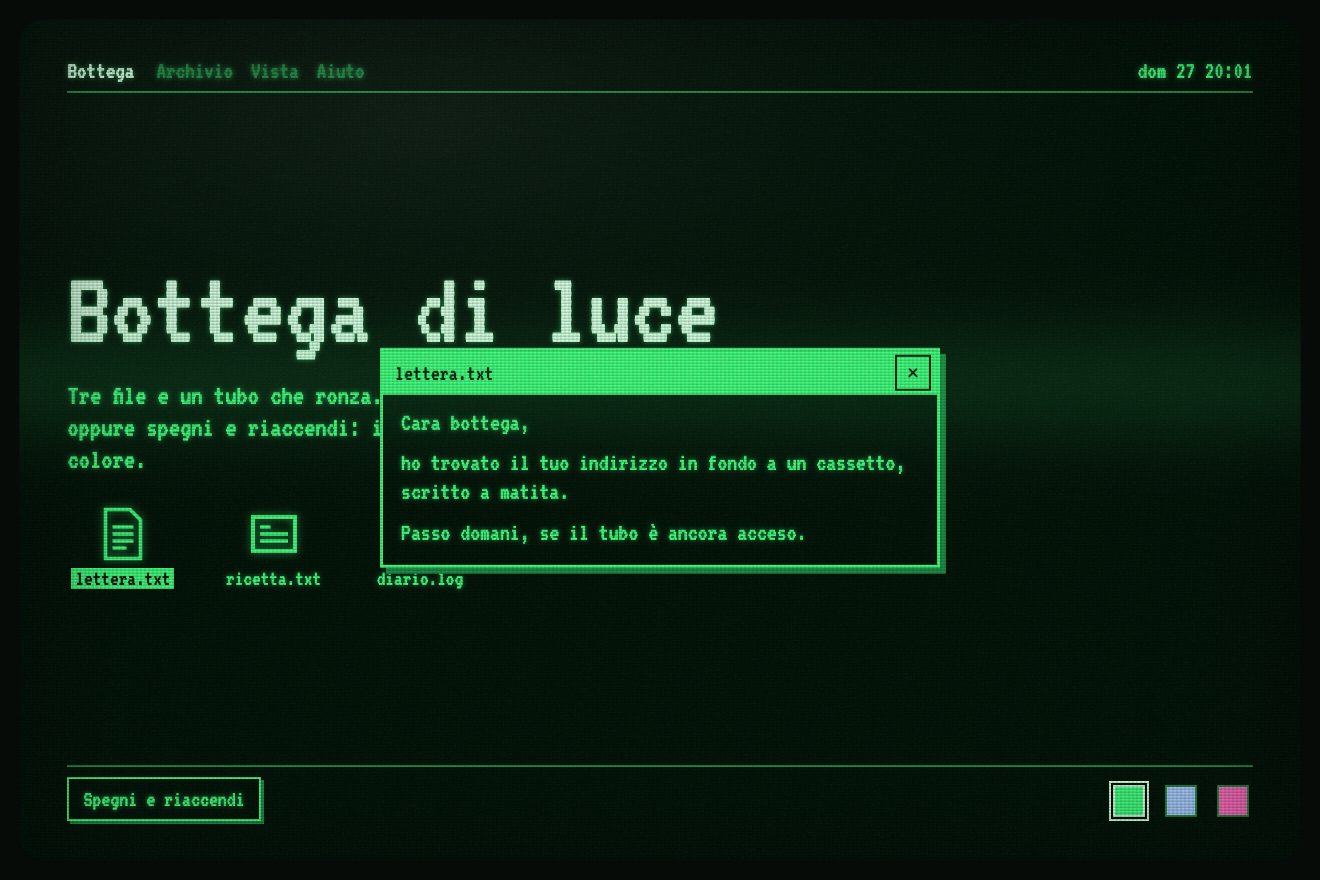
The cathode-ray tube
WebGL, Text, Transitions
Free
A minimal-style WebGL animation: a big word that nobody writes, it grows. A shader runs a reaction-diffusion simulation (the Gray-Scott model, the one behind coral and fingerprints) and the pattern can only live inside the letters: from a few seeds of ink a maze grows and fills the word, with the growing edge in vermilion, while the word gains weight. The pointer plants new seeds.
A folder that runs on its own: index.html, style.css, script.js and the libraries from a CDN. The React and Vue tabs hold the same demo as a ready component, which switches its animations off when it leaves the page.
<!doctype html>
<html lang="en">
<head>
  <meta charset="utf-8">
  <meta name="viewport" content="width=device-width, initial-scale=1">
  <title>Lichen</title>
  <link rel="stylesheet" href="https://cdn.jsdelivr.net/npm/@fontsource-variable/archivo@5.3.0/wdth.css">
  <link rel="stylesheet" href="style.css">
</head>
<body>
  <!-- a word that grows like coral: a reaction-diffusion simulation (Gray-Scott) runs in a WebGL shader, and the letters
       of the word are the only place where the pattern can live; the pointer drops new seeds -->
  <main class="pagina" data-pagina>
    <canvas class="tela" aria-hidden="true" data-tela></canvas>
    <h1 class="sr">Lichen</h1>

    <header class="testa">
      <p class="marchio" data-entra>Lichen</p>
      <p class="testa__nota" data-entra>Living materials lab</p>
    </header>

    <p class="nota" data-entra data-nota>Draw to plant a seed</p>
  </main>

  <script src="https://cdn.jsdelivr.net/npm/gsap@3.15.0/dist/gsap.min.js"></script>
  <script src="script.js"></script>
</body>
</html>Change values, colours and text with the controls and watch the animation respond live. Or write in the code yourself. Then download the folder with your changes.
19 values to change
With the Animorio connector, Claude Code takes it from here, guide included, and fits it into your project. Paste this request:
Take “The word that grows like coral” from Animorio and fit it into my siteThe simulation is a grid of cells as big as the page divided by the cell size (CELLS makes a stroke of the word about 22 cells wide). Each cell has two numbers, u and v, the two substances of the Gray-Scott model, stored in the red and green channels of a floating-point texture (RGBA16F, WebGL 2 with EXT_color_buffer_float). There are two textures that take turns: the shader reads from one and writes into the other, then they swap (ping-pong).
At every step the shader takes the nine-point Laplacian of u and v (minus the centre, 0.2 for the four neighbours, 0.05 for the four diagonals), then the reaction r = u·v²: u becomes u + Δu − r + F·(1 − u) and v becomes v + 0.5·Δv + r − (F + k)·v. With F = 0.0545 and k = 0.062 the pattern is coral, a branching maze. GROW_SPEED steps per sixtieth of a second set how fast it grows.
The word is drawn white on black in a 2D canvas as big as the grid and uploaded as an R8 texture: that is the mask. Inside the mask k is KILL, outside it is 0.0075 higher and v wears away by 0.4 per cent per step: the pattern cannot stay there. Each letter is drawn at the centre of its slot measured at the final weight, so as the weight rises from 460 to 780 the letter widens in place and the seeds stay inside.
A second shader plants the seeds: inside a circle of cells v goes to 0.9 and u drops to 0.45. The opening ones are picked with a fixed-seed random among points at least six cells from the edge, eight per letter and far apart; the pointer's land where it passes. The blue channel counts how long a cell has been full: where it is young the third shader, the one that draws, uses vermilion instead of black.
The round runs on GSAP's ticker and growth is counted in steps: the steps keep up with time (seven seconds), but the phase only ends when they are all done, so on a slow graphics card the word takes longer but always fills. The weight rises from 460 to 780 on the same curve as the steps, then the word stays full for HOLD seconds and k rises everywhere over 2.4 seconds: the coral wears away and the paper is clean again. The drawing reads v with a hand-written bilinear filter and a soft threshold, so the stripes have smooth edges even with two-pixel cells. With reduced motion 1400 steps run at once, before the word is shown, and then nothing moves.
| Name | File | Default | What it changes |
|---|---|---|---|
WORD | script.js | Lichen | The word that grows. |
GROW_SPEED | script.js | 3 | How many simulation steps per sixtieth of a second: higher grows faster. |
FEED | script.js | 0.0545 | How much feed comes in: it changes the pattern (lower, spots; higher, mazes). |
KILL | script.js | 0.062 | How much is taken away inside the letters: higher, thinner and sparser stripes. |
SEEDS | script.js | 8 | How many seeds per letter at the start: more seeds, more little cells and faster growth. |
HOLD | script.js | 4.5 | How many seconds the word stays full before it melts. |
WEIGHT_FROM | script.js | 460 | The weight of the word when it starts to grow. |
WEIGHT_TO | script.js | 780 | The weight it reaches. |
PEN | script.js | 4 | The radius of the seed the pointer leaves, in cells. |
CELLS | script.js | 22 | How many cells wide a stroke of the word is: more cells, finer coral (and more work for the graphics card). |
As the opening of a biology lab, a materials studio, a natural cosmetics brand or a plant nursery; as the title of an exhibition about nature and growth; as the landing page of a generative design studio that wants to show its name made by a process rather than a hand.
The same animation: the word is sized on the width and the simulation grid follows the word, so on a phone there are fewer cells (and less work) but the coral fills the letters the same way. A finger that touches or drags plants the seeds.
The word has already grown and is still, full of its black coral: the simulation steps all run before it is shown, then it fades in. A touch plants a seed and the coral grows at once, with no animation.
GSAP 3.15.0, Archivo (font variabile) 5.3.0.
Compressed with gzip, the three demo files weigh 8.8 KB; the libraries: GSAP 28 KB.
Tested on 22 October 2026
Use it in your own projects and in your clients’ projects. Do not resell it or redistribute it as is. GSAP stays under its own Standard license. Full license.
With your account’s email and password.
or with your email
You’re signed in as .
With your account, you can download the zip of every animation and every pack, for free.