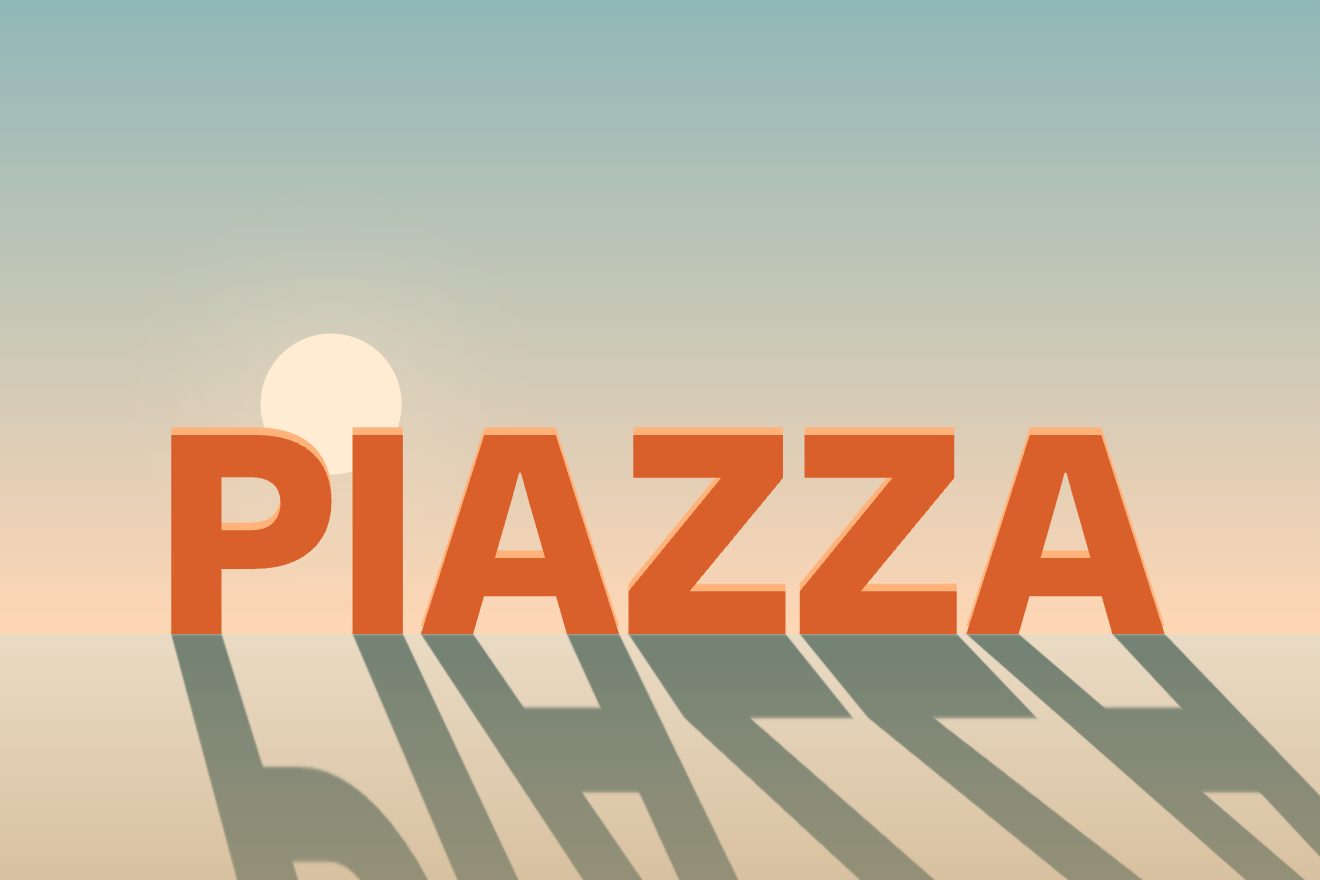
Standing letters with a long shadow
Text, Scroll, 3D
NewFree
Scroll inside the preview
A word in thick glass floats over a wall of brush strokes: through its curves the wall shows bent three times, once per colour, and as you scroll the glass melts back into the wall.
A folder that runs on its own: index.html, style.css, script.js and the libraries from a CDN. The React and Vue tabs hold the same demo as a ready component, which switches its animations off when it leaves the page.
<!doctype html>
<html lang="en">
<head>
  <meta charset="utf-8">
  <meta name="viewport" content="width=device-width, initial-scale=1">
  <title>The glass word</title>
  <link rel="stylesheet" href="https://cdn.jsdelivr.net/npm/@fontsource-variable/mona-sans@5.3.0/standard.css">
  <link rel="stylesheet" href="style.css">
  <script type="importmap">
    { "imports": {
      "three": "https://cdn.jsdelivr.net/npm/three@0.178.0/build/three.module.min.js",
      "three/addons/": "https://cdn.jsdelivr.net/npm/three@0.178.0/examples/jsm/"
    } }
  </script>
</head>
<body>
  <main>
    <!-- the opening: 220% of the screen tall, with a sticky stage; the word melts into the wall as you scroll -->
    <section class="opening" data-opening>
      <div class="stage" data-stage>
        <canvas class="canvas" data-canvas aria-hidden="true"></canvas>
        <p class="wait" data-wait>The glass is cooling</p>

        <header class="top">
          <p class="brand">Mirage</p>
          <p class="top__line">Digital studio</p>
        </header>
        <h1 class="sr">Mirage, a digital studio</h1>

        <p class="corner" data-corner>Interfaces, apps and brands built to hold up in the heat.</p>
        <p class="invite" data-invite>Scroll to discover</p>
      </div>
    </section>

    <section class="after">
      <h2 class="after__title">Solid on arrival. Invisible in use.</h2>
      <p class="after__text">We design and build interfaces that catch the eye in the first second and then step aside, so the work shows through.</p>
    </section>
  </main>

  <script src="https://cdn.jsdelivr.net/npm/gsap@3.15.0/dist/gsap.min.js"></script>
  <script src="https://cdn.jsdelivr.net/npm/gsap@3.15.0/dist/ScrollTrigger.min.js"></script>
  <script type="module" src="script.js"></script>
</body>
</html>Change values, colours and text with the controls and watch the animation respond live. Or write in the code yourself. Then download the folder with your changes.
29 values to change
With the Animorio connector, Claude Code takes it from here, guide included, and fits it into your project. Paste this request:
Take “The glass word” from Animorio and fit it into my siteThe wall is painted once on a canvas a third of the screen’s size: 90 diagonal strokes from a seeded generator, light and dark, each a linear gradient. Stretched back over the screen, the third softens it by itself. It becomes a texture, and a quad covering the screen shows it by reading it at the pixel’s own position, gl_FragCoord divided by the resolution: so wall and glass line up to the pixel.
The outline of mirage comes from Pacifico (SIL OFL licence), written as an SVG path in font units. SVGLoader turns it into shapes and ExtrudeGeometry extrudes them: depth 110, a 26 by 64 bevel in 8 steps. The bevel grows inwards, with bevelOffset equal to minus its width, so the script’s small counters stay open.
No physical material: a ShaderMaterial. For every pixel the refraction is computed three times, with indices 1.42, 1.45 and 1.48, one per channel: red bends least, blue most, and at the edges the colours part. The offset is 0.04 of the screen. Where the glass is thick the colour leans towards #bccbd2, the rim, (1 − N·V)^2.2, darkens towards ink, a raking light brightens the edges facing it and a narrow glint, (N·H)^90, makes the highlight.
The view reflected on the normal reads two vertical panels and a light from above, drawn by a function rather than a photo; their edges are filtered with fwidth, so they stay soft even on the bevels. Each channel reads them 0.006 apart, a hint of prism. They weigh 0.5 times a fresnel that grows towards the edges, and a slow glint crawls over the curves.
The word sits in three nested groups: the first moved by scrolling, the second by the entrance, the third by the float. The entrance lasts 2.6 seconds of power3.out through three points, with sine.inOut between them, and turns from a crooked angle to straight. The pointer tilts it up to 0.16 radians and moves the light, with a lag that does not depend on the screen’s refresh rate. Scrolling arrives through an object scrubbed with a 0.6 second lag: from 35% to the end of the opening the glass mixes into the wall and disappears.
| Name | File | Default | What it changes |
|---|---|---|---|
WORD | script.js | mirage | The word’s outline as an SVG path: to change it, export another word’s outline from the typeface you like. |
DEPTH, BEVEL | script.js | 110, 26 × 64 | How thick the glass is and how wide and deep the bevel, in font units (1000 = the type size). |
IOR | script.js | 1.42, 1.45, 1.48 | The refraction indices of red, green and blue: the further apart, the more rainbow on the edges. |
BEND | script.js | 0.04 | How far the refraction moves the wall behind. |
TINT, RIM | script.js | #bccbd2 | The colour of thick glass and of the rim. |
STUDIO, PRISM | script.js | 0.5, 0.006 | The strength of the reflected panels and how far apart their colours are. |
FILL | script.js | 0.74 | How much of the screen width the word takes (0.92 on a phone). |
MELT | script.js | 0.35, 1 | Between which points of the opening the glass melts into the wall. |
STROKES, FLIGHT | script.js | 90, 2.6 | The brush strokes on the wall and the seconds of the entrance. |
For the opening of a site that has to be remembered in its first second: a studio, a brand, a product with a short name. It works with a word or a symbol, not a sentence: glass wants thick, curved shapes.
The word takes 92% of the width instead of 74%, the line at the bottom spans the full width above the invitation to scroll, and the canvas lets the finger scroll through. The stage is as tall as the screen with the browser’s bars tucked away, and the lines at the bottom rise by the bars’ height.
No flight, no float and no tilt: the word appears in 0.6 seconds already in place. The light still follows the pointer, and scrolling still lifts and melts the word, because the person scrolling drives it.
Three.js 0.178.0, GSAP 3.15.0, ScrollTrigger (GSAP) 3.15.0, Mona Sans (font variabile) 5.3.0.
Compressed with gzip, the three demo files weigh 9.0 KB; the libraries: GSAP + ScrollTrigger 45 KB, Three.js + SVGLoader 190 KB.
Tested on 28 September 2026
Use it in your own projects and in your clients’ projects. Do not resell it or redistribute it as is. GSAP stays under its own Standard license. Full license.
With your account’s email and password.
or with your email
You’re signed in as .
With your account, you can download the zip of every animation and every pack, for free.