A24, by Ravi Klaassens
A24, how it’s made: a film archive of discs to flip
Ravi Klaassens’s concept that reimagines A24’s films as a row of 3D discs: a drum loader, discs with the poster printed on the front and an iridescent back, a sheet that melts over the film still. We take it apart with three demos rebuilt from scratch.
The palette
- #F2F2F2the page
- #000000text and rules
- #D6D3D1the stone grey of the film pages
- #891A20the brand red
- #1A1E2Athe discs’ iridescent back
- #499FF5the rim light on the discs
Tap a colour to copy its code.
A24 is an experimental, non-commercial project by Ravi Klaassens, a designer and developer from Enschede: it reimagines the films of the production company A24 as an archive of 3D discs. There are films, series, an index, and a page for every title, from Backrooms to Ex Machina.
It looks like a film library archive: a light grey page, #F2F2F2, black text and hairline rules, a stone grey, #D6D3D1, for the film pages. Titles are set in PP Eiko, a thin uppercase serif, text in PP Neue Montreal, labels in small caps. The only colour comes from the films: each one is a disc, a DVD with its poster printed on it.
Underneath there is an Astro build with Barba for page transitions, GSAP 3.15 with ScrollTrigger, Observer, Flip, CustomEase and SplitText, Lenis for scrolling and Three.js r178 with rect area lights. Almost everything is tuned from large settings objects and data attributes, and the code is careful: it handles WebGL context loss, prerendered pages, a cap of 2.6 million pixels. We take it apart in three moments, with a demo rebuilt from scratch for each: films, posters, texts, colours, formulas and code are our own. From the site we took the idea and the timing.
The row of discs
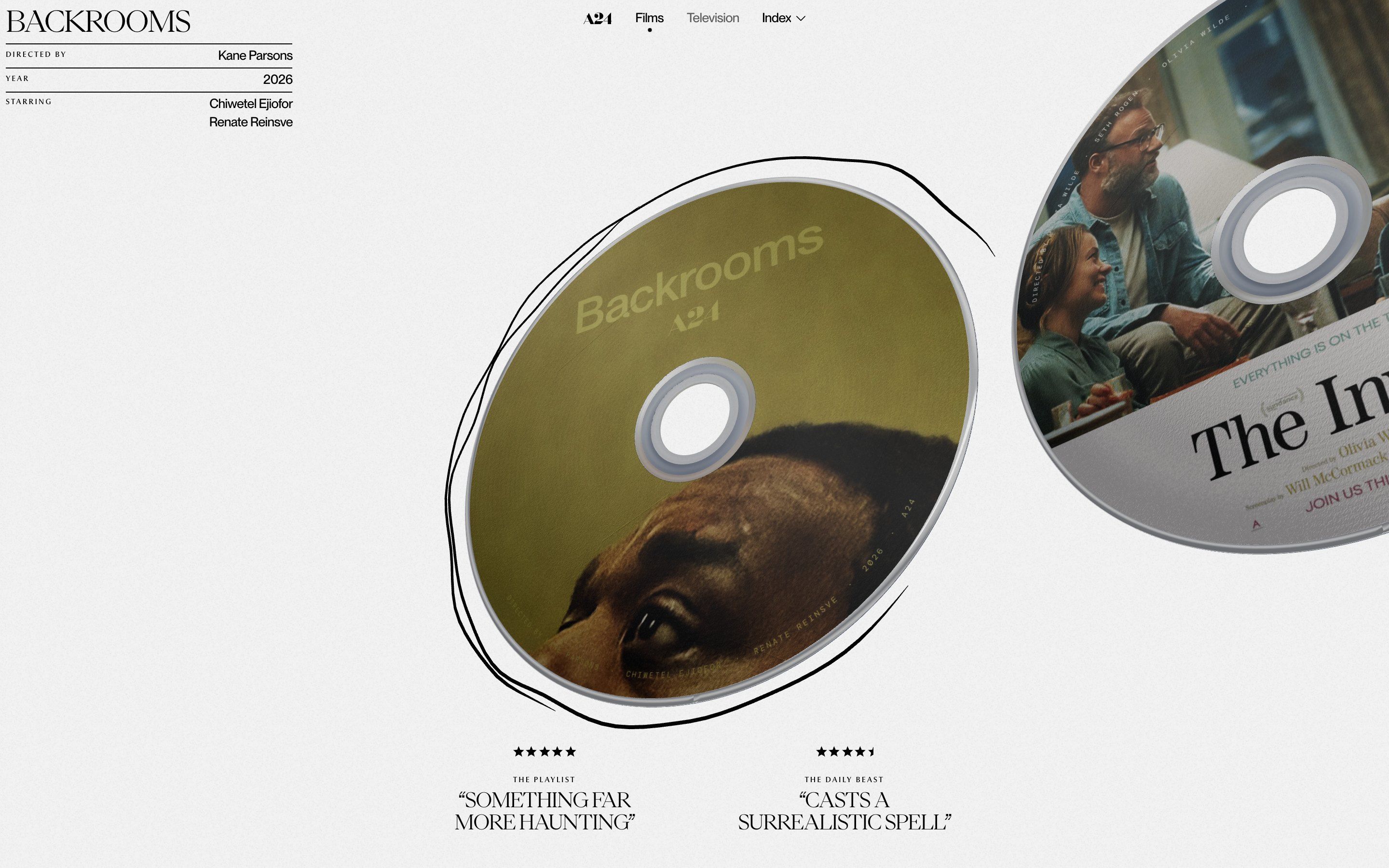
On the home page the films are a row of discs seen at an angle. The front one has its credits beside it and two reviews with stars below; the wheel, a drag or the arrows move the row one disc at a time.
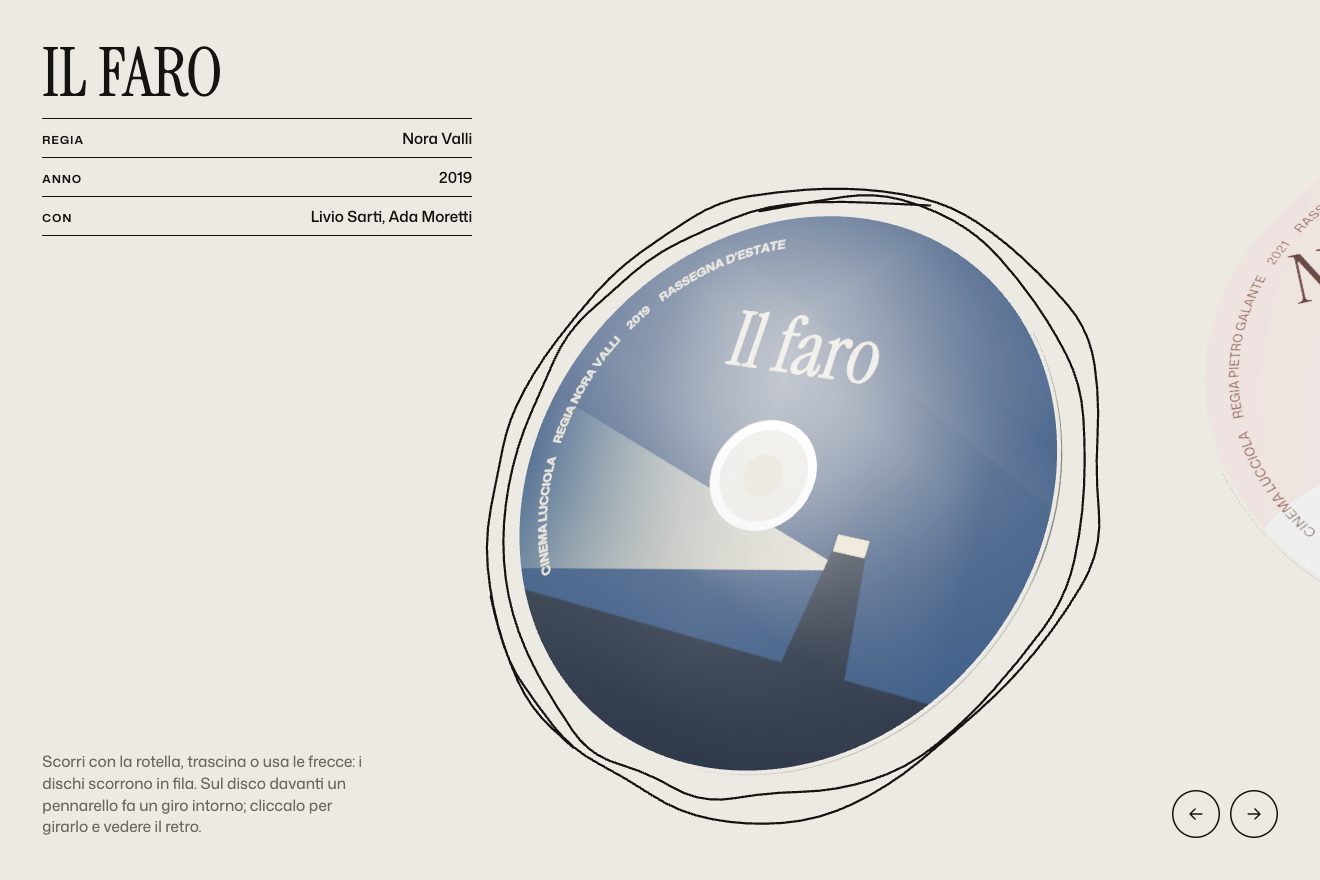
On the site the row is a group rotated by −30° on two axes, and each disc sits on an arc around the head of the row: the angle is (i − head) × 0.35, x comes from the sine and depth from the cosine, so distant discs turn and recede. The front one is slightly raised, the others shrink to 80%. The disc is built like a real one: a face with the poster plus grain, scratches and print, a turned edge with a bevel, a dark metal back with iridescence at index 1.86, a clear hub with a metal ring. The spring that stops the row has frequency 9.5 and damping 12; while it runs the discs lean by √speed × 0.055, the one under the pointer tilts towards it, sweeping the mouse quickly over the discs pushes and spins them, and a click pushes one in. On the front disc a black marker draws two loops, 24 points each, redrawn ten times a second.
In our demo the discs are six invented films from a summer film season, with posters drawn by the script. The row follows a simpler curve, x = (i − head) × 2.2 and z = −(i − head)² × 0.12; reflections come from a room of lights generated by Three.js. The front disc turns slowly on itself, and a click flips it to show the iridescent back.
The melting sheet
On the film pages the huge title and the credits sit on a stone-grey sheet laid over the film still. As you scroll the sheet does not slide away: it melts, into blobs and islands, and the still appears from underneath. With the pointer on it the edge stirs and sheds drops.

The edge is the contour of a noise field on a 16-pixel grid, with 230-pixel blobs, a warp of 1.25 and blobs never smaller than 45 pixels; the contour becomes a clip-path: path(evenodd, …) recomputed every frame. Scrolling lowers the sheet’s level, the field keeps living by itself, and the pointer stirs it: it bites the edge and sheds up to 28 drops. Near links and buttons the bite stops, so they stay clickable.
In our demo the sheet carries the title of an invented film, and underneath is a lighthouse at sunset painted by the script. The contour is computed with marching squares on 14-pixel cells, the noise has three octaves and changes over time, the pointer digs a hole 80 pixels wide. Far from the edge the noise is not even computed.
The drum counter
The loader is a counter at the bottom, and its digits are drums: they spin like a slot machine. As it rises, a first disc arrives from below and turns towards the camera; on the right the years roll from 2012 to today, on the left it says A24 Films.
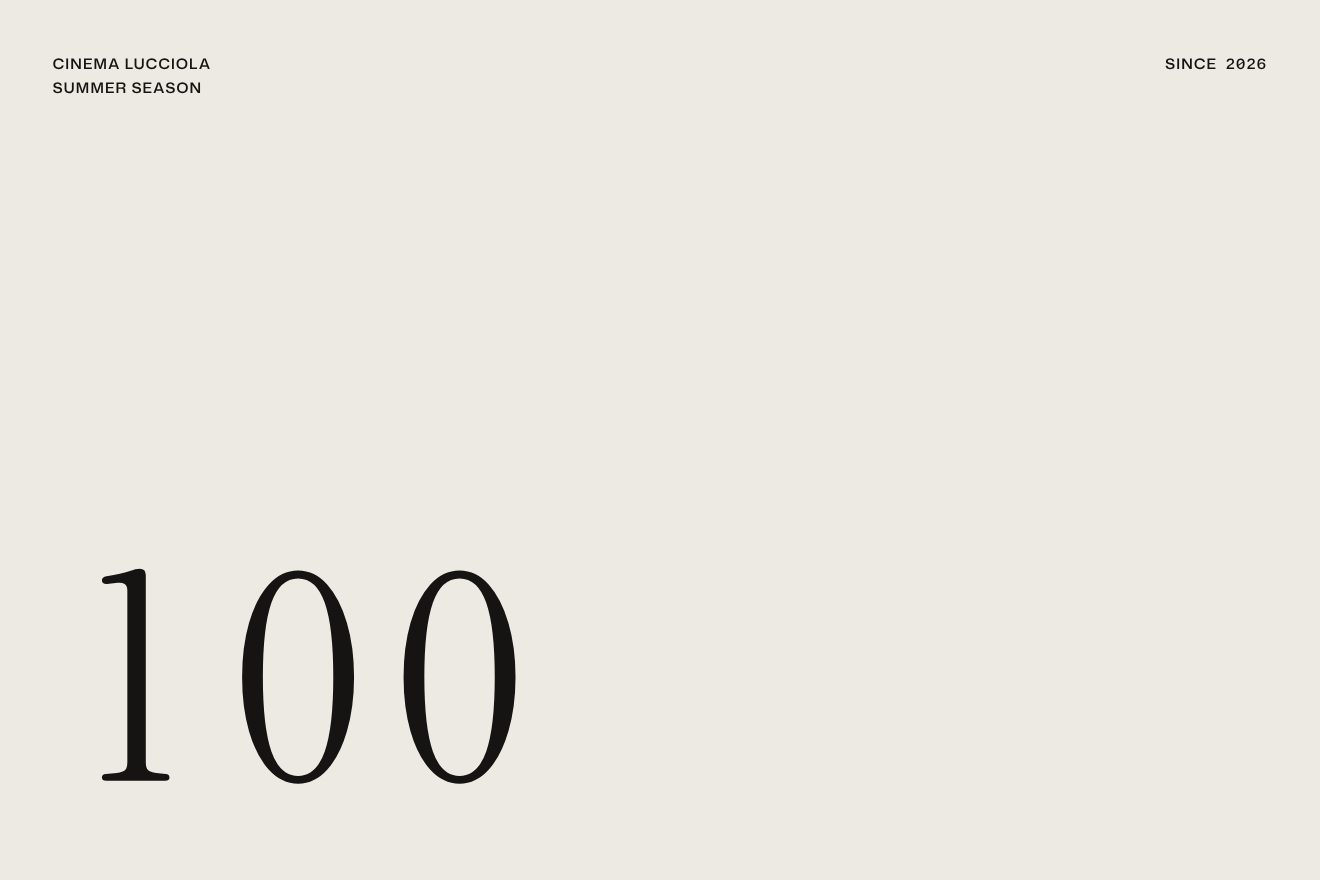
The progress is honest: it follows what really loads, first the scene and then the disc posters, never ends before 2.85 seconds and is chased at 8 per second. On top there are beats: at 5% the drums spell A24, at 50% a random number between 40 and 52, at 75% one between 68 and 80, then 100, each with a drum spin of 0.55 to 0.7 seconds. At the end the other discs fan out and the digits rise away.
In our demo the veil covers the season’s July programme. The jumps are our own, from 12-24 to 38-55 to 66-84 and then 100, and the progress follows the font loading with a minimum duration of 2.6 seconds.
The other details
When the front disc changes, the title and credits leave upwards through their masks and new ones come in, and the rules redraw. Reviews have half stars cut with clip-path. Between pages the discs fly off and come back with Barba; a film page receives its disc with a roulette, eleven steps from fast to slow before it stops, and at the bottom the next film waits with its disc half visible. The nav has a small loading signal that says Projecting, and the index is a dropdown with the years.
Where it stumbles
It is heavy: Three.js alone is almost 700 kilobytes, plus 250 for the rect area lights, and then the site’s own code. For an archive of twelve films that is a lot, even if everything loads sensibly.
On the home page the wheel does not scroll the page: it steps the discs. That is the point of the site, but whoever arrives expects to scroll and finds themselves changing film.
On a phone the row becomes a single large disc, with the next one peeking in from the edge: it works, but the row, the loveliest thing, is lost.
What we take away
A physical object, well made, is enough to carry a site: here the disc has a face, a back, an edge and a clear centre, and every movement treats it like a real thing. And a loader can be honest and fun at once: it follows the real work, but in jumps, with a bit of theatre.
The effects
- The row of discsSix discs in Three.js, in a row seen at an angle, with a film poster printed on the front and iridescent metal on the back: they slide with the wheel or a drag, lean as they run, and a marker circles the front one.Free
- The melting sheetA stone-coloured sheet covers a film still, a real photo of a lighthouse at sunset, and as you scroll it melts into blobs and islands: its edge is the contour of a noise that changes over time, recomputed every frame as a clip-path, and the pointer bites it.Free
- The drum counterA loader that moves in jumps like a slot machine: every digit is a drum that spins to the new number, the progress follows what is really loading and never ends before a minimum duration.Free