Aspen Search, by Edoardo Lunardi, Elliott Mangham, Louis Saville
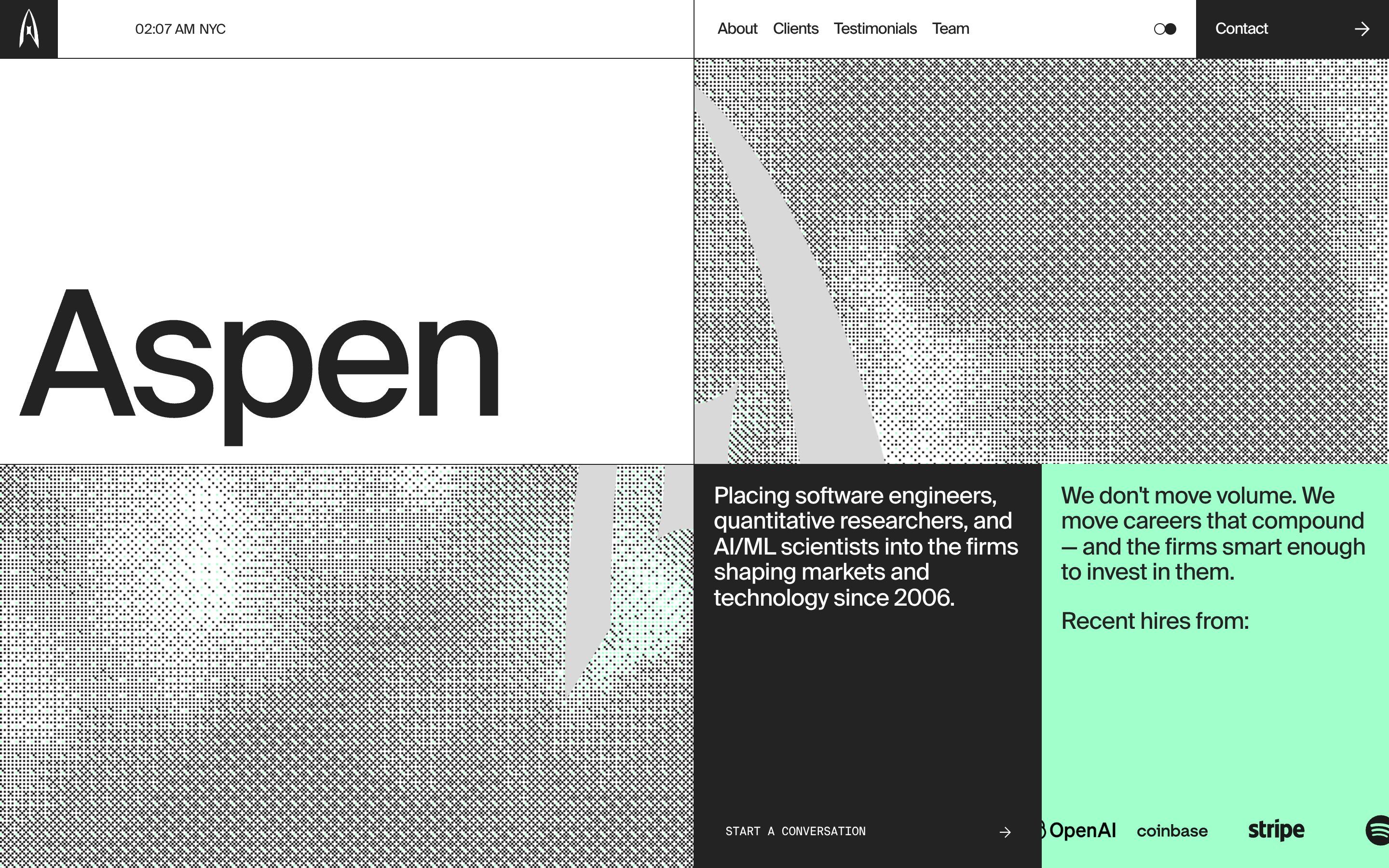
Aspen Search, how it’s made: the dithered ground with the mint smoke, the clock that changes city and the ellipses that make a sphere
The site of Aspen Search, a firm that finds engineers and researchers for quant funds and tech companies, is a black and white grid whose empty cells open onto a ground of dots, like an old one bit screen, where the pointer leaves a mint coloured smoke. We take it apart with three demos rebuilt from scratch.
The palette
- #FFFFFFthe white of the ground, which turns into the text colour in the dark theme
- #232323the near black of the text and the dark panels, and the ground of the dark theme
- #A1FFCBthe mint, the only accent: the clients panel, the buttons and the smoke trail in the dither
- #D9D9D9the grey of the «Search» panel and of the large A turning behind the grid
- #888888the dark grey of the noise, before the dither turns it into dots
- #E0E0E0the light grey of the noise, the other end of the dither
Tap a colour to copy its code.
Aspen Search is an executive search firm: since 2006 it has been finding software engineers, quantitative researchers and AI scientists and placing them in quantitative trading firms and venture backed technology companies. The site says it in one sentence, on the mint panel of the opening: «We don’t move volume. We move careers that compound». It is a single page, built as a grid of cells split by one pixel lines: white, #FFFFFF, and a near black, #232323, which swap places in the dark theme; a light grey, #D9D9D9, for the «Search» panel and the large A turning behind; and a single accent, the mint #A1FFCB. The typeface is Suisse Int’l, with every headline in the Book 450 weight and the letters tightened by 4%, and its monospaced cut for the uppercase labels. It was Site of the Day on Awwwards on 15 September 2026, with 7.48 from the jury, and took the developer award, 7.32, with 7.6 for animations. The credits list Edoardo Lunardi, Elliott Mangham and Louis Saville; in the console the site signs itself «Engineered by» Edoardo Lunardi, and the foot of the page reads «Website by Code Resolution».
Underneath there is Next.js 16.4.2 with Turbopack and a canary build of React 19.3, with the React Compiler. The 3D is three.js r185, with React Three Fiber and the postprocessing library, but it only draws full screen planes: no models. Smooth scrolling is Lenis 1.3.26, the interface motion is Motion, the copy comes from Sanity and the styling is Tailwind 4. There is no GSAP. The headline words are split by a component of their own, built on Intl.Segmenter, which can break lines, words and letters in any language.
The page is sober, almost a table, and the motion lives in the details: a ground of dots that breathes, a clock, some fine line drawings. We take it apart in three moments, with a demo rebuilt from scratch for each one. The copy, the brands and the code are ours; from the site we took the ideas and, where we say so, the numbers.
The dithered ground with the mint smoke
In the opening the grid is not full: two cells out of four are empty, and inside them shows a grey ground made only of black and white dots in regular rows, like a halftone print or the screen of an old one bit computer. The patches of the dither drift slowly. Move the mouse and it leaves a trail of mint smoke, made of the same dots, which curls and fades in half a second. The empty cells are not separate boxes: the ground is a single one, under the whole section, and the cells are windows. In front of it, between the ground and the grid, a large grey A turns slowly, thin as a blade when it is edge on.
The ground is a full screen plane with its own shader. The noise is a classic Perlin summed over four octaves in absolute value, what is called turbulent noise, with a frequency of 3 and each octave at 40% of the one before. The space of the noise is warped by another noise, computed once into a separate image and redone only when the size changes; every frame the noise drifts by 0.006 per second, is squeezed between 0.28 and 0.72 and coloured between two greys, #888888 and #E0E0E0. The dither is a later pass: the image is reduced to pixels of 2, darkened by 0.18 and compared with an 8 by 8 Bayer matrix, written out in full in the shader, which decides for every dot whether it is black or white. The smoke is a small fluid simulation: velocity on a 128 pixel grid, colour on a 384 pixel one, the swirls reinforced with a curl of 22, velocity fading with 1.8 and colour with 3.2. Every pointer move leaves a splat with a force of 2200. Then comes the move that holds it all together, and the comment explaining it is still in the code: the smoke goes through the same Bayer matrix as the ground, and from a soft cloud it becomes mint dots of the same dither. The ground runs only while it is on screen and stops when the browser tab is hidden; on phones there is no smoke.
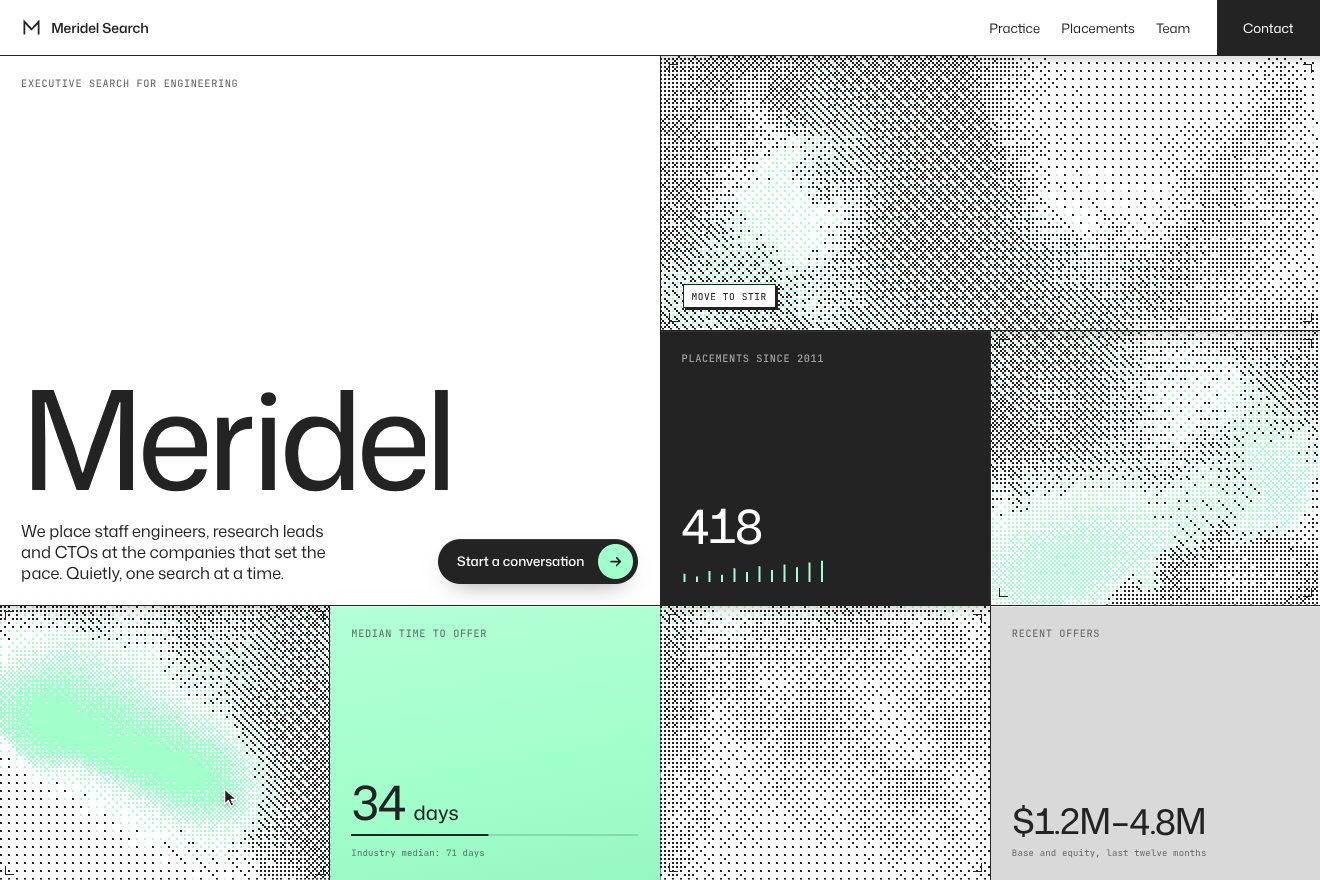
In our demo the firm is made up, Meridel Search, and the opening is a grid like the site’s: the large name, a line and the «Start a conversation» button in the white cell, the placements since 2011 on a near black cell, the days it takes to get an offer on mint, the recent offers on grey, and the other cells empty, open onto the dither. It is all hand written WebGL2, no three.js. From the site come the whole noise, the Perlin times 2.3, the four octaves with frequency times 3 and amplitude times 0.4, the warp computed only when the size changes, the 0.006 drift, the smoothstep between 0.28 and 0.72 with the 1.2 power and the two greys; the dither, with the 8 by 8 Bayer matrix written out in full, the 2 pixel dots, the 0.18 bias and the 3,686,400 pixel ceiling; the smoke, with velocity at 128 and colour at 384, the swirls at 22, the 1.8 and 3.2 dissipations, the 2200 force and the 48 pixel radius; and the smoke going through the same threshold as the dither. We too stop it when it is off screen or the tab is hidden. Rebuilding it we found a detail: with only two colours the lowest threshold of the matrix is zero, and the site’s shader turns one dot in 64 mint even where there is no smoke; we raise the smoke threshold by half a sixty fourth. Ours are the noise computed into an image with one point per dither dot, which costs a quarter; the dither that forms from the bottom when the page opens, dot by dot; the smoke dosed by distance, so a slow move leaves a sparser trail; the corner marks that widen over the window under the pointer and the shadow that makes the windows look recessed; the numbers arriving on rollers; and the button that fills with mint from the left and leaves to the right, which gives when pressed, springs back, puffs a ring of smoke and says «We reply within a day». Left alone, a pointer passes through the windows. With a finger the smoke is there, on phones too. Without WebGL2 the same dither is computed once and stays still; with reduced motion the dither stands still, which the site does not do.
The clock that changes city
In the header, next to the logo, is the time in New York: «02:07 AM NYC». Every five seconds the line slides up and the time in Los Angeles takes its place, then New York comes back. When the minute changes the digits are not swapped: they roll, like an odometer. Further down, the same rollers bring up the firm’s numbers as they come on screen: «500+» placements since 2006, «19+» years, and the range of recent offers, «$1M-5M», on mint.
The time comes from the browser, with Intl.DateTimeFormat and the two time zones, America/New_York and America/Los_Angeles, in twelve hour format. Updates are aligned to the minute: the first lands when the real minute ticks over, then one every sixty seconds. The two cities sit in a column inside a box one em tall, with the rest hidden, and the change is a one em move in 0.65 seconds on the curve cubic-bezier(.16, 1, .3, 1), an exponential ease out that arrives fast and settles slowly. The odometer is a component of its own: every digit is a column from 0 to 9, ten ems tall, which moves by as many ems as the digit’s value, on the same curve, in 1.2 seconds, each digit starting 0.06 seconds after the one before; in the clock the roll is shorter, 0.65 seconds and 0.04 between digits. For screen reader users the time is also a time element and a hidden text, updated through aria-live.

In our demo the firm is made up, Halden Row, and the clock is a light card on a paper coloured ground: the time set large, the city code, a small dial, the time zone and the state of the office, «Office open» or «After hours», then a row of four offices, New York, London, Zurich and Singapore, and below them the firm’s three numbers, the last one on orange. From the site come the real time of each city with Intl.DateTimeFormat and its time zone, the change of city every 5 seconds with the line sliding up one em in 0.65 seconds on the curve cubic-bezier(.16, 1, .3, 1), the digits made of columns from 0 to 9 moved by as many lines as the digit’s value, 0.65 seconds and 0.04 between digits in the clock, 1.2 and 0.06 in the numbers, and the curves of the words, [.23, 1, .32, 1] in and [.7, 0, .84, 0] out. Ours are the four offices instead of two, with the white pill sliding under the lit city and a thin orange line counting the five seconds; the dial with its hands sweeping round to the new city’s time and the orange second hand; the arrival where every digit makes a full turn starting from zero; the extra pixel each roller settles with; the clock going to the city under the pointer and waiting there; the numbers rolling again when hovered; the one pixel edge catching the light where the pointer passes. Left alone, a pointer goes round the cities. With reduced motion the digits change without rolling. The screen reader is told the time once, without announcing it again every five seconds.
The ellipses that make a sphere
The services section is on black. For each of the four services, from quantitative research to building teams, there is a drawing in thin white lines that moves on its own. The first is a sphere: a dashed circle around it and inside it ellipses that narrow and widen, like the meridians of a turning globe. As the page scrolls, the dashed circle rotates.
The globe is not 3D. It is twelve identical SVG ellipses, round at first, in an 800 by 800 drawing, and each has three animations that never end, run by Motion straight on the attributes. The first moves it horizontally from -200 to 200 in 6.67 seconds; the second narrows its horizontal radius from 200 to 1 and widens it again, in 3.33 seconds each way; the third fades it in and out over the same time. Each ellipse’s delay is twelve elevenths of the cycle times its number, so the twelve are offset by one eleventh from each other and together they look like the faces of a rotating sphere. The dashed circle, with dashes of 4 and gaps of 7, is tied to scrolling: it turns 65 degrees while the section crosses the screen, from entering at the bottom to leaving at the top. The other drawings follow the same principle, with 49 rays swinging or a small square going round a circle, and they all pause when they leave the screen.
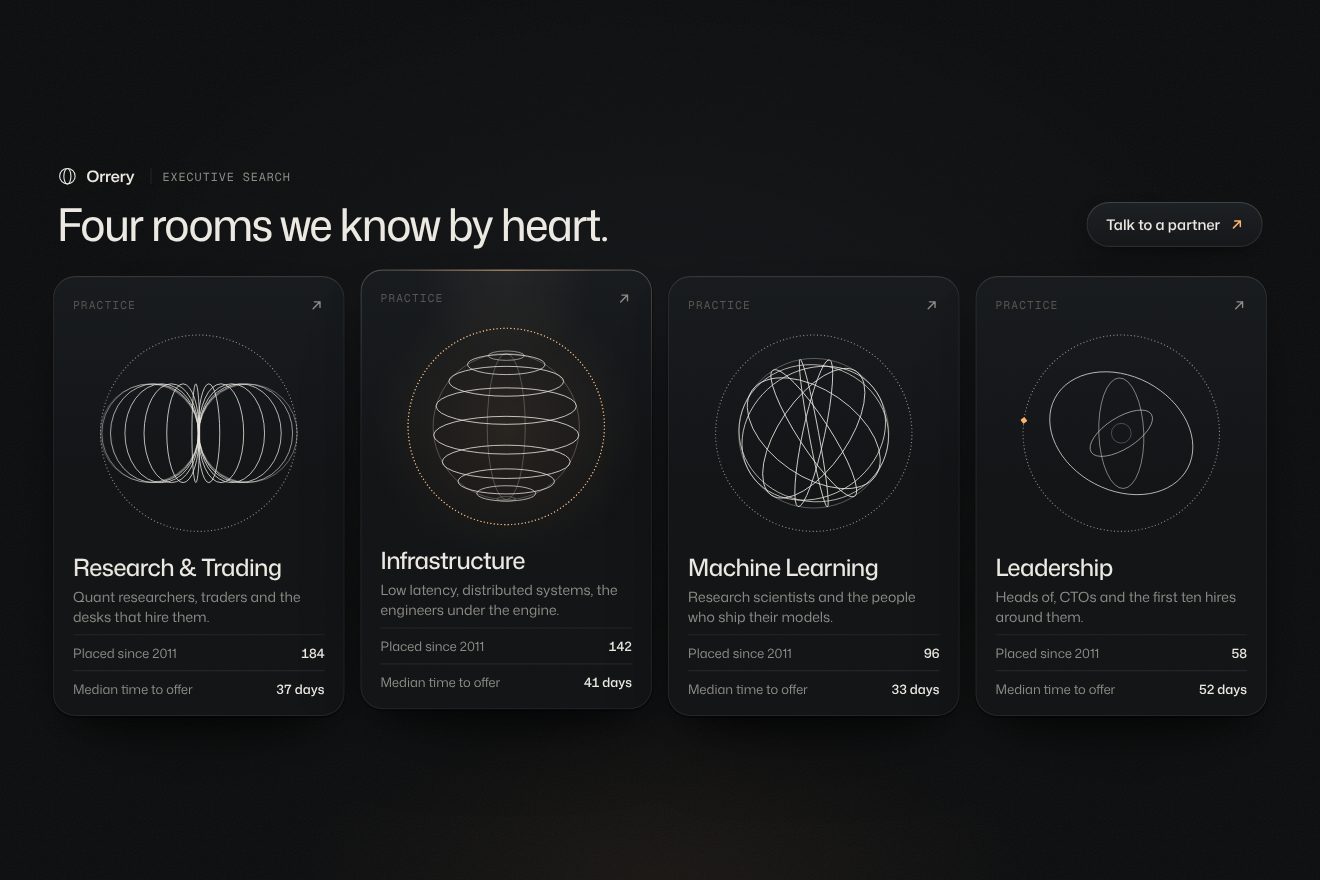
In our demo the firm is made up, Orrery, and there are four cards on a near black ground: Research & Trading, Infrastructure, Machine Learning and Leadership, each with its drawing, a line, how many people it has placed since 2011 and how many days on average it takes to get an offer, with the numbers counting up as the card comes in. Scrolling is Lenis with ScrollTrigger. From the site come the first drawing, rebuilt with GSAP on the same numbers: the twelve ellipses inside the dashed circle at 4 and 7, the move from -200 to 200 in 6.67 seconds on the curve [.37, 0, .63, 1], the radius from 200 to 1 and back in 3.33 seconds, the fade on the exponential ease out, the circle turning 65 degrees with the scroll, the 12 second linear turn of the rings and smooth scrolling with a step of 0.1, as on the site. Rebuilding it we found a small slip: with twelve ellipses offset by one eleventh, the twelfth lands exactly on top of the first, and only eleven show. We offset them by one twelfth, and all of them show. Ours are the other three drawings on the same principle, parallels sinking through a globe, a rosette of eight ellipses breathing one after another and three rings flipping like a gyroscope with a small amber square on the edge; the material of the cards, with one pixel edges that light up amber where the pointer passes; the amber light that scrolling carries from card to card, the lit card rising and its drawing speeding up; the push a fast scroll gives to every drawing; and on hover the ellipses speeding up 2.4 times and drawing in with a small bounce, a press that sinks the card. Every drawing keeps its own clock, so speeding up never makes it jump. On phones the cards slide sideways, one at a time. With reduced motion the drawings stand still in a readable pose.
The other details
The large A behind the grid turns on its vertical axis at 18 degrees per second, and every pixel per second of scrolling adds 0.05; scroll down and it turns one way, up and it turns the other, and the change of speed is damped, so it never jerks. The same code turns the small logo in the header, and hovering it bursts eighteen coins with the logo, black and white, drawn on a canvas with gravity, friction and a life of a second and a half. The theme button, two circles, one empty and one full, turns half a turn on hover with a small bounce; pressed, the page goes dark behind a curtain that sweeps from left to right in 1.2 seconds, made with the browser’s View Transitions, and goes back to light from right to left; the dithered ground and the A stay outside the curtain. «CONNECTING TOP-TIER TALENT» is set on three lines that all share one size: the site measures each line at 100 pixels off screen and computes the size in container units, so the longest line fills the column exactly. Links fill from the side the mouse comes in from, and empty towards the side it leaves by. The team photos, under the mouse, shift in small squares on a 30 cell grid and split red from blue at the edges of the trail: one canvas for every photo, copying the position of the real images every frame.
Where it stumbles
Reduced motion is respected almost everywhere: text, odometers, the turning A, the coins and the curtain stop, and the smoke switches off. The noise of the ground keeps drifting though, and so does the row of client logos, and Lenis smooth scrolling stays on. three.js arrives whole, in a file of 888 kilobytes before compression, to draw nothing but full screen planes. The first load is light, about 0.9 megabytes in 54 requests, but the HTML alone weighs 421 kilobytes, mostly React data repeated in the page. The screen reader labels of the service drawings do not match their titles: the one under quantitative research is still called «Executive Search animation».
What we take away
Aspen Search is a site you could print: white, black, one mint and a single typeface. Motion does not fill it, it keeps it alive: a dither breathing behind the empty cells, a smoke that turns into dots of the same dither, a clock that changes city, twelve ellipses that pass for a sphere. The most useful lesson is the smoke: a soft effect taken as it is would have clashed with a ground of dots; put through the ground’s own matrix, it becomes part of the drawing.
The effects
- Mint dither backgroundThe opening of Meridel Search, a made-up executive search firm, laid out as a premium product grid: the title, a line, the pill button and three cells with figures. The empty cells are windows on one background in hand-written WebGL: fBm noise with its space warped, turned into black and white dots by an 8x8 Bayer matrix, like an old 1-bit screen. The pointer stirs a small fluid simulation and its smoke becomes mint dots that curl and fade in half a second. Minimal premium style.Free
- Office world clockThe offices card of Halden Row, a made-up executive search firm: a big clock with the real time in New York, London, Zurich and Singapore. Every 5 seconds the line slides up by one line in 0.65 s and the next city arrives; when the minute turns the digits roll like an odometer, one after the other, and settle one pixel too far. Over a city the clock goes there and waits. Below, the numbers of the firm roll in on the same reels. Premium minimal style.Free
- Ellipse service cardsThe four service cards of Orrery, a made-up executive search firm, on a warm black. Each card has a fine line drawing made of ellipses that never stop: the sphere with the site’s numbers (twelve ellipses sliding from one circle to the other while they narrow to a line, one turn in 6.67 s), parallels falling through a globe, a rosette of breathing ellipses, three rings like a gyroscope. The scroll, smoothed by Lenis, walks an amber light from card to card and turns the dashed ring of every drawing by up to 65 degrees; under the mouse the ellipses speed up and draw in and the edge catches the light where the pointer is. Premium minimal style.Free