FC Porto Memorial, by Significa
FC Porto Memorial, how it’s made: the collage that stops on one object, the numbers that roll like a counter and the steps that rise as a double curtain
The digital memorial FC Porto dedicated to its longest-serving president is a single page, in the dark, that you scroll like a documentary: numbers rolling like counters, seventy-five objects left by the fans filling the screen one at a time, and the conservation steps rising like curtains. We take it apart with three demos rebuilt from scratch.
The palette
- #01060Ethe near-black blue of the background
- #DCD6C7the warm ivory of the headings and the text
- #00408Athe club blue, in the glow under the opening
- #F4F3F1the white in the palette on the award page
Tap a colour to copy its code.
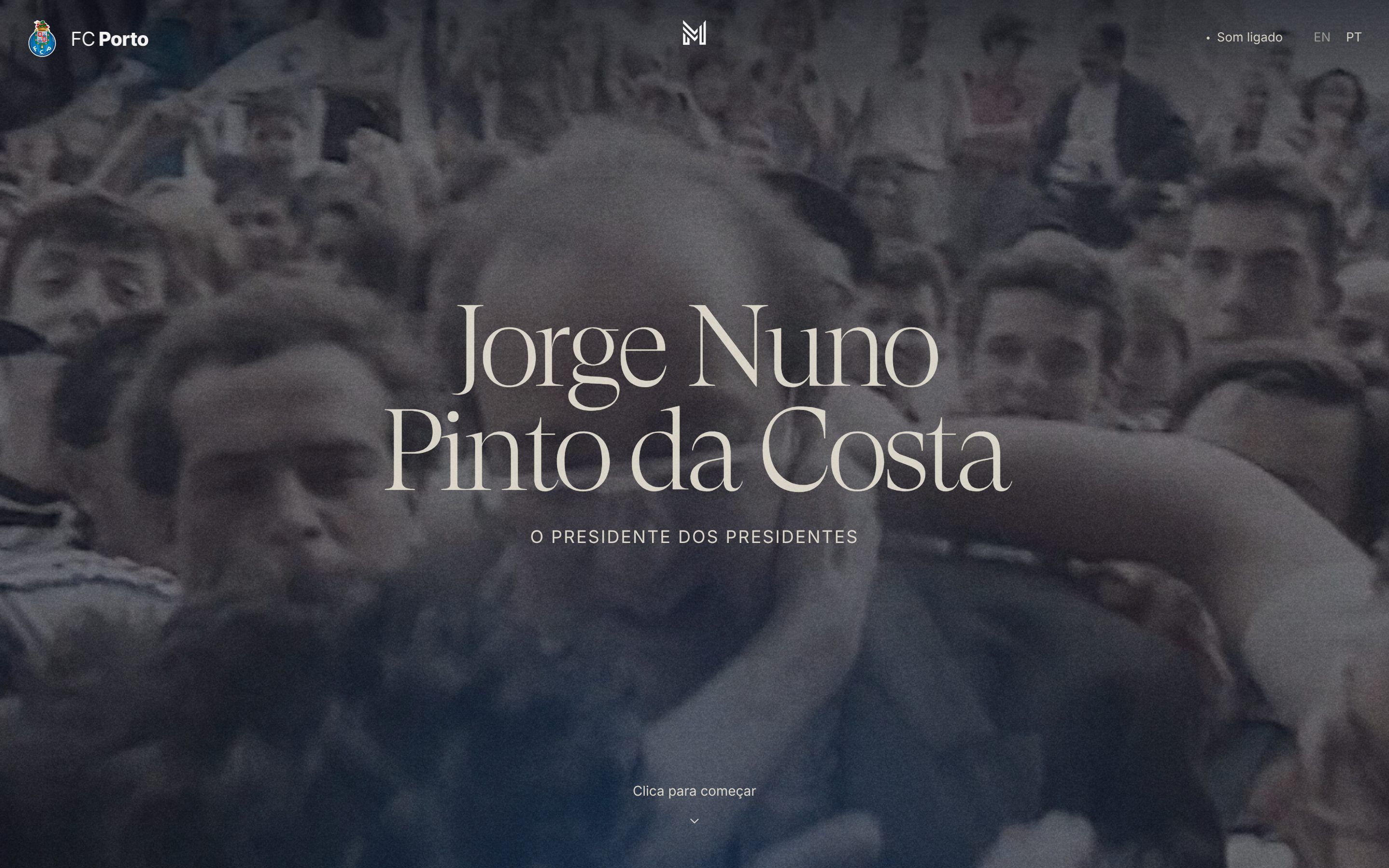
FC Porto Memorial is the digital memorial FC Porto dedicated to Jorge Nuno Pinto da Costa, president of the club for 42 years, from 17 April 1982 until the president’s death on 15 February 2025. It is not a site to browse but a single, very long page, in Portuguese and in English, that you scroll like a documentary: the election, the 2594 titles, the 42 years, the death, the objects the fans spontaneously brought to the stadium, the way the club collected and preserved them, and the permanent Memorial, opened to the public on 28 December 2025. It is all in the dark: a near-black blue, #01060E, with the text in a warm ivory, #DCD6C7, and a glow of the club blue, #00408A, under the opening. The headings are in GT Super Display Light, a thin, tall serif; the small text in Inter Light. Over everything there is a grain that moves in steps and a faintly blue vignette. It was made by Significa; on Awwwards it was Site of the Day on 22 March 2026, with 7.27 from the jury, where the highest mark is content, 7.84, and the developer award, 7.09, where the highest mark is animations, 7.6.
Underneath there is Astro, with one script for each section of the page, and Tailwind CSS 4.1.18. The animation is GSAP 3.14.2 with ScrollTrigger, the smooth scrolling is Lenis 1.3.17, tied to the GSAP ticker, and the audio is Pizzicato.js: an ambient bed that starts on the first click and a sound for each chapter. There is no WebGL: the two «films» you scroll through are image sequences drawn on a canvas, and the collage of objects is another canvas drawn by hand. The building blocks that come back everywhere are two home-made elements, one for text entering word by word and one for numbers that roll.
We take it apart in three moments, with a demo rebuilt from scratch for each one, for an invented archive, that of the Halden Rowing Club, a rowing club founded in 1891, with its oars, its medals and its regatta tickets: the text, the objects, the drawings and the code are ours. From the site we took the ideas and, where we say so, the numbers. The memorial is about a real person and a real death; our demos are not: they only tell the story of an archive of objects.
The collage that fills up and then stops on one object
After the president’s death people began to leave things at the stadium: shirts, scarves, soft toys, flags, newspapers, a model of the stadium, a membership card. The site shows them all together, seventy-five of them, in a collage that fills up as you scroll down: the objects appear one at a time, all at once, until the screen is full. Then the testimonies arrive, and for each one the camera flies onto a single object, the one that person brought; all the others go out in the dark.
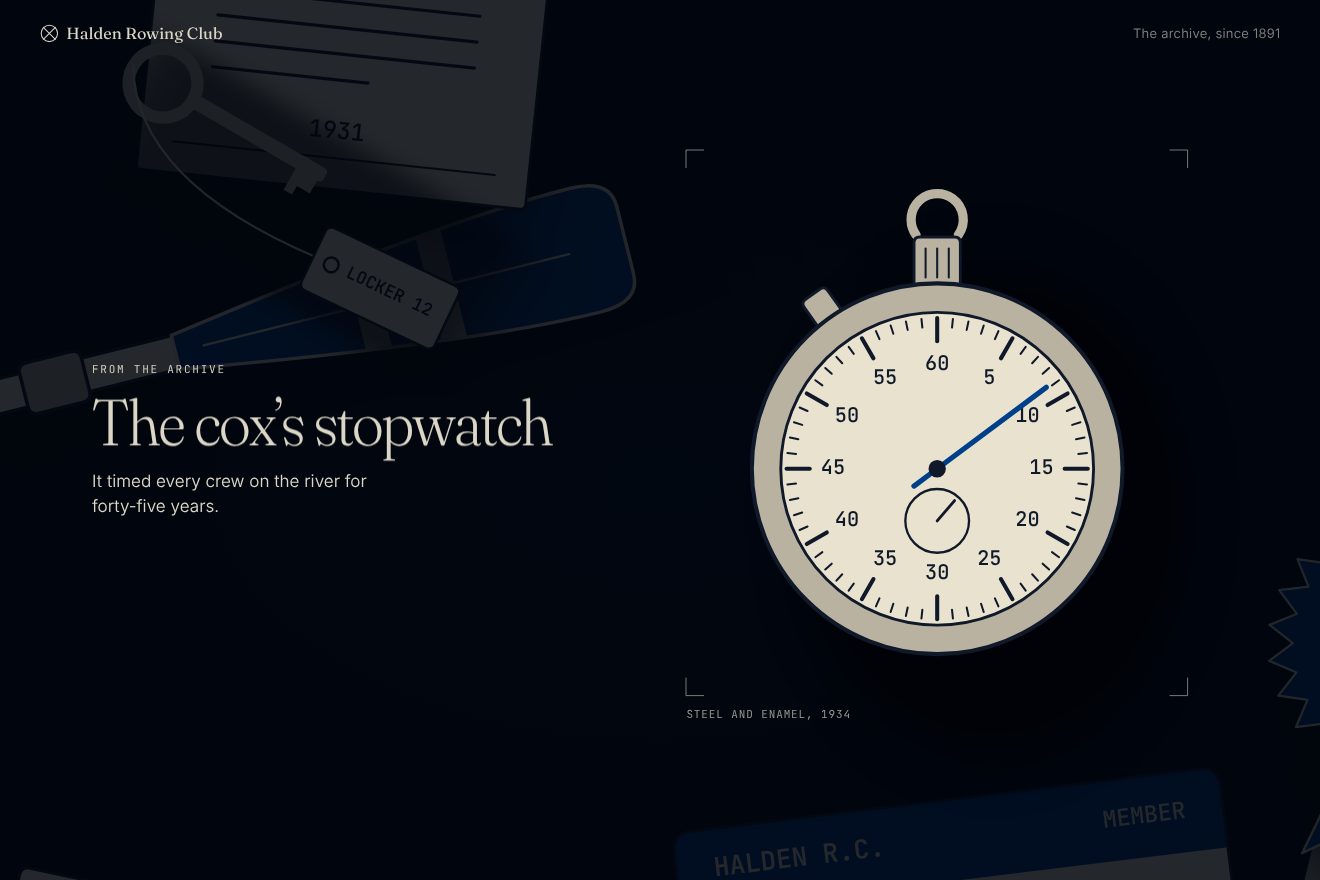
The collage is not made of images in the page but is a single canvas, the size of a 1440 by 960 sheet and stretched like a photo with object-fit: cover. Each object has its position, its size and a rotation of a few degrees on the sheet. The clever part is how it animates: the camera position, its scale, the dark veil and the opacity of each object live in a JavaScript Proxy, which redraws the canvas every time a value changes. So GSAP animates plain numbers, as it would an element in the page, and the canvas updates by itself. The entrance is a timeline tied to the scroll over one and a half screens: each object goes from invisible to full in a thousandth, one every two hundredths of the timeline, which means it simply appears. For the zoom the code works out where the camera has to go so that the chosen object lands exactly over an empty frame in the page, next to the testimony, taking the cover crop into account, and gets there with power1.inOut following the scroll. Meanwhile a black veil rises to 0.85 and the chosen object is drawn after the veil, on top of it: it is the only one still lit. The person’s video comes in from the side, once from the right and once from the left, and their words rise one by one. Below 768 pixels the zoom is off.
In our demo the archive belongs to the rowing club, with thirty-six objects we drew as vectors inside the canvas: two oars, medals, rosettes, regatta tickets, membership cards, pennants, a stopwatch, photos of boats, a cup, caps, scarves, envelopes, keys with their tags, a megaphone, a rudder, a rope. Then three memories: the first oar, the cox’s stopwatch, a ticket from 1923. From the site come the 1440 by 960 sheet in cover, the Proxy that redraws, the objects appearing all at once one every two hundredths over one and a half screens of scroll, the camera worked out so the object lands on the frame, with power1.inOut, the veil at 0.85 and the chosen object above the veil. In ours the Proxy does not redraw on every value but marks the canvas as dirty and redraws it once per frame. Ours are the soft shadow under each object, the small four-pixel drop with a settle when it appears, the veil in the blue of the background instead of black, the chosen object straightening and lifting with a longer shadow, the four thin corners of the frame with the museum label under it, the stopwatch ticking the seconds while it is lit, and the closing line, «Thirty-six objects. One river.», over the whole archive in half-light.
The numbers that roll like a counter and the words that crowd in
The story rests on numbers, and the two biggest, «2594 Títulos» and «42 Anos de História», do not appear already written: they roll, like the drums of a mechanical counter, and the digits stop one after the other from left to right. Below, the text does not come in all at once: the words rise from below, blurred, and the last ones arrive closer together than the first.
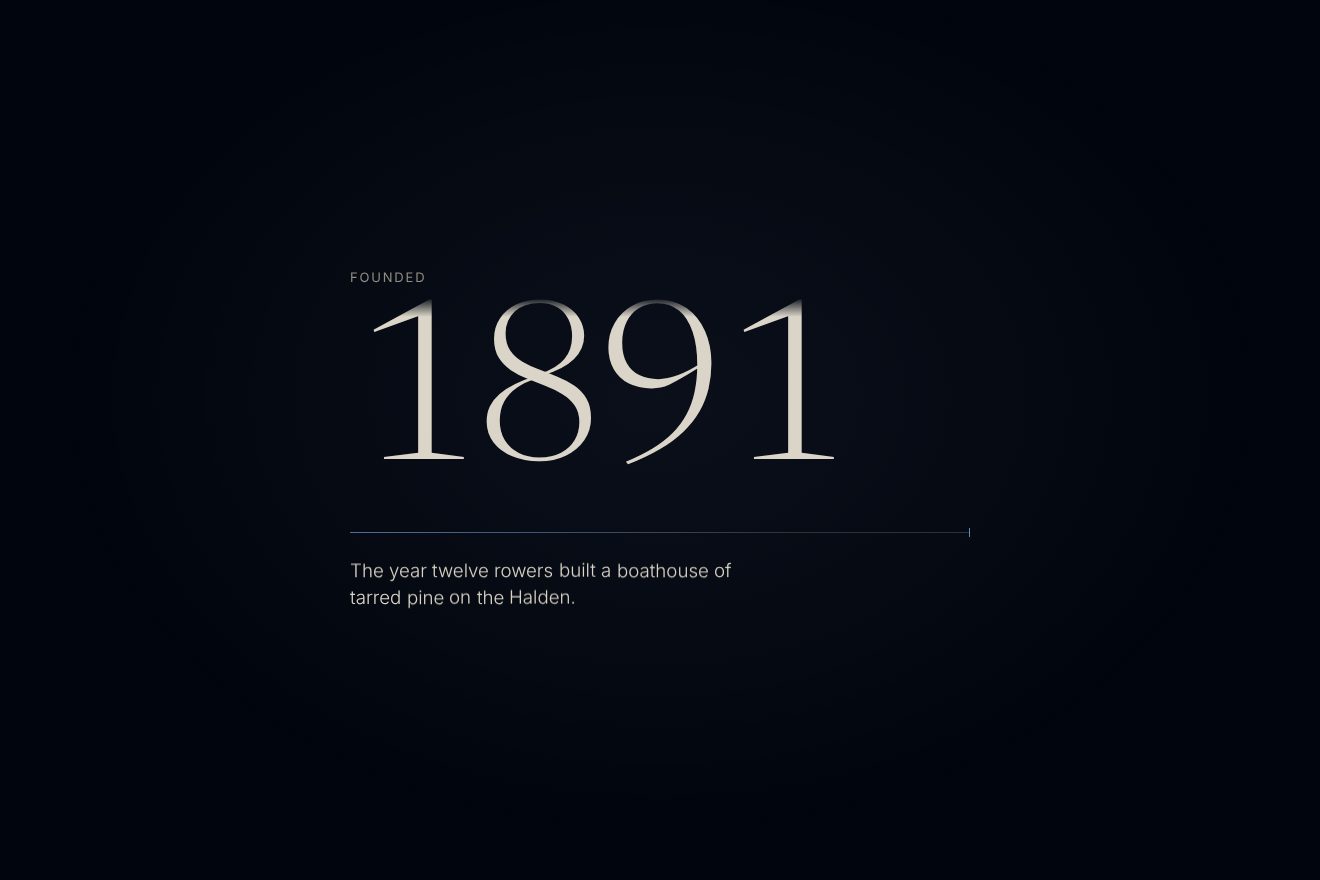
The number is a home-made element: each digit is a column with the ten numbers from 0 to 9, in a window one line high that hides the rest. To show a 4 the column moves up by 40 per cent of its height, that is ten per cent for each unit. The first column takes a second and a quarter, each of the others five hundredths more, and each starts five hundredths after the one before, always with power3.out: that is why the number settles from left to right. The text is the other element: it splits the sentence into words, and each word rises from 125 per cent of its height, transparent and blurred by 12 pixels, in a second and a quarter with power4.out. The delay, though, does not grow in step: it is the word’s index raised to 0.8, times an eighth of a second. With the exponent below one the first words start well apart and the others squeeze together, as if the sentence were picking up speed. In the chapter «Do Porto para o Mundo», then, the title is in two lines that swap sizes as you scroll: the first shrinks to 0.56 and fades to 0.6, resting on its bottom edge, while the second grows from the same size, hanging from its top edge.
In our demo the numbers are those of the club archive: the year it was founded, 1891, the regattas rowed, 312, and the objects kept, 1048, each with a sentence underneath, after a title in two lines that swap sizes. From the site come the columns from 0 to 9 moving ten per cent per digit, the second and a quarter with five hundredths more and five hundredths of start for each column, with power3.out, the words rising from 125 per cent blurred by 12 pixels in a second and a quarter with power4.out and the delay raised to 0.8 and, in the closing sentence, to 0.7, and the title passing from one line to the other with 0.56 and 0.6 and the two origins. In ours the numbers sit one at a time in the same spot on the screen, and the old one leaves upwards, blurring, before the new one arrives. Ours are the vertical-only motion blur on the digits, which depends on the real speed of each column, the one-pixel overshoot past the mark and back, the thin line drawn under the number, the commas standing still in a softer tone, the water line that ripples more when the page moves, and the extra turn the number makes when you touch it.
The steps that rise as a double curtain
Towards the end the site tells how the club preserved the objects, in five steps: collecting, transport, cataloguing, archiving and building the Memorial. Each step is a full screen with its photo or its video, and as you scroll down it does not slide away: the new step rises from below and covers the previous one, while the image inside stays still. It looks like a blind going up to reveal something that was already there.
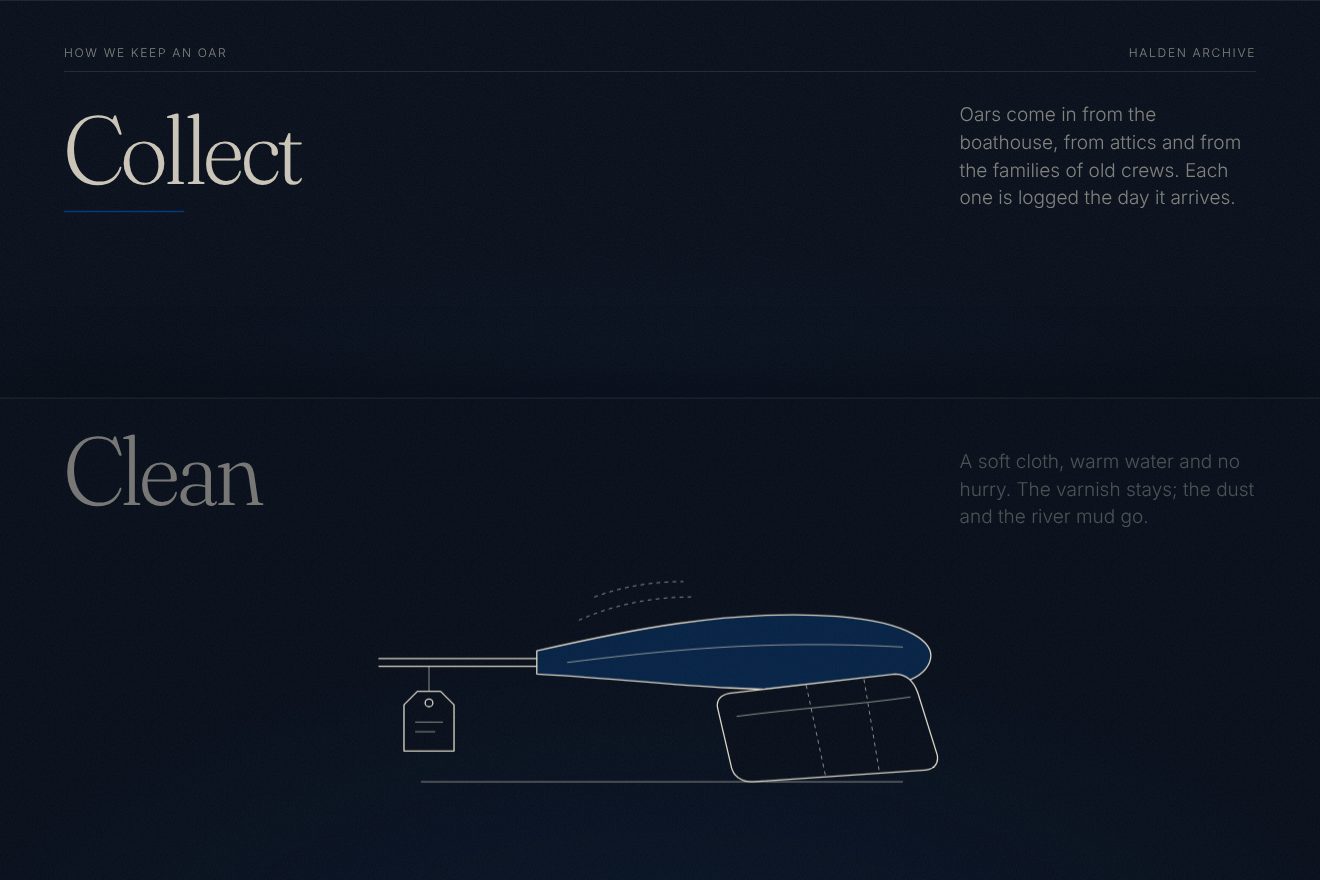
Each step is a block pinned to the top of the screen, as tall as the screen, hiding whatever goes past its edges. A timeline tied to the scroll, from the moment the block enters from below to when it reaches the end of its travel, does two things at once, with the same duration: it moves the block from 100 per cent of its height to zero, and it moves the image inside from minus 100 per cent to zero. The two movements cancel out: the frame rises, the photo stays where it is. The first step uses sine.out, the others sine.inOut. The text arrives afterwards, from above, from transparent and from minus 75 per cent, in six tenths with power2.out and four tenths of delay, and meanwhile the text of the previous step drops to half light. All of this only applies from 1024 pixels up: below that, the steps scroll normally and only the previous step dimming remains.
In our demo there are four steps, the ones the club archive uses to keep an oar, Collect, Clean, Catalogue and Store, with no numbers in front, each with an SVG drawing of ours: an oar with its tag, the blade with a folded cloth, the tag written in pencil, the archive box. From the site come the block rising from 100 per cent while the drawing inside comes down from minus 100, together, with sine.out for the first and sine.inOut for the others, the text arriving from minus 75 per cent in six tenths with four tenths of delay, and the previous step dropping to half light. In ours the curtain is there on the phone too, with the same animation and adapted sizes. Ours are the shadow growing on the edge of the card that is covering, the tag swinging by one degree on its string when the card stops, the drawing settling by a pixel and a half, the blue line stretching under the step’s name, the drawing of the previous step dimming along with its text, and the grain of the paper.
The other details
At the opening the page is still: scrolling is locked until you click, and a click anywhere starts the ambient bed and scrolls down by itself by the height of the opening in two seconds. Then, as you scroll, the president’s name does not leave: it comes towards you, grows to 3.33 times and blurs by 12 pixels as it disappears. The twelve photos around the number of titles scroll at different speeds, each with its own value written in the page, from 1.05 to 1.7, and the image inside the frame moves the opposite way by 8 per cent. The chapter «Do Porto para o Mundo» is a sequence of 211 images scrubbed with the scroll, behind a title in two lines that swap sizes; the corridor of the Memorial, at the end, is another sequence, of 585 images, scrubbed with a curve that starts slow, so the walk speeds up. The sequences load in passes: first one image in sixteen, then one in eight, four, two, one, so they can be scrolled right away, jerky at first and then smooth. The chapters come in and go out with a 24-pixel blurred fade over three quarters of a screen. And the videos only play when they are in view and go back to the start when they leave.
Where it stumbles
There is no reduced-motion check anywhere in the code: blurs of up to 48 pixels, the zoom on the name and the two sequences run for everyone. The scroll locked at the opening is a directing choice, but a click by mistake sets off an automatic scroll, and on Awwwards accessibility has the lowest mark, 6.4. The two sequences are 796 images of 1440 by 810, all downloaded once the page has finished loading, even though they are dozens of screens away. Then there are small slips: the history video has its fragment written «#=t0.1» instead of «#t=0.1», so it does not start at the intended tenth of a second; the Inter font is loaded as TTF instead of WOFF2; and the site’s security policy blocks the script Cloudflare adds to the page. Two things do not follow the rules we set ourselves: the conservation steps are numbered from 01 to 05, and on the phone there is a progress bar at the top.
What we take away
FC Porto Memorial tells of a loss without becoming an obituary: it is an archive. The strongest part is not an effect but a decision, to show the real objects people left, all together, and then to stop on just one, turning the others off, while someone tells why they brought it. The animation is there for this: to give weight to the numbers, to let things arrive one at a time, to take its time.
The effects
- Archive collageThe archive of a made-up rowing club, minimal, on a blue-black background: as you scroll, thirty-six objects of the club land on the table one at a time, each with its soft shadow (oars, medals, rosettes, regatta tickets, a membership card, a stopwatch, photographs of boats). Then, three times, the camera flies onto one object, straightens it and lifts it above a veil, with a line of text and its museum label.Free
- Club numbers counterThe numbers page of the archive of a made-up rowing club, minimal on an almost black blue: in the opening the two lines of the title swap sizes as you scroll, then every big number rolls into place like a mechanical counter, figure by figure from left to right, with a touch of motion blur and a one-pixel settle, a thin line draws itself underneath and the caption words rise out of a blur, the last ones crowding in.Free
- Double curtain stepsA step-by-step section for the archive of an invented rowing club: four cards as tall as the screen, Collect, Clean, Catalogue and Store, rise one over the other on scroll while the drawing inside slides down by the same amount and seems to stay still, like a window opening from below. The text drops in from above last, the step before fades to half, the rising card casts a shadow on the one below and, when it stops, the tag on its drawing swings by one degree.Free