Overworld Audio, by Rogier de Boevé
Overworld Audio, how it’s made: the mark the pointer wipes away, the mark that rises from the noise and the mark that becomes a map
The Overworld Audio site is a 3D night landscape with the logo carved into the rock: you enter through a threshold where the name appears, the logo’s outline rises out of a noise and the mouse trail wipes it away. We take it apart with three demos rebuilt from scratch, in the minimal style.
The palette
- #13151Fthe almost black blue of the ground
- #E9ECEEthe cool white of the text
- #AAB9C7the blue grey of the secondary items
- #6E8799the dull blue of the fog
- #4C5E6Bthe slate blue of the rocks
Tap a colour to copy its code.
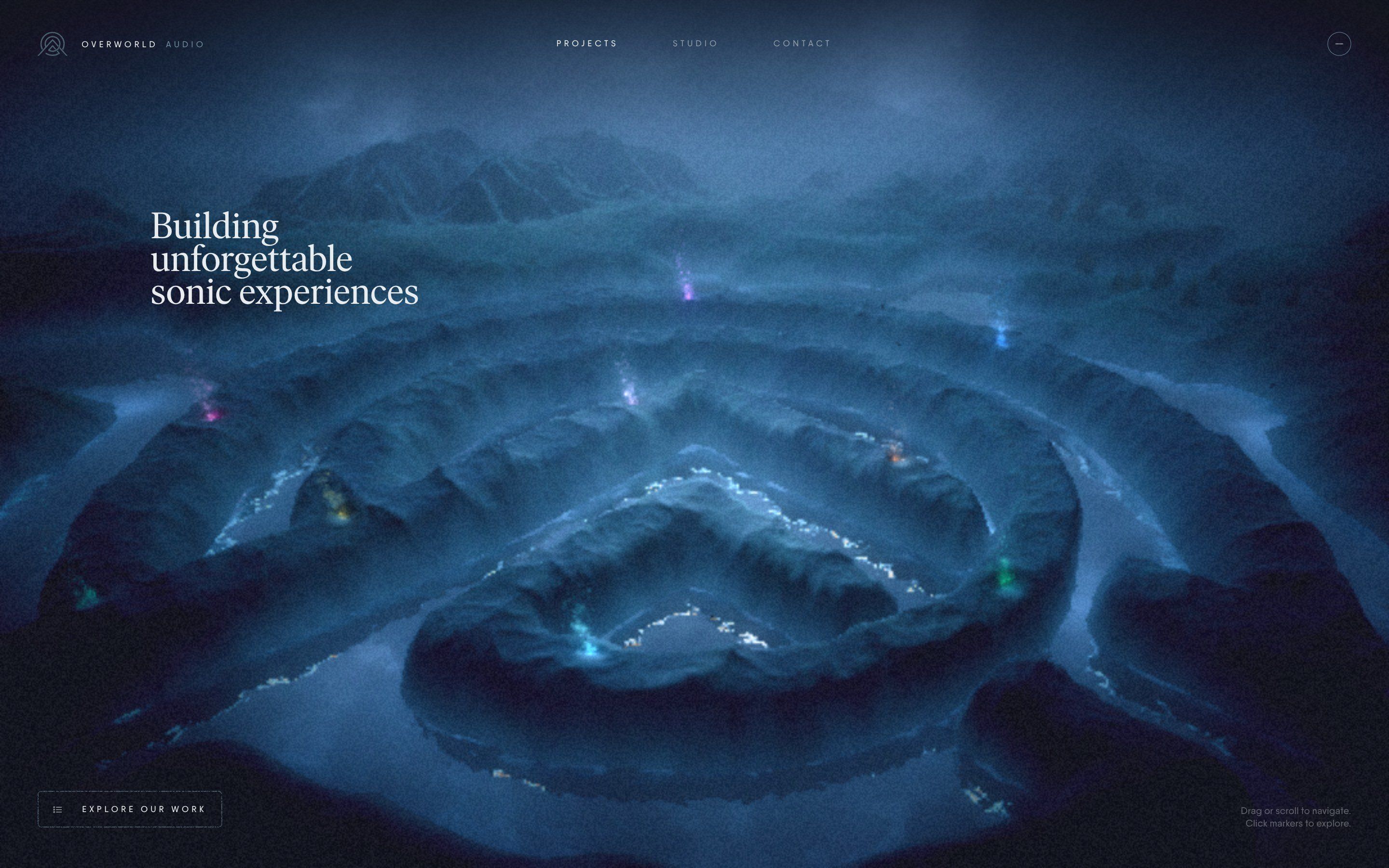
overworldaudio.com is the site of Overworld Audio, which describes itself as “audio co-development for games and interactive experiences, from prototype to final mix”. The home page is a landscape at night, in 3D: wet rocks, blue fog, a few flashes of lightning, flocks of birds and, scattered over the ground, coloured lights that are the projects. Seen from above, the valleys turn out to draw the studio’s logo. The colours are few: an almost black blue, #13151F, a cool white, #E9ECEE, and three blue greys for the text and the fog. On Awwwards it is Site of the Day on 15 October 2026, with 7.38, and it scored 7.36 in the developers’ vote; the author listed is Rogier de Boevé.
It is built with Nuxt 4.4, so Vue, with Three.js r184 for the landscape and Theatre.js for the direction: the whole opening, the camera, the light and the fades, is a seven-second sequence written in a Theatre file, and the code starts and stops it. Sounds go through Howler, the project texts come from Sanity but are already baked into the site, and a small graphics card test, detect-gpu, picks one of four quality tiers.
We take it apart in three moments, with a demo rebuilt from scratch for each, in the minimal style, for a made-up sound studio, Halde: the mark, the map and the code are ours. From the site we took the ideas and, where we say so, the numbers.
The mark the pointer wipes away
Before you go in there is a threshold: the logo’s thin outline over a dark veil. Moving the mouse wears the outline away where it passes, and holes open in the veil through which the landscape underneath shows. The trail is soft and a little smoky, and it is strong only while the mouse is running.
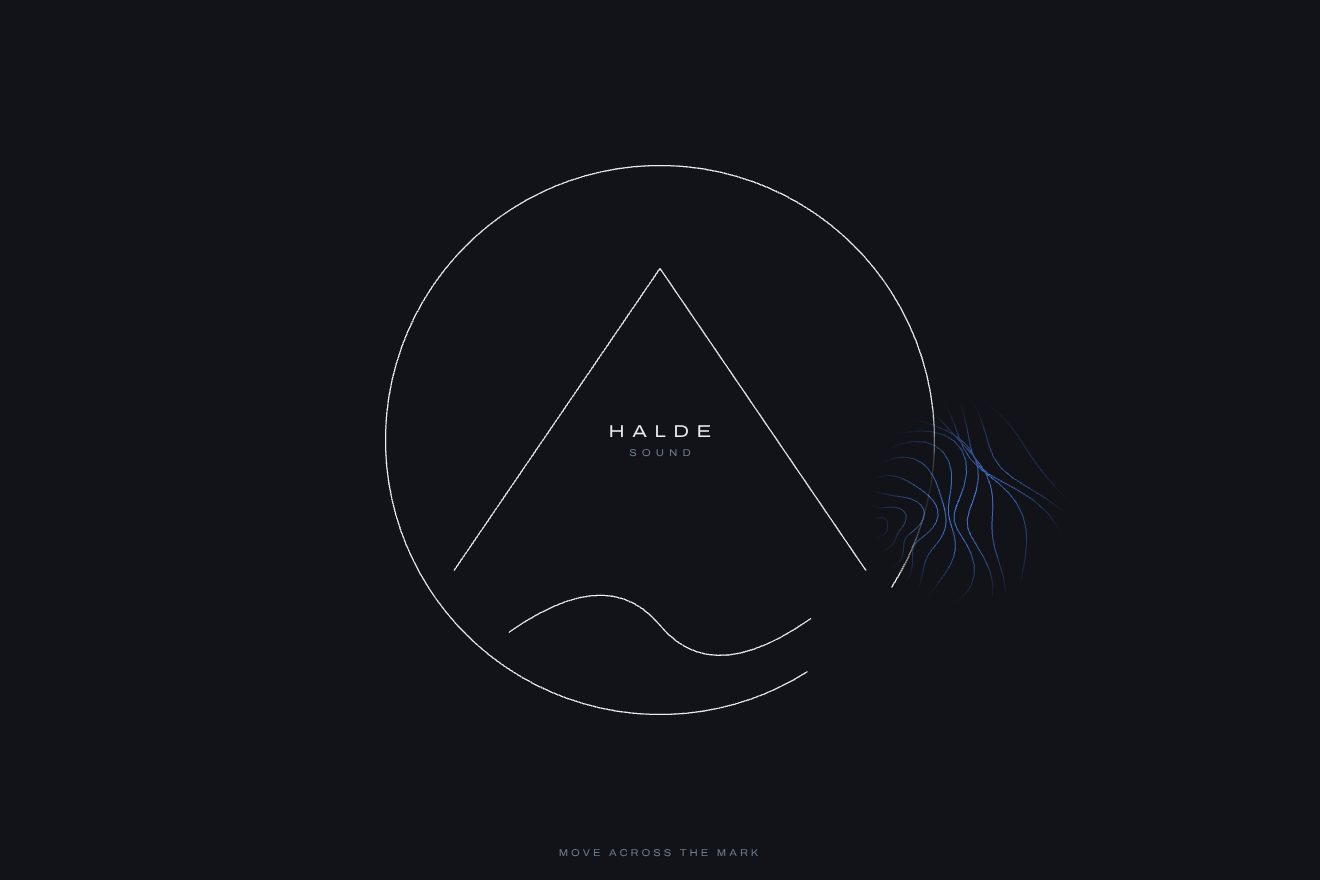
The trail lives in a small texture, a tenth of the canvas, that bounces between two buffers. Every frame what was there drifts a little along a noise field, which is why it fades like smoke, and loses part of itself: 0.92 is left every tenth of a second, worked out with real time and not per frame. The tip of the brush chases the mouse with a lerp of 7.5 times the time passed, and its speed, divided by 0.3, says how strong the trail should be; the real strength gets there fast when it rises, at 12, and slowly when it falls, at 3. The trail is never shown on its own: the logo shader multiplies the outline by one minus the trail times the strength, and the dark veil over the landscape does the same, so a single gesture erases the sign and opens the window.
Our demo has three 2D canvases: the mark, a contour map in blue lying underneath, and the trail, a quarter of the screen. The trail is added to itself four times, keeps the map only where it passes and takes away the line of the mark. The brush is grainy rather than smoky. The persistence, the chase, the speed threshold and the rise and fall times are the site’s; on top of that the mark draws itself at the start and, if nobody touches it, a ghost pointer wanders over it.
The mark that rises from the noise
The loader is almost nothing: the word Overworld with audio underneath in grey, appearing in 0.8 seconds, a one-pixel line that fills and the percentage. Then the line goes, the logo’s outline rises out of a noise and two buttons arrive, Enter with sound and Enter without sound.
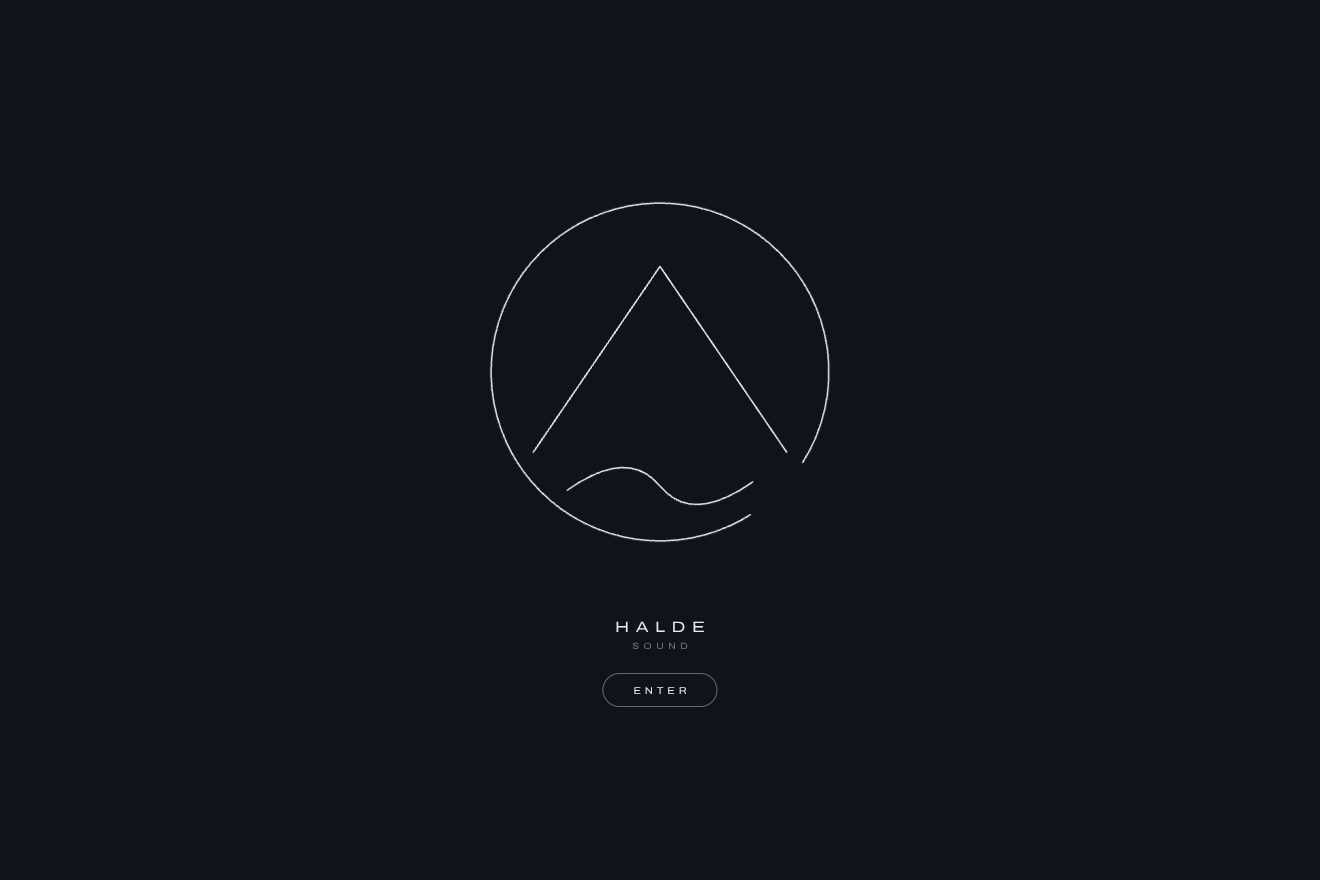
The loader lasts at least a second even when everything is ready, then waits for the images and half a second more before leaving. The logo is an MSDF, a texture that knows the distance from the edge at every point, so the outline stays sharp at any size. The shader that brings it up compares a noise with a number, the reveal, widened a little past zero and one: times one plus twice the softness, minus the softness, so at zero nothing shows and at one it is all full. In the code the softness is 0.15 and the noise drifts at 0.02; the values the site really uses are in the Theatre file, with a tighter softness, 0.086. The button with sound comes in after 0.3 seconds over 2.5 seconds, dissolving through an SVG turbulence filter; the one without sound with a plain fade, half a second later, in 0.8. Both stay disabled until the opening is over, or for six seconds at most.
In our demo the mark is drawn once with the canvas and handed to a WebGL shader that does the same widened threshold with a noise in three octaves. The blue thread in front, where the line is lighting up, is ours, as is the single button that sends the mark back into the noise and starts again. The timing of the name, the minimum wait, the half pause, the softness, the noise speed and the button’s entrance are the site’s.
The mark that becomes a map
After the click the camera comes down over the landscape, and the valleys take the shape of the logo. It is not a hand-made model: the ground is made in the browser, and the logo is carved into it.
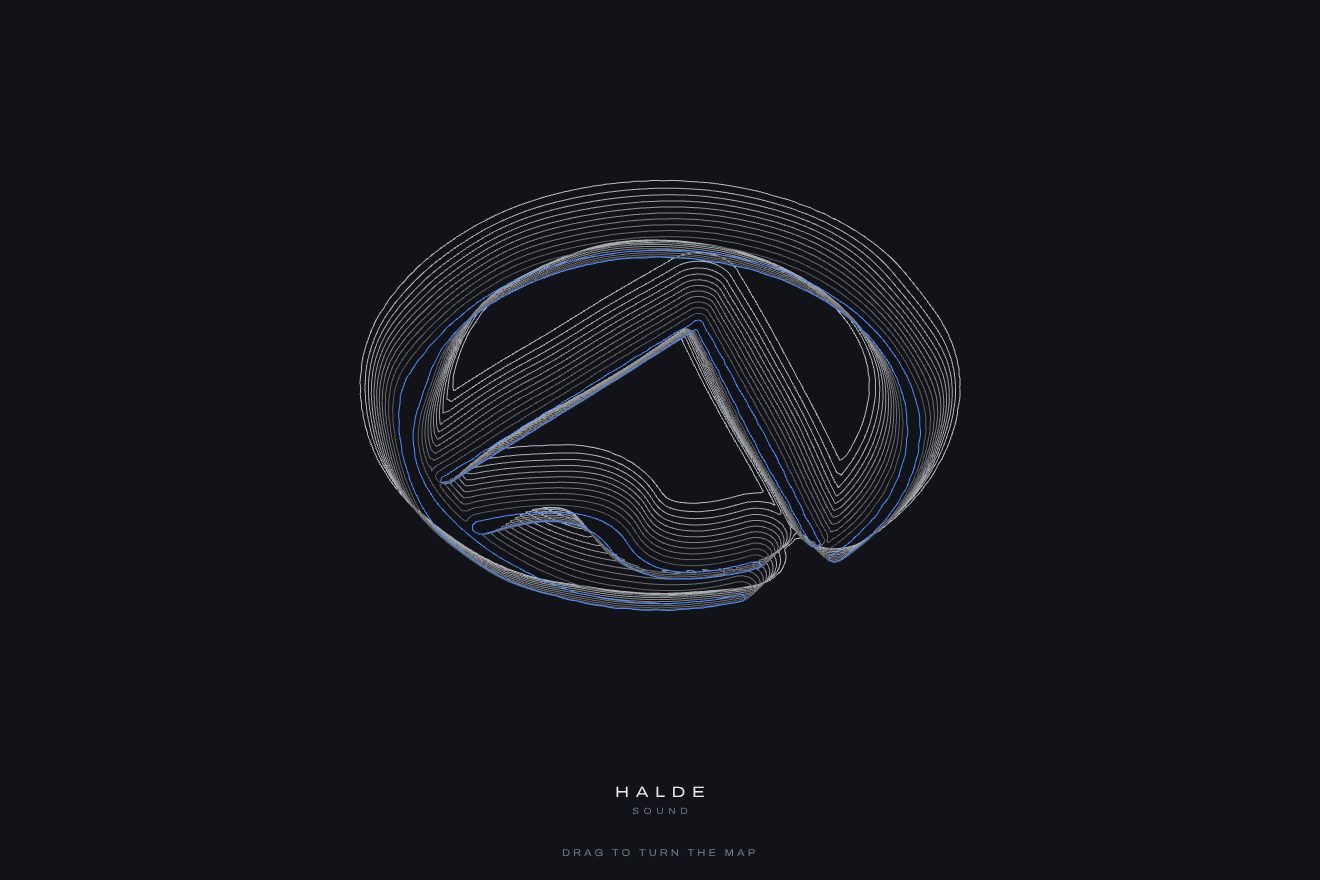
The landscape is a height map worked out on the graphics card, at 2048 pixels on the higher tiers: a ridged fractal noise in twelve octaves, each 2.17 times finer and half as strong, multiplied by a mask, and then the height loses 5.6 times the value of an image of the logo. Where the logo is, the ground sinks, and from above the valleys draw it. Around each project the ground makes a ripple and a small dip. The camera comes down between 3 and 5.4 seconds into the sequence, from a height of 15 to one of 3, and from then on the map can be dragged; the wheel moves the map instead of scrolling the page.
In our demo the landscape becomes a topographic map in thin lines. The height is the distance from the strokes of the mark turned into a valley; the contour lines are found only once with marching squares and WebGL turns and tilts them every frame. From above it is only a bundle of lines round the mark, then the lines rise and the view tilts: the deepest line, in blue, is the mark. The idea of the carved logo is the site’s; the line drawing and all the numbers are ours.
The other details
Lightning comes every three to eight seconds and lasts a little over a second, made of four pulses added together, and each flash sets off one of eight thunderclaps, louder or softer with the strength of the flash; right after you enter, the thunder stays silent for 2.8 seconds and then rises over two. The birds are six flocks of one to four, flying round closed loops, with the wingbeat done in the vertex shader. The project lights are twelve at most. Over everything there is a post-processing pass with bloom, a vignette, colour grading through a 32-cubed table, grain and a veil of blue noise.
The sound is as carefully made as the picture: a looping track that drops to 0.4 on the inner pages and goes through a filter that cuts the highs, and for every mouse-over and every click three to six variations of the same sound, so it never repeats exactly.
Where it stumbles
Reduced motion is considered only once: the smooth scrolling component does not start if you ask for it. Everything else, the camera coming down, the lightning, the birds, the WebGL fades, moves as always.
The mouse trail is switched off by a width check and not by the kind of screen: below 1280 pixels it is not there, even on a computer with a narrow window or on a small laptop.
The published site still has the development switches in the address: ?debug, ?tweak, which opens a panel to move the project lights, ?studio, which loads the Theatre editor, and ?perf, which after 45 seconds tries to send a performance report to port 4599 of the same domain, over plain http: a leftover of local testing, which the browser blocks from an https page. The code also holds a rain of six thousand drops that is never created. And the loader bar has the right role for screen readers, but does not say from where to where it counts or what it is loading.
What we take away
A single mark, used three ways: as an outline to erase, as a sign that rises, as the shape of the ground. The threshold is not a wall between the visitor and the site, it already is the site: the trail opening holes in the veil shows the landscape before you even go in. And everything hangs on a few numbers, the trail’s persistence, the threshold’s softness, the depth of the valleys, which can be changed without touching the rest.
The effects
- Wipe-away markThe threshold of a sound studio, in the minimal style: a large mark drawn in a single line on a dark ground. Where the pointer passes the line wears away like chalk under a thumb and a contour map in blue shows through; the trail is grainy, strong when you move fast, and fades by itself.Free
- Mark from noiseThe opening of a sound studio, in the minimal style: the name, a thin line filling with a count, then the mark rising out of a slowly drifting noise, grain by grain, with an edge that burns blue. Enter sends it back into the noise.Free
- Mark into a mapA sound studio’s mark read as a landscape, in the minimal style: seen from above it is only a bundle of thin contour lines; then the lines rise, the view tilts and the strokes of the mark become valleys. The deepest line, in blue, draws the mark. Drag to turn it.Free