Santioni Spirits, by Active Theory, plan8
Santioni Spirits, how it’s made: the engraved comic that reads itself
The launch site of a liqueur brand, told as a comic: captions a voice reads word by word, a bottle you hold to pour, a temple that cracks and flies away into a red sky, all drawn in real time as an engraving. We take it apart with three demos rebuilt from scratch.
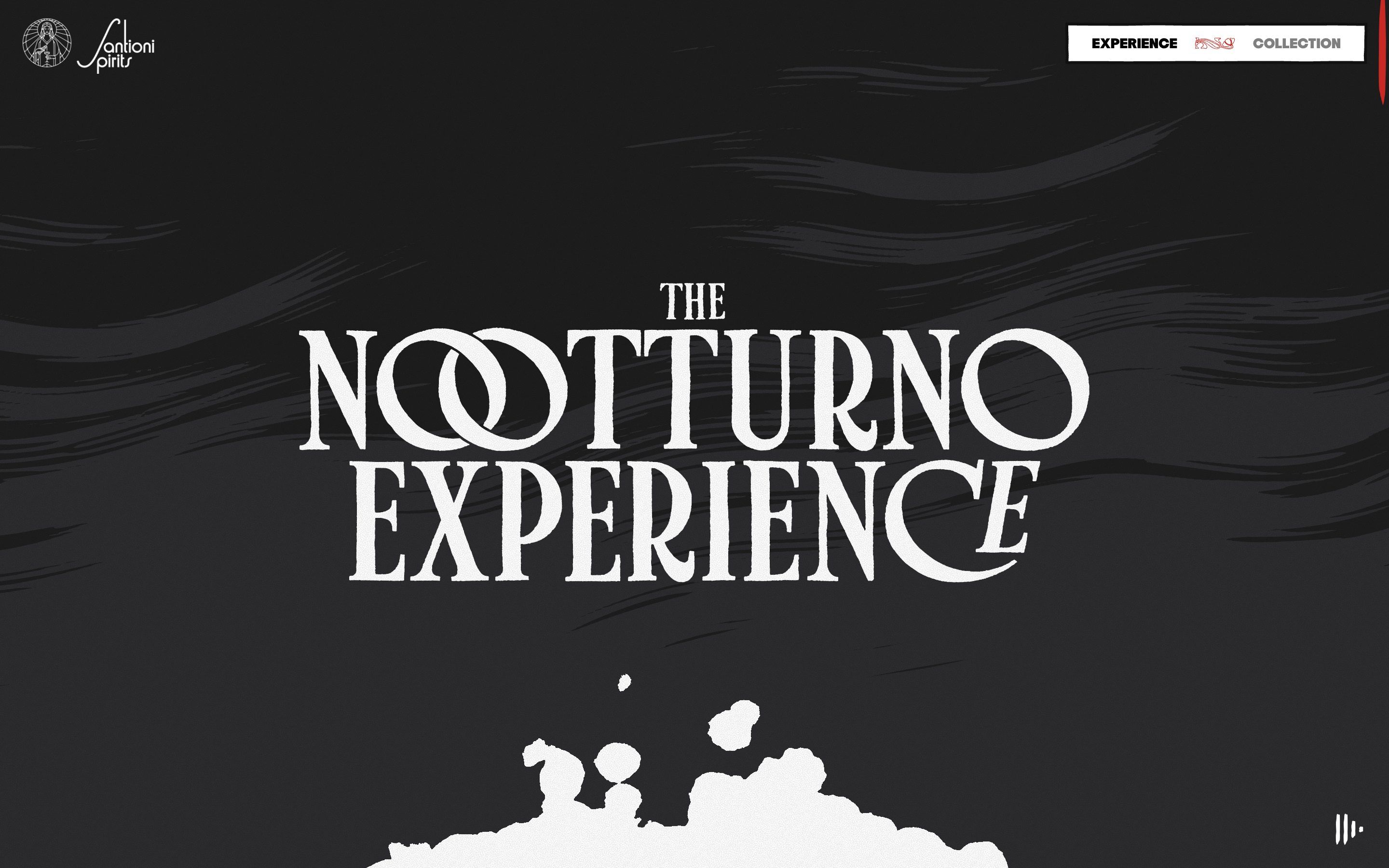
The palette
- #121212the black, never darker than this
- #FFFFFFthe white of the paper and the titles
- #B5241Cthe red of the sky and the halls
- #C82924the word being read in the captions
- #B0976Athe ochre of the saint’s robe
- #63C4F4the blue of the first flavour
- #97F3ADthe green of the second
- #FBEB7Fthe yellow of the third
Tap a colour to copy its code.
santionispirits.com is the site that introduces Santioni Spirits, a new brand of cream liqueurs: the collection is called Notturno and the flavours are mint and chocolate, orange and chocolate, marshmallow and coffee. More than a shop it is a comic to walk through, «The Notturno Experience»: a pilgrim saint walks through the mist, finds a monolith with a red portal, steps in, drinks from one of three bottles, and the temple around him cracks and flies away into a red sky. It was made by Active Theory, for the drawing and the code, and plan8, for the sound.
Everything happens in a single WebGL canvas, with Hydra, Active Theory’s own framework: even the text and the buttons are drawn there, and the buttons have an invisible twin in the DOM that the Tab key can reach. The page is 900 pixels tall: the scrolling is simulated, worked out from the wheel. The code is a 2 MB file with 433 classes, the shaders are 188 pieces in a single file, the geometry arrives in binary files decoded by workers and the scenes are described by a JSON of 3,612 entries out of their editor. Before you get in there is a loader with a Lottie animation at half speed, then a gate asking «Are you of legal age?», and the cookie banner, with Accept and Decline.
It is Site of the Day on Awwwards today, 5 October 2026, with 8.09 (design 8.25, usability 7.54, creativity 8.5, content 8.28), and it also has the Developer Award, 7.66, with 9.4 for animations and 6.6 for accessibility. On The FWA it was FWA of the Day on 18 August with 87 points, then FWA of the Month for August. We take it apart in three moments, with a demo rebuilt from scratch for each, for three invented brands: drawings, copy and code are ours. From the site we took the ideas and, where we say so, the numbers.
Before the demos: the engraving
Every figure in the story is a 3D model, but it looks like an engraving, and all three demos borrow the style. The shader compares the light at each point with a texture of wavy lines, 1024 pixels of upright stripes read in the model’s own coordinates. Below a first threshold the point is black, above it the colour of the thing, the ochre of the robe for instance, and above a second threshold it is white; the lines push both thresholds about, so the edges between light and shade are hatched. The lines themselves are half black in the dark and vanish in the light, and in between a noise breaks them into dots, the more so the more light there is. The black never goes below 18 out of 255.
Then time moves in steps: the lines slide along themselves eight times a second, the wind moves the robe eighteen times, the saint’s breathing eight, the titles tremble six. The drawing looks handmade, one frame after another.
Captions that read aloud
The story is told by a voice, and every sentence sits in a caption: a white box with a black border and the text in capitals, in PP Nikkei Maru, with a line height of 1.7. When it comes on screen the box unrolls from its left edge and the lines come in from that edge, one after another; then the voice reads, and the word being read turns red.
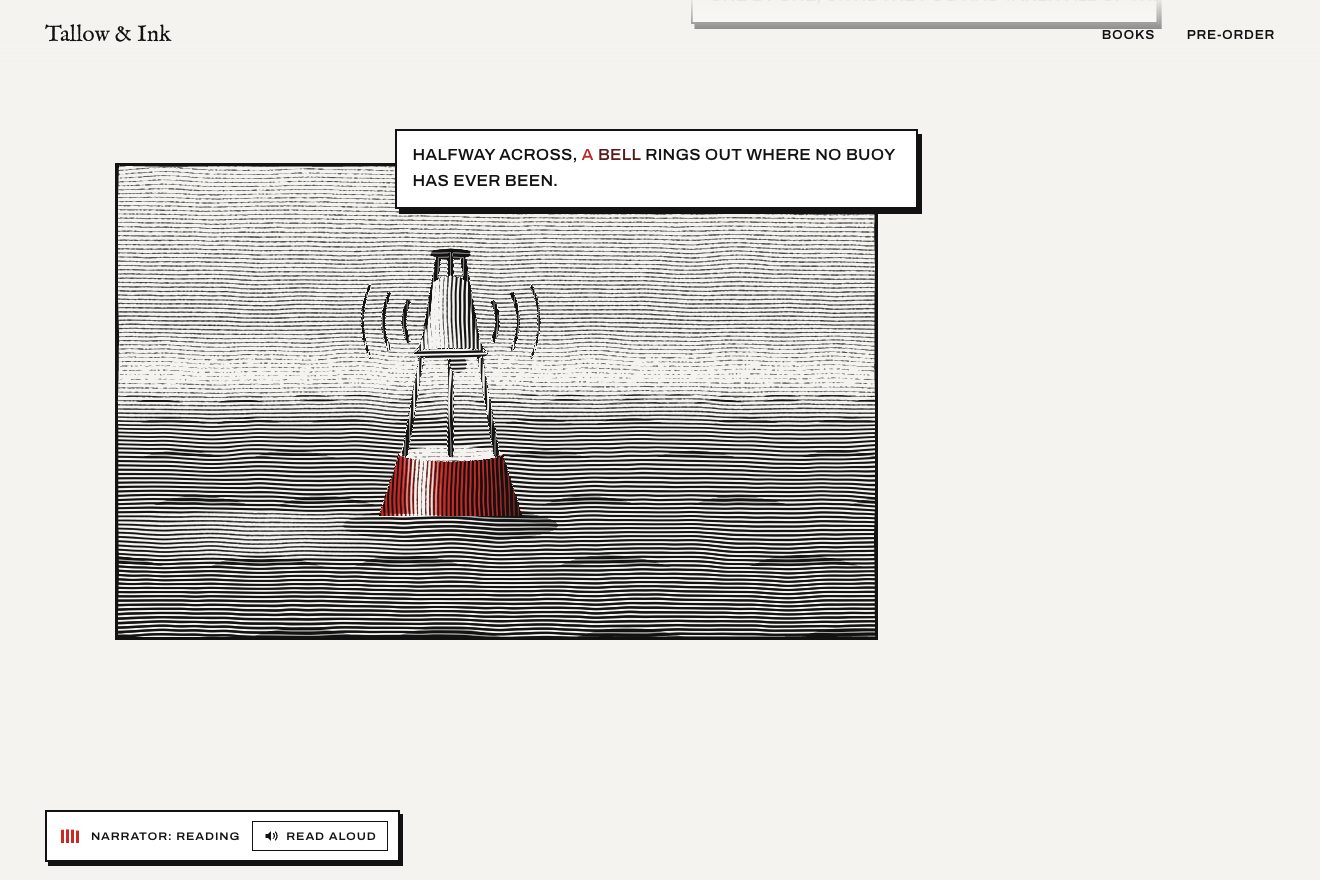
The box starts at a quarter of its width and a little further left, and opens in 800 milliseconds on a curve of its own, cubic-bezier(0.45, 0.30, 0.16, 1.00), while the background appears in a third of a second. Each line slides in over 2 seconds with easeOutQuart, 200 milliseconds after the one before (150 if there are more than four lines), and whatever is still left of the edge is hidden. A small sound, «textbox», goes with every entrance.
The voice has a file of timings: for each of the sixteen sentences, plus two variants for the flavours, the start and end of every word. The text shader colours a word red, #c82924, from 0.4 seconds before it starts to 0.4 after it ends. The captions wait in a queue: the voice starts only if no other is speaking and the scroll has been still for 100 milliseconds; if the caption leaves while it speaks, the volume drops in 0.15 seconds and 400 milliseconds later the next one starts. With the sound off the red goes in 400 milliseconds.
In our demo the comic belongs to an invented publisher, Tallow & Ink: The Night Ferry, a ferry that leaves empty every night. The script paints the four panels in greys and then engraves them pixel by pixel with the same three-tone logic, three times with the lines moved slightly, and the three drawings take turns eight times a second. Without a recorded voice we work out the timings: they are the averages measured on the 364 words of the site’s file, 0.076 seconds a letter minus 0.036, 0.06 between words, 0.68 after commas, 0.92 after full stops. A box at the bottom says whether the narrator is reading, waiting or quiet, «Read aloud» gives it the browser’s voice (the red follows the words the voice reaches), and a caption that left the screen rolls up and is read again when it comes back.
Hold and pour
Halfway through the story the saint’s hand holds a bottle over a cocktail glass, and the cursor becomes a white disc that says «Hold & Pour». Holding tips the bottle and a blue stream fills the glass; moving the mouse moves it; letting go stands it up again.
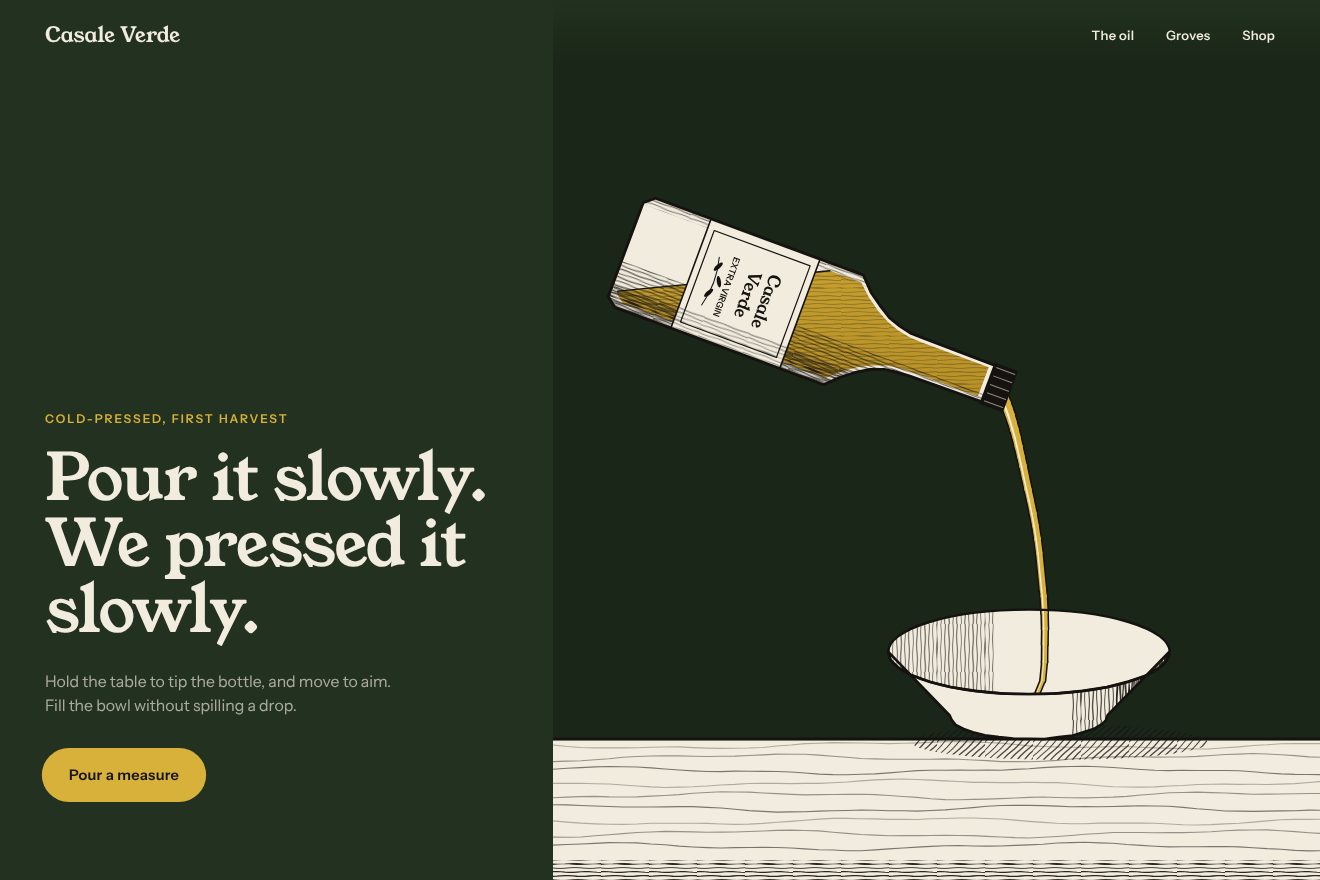
While you hold, a number rises from 0 to 1 in 3 seconds, linear, and letting go brings it back to 0 in 1 second: it drives the arm’s animation and how far the bottle tips. The arm follows the mouse, from -0.25 to 0.25 sideways and up to 0.6 upwards, times that number, with a lag of 0.1 and 0.08 a frame; on phones the range is from -0.4 to 0.11. The liquid in the bottle is drawn by the shader, with a line that drops over time, and the stream is a chain of points born at the bottle’s tip: they start with a sideways push of 1.5 times the stream’s strength, plus a slow wobble, gravity pulls them down and the air slows them, by 5 per cent a frame at full flow. The strength comes from the tilt: the cosine between the bottle and the horizontal, taken between 0.9 and 0.995 and squared. The liquid in the glass is a plane with waves: rings spreading from where the stream lands, stepped eighteen times a second, and near that point a splashing noise. The pouring sound starts once the move passes 24 per cent, and the three flavours change the colour of bottle, stream and saint: #63C4F4, #97F3AD, #FBEB7F.
The cursor is a 120-pixel disc that follows the mouse with a lag of 0.1 a frame. It grows in over 600 milliseconds; pressed, it shrinks to half in 400 and the words disappear. It stretches the way it moves, by 0.01 for every pixel of speed, four times as much when pressed, and narrows across by a tenth; its edge trembles in steps eight times a second.
In our demo the pour is olive oil, from an invented mill, Casale Verde, into a bowl on a board. The level in the bottle is not a shader trick: every frame the script looks by bisection for the line that leaves exactly the oil there is below it, inside the tipped bottle, and the oil runs out when that line goes past the lip of the neck, harder the further under it is, like water from a hole. Ninety drops a second make the stream, the bowl fills with rings where it lands, and whatever misses ends in a puddle on the board. The disc with its stretch and the stream’s numbers are the site’s; the «Pour a measure» button pours one measure without a mouse too.
The temple that flies away
The finale: a roar of stone, and the temple’s columns and roof crack and rise, slowly, into a deep red sky, while the saint stays on the ground.
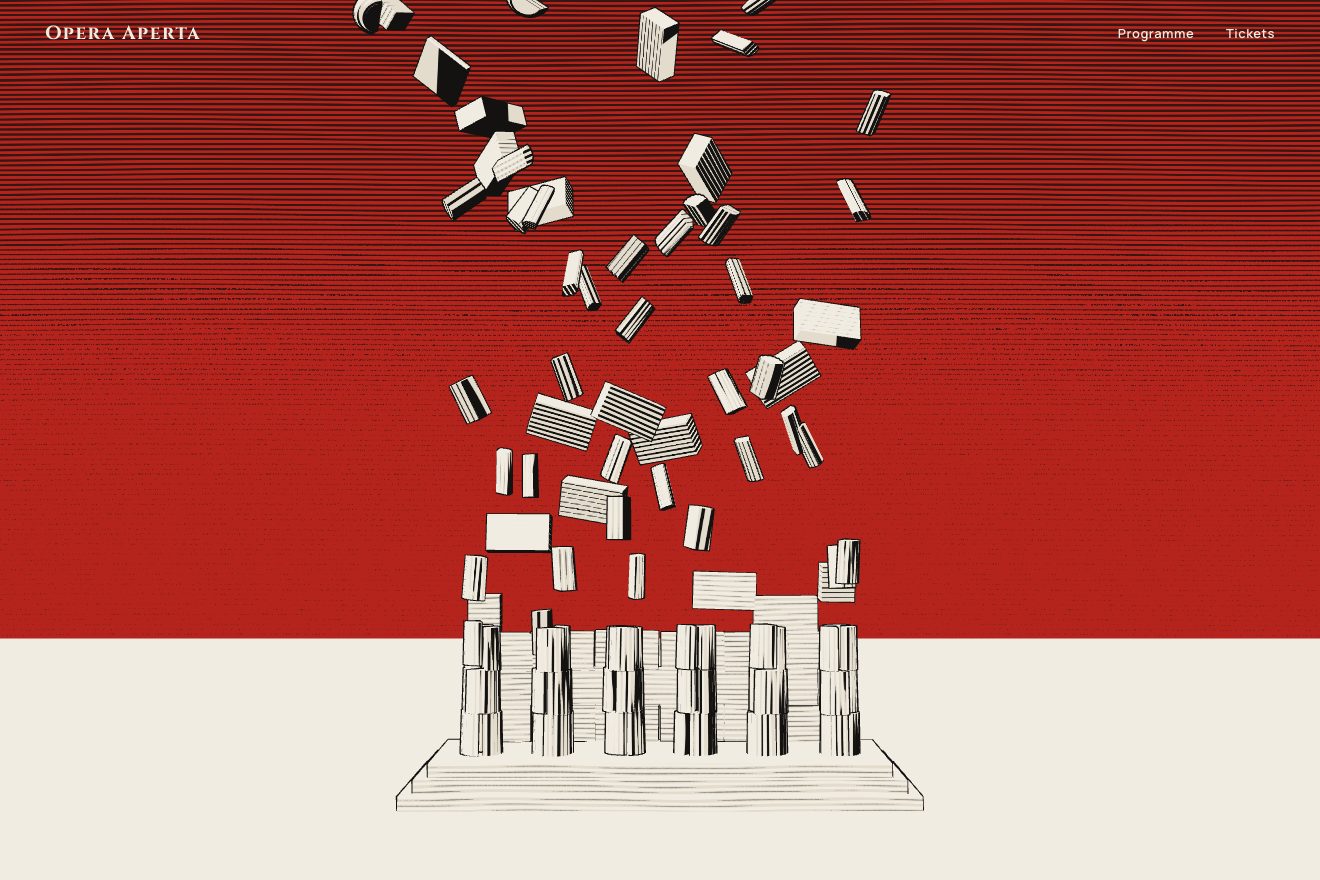
The columns are made of pieces, and every vertex knows the centre of its piece. The shader moves them: each piece turns on a random axis worked out from its centre, by an angle that grows with height, moves away in the direction of its centre and rises, the high ones more (by height to the fifth power times 0.5). The time that moves them goes in steps, six times a second, so the floating pieces jump like a hand-drawn animation. The mouse pushes them: pieces closer than 1.3 units move away with a cubicInOut curve and a push that breathes between 0.6 and 1, and when the mouse leaves they come back, because the push has no memory. The same thresholds and lines of the engraving draw them, and the lines turn with them.
In our demo the temple belongs to an invented open-air opera festival, Opera Aperta, and the scroll breaks it: the section is four screens tall, the temple stays still on screen, first the stone trembles and its joints open, then the pieces leave from the top down, pediment, cornice, frieze, capitals, then the column drums, each in three wedges, while the sky fills with red behind an edge torn by the same lines. The script builds the temple, fluted columns included, and WebGL2 draws it with no libraries, the outlines made by a swollen copy seen from inside, as on the site.
The other details
The title «The Notturno Experience» assembles letter by letter: the letters come in from both sides towards the middle, the outer ones last, the «The» row on timings of its own, and each letter grows from the inside towards its edge, read from a texture of distances, trembling slightly six times a second. In the hand scene, «Hold & Move», the fingers brush water that ripples where they pass; in the beam of light, «Hold», the saint rises from the ground. The panels are frames in 3D that the characters step out of, and the change from one scene to the next is a black rising from the bottom with an edge made of the same lines and a noise.
plan8’s sound is part of the drawing: the footsteps change between inside and outside, every caption and every bottle has its sound, underneath there are five drones and a distant jazz, and the narrating voice reads the whole story.
Where it stumbles
The weight, first of all, and when it arrives. While you are still at the age gate the site downloads the whole story: nine seconds after loading it is 226 requests and 14.4 MB, of which 8.9 MB of audio in 65 files (the five drones alone make 4.4 MB), 2.3 MB of images, 1.9 MB of geometry in 77 files and 0.65 MB of code. Then, going through the story, nothing more arrives. Anyone who answers «No» at the gate has downloaded it all the same.
Reduced motion is not there: nothing in the code asks for prefers-reduced-motion, and the story moves, trembles and boils for everyone. The text drawn in the canvas has its twins in the DOM, which is a kind thought, but a page 900 pixels tall with simulated scrolling remains hard to read without a mouse: the accessibility score, 6.6, says so. On the other hand, the console stayed clean on our visits.
What we take away
One style, done well, holds everything together: the same thresholds and lines draw the saint, the bottle, the stream and the columns, and stepped time makes even a 3D model look drawn by hand. A voice that waits for you to stop scrolling is kinder than one that starts anyway. And holding to pour turns a product into a gesture: it is the moment of the site you remember.
The effects
- Captions that read aloudA comic in four engraved panels. When a caption comes on screen its box unrolls from the left edge and its lines come in one after another; then a narrator reads it, one red word at a time, at the pace of a real voice, and waits if you scroll in a hurry.Free
- Hold and pourAn oil bottle that tips while you hold: the oil inside always stays level, runs out of the neck once it reaches it and falls in a stream the pointer aims. The bowl fills with rings where the stream lands; whatever misses it ends on the board.Free
- The temple that flies awayA temple engraved in WebGL that, as you scroll, trembles, cracks and flies away in pieces, from the top down, while the sky behind fills with red. The pieces float moving in small jumps and the pointer pushes them aside.Free