Son Daven, by The First The Last, Ivan Chopei
Son Daven, how it’s made: mountains in lines, cards that cross over and a curtain of cells
The site of Son Daven, a design hotel being built in the Carpathians, draws mountains, sheep and birds with vertical lines of varying thickness, like an engraving that moves. We take it apart with three demos rebuilt from scratch, in the minimal style.
The palette
- #A89474the sand of the light pages and the cells
- #2C2824the almost black brown of the text and the lines
- #FFFFFFthe white of the text over the photos
- #000000the black of the veil between two pages
Tap a colour to copy its code.
How others rated it
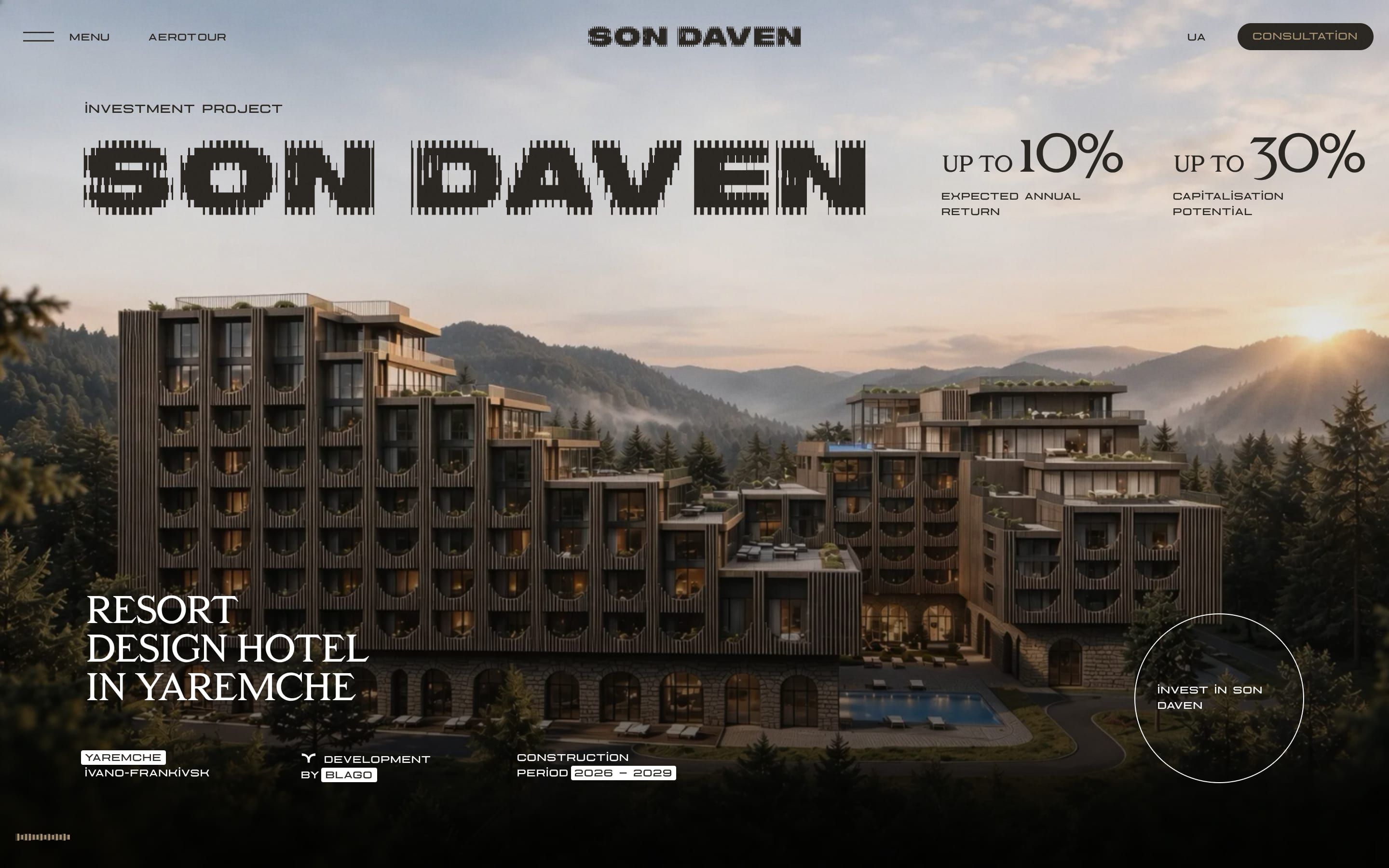
CSSDAWebsite of the Day, 7 August 20268.50/10the jury scoreSon Daven is the site of a resort, a design hotel being built from 2026 to 2029 in Yaremche, in the Ukrainian Carpathians, in the Ivano-Frankivsk region, developed by Blago. It speaks less to the people who will sleep there than to the people who might invest in it: at the top, two big numbers, up to 10 per cent expected annual return and up to 30 per cent capitalisation potential, then the prologue, the place and its surroundings, the seasons, the benefits, the building schedule, the apartments, the figures and the questions. There are two colours, a sand, #A89474, and an almost black brown, #2C2824, which swap places between light and dark sections; the typefaces are KTF Metro Roman for headings and KTF Metro Blueline for text. On CSS Design Awards it was Website of the Day on 7 August 2026, with 8.50 from the judges. The site is signed by the agency The First The Last: according to the credits printed in the browser console, design and development are by Ivan Chopei and production by Maks Stepenko.
It is built with Webflow, with jQuery 3.5.1. The animations are GSAP 3.13, with ScrollTrigger, SplitText and CustomEase, plus Flip taken from 3.14.1; smooth scrolling is Lenis 1.3.15, with a duration of 1.2 seconds on an exponential braking curve; page changes go through Barba, galleries through Swiper 11. All the animation code sits in a single file served by Slater, 80 KB minified, about four thousand lines once tidied up: the values we quote come from there. The line drawing is hand-written WebGL, a single shader, no Three.js.
We take it apart in three moments, with a demo rebuilt from scratch for each, in the minimal style, for an invented mountain hotel, Hollin: the cards, the words and the code are ours, the landscape photos are free to use. From the site we took the ideas and, where we say so, the numbers.
Mountains in lines
Almost everything that moves on Son Daven is drawn in vertical lines: the mountains behind the hotel, the tree, the sheep in the meadow, the stork, the birds crossing the sky, the clouds. They look like engravings, but they move, because there are videos underneath. In the seasons section, Summer and Winter are two buttons: a click makes one landscape disappear and the other draw itself.
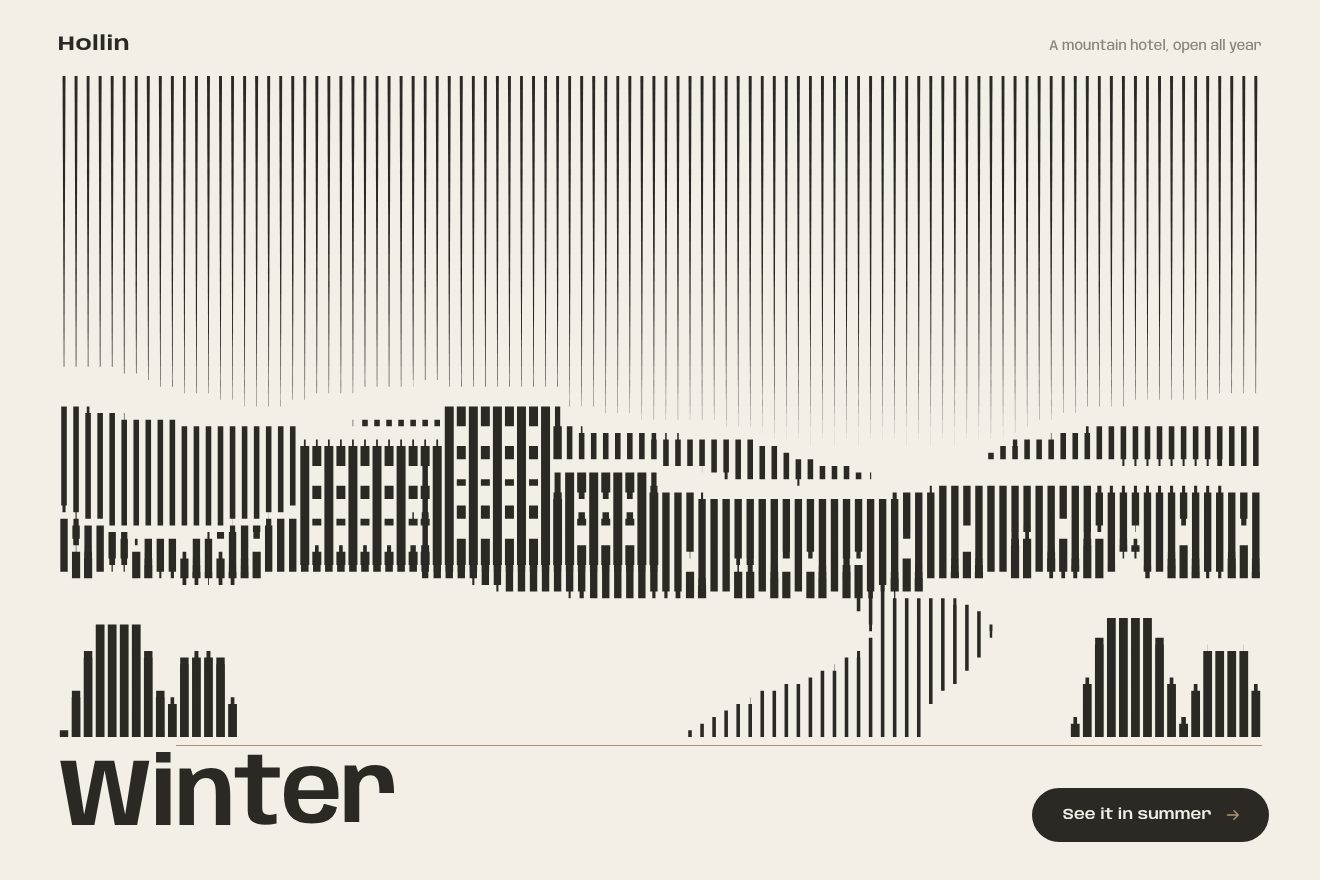
Each scene is a WebGL canvas holding images and small videos, each in its own box. The shader splits the box into a grid, usually 100 by 100 cells, sometimes 150 by 100, reads the colour at the centre of each cell and draws a solid vertical line there, centred, as wide as the cell is dark: nothing where it is white, from minus 2 to 102 per cent of the cell where it is black, so neighbouring lines touch. Before the brightness come the levels, two numbers from 0 to 255, the black point and the white point, as in a photo editor; and those are what get animated. As you scroll the first screen, the mountains go from 25 and 200 to 45 and 175 and grow harsher; the birds have their levels reversed, 255 and 0, and cross the sky from off the left edge to off the right in five seconds, with a five second pause. The shader also throws away black cells and cells with a black neighbour: that way the black background of the videos stays transparent and leaves no edges. The drawing runs at most at 60 frames per second and stops when the scene leaves the screen.
In the seasons the lines are transparent and the picture is made by the gaps between one line and the next. On a click on Winter, in 1.2 seconds, summer goes to levels 254 and 255, almost everything turns black, the lines widen until they touch and the landscape disappears; winter goes from 254 and 255 to 25 and 150 and draws itself. Summer does the opposite, and summer goes back to 0 and 255.
In our demo the lines are ink on a warm white paper, and the two landscapes, summer and winter in front of the hotel, are two real, free photos of the same mountain lake, read from a hidden canvas; the drawing is a 2D canvas, not WebGL. To hide a season we use levels 0 and 1, which the site gives winter before the first click: everything turns white and the lines thin out to nothing. The 100 by 100 cells, the line from minus 2 to 102 per cent, winter’s levels of 25 and 150, the 1.2 seconds and the InOut curve, 0.76, 0, 0.24, 1, are the site’s; the wave from left to right, the lines growing from the bottom of their cell and the word that changes with the season are ours.
Cards that cross over
Among the resort’s benefits there is a horizontal row of cards. As you scroll, the page holds still and the row slides left: each card comes in low and crooked from the right, crosses the screen rising and leaves at the top left, tilted the other way. No two take the same path.
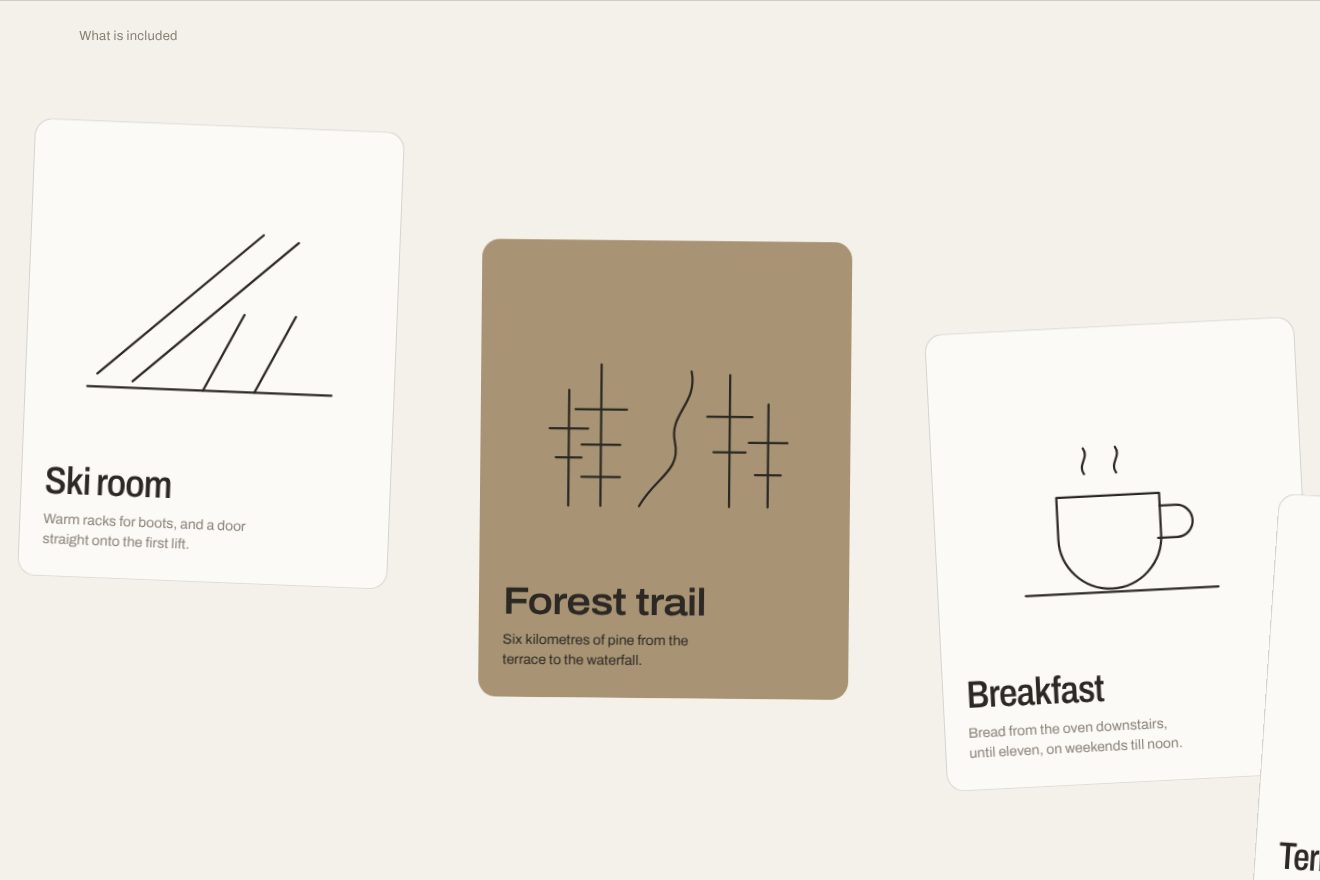
The row goes from 0 to minus 100 per cent of its width, tied to the scroll with scrub from the start to the end of the section. Each card has its own tween that uses that row as its clock, with ScrollTrigger’s containerAnimation: it starts when the card’s left edge is at 120 per cent of the screen and ends when its right edge is at minus 20. It starts rotated by an angle between 5 and 10 degrees, shifted sideways by 20 to 30 per cent of its width and down by 75 per cent, plus 5, plus or minus 15 on alternate cards; it arrives with everything reversed, rotated the other way and up high. Angle, shift and direction are chosen by Math.random on every visit. Below 992 pixels of width the scene is not there.
In our demo there are six benefits, the sauna, the ski room, the forest trail, breakfast, the terrace and the library, each with a small drawing in lines; the trail card is sand, the others paper. The angles between 5 and 10 degrees, the shifts between 20 and 30 and of 75 per cent with the alternating 15, the 120 and minus 20 per cent points and Lenis’s 1.2 second duration are the site’s. Chance, though, has a fixed seed, so every run is the same; each card’s title widens as it passes the middle; and on a phone the scene is still there, with narrower cards.
A curtain of cells
Every page change goes through a curtain: the screen fills with sand coloured cells that widen in a wave starting from the bottom right corner, the page underneath darkens, then the cells close again in the same order over the new page, and the words of the heading arrive in jumps, from above and below, in scattered order.
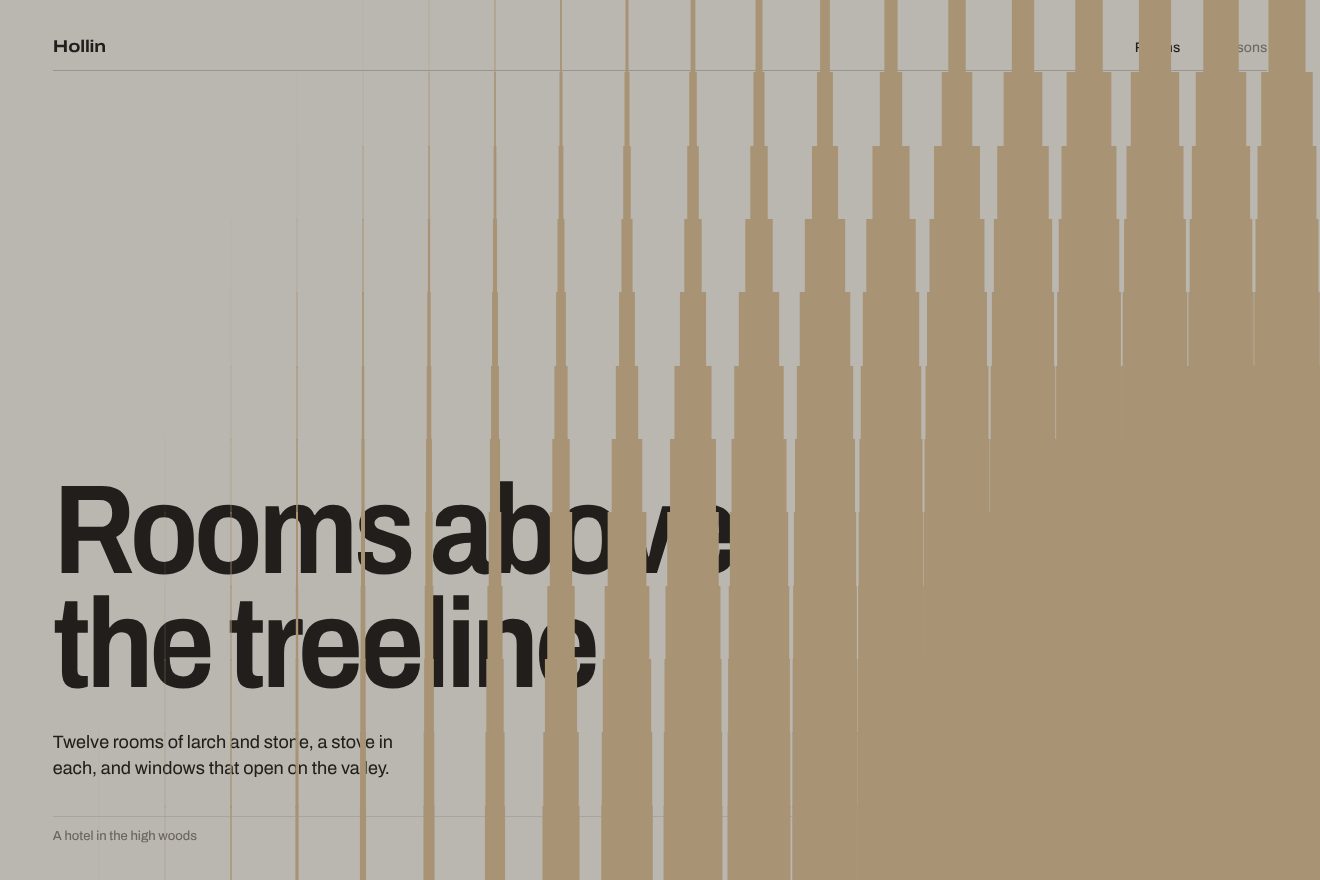
In the code the Barba transition is called dither. The curtain is made of 20 columns of 12 cells each, 240 in all, with a margin of minus one pixel so no gaps show. On the way in each cell goes from scaleX 0 to 1 in 0.4 seconds on the InOut curve, one every 0.03 seconds, and GSAP orders them as a 20 by 12 grid starting from the last one: the wave lasts about two thirds of a second and the curtain is closed in just over one. Underneath, a black veil goes from clear to solid in 1.2 seconds; after 1.2 seconds the page changes and the cells go back to zero the same way. The words of the new heading, split by SplitText, start at zero scale and shifted by minus 150, 75, minus 75 and 150 per cent of their height, in turn, and arrive in 1.2 seconds on the Out curve, 0.25, 1, 0.5, 1, one every 0.025 seconds at random, after two tenths of a second.
In our demo there are two pages, the rooms on light paper and the seasons on the brown, and the words land wide and light and narrow as they gain weight, with Archivo’s axes. The 20 columns of 12 cells, the 0.4 seconds, the 0.03 gap from the last cell, the veil and the 1.2 seconds, the jumps of 150 and 75 and the random 0.025 are the site’s.
The other details
The loader only appears on the first visit, which the site remembers in sessionStorage. The percentage counts the scenes that are ready, and the loader also waits for the fonts and the frames of the opening; then the logo flies from the centre to the header with Flip in 1.8 seconds, while the opening image settles from 1.5 to 1 in 2.4. On screens at least 992 pixels wide the opening is a video made of 120 webp images drawn on a canvas: as you scroll, the frames advance with the scroll, the heading rises, shrinks to half and disappears, and towards the end of the section the photo shrinks to three tenths of its size, in the middle of a sand coloured field, while the mountains in lines draw themselves underneath.
The header disappears as you scroll down, but only after the first thousand pixels and only if the scroll moves more than 40 pixels at a time, and it comes back when you scroll up or at 160 pixels from the bottom. Magnetic buttons spring back with elastic.out(1, 0.3) in 1.6 seconds. The prologue lights up letter by letter as you scroll, from a tenth of opacity to full. In a corner there is a music button, a 1.56 MB mp3 of Carpathian sounds that is only downloaded on the first click and rises to 25 per cent volume in eight tenths of a second; its little bars rise and fall at random, the middle ones taller.
Where it stumbles
There is no reduced motion: neither the code nor the stylesheets look at prefers-reduced-motion, and the smooth scrolling, the moving lines and the curtain of cells are there for everyone.
On wide screens the 120 images of the opening video weigh 22.8 MB together, and the first visit’s loader waits for all of them before opening the page. Barba comes from unpkg without a version number, so it always takes the latest, today 2.10.3, and the cookie module takes the latest of version 1; GSAP is 3.13 but Flip is 3.14.1. The two typefaces are OTF files, 78 and 40 KB, instead of the lighter WOFF2. And below 992 pixels many of the line scenes, such as the prologue, the page about the hotel and the seasons, do not start: on a phone you see a simpler site.
What we take away
One technique, kept for everything: mountains, trees, sheep, birds and storks made of the same vertical line, so that different images and videos seem to come from the same hand. And the idea of animating the levels instead of the images: by moving two numbers, the black point and the white point, a landscape draws itself, hardens or vanishes without touching a pixel of the video.
The effects
- The seasons in linesTwo real photos of the same mountain lake, in summer and at the end of winter, shown as an engraving of vertical lines, in the minimal style: every cell of the grid holds a line as wide as the photo is dark there. The button changes the season: the summer’s levels wipe the lines column by column and the winter’s make them grow from below, until the frozen lake stands with its snow left empty between the lines.Free
- Crossing cardsA minimal-style scroll animation: what a mountain hotel offers, on six large cards in a row. The page holds still and the row slides left with the scroll; each card comes in low on the right and tilted, rises as it crosses the screen and leaves high on the left, tilted the other way. The card’s title widens as it passes the middle.Free
- The cell transitionA minimal-style page change for a mountain hotel’s site: on a click a curtain of 240 sand-coloured cells, twenty columns of twelve, closes over the page in a wave that starts from the bottom right corner while a veil darkens underneath; then it opens again with the same wave and the words of the new headline arrive in jumps, in scattered order, wide and light, and narrow down as they gain weight. Remade from scratch on the idea of the page change of sondaven.com.Free