Star Party Silverlake, by Hayda Studios
Star Party Silverlake, how it’s made: the real sky to drag, the page that follows the sun and the Windows 98 window
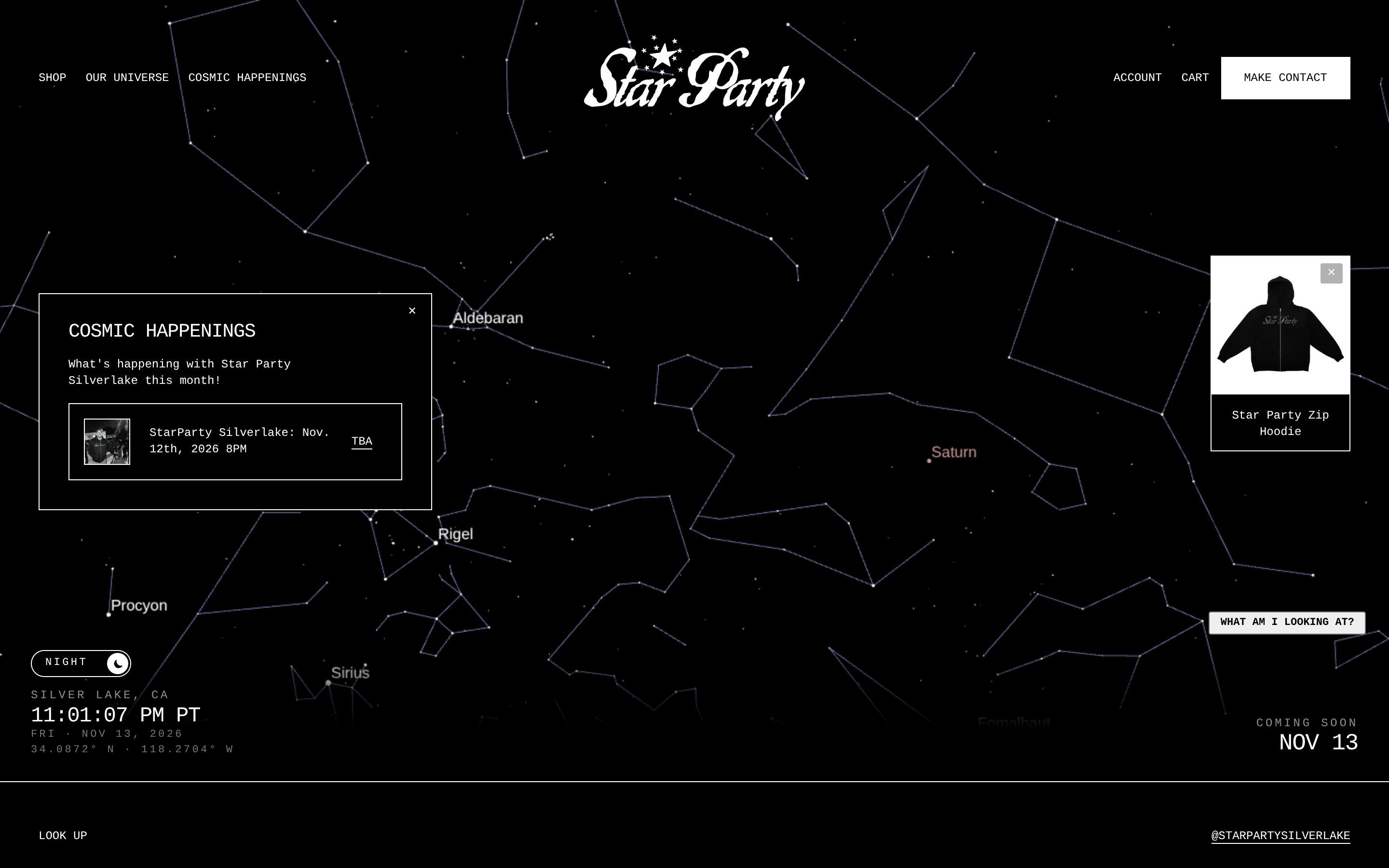
The site of Star Party Silverlake, an astronomy night that brings telescopes to a Los Angeles neighbourhood every month, opens on the sky of that very moment, and turns white when the sun rises there. We take it apart with three demos rebuilt from scratch.
The palette
- #000000the black of the night: the ground of the sky, the header and the panels while the sun is below the horizon
- #FFFFFFthe white of the day: with the sun up the sky turns negative and the page flips
- #C0C0C0the Windows 98 grey of the window that explains the sky
- #808080the dark grey of the window’s bevelled edges
- #000080the navy where the title bar starts
- #1084D0the blue where the title bar ends
Tap a colour to copy its code.
How others rated it
CSSDAWebsite of the Day, 1 November 20268.29/10the jury scoreStar Party Silverlake is an astronomy night that, once a month in Silver Lake, a Los Angeles neighbourhood, puts telescopes out on the street and invites anyone walking by to look through them. The site is also its shop: there is a black hoodie with the name written in script, and little else. But the first screen does not show the hoodie: it shows the sky, the real one, above the neighbourhood, at the exact moment the page is opened, with the constellations drawn in thin lines and the names of the stars. If it is daytime there, the sky turns negative and the whole page goes white. There are two colours, black and white, and they swap with the sun; the only exception is the grey of a Windows 98 window. There is one typeface, the system monospace («SF Mono» on Macs, then Menlo, Consolas and the rest), for headings and text alike, with the labels in capitals, spaced two tenths of an em apart. It was Website of the Day on CSS Design Awards on 1 November 2026, with 8.29 from the jury. It is signed, at the foot of the page, by Hayda Studios, a Los Angeles studio that makes brands and Shopify stores.
Underneath there is Shopify, with the Solis 3.4.0 theme, and no animation library at all: no GSAP, no smooth scrolling. The change from one page to the next is the theme’s, made with the browser’s View Transitions. Everything that makes the first screen special lives in a few scripts written by hand inside the page, each with its comment in capitals: the sky, day and night, the clock, the countdown, the window, the buttons that close the panels. It is a lesson in restraint: an award-winning site with a few hundred lines of its own code.
We take it apart in three moments, with a demo rebuilt from scratch for each. The texts, the brands and the code are ours; from the site we took the ideas and, where we say so, the numbers.
The real sky to drag
The whole first screen is a starry sky, 90% of the window tall. The stars sit in their real places, the constellations are joined by thin lilac lines, the brightest have their names beside them (Aldebaran, Rigel, Procyon, Sirius) and Saturn has its pinkish dot. At the bottom the sky fades into the black where the ticker runs. Drag it left or right and the sky turns, as when you turn your head.
The site did not draw the sky: it is VirtualSky, an open source planetarium for the browser written by Stuart Lowe, placed in the page in an iframe that covers the whole hero. The site passes its choices in the address: the latitude and longitude of the neighbourhood, the stereographic projection (the one that makes the sky look like a dome seen from below), live=true so it follows the real time, constellations and star names on, type at 11 pixels, and off the help, the date, the position, the cardinal points, the sky gradient and the credit line. An 80-pixel square in the colour of the ground, laid over the top right corner, covers what VirtualSky draws there on its own. A gradient rises from the bottom to keep the ticker readable: it is as tall as the ticker itself, which a script measures with a ResizeObserver, and goes from transparent to 55% of the ground colour a third of the way up, and to the full colour at six tenths.
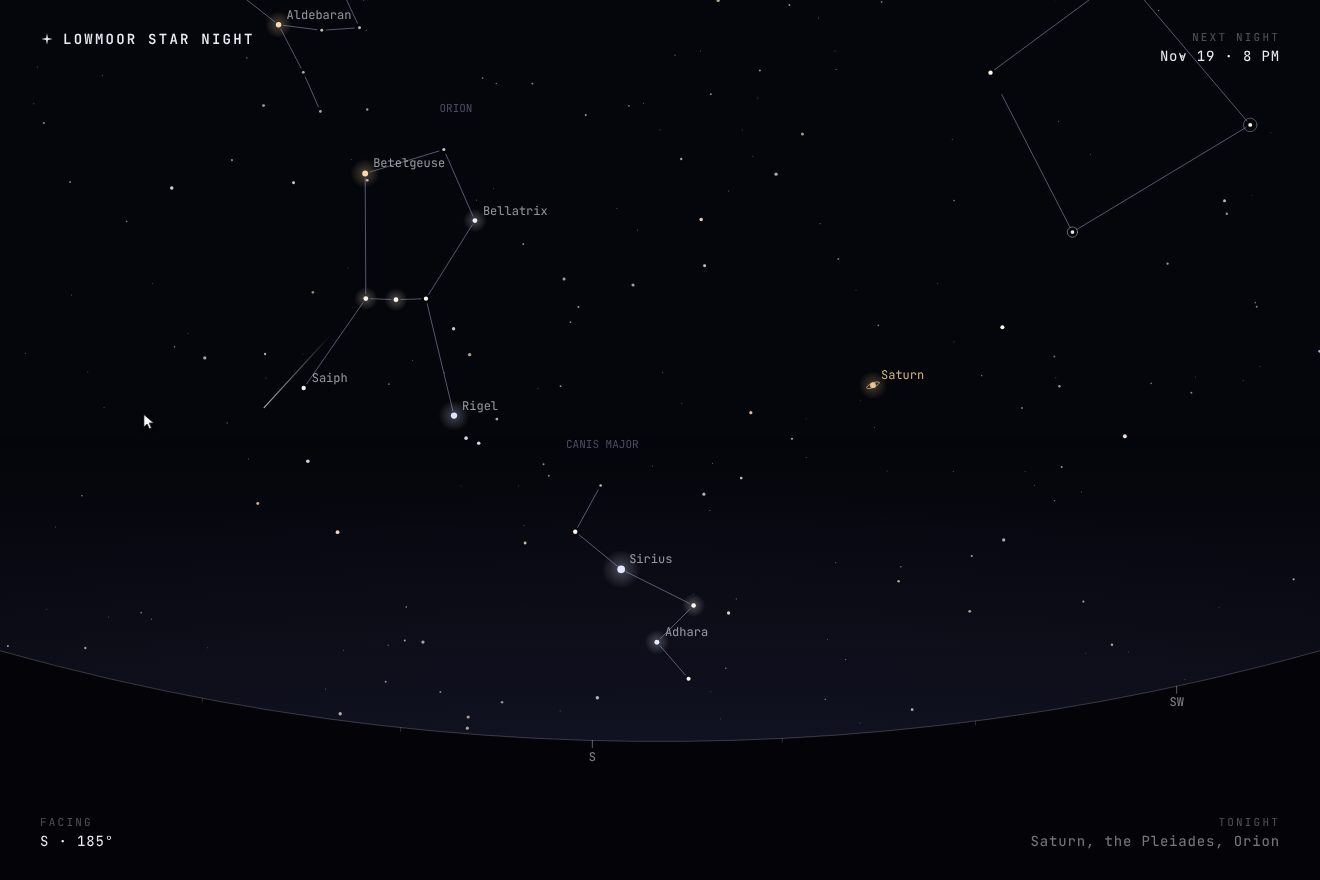
In our demo the night is made up, Lowmoor Star Night, and the sky is not an iframe: we draw it ourselves on canvas, in the same stereographic projection, with six hundred stars, each as large as its magnitude, Saturn with its ring, the Pleiades and a horizon curving at the bottom with the cardinal points. From the site come the full-page sky that you drag left and right, the thin lilac lines of the constellations, the names of the brightest stars beside them, the gradient rising from the bottom behind the text, the monospace type and the capital labels spaced two tenths of an em. All the motion is ours: let go, the sky keeps turning and slows down gently; pulled up or down, a spring brings it back to the horizon. The constellations draw themselves line by line as they come into view, with a small ring of light where the line reaches the star, and the names arrive a moment later; a name that would cover another one fades out and comes back when there is room. With the pointer still, a thin reticle locks onto the nearest bright star and writes its name and magnitude. At the bottom the direction you are facing changes as you turn, and now and then a meteor goes by. Left alone, a pointer drags the sky and aims at the stars. With reduced motion the sky is already fully drawn, the stars do not twinkle and, pulled up, it is back on the horizon at once.
The page that follows the sun
The site has a light theme and a dark one, but the visitor does not choose them: the sun above Silver Lake does. A script works out, on load and then every minute, how high the sun is above the neighbourhood’s horizon. Above -0.833 degrees it is day: that is the figure astronomers use for sunrise and sunset, because the sun is still visible when its centre is already a little below the horizon. By day the header, the hero and the panels turn white with black text, the VirtualSky sky is reloaded in negative, with black stars on white, and the logo changes image. Bottom left there is a toggle to choose by hand.
The sum is done with the formulas of astronomy, in fifteen lines: the days since 1 January 2000, the sun’s mean anomaly, the equation of the centre with its three terms, the ecliptic longitude, the declination with the Earth’s axial tilt of 23.4397 degrees, sidereal time and the hour angle. The result ends up in an attribute on the html element, data-spsl-sky, which is day or night, and everything else listens to it: the CSS swaps the colour variables, and three MutationObservers update the sky, the logo and the toggle. The colours change in 0.6 seconds. By day the white panels get a one-pixel black outline, inset by one pixel, so they do not get lost on the white sky. The toggle is a 104 by 28 pixel pill with a thin border, a 22-pixel knob that slides in 0.35 seconds with the sun or the moon inside, drawn in SVG; the DAY and NIGHT labels swap in 0.25 seconds, and it is a real switch for screen readers too (role="switch"). Once touched, the visitor’s choice beats the sun until the page is reloaded. On the phone only the icon is left, 56 pixels wide, and it moves up above the ticker.
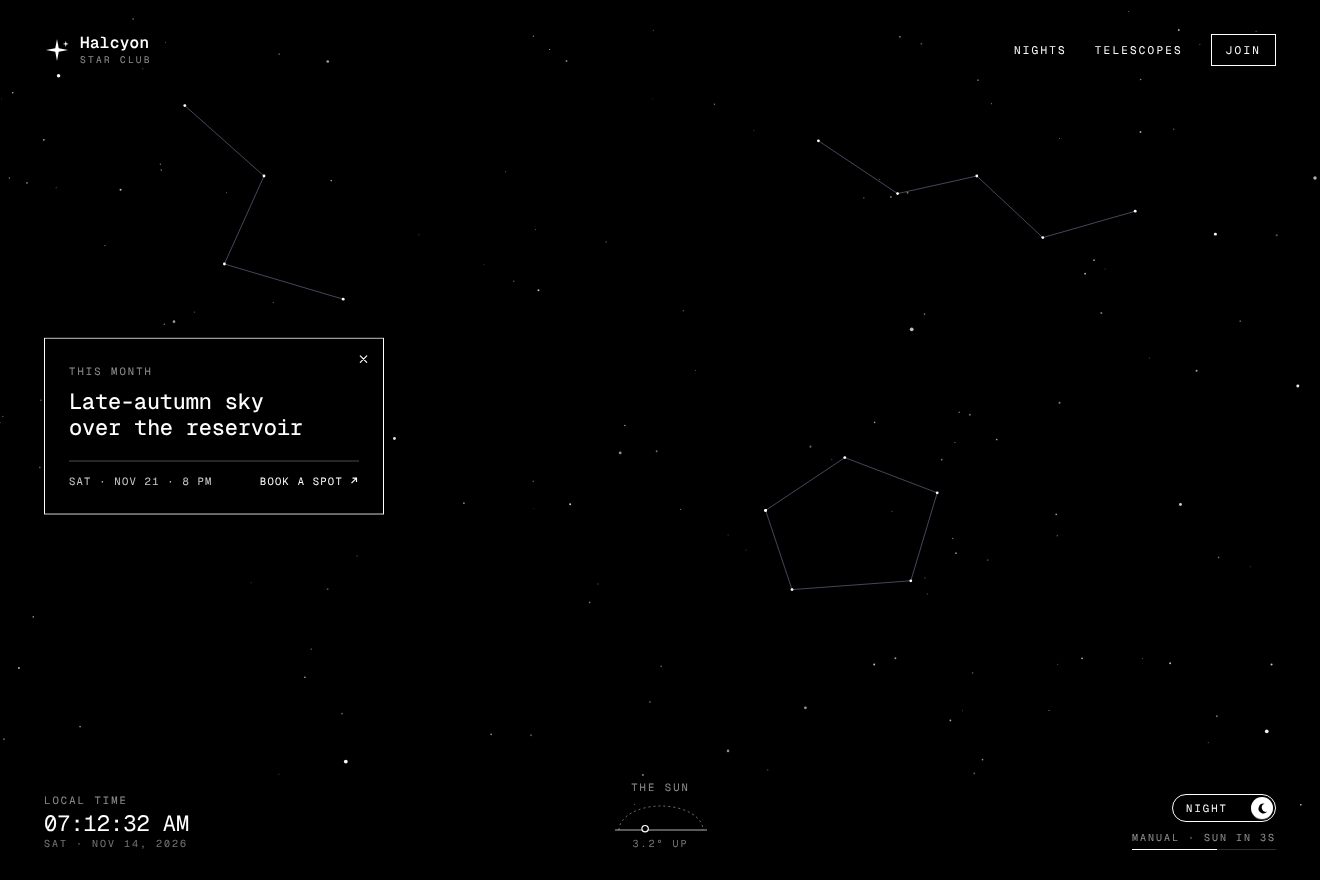
In our demo the club is made up, Halcyon Star Club, and the page is a small black and white opening: the header with the name and three links, the panel of this month’s night with its close button, a starry sky with three constellations, and at the bottom the ticker with the clock to the second in tabular figures and the sun on a little arc, with its height in degrees. From the site come the sun height sum, with the same formulas and the same -0.833 degree threshold, the thin-bordered pill and the knob with the drawn sun and moon, the DAY and NIGHT labels swapping, the theme flipping completely between black and white, and the hand choice beating the sun. We do not show the place: the longitude comes from the visitor’s time zone. The motion and the return are ours: the knob runs on a spring, goes one pixel too far and stretches a little halfway, while the sun and the moon swap with a turn; from the knob a circle spreads out and flips the sky, the stars change colour one by one as the wave reaches them, and the header, the panel and the ticker columns change exactly when the wave touches them, not all at once. Then «MANUAL» appears under the switch with a thin line running down, and when it ends, after five seconds, the page goes back by itself to the theme the sun wants. Left alone, it flips the switch and waits for the sun. With reduced motion the knob jumps into place and the colours change in a half-second fade.
The Windows 98 window
Beside the sky, bottom right, there is a grey button that says «WHAT AM I LOOKING AT?». Touched, it opens a window that looks like it came out of a late nineties computer: the Windows 98 grey, the bevelled edges, the blue title bar reading «Virtual Sky», the little square to close it. Inside, one sentence: you can see where the planets, the stars and the constellations are above Silver Lake, right now, and you just drag. Below, the ticker keeps the time: the Los Angeles clock to the second, the date, and on the right «COMING SOON» with the day of the next night.
The window is made entirely of styles written in the HTML: the #c0c0c0 ground, two-pixel edges, white at the top and left and #808080 at the bottom and right, a one-pixel black shadow, and the title bar shading from #000080 to #1084d0, the blues of that Windows; even the 16 by 14 pixel close button has its bevel. It opens and closes at once, with no animation, as it did back then; a click outside closes it. The clock updates every second reading the Los Angeles time zone, in tabular figures, all the same width, and its space is fixed at 13 characters so the line does not wobble when a 1 becomes an 8. The countdown, in days, hours and minutes, updates every minute. The two panels over the sky, the month’s night and the hoodie, each have a close button added by a script: touched, the panel fades in 0.3 seconds and then disappears. On the phone the panels are gone and the middle column of the ticker is hidden.
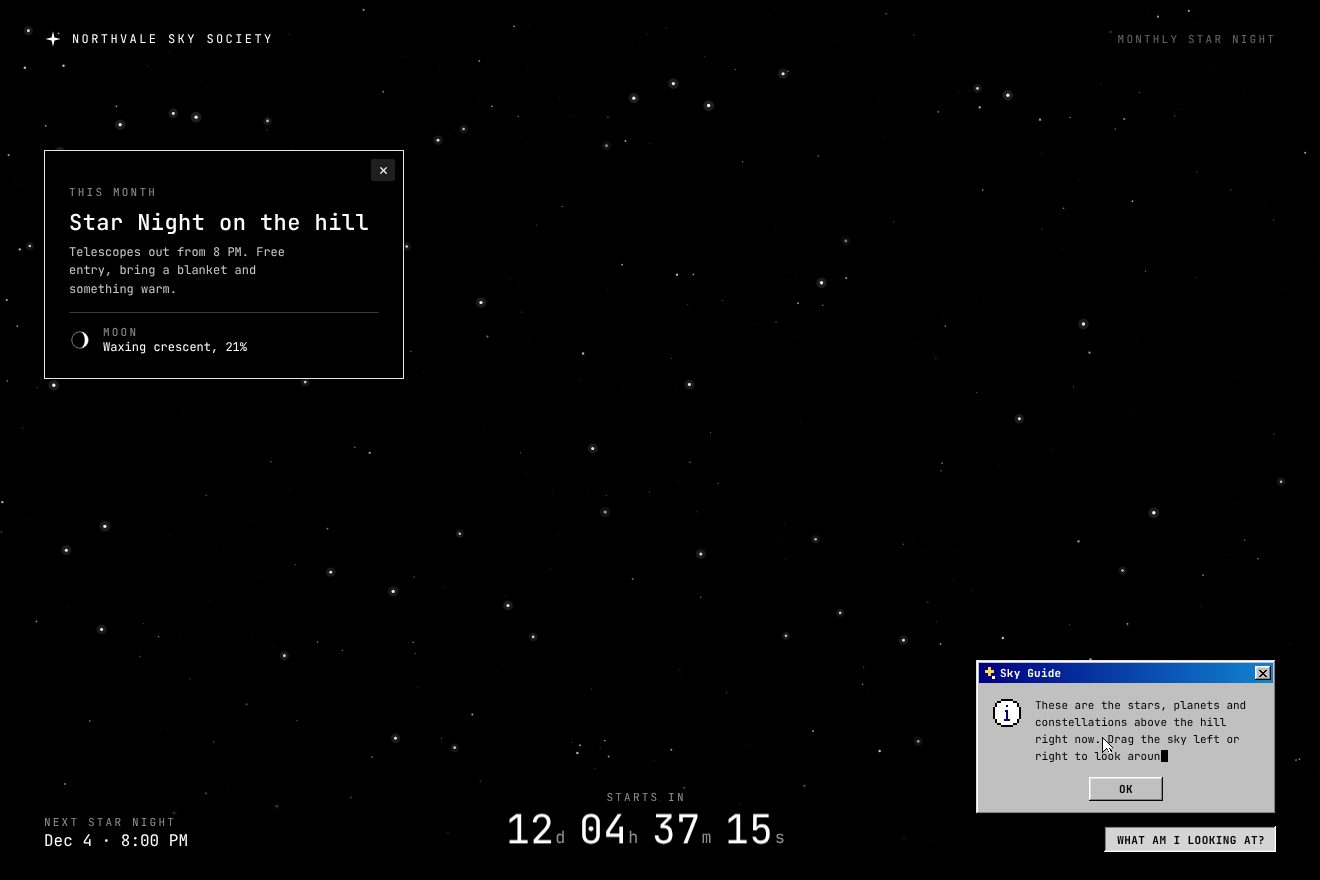
In our demo the club is made up, Northvale Sky Society, and the page is black with a still sky of dots, the panel of this month’s night, «Star Night on the hill», with the phase of the moon, and at the bottom the date of the next night and the countdown. From the site come the window, with its greys, its bevels, the title bar shading between the two blues and the 16 by 14 close button, the button that opens it, the panel fading in 0.3 seconds when closed, the tabular figures, the capital labels spaced two tenths of an em and the monospace type. The way it opens is ours: the way Windows really opened it, a dotted frame leaps from the button to the window in seven steps leaving a trail of three, then the window is there with its title bar still grey, inactive, turning blue a sixth of a second later; inside, the line that explains the sky is typed out at 46 letters a second, with a block caret. The cross and the OK button sink into their bevel when pressed, and the frame leaps back to the button. In the countdown, which here has seconds too, every digit is a strip that rolls down to the next with a small settle. Left alone, a pixel pointer opens the window, closes it, closes the panel and brings it back. With reduced motion the window fades in and out and the line is already written.
The other details
The ticker is written with a lot of care against surprises: each of its parts repeats «horizontal writing, no transform», and a comment explains that the colour is forced so the iframe’s does not bleed onto it. The labels are 12 pixels at 0.55 opacity, the lines below 11 pixels at 0.45, and the time 22 pixels: only three sizes, set apart by light more than by size. Below the hero a one-pixel white line separates the footer, with «LOOK UP» on the left and the Instagram handle on the right, and further down the mailing list sign-up opens with «THE STARS ARE ALIGNING…». The cart is the theme’s, with the product flying to the icon when it is added.
Where it stumbles
The date of the next night is written by hand in the code, 12 November 2026 at 8 pm, with a -7 hour offset: but in November Los Angeles is at -8, so anyone looking from Europe reads «NOV 13». Once the evening has passed the countdown empties and only the date is left, and in the panel the night’s button says «TBA» and links to #. The hero script still holds all the code for a background with NASA’s astronomy picture of the day: the elements it was meant to fill are gone, but the request to NASA still goes out on every visit, with the key written in plain sight. The sky is an iframe with loading="lazy" and the page reloads it every time it changes between day and night. The colour and knob transitions ignore reduced motion (only the theme’s page change looks at it), half the images on the home page have no description, and the Windows 98 window does not close with the Esc key and does not take focus when it opens.
What we take away
Star Party Silverlake sells a night under the stars, and instead of describing it puts the screen under the same sky. The loveliest trick costs fifteen lines: ask the sun what time it is, and let it choose the theme. The rest is subtraction: one typeface, two colours, a borrowed planetarium and a Windows 98 window to make you smile. You can make an award-winning site writing very little, if every line has a reason.
The effects
- Star night skyThe home page of Lowmoor Star Night, a made-up astronomy night, is tonight’s sky drawn on a canvas in a stereographic projection: six hundred stars with their magnitudes, Saturn with its ring, the Pleiades, the horizon curving at the bottom with the cardinal points. Drag it left and right and it turns with inertia; up or down, a spring brings it back to the horizon. The constellations draw themselves line after line as they come into view, with a small glint where a line reaches a star, and the names follow a beat later. With the pointer still, a thin reticle locks on the nearest bright star and writes its name and magnitude. Rebuilt from scratch from the live sky of Star Party Silverlake, minimal style.Free
- Day-night page flipThe home page of Halcyon Star Club, a made-up astronomy night, all in black and white and in a monospaced type, like the one of Star Party Silverlake. In the ticker at the bottom sits the pill switch: the knob runs on a spring and one pixel too far, the sun and the moon swap with a turn, and the page flips not all at once but with a wave leaving the knob: the sky turns over in a circle, the stars become ink dots, and ticker, panel and header change colour the moment the wave reaches them. Touched, the switch says MANUAL and a thin line wears down; when it ends, the page goes back by itself to the theme of the real sun, worked out from the sun’s altitude.Free
- Windows 98 sky windowThe black page of Northvale Sky Society, a made-up astronomy club: a still sky of dots, the panel of this month’s star night with its close button, the countdown to the next night with rolling digits and the «What am I looking at?» button. The button opens a Windows 98 window the way Windows did: a dotted frame leaps from the button to the window in steps, leaving a short trail, then the window is there, its title bar still grey and turning blue a moment later. Inside, the line that explains the sky is typed out with a block caret.Free