Warm & Fuzzy, by Neutral Studio, Paulo Ferreira Jorge
Warm & Fuzzy, how it’s made: stickers, letters full of film and weightless cubes
The site of a creative studio split between Los Angeles, Boulder and New York: solid letters drawn in WebGPU that work as windows onto the videos, objects floating over the titles and, if you leave the page still, a shower of stickers. We take it apart with three demos rebuilt from scratch.
The palette
- #190BB6the ultramarine blue of the intro and the sections
- #F7DD47the lemon yellow
- #E74A27the tomato orange of the error page
- #5E54CCthe lighter blue
- #F9E77Ethe lighter yellow
- #EE8067the lighter orange
- #000000the black of the work pages
- #FFFFFFthe white of the text
Tap a colour to copy its code.
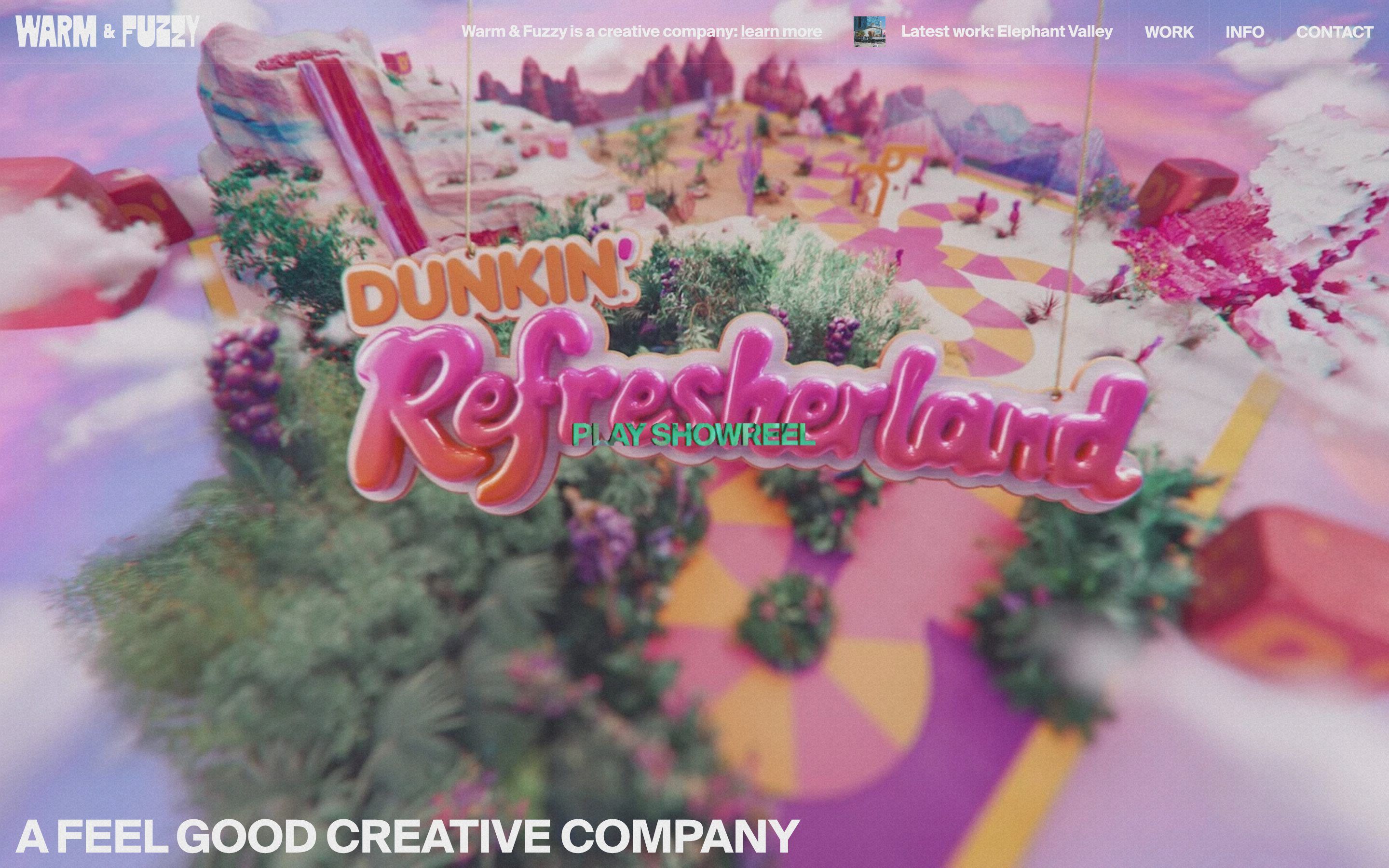
Warm & Fuzzy is a creative studio with roots in Los Angeles, Boulder and New York: creative direction, production, animation, visual effects, live experiences, editorial, and lately artificial intelligence too. It calls itself «a feel good creative company», founded by artists «with a healthy resistance to boredom», and the home page shows the work of the last year: Dunkin’s Pumpkin Spice found again, a world of snacks for AMPM, an anamorphic billboard with an elephant for the San Diego Zoo, the concert visuals for Pearl Jam. The site was made by Neutral Studio and Paulo Ferreira Jorge.
The site is made of three flat colours that take turns from one section to the next: an ultramarine blue, #190BB6, a lemon yellow, #F7DD47, and a tomato orange, #E74A27, for the error page; the work pages are black. There is a single typeface, Suisse Int’l in bold, in capitals for the labels. The logo instead is drawn on purpose: big letters, with notches and round holes, and each one also exists as a 3D solid. Over everything runs a grain: a 32 pixel tile at half opacity that jumps to eleven positions every second, like film.
Underneath there is Next.js 16 with React 19, with the pages generated ahead of time and the content taken from Storyblok. The videos come from Mux, in pieces, with hls.js, and Mux also measures how they are watched. The smooth scrolling is Lenis, with a duration of 0.6 seconds, and some animations go through Motion. The unusual part is the 3D: the letters of the logo are .bin files with their meshes, drawn in WebGPU, the newest graphics interface in browsers, with no 3D library at all. Where WebGPU is missing the letters become flat masks and the intro is skipped. On Awwwards the site was Site of the Day on 12 September 2026, with 7.26 and a Developer Award of 7.52.
We take it apart in three moments, with a demo rebuilt from scratch for each, for three invented brands: drawings, texts and code are ours. From the site we took the ideas and, where we say so, the numbers.
The page covered in stickers
If you leave the site still for fifteen seconds, without moving the mouse, touching, scrolling or pressing a key, the studio’s stickers rise from below the screen and cover everything. It is the same game as the photo at the bottom of the home page, the El Camino truck plastered with stickers. At the first movement they fly away upwards.
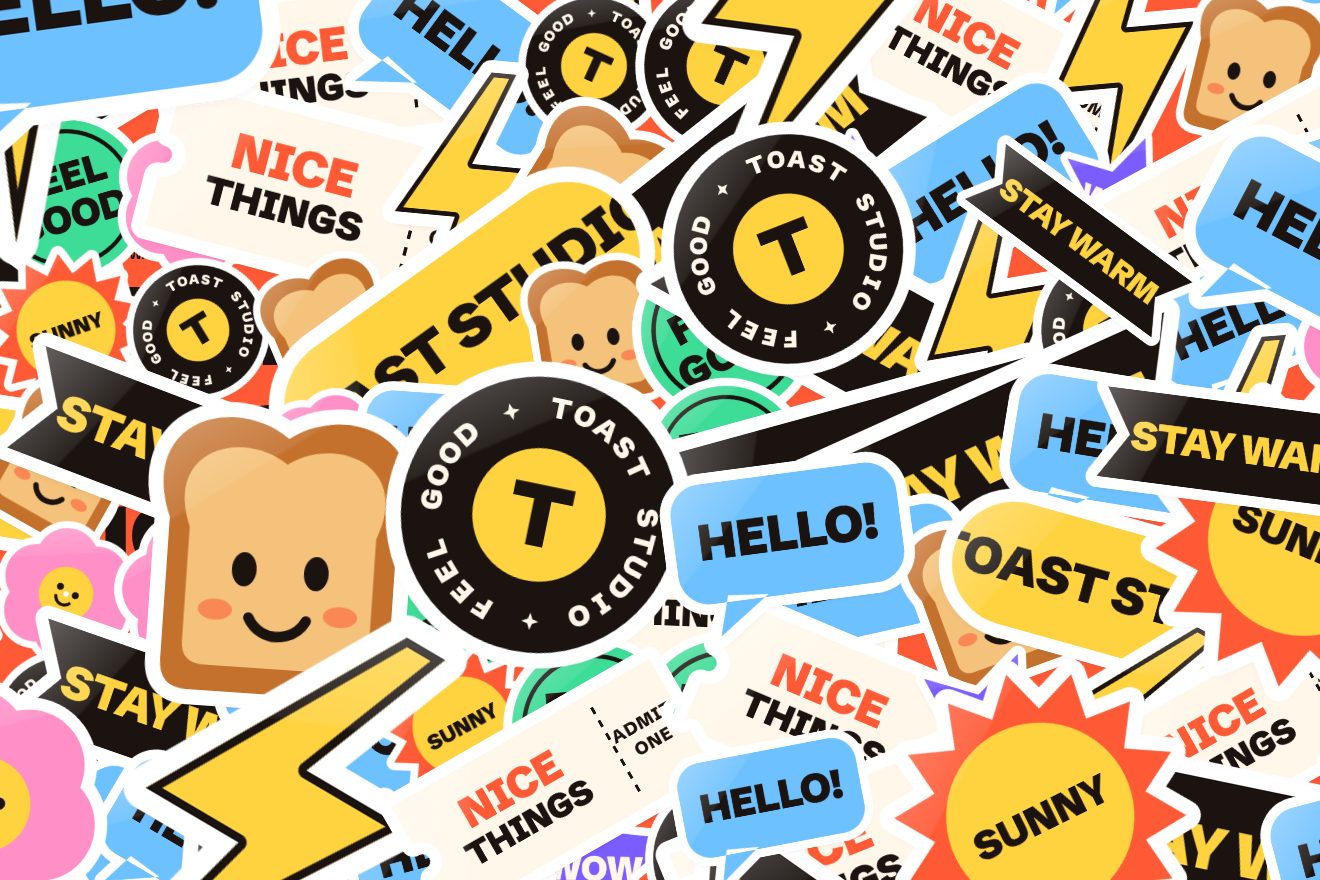
On the site the stickers sit on a grid in three layers. The cell is 15% of the short side of the screen. The first layer puts a sticker between 15 and 20% wide on every cell. The second puts one between 20 and 35% every two cells, on half the places, and the third one between 35 and 45% every three cells, on three places out of ten. The big ones arrive first and fast, in 250-400 milliseconds; the small ones last, in 750-1000, after 120 milliseconds and a random delay of up to a hundred. Each sticker starts 20-120 pixels below the screen, turned up to 100 degrees and shifted up to thirty pixels, and lands turned up to 40, with the curve 0.76 / 0 / 0.24 / 1. On the way out it rises past the top edge and the order flips: the small ones leave first.
Everything is in a single canvas inside a dialog. The images are prepared once, as bitmaps already at the right size, and on every frame a setTransform per sticker is enough, with the pixel density kept at 1.5 at most. If you interrupt it halfway, each sticker starts again from where it is. If you come back to the browser tab after leaving it, the page is already covered. For people using a screen reader there is a notice: «Screensaver is active — move your mouse or press a key to dismiss».
In our demo the studio is invented, Toast Studio, and the eleven stickers are drawn by the script on hidden canvases, each kept in three sizes so that the small ones do not flicker while they turn. The wait is four seconds instead of fifteen, and a «Stick now» button has a ring that fills while the page stays still. It is the second screensaver in the journal, after the Noho chair: there an object bounces in the dark, here the page disappears under its stickers.
Letters full of film
Under «Work that grabs you by the eyeballs» there are four cards: Design, Animation, Visual Effects and Live Experiences, each with the number of its projects. In each one a letter of the logo, W, A, R, M, slowly turns on itself. Inside the letter runs the video of the category, not printed on the letter but flat, as if the letter were a hole in the screen.
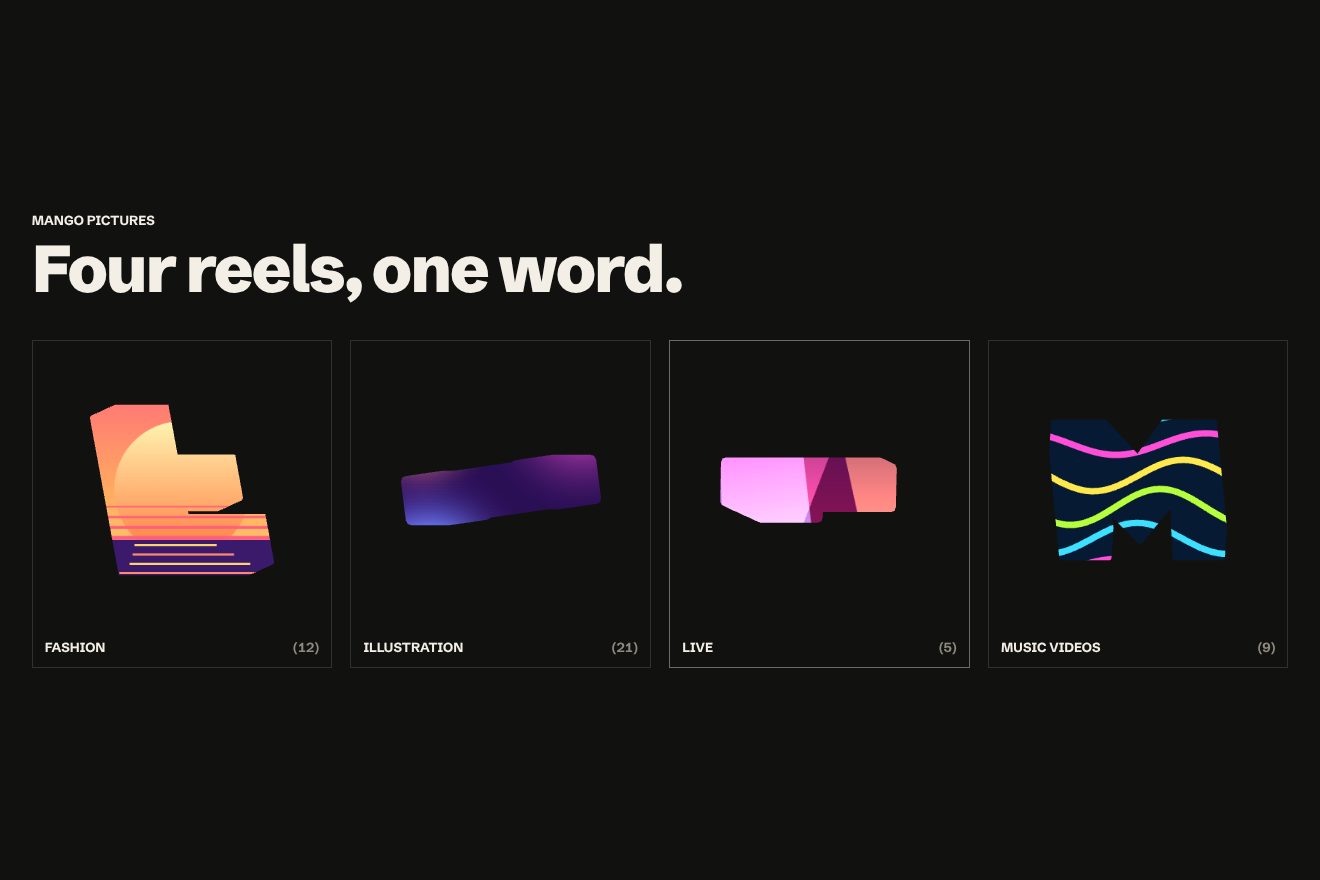
Each letter is a .bin file. At the start there are two 16 bit numbers, how many vertices and how many indices, then the coordinates as 16 bit integers, to multiply by 16 / 32767, and finally the triangles. The scene draws the letter in an offscreen canvas, with an orthographic camera √768 wide: it is the largest distance from the centre that a letter of 32 can reach while it turns, so it never touches the edges. The angles start from a random point and grow by 0.0008 and 0.00082 radians a millisecond around x and y. Then the visible canvas copies the silhouette and paints the video frame over it in source-in: where the letter is you see the video, cropped like a cover image. The scene only starts when the card enters the screen. Without WebGPU the same letter becomes a still SVG mask-image, 60% as wide as the card.
In our demo the letters are ours, F, I, L and M, for an invented production company, and we extrude them with Three.js, which uses WebGL and works almost everywhere. Instead of copying the silhouette onto another canvas we read the film directly in the shader, at the screen pixel, and a single canvas draws all four cards. The films are painted by the script thirty times a second; with the pointer over it, the letter turns four times faster and the film comes closer.
Weightless objects
On the Work and Info pages, and on the error page, the title is a huge ticker that runs across, and objects float around it: glass cubes with letters inside, a cube of cheese, a holographic one, the same letters full of images. They drift, turn, bounce off the edges, and the pointer pushes them away.
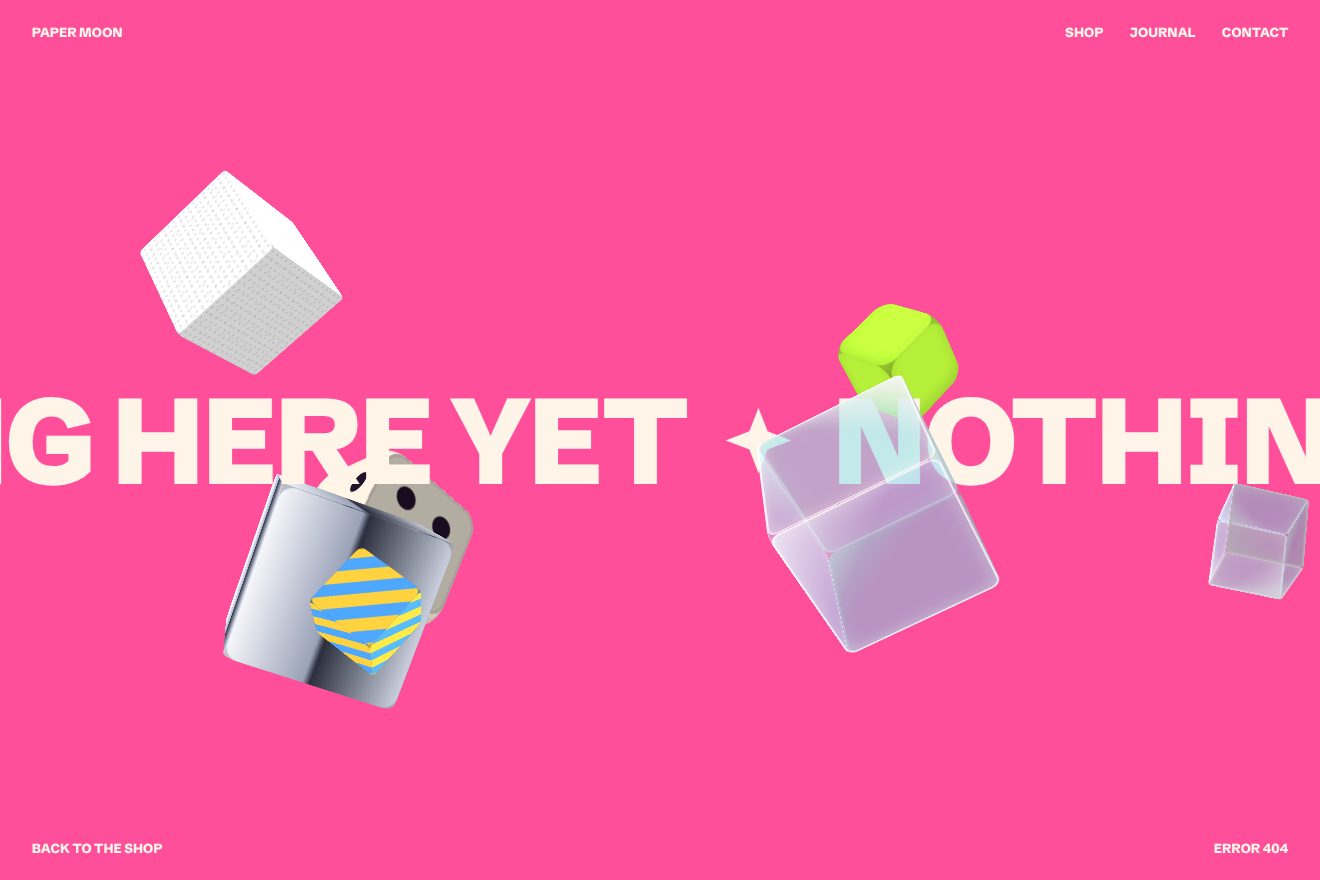
Each object has its position between 0 and 1 in the container. It sets off in a random direction at a speed between 0.00006 and 0.00014 a millisecond, with a spin of up to 0.02 degrees a millisecond. On every frame it keeps 99.6% of the speed above 0.0001 and 99.6% of the spin: it slows down to a quiet cruise and never stops. The edge that counts is the one of its box turned by the current angle. When it touches it, it bounces, and the speed along the wall, multiplied by 150, becomes spin, which never goes over 0.15. The pointer pushes the objects within 0.12 with a force of one millionth a millisecond. There are three sizes, 75, 125 and 175 pixels, which double from 768 pixels up. Turning on the site’s debug mode shows the dashed outline of the collisions. The objects are animations already rendered, like the glass cube, an animated webp of 300 pixels at 50 frames a second. The ticker runs at 0.15 pixels a millisecond and hides the copies that leave the screen.
In our demo it is the error page of an invented shop, with seven CSS 3D cubes in place of the rendered animations: glass, a die, sugar, candy, rubber and chrome, some in front of the letters and some behind. The numbers are the site’s, with one difference: the damping is tied to time and not to the frame, so on a 120 Hz screen the cubes do not slow down twice as fast.
The other details
The intro is the same solid W, used the other way round. The screen is all blue and the W is a hole: it grows to √3 × 0.15 in one second, then to √3 × 1.5 in another, turning from 350 to 200 degrees on one axis and from 310 to 220 on the other, until the hole is bigger than the screen and the page is uncovered; then the blue disappears in two tenths of a second. It only starts if there is WebGPU and less motion has not been asked for.
The ticker at the bottom, «We’d love to work with you», carries the studio’s bear between one sentence and the next, once standing and once upside down. While it is on screen, every now and then the bear wiggles, squashes and blinks. The email address in the footer is copied with a click, and the label changes to say so. In the work grid the previews of a project are stacked askew, and on hover they line up.
Where it stumbles
The screensaver starts after fifteen seconds without movement, and that is a short time: someone reading a case study without touching the mouse finds the text covered in stickers, and has to move it to get back to reading.
The best of it depends on WebGPU. Where it is missing, the intro is not there and the letters are still masks: you see a quieter site and you do not know it.
It is heavy. Scrolling the home page downloads 52 JavaScript files, 1.76 MB, that is about 576 KB compressed, and fifteen different videos start, each at its own quality.
What we take away
A brand can be a material, not just a logo: here the letters work as windows onto the work, the stickers as a screensaver, the objects as toys, and everything comes back to the same drawing. And new technology can be used without leaving anyone behind: those with WebGPU see the turning solids, those without see the same letters, flat and still, and the site works all the same.
The effects
- The sticker-bombed pageLeft alone for a few seconds, the page gets covered by its own stickers: they fly up from below, spinning, and stick everywhere, the big ones first, then the middle ones, then a dense carpet of small ones. At the first movement they fly off upwards, and cut short halfway they turn back from wherever they are.Free
- Letters full of filmFour cards with the letters of the word FILM: each letter is a solid turning slowly around two axes, and its outline is filled with the footage of its category, flat, as if the letter were a hole in the screen. Only the outline changes, the picture inside stays put and keeps playing.Free
- The weightless objectsA giant title runs across the page like a ticker, and in front of its letters and behind them float cubes of glass, sugar, candy, rubber and chrome: they drift and turn, slow down to a quiet cruise, bounce off the edges and the bounce becomes spin. The pointer pushes them away.Free