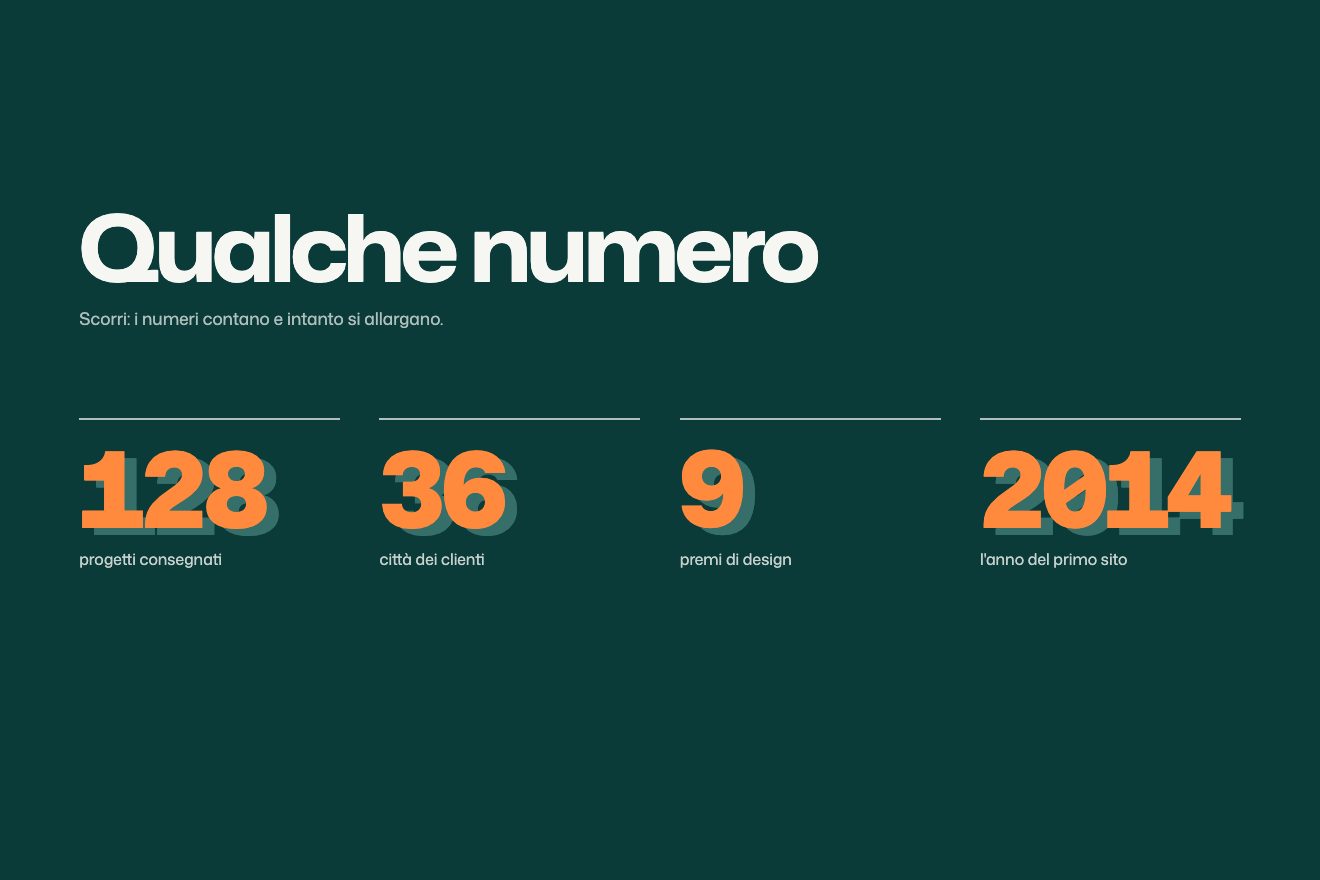
Long shadow letters
Text, Scroll, 3D
Scroll inside the preview
The story of a made-up spring water, Stillmere, in three chapters on a stage that stays put while you scroll: past each chapter’s threshold the old headline’s lines leave upwards leaning back and the new ones rise from below leaning forward, settling on a short spring; the two pictures beside it fold askew into their bottom edge and the new ones open out of it. Within a chapter the pictures tilt and drift as you scroll. Minimal style, warm white paper, sage and blue-black ink.
Rebuilt from scratch studying aupalevodka.com by Locomotive: the idea is theirs; code, copy and images are ours. Read how it’s made
A folder that runs on its own: index.html, style.css, script.js and the libraries from a CDN. The React and Vue tabs hold the same demo as a ready component, which switches its animations off when it leaves the page.
<!doctype html>
<!--
  "Askew chapters" from Animorio · https://animorio.com
  License: free on your own sites and your clients’ sites, paid work included.
  Not for resale, redistribution, templates or code collections · https://animorio.com/en/license/
-->
<html lang="en">
<head>
  <meta charset="utf-8">
  <meta name="viewport" content="width=device-width, initial-scale=1">
  <title>Chapters that swap askew on scroll</title>
  <link rel="stylesheet" href="https://cdn.jsdelivr.net/npm/@fontsource/instrument-serif@5.3.0/400.css">
  <link rel="stylesheet" href="https://cdn.jsdelivr.net/npm/@fontsource/instrument-serif@5.3.0/400-italic.css">
  <link rel="stylesheet" href="https://cdn.jsdelivr.net/npm/@fontsource-variable/mona-sans@5.3.0/wdth.css">
  <link rel="stylesheet" href="style.css">
</head>
<body>
  <!-- the story of a made-up spring water, Stillmere, told in three chapters. The section is tall and its stage stays
       on screen: the chapter shown is the part of the section you are in. When you cross into the next one, the lines
       of the old headline leave upwards, leaning back, and the new ones rise from below, leaning forward, and settle
       on a spring; the two small pictures beside the headline fold away into their bottom edge and the new ones open
       from it. Inside a chapter the pictures tilt a little more and drift as you scroll -->
  <main class="pagina">
    <section class="storia" data-storia aria-label="The Stillmere story">
      <div class="palco" data-palco>
        <div class="grana" aria-hidden="true"></div>

        <header class="barra">
          <span class="marchio">STILLMERE</span>
          <nav class="capi" aria-label="Chapters">
            <button type="button" class="capo" data-capo="0" aria-current="true">Source</button>
            <button type="button" class="capo" data-capo="1">Stone</button>
            <button type="button" class="capo" data-capo="2">Glass</button>
          </nav>
        </header>

        <!-- chapter: the source -->
        <article class="capitolo" data-capitolo>
          <h2 class="motto" data-motto>
            <span class="riga"><span class="riga__in">We take <em>nothing</em> out,</span></span>
            <span class="riga"><span class="riga__in">we add <em>nothing</em> in.</span></span>
          </h2>
          <figure class="carta carta--sinistra" data-carta>
            <div class="media" data-media>
              <img src="ghiaccio.webp" width="960" height="600" alt="Pale lake ice, cracked across, under a thin layer of snow" style="object-position: 50% 50%" loading="eager" decoding="async" />
              <span class="lampo" data-lampo aria-hidden="true"></span>
            </div>
          </figure>
          <figure class="carta carta--destra" data-carta>
            <div class="media" data-media>
              <img src="cresta.webp" width="1024" height="683" alt="A snowy mountain ridge going into the clouds" style="object-position: 40% 50%" loading="eager" decoding="async" />
            </div>
          </figure>
          <div class="nota" data-nota>
            <p class="nota__titolo" data-riga-nota>Nothing added. Nothing removed.</p>
            <p class="nota__testo" data-riga-nota>What leaves the spring is what fell as snow.</p>
          </div>
        </article>

        <!-- chapter: the stone -->
        <article class="capitolo" data-capitolo>
          <h2 class="motto" data-motto>
            <span class="riga"><span class="riga__in">Water that waited</span></span>
            <span class="riga"><span class="riga__in"><em>ten thousand</em> winters</span></span>
            <span class="riga"><span class="riga__in">under the <em>stone</em>.</span></span>
          </h2>
          <figure class="carta carta--sinistra" data-carta>
            <div class="media" data-media>
              <img src="granito.webp" width="960" height="640" alt="A face of grey granite, split along its grain" style="object-position: 35% 50%" loading="eager" decoding="async" />
            </div>
          </figure>
          <figure class="carta carta--destra" data-carta>
            <div class="media" data-media>
              <img src="goccia.webp" width="1024" height="683" alt="A drop falling into dark still water, rings opening around it" style="object-position: 62% 50%" loading="eager" decoding="async" />
            </div>
          </figure>
          <div class="nota" data-nota>
            <p class="nota__titolo" data-riga-nota>Filtered by granite.</p>
            <p class="nota__testo" data-riga-nota>Snowmelt sinks through the mountain and comes back cold and clear.</p>
          </div>
        </article>

        <!-- chapter: the glass -->
        <article class="capitolo" data-capitolo>
          <h2 class="motto" data-motto>
            <span class="riga"><span class="riga__in">Bottled <em>where</em></span></span>
            <span class="riga"><span class="riga__in">it rises,</span></span>
            <span class="riga"><span class="riga__in">still <em>cold</em>.</span></span>
          </h2>
          <figure class="carta carta--sinistra" data-carta>
            <div class="media" data-media>
              <img src="bottiglia.webp" width="683" height="1024" alt="A bottle of clear glass with a long neck, on a pale sage ground" style="object-position: 50% 60%" loading="eager" decoding="async" />
              <span class="riflesso" data-riflesso aria-hidden="true"></span>
            </div>
          </figure>
          <figure class="carta carta--destra" data-carta>
            <div class="media" data-media>
              <img src="riva.webp" width="960" height="640" alt="A still lake shore, pebbles under clear water and mountains reflected" style="object-position: 55% 50%" loading="eager" decoding="async" />
            </div>
          </figure>
          <div class="nota" data-nota>
            <p class="nota__titolo" data-riga-nota>Bottled at the source.</p>
            <p class="nota__testo" data-riga-nota>One spring, one valley, one bottle of clear glass.</p>
          </div>
        </article>

        <p class="scendi" data-scendi aria-hidden="true"><span>Scroll</span><svg viewBox="0 0 12 40"><path d="M6 0v36" /><path d="M2 32l4 6 4-6" /></svg></p>
      </div>
    </section>

    <footer class="chiusa">
      <p class="chiusa__marchio">Stillmere</p>
      <p class="chiusa__riga">Spring water from a still lake.</p>
    </footer>
  </main>

  <script src="https://cdn.jsdelivr.net/npm/gsap@3.15.0/dist/gsap.min.js"></script>
  <script src="https://cdn.jsdelivr.net/npm/gsap@3.15.0/dist/ScrollTrigger.min.js"></script>
  <script src="https://cdn.jsdelivr.net/npm/lenis@1.3.26/dist/lenis.min.js"></script>
  <script src="script.js"></script>
</body>
</html>Change values, colours and text with the controls and watch the animation respond live. Or write in the code yourself. Then download the folder with your changes.
46 values to change
With the Animorio connector, Claude Code, ChatGPT, Cursor or VS Code take it from here, guide included, and fit it into your project. Paste this request:
Take “Askew chapters” from Animorio and fit it into my siteThe section is as tall as the chapters times CHAPTER_HEIGHT screens and holds a sticky stage 100lvh tall. All the chapters sit on the same stage, one on top of the other, and only one shows. A ScrollTrigger from top top to bottom bottom gives the section’s progress; the chapter to show is floor(progress times the number of chapters), as on the original.
The swap doesn’t follow the scroll: when the index changes, the old chapter gets the timeline that hides it and the new one, a tenth of a second later, the one that shows it. The timelines last 0.7 seconds however fast you scroll, and a new one kills the one running.
Each headline line is a block with overflow: clip and two tenths of an em of room above and below, so italics and tall letters aren’t cut. Inside, the line comes in from yPercent 100, skewX 10 degrees and scale 1.04 with expo.out; it leaves to yPercent -104, skewX -12 and scale 0.96 with opacity 0.2, five hundredths of a second apart. The small lines below come in on a spring.
The original uses anime.js createSpring with bounce 0.214 and a perceived duration of 700 milliseconds. We rebuild it by hand: stiffness (2π/0.7) squared, damping (1 − 0.214) times 4π/0.7, the damped oscillator’s solution as an easing function, and the time the spring really takes to stop as the tween’s duration.
Each picture opens from scale 0, skewX 12 and skewY 10 degrees, opacity 0 and a clip-path of inset(100% 0 0 0 round 16px), that is, shut into its bottom edge, to fully open in 0.8 seconds, a tenth apart; it folds back the same way. As it lands it drops a pixel and a half and comes back up.
On every scroll update the progress inside each chapter is measured; the offset is (the section’s progress plus the chapter’s) times −2.5 hundredths of the screen height. The headline follows it fully, the line below at three quarters, the pictures five times, in opposite directions that swap from one chapter to the next, and they rotate up to 15 degrees by the end of the chapter. On narrow screens the pictures move at 30 per cent.
| Name | File | Default | What it changes |
|---|---|---|---|
CHAPTER_HEIGHT | script.js | 150 | How much scroll each chapter lasts, in screen heights. |
DURATION | script.js | 0.7 | Seconds of the swap between one chapter and the next. |
LINE_STAGGER | script.js | 0.05 | Seconds between one headline line and the next. |
PICTURE_STAGGER | script.js | 0.1 | Seconds between the two pictures. |
BOUNCE | script.js | 0.214 | How much the spring the small lines settle on bounces (0 none, 0.6 a lot). |
LEAN | script.js | 10 | How many degrees the lines lean as they come in. |
TILT | script.js | 15 | How many degrees the pictures tilt by the end of their chapter. |
DRIFT | script.js | 2.5 | How far everything drifts as you scroll, in hundredths of the screen height. |
SMOOTH | script.js | 1.1 | Seconds of the smooth scroll; 0 for the browser’s own. |
To tell the story of a brand, a product or a place in a few chapters: a drink’s philosophy, the steps of a craft, a company’s values, the rooms of a hotel. It works when each chapter has one strong sentence and two small pictures.
The same swap with the same curves: the pictures go above and below the headline instead of beside it, sized on the height too, and drift at 30 per cent; the long sentence below goes and the uppercase line stays.
The chapters swap with a half-second fade, already in place: no rising lines, no opening pictures, no tilt or drift, no life inside the pictures, no smooth scroll.
GSAP 3.15.0, ScrollTrigger 3.15.0, Lenis 1.3.26, Instrument Serif 5.3.0, Mona Sans (font variabile) 5.3.0.
Compressed with gzip, the three demo files weigh 7.1 KB; the libraries: GSAP + ScrollTrigger 45 KB, Lenis 5.3 KB.
Tested on 8 November 2026
Use it in your own projects and in your clients’ projects. Do not resell it or redistribute it as is. GSAP stays under its own Standard license. Full license.
Support Animorio
Animorio stays free thanks to the people who support it. If you like, buy us a coffee: it helps us make the next animations.
You asked for
We made it for you: it’s in the library, with the preview, the Playground and the code to copy.
An animation you can’t find, or a site to take apart in the journal: tell us which. We pick the next ones from here.
With your account’s email and password.
or with your email
You’re signed in as .
With your account, you can download the zip of every animation and every pack, for free.