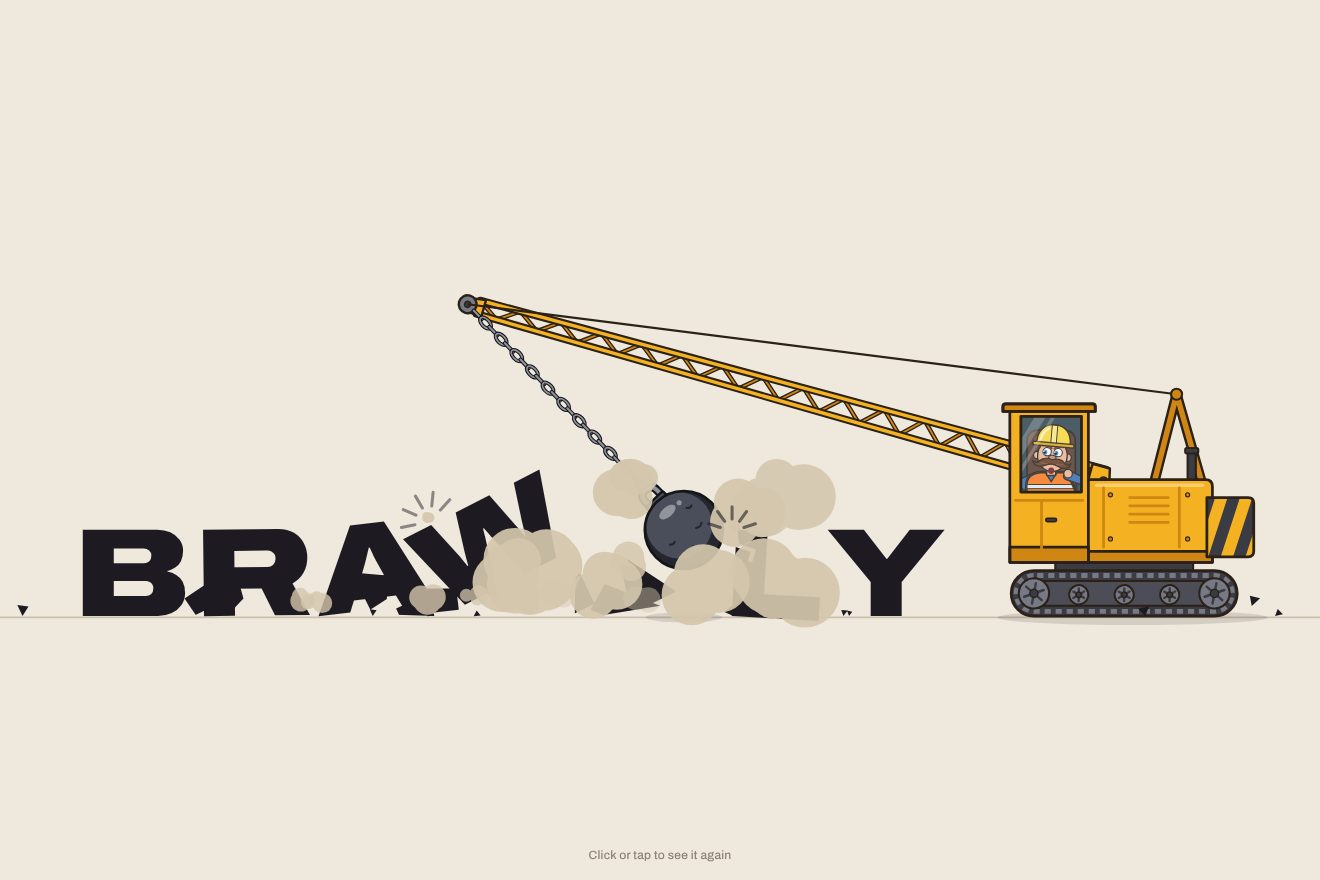
The wrecking-ball logo
Intro, Physics, SVG, Text
NewFree
In the minimal style, with real physics: the letters of CHAIN stand on a thin line like dominoes, each inside a tall rectangle drawn with a single line. A vermilion push tips the first one over; it hits the second and leans on it, and the knock runs through the word until the last one lies flat and the others rest one on the next. At every knock the letter narrows on the width axis and warms up in vermilion; then the tiles stand up again one after another.
A folder that runs on its own: index.html, style.css, script.js and the libraries from a CDN. The React and Vue tabs hold the same demo as a ready component, which switches its animations off when it leaves the page.
<!doctype html>
<html lang="en">
<head>
  <meta charset="utf-8">
  <meta name="viewport" content="width=device-width, initial-scale=1">
  <title>Chain</title>
  <link rel="stylesheet" href="https://cdn.jsdelivr.net/npm/@fontsource-variable/anybody@5.3.0/wdth.css">
  <link rel="stylesheet" href="style.css">
</head>
<body>
  <!-- the whole room is the button: a click pushes the first letter, or the one under the pointer -->
  <main class="stage" data-stage tabindex="0" role="button" aria-label="The word CHAIN set up as dominoes. Press to push the first letter.">
    <header class="top">
      <span class="top__brand">Chain</span>
      <span class="top__note">Automations that run themselves</span>
    </header>

    <svg class="room" data-svg aria-hidden="true">
      <path class="floor" data-floor d="" />
      <g data-ticks></g>
      <g data-tiles></g>
      <path class="finger" data-finger d="" />
    </svg>

    <p class="hint" data-hint>Click to push the first letter.</p>
    <p class="read" data-readout><span class="read__label">Chain</span> <b class="read__value" data-read>0.00 s</b></p>
  </main>

  <script src="https://cdn.jsdelivr.net/npm/gsap@3.15.0/dist/gsap.min.js"></script>
  <script src="script.js"></script>
</body>
</html>Change values, colours and text with the controls and watch the animation respond live. Or write in the code yourself. Then download the folder with your changes.
17 values to change
With the Animorio connector, Claude Code takes it from here, guide included, and fits it into your project. Paste this request:
Take “The domino word” from Animorio and fit it into my siteEach tile is a slab turning on its front corner, with an angle and an angular speed. Gravity acts on its middle: while the middle is behind the corner it holds the tile up, as soon as it passes it pulls it down. The moment of inertia is that of a slab about a corner, (thickness² + height²) / 3. Everything is measured in tile heights, so the fall keeps the same pace on every screen. The physics step is a twelve-hundredth of a second, inside gsap.ticker, and a frame's time never goes over a thirtieth of a second.
At every step the top corner of a tile is looked at in the frame of the next tile: if it has gone into its back face, there is a contact. Along the face's normal the relative speed of the two points is worked out and an impulse cancels it (with a small bounce, 0.12, only for real knocks), then the overlap is taken away by turning both tiles in proportion to their levers. Eight passes per step are enough for a row of leaning tiles to stay still without trembling.
The gap between tiles is held between two limits: wide enough for a tile to reach its neighbour after it has passed its balance point (above the sine of the critical angle), narrow enough for the one before the last to still find the last one's face when that one lies flat. With a gap of 0.42 the first tile reached the second just past balance, with no swing left, and fell back: now the tiles are thinner (0.3) and further apart (0.55).
A real knock, above a speed threshold, lights the tile that is hit: the outline and the letter turn vermilion with gsap.utils.interpolate and cool down in a second; the letter narrows on the wdth axis (font-stretch) and gains weight, then comes back on an elastic. The floor stops the tile lying flat with a small bounce; the last one to touch down stops the stopwatch.
The hand is a GSAP timeline: a vermilion stroke comes in from behind with power2.in and at the touch gives the tile the angular speed it needs to pass its balance, times PUSH. When everything is still the physics falls asleep and the drawing stops: nothing is redrawn until something moves. The tiles stand up on another timeline, one after another, going a hair past upright onto the other corner and coming back with back.out. The loop is always the same, because every push starts with the physics clock reset.
| Name | File | Default | What it changes |
|---|---|---|---|
WORD | script.js | 'CHAIN' | The word: one tile per letter, from 3 to 7 letters. |
GRAVITY | script.js | 22 | How fast a tile falls, in tile heights per second squared: 10 is slow motion, 40 is brisk. |
SPACING | script.js | 0.55 | The gap between two tiles, as a share of their height (0.5 to 0.6). |
SLAB | script.js | 0.3 | How thick a tile is, as a share of its height. |
PUSH | script.js | 1.4 | How hard the hand pushes: 1.4 is a firm nudge, 2.5 is a shove. |
HOLD | script.js | 1.6 | How many seconds the fallen word rests before it stands up again. |
SQUASH | script.js | 1 | How much a knock narrows the letter on the width axis (0 = not at all). |
--accent | style.css | #e5432a | The colour of the hand and of the knock running through the word. |
--weight | style.css | 720 | The weight of the letters’ typeface, from 100 to 900. |
For the title of a product that sets things off by itself: an automation service, a workflow app, the how it works part of a landing page, the cover of a physics or type project. It works with any short word in capitals, a brand name too.
The same physics, measured in tile heights: the tiles are smaller so the whole row, the last one lying flat included, fits the width. A tap pushes the first tile, or the one tapped; with the tiles down, a tap stands them up.
Nothing falls in front of you: the tiles fade in, standing. A click fades them out and back in already fallen, in the exact pose the physics finds (worked out silently to the end), with the time of the chain; another click puts them back up the same way.
GSAP 3.15.0, Anybody (font variabile) 5.3.0.
Compressed with gzip, the three demo files weigh 8.2 KB; the libraries: GSAP 28 KB.
Tested on 19 October 2026
Use it in your own projects and in your clients’ projects. Do not resell it or redistribute it as is. GSAP stays under its own Standard license. Full license.
With your account’s email and password.
or with your email
You’re signed in as .
With your account, you can download the zip of every animation and every pack, for free.