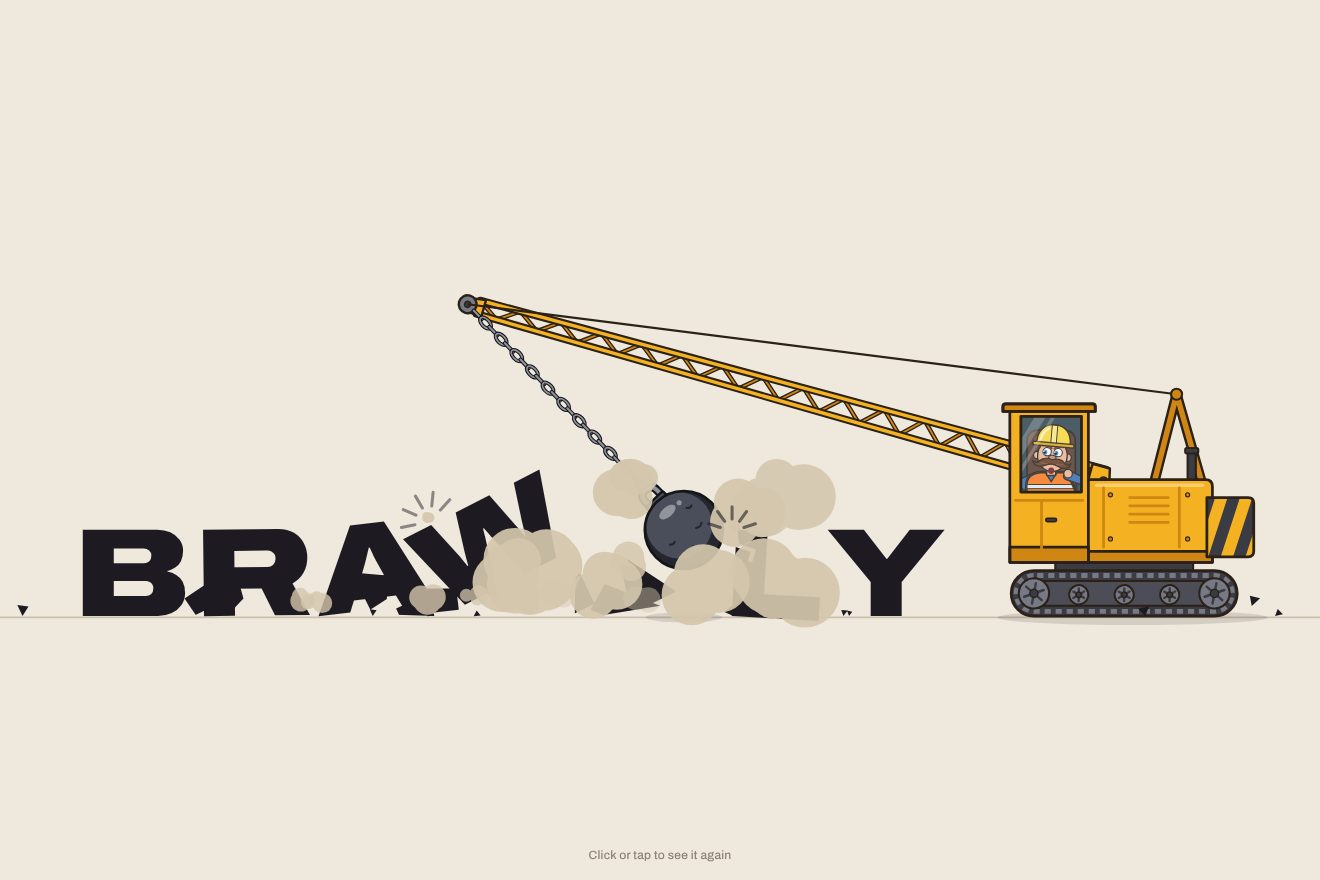
The wrecking-ball logo
Intro, Physics, SVG, Text
NewFree
In the minimal style, with real physics: a sentence where every letter is a weight tied to its neighbours by springs, closed between two thin walls. A wall knocks and a compression wave runs along the sentence like sound through air, bounces off the other wall and comes back, weaker every time: where it passes the letters get narrower, heavier and blue on the axes of the variable typeface, and below a thin trace draws the pressure.
A folder that runs on its own: index.html, style.css, script.js and the libraries from a CDN. The React and Vue tabs hold the same demo as a ready component, which switches its animations off when it leaves the page.
<!doctype html>
<html lang="en">
<head>
  <meta charset="utf-8">
  <meta name="viewport" content="width=device-width, initial-scale=1">
  <title>Hall acoustics</title>
  <link rel="stylesheet" href="https://cdn.jsdelivr.net/npm/@fontsource-variable/roboto-flex@5.3.0/full.css">
  <link rel="stylesheet" href="style.css">
</head>
<body>
  <!-- the whole room is the button: a click knocks the sentence from the nearer end; a letter can be pulled and let go -->
  <main class="stage" data-stage tabindex="0" role="button" aria-label="A sentence made of letters on springs. Press to knock it from one end and watch the push travel along it.">
    <header class="top">
      <span class="top__brand">Hall</span>
      <span class="top__note">Acoustics for rooms that carry a voice</span>
    </header>

    <!-- the sentence: the script splits it into letters, each one a weight on a spring between its neighbours -->
    <h1 class="line" data-line>a push, passed along</h1>

    <svg class="scope" data-svg aria-hidden="true">
      <path class="wall" data-wall-l d="" />
      <path class="wall" data-wall-r d="" />
      <path class="axis" data-axis d="" />
      <path class="marks" data-marks d="" />
      <path class="trace" data-trace d="" />
    </svg>

    <p class="hint" data-hint>Click near an end to knock the sentence, or pull a letter.</p>
    <p class="read" data-readout><span class="read__label">Compression</span> <b class="read__value" data-read>0%</b></p>
  </main>

  <script src="https://cdn.jsdelivr.net/npm/gsap@3.15.0/dist/gsap.min.js"></script>
  <script src="script.js"></script>
</body>
</html>Change values, colours and text with the controls and watch the animation respond live. Or write in the code yourself. Then download the folder with your changes.
16 values to change
With the Animorio connector, Claude Code takes it from here, guide included, and fits it into your project. Paste this request:
Take “The knock that runs through the sentence” from Animorio and fit it into my siteThe sentence is split into letters, each in a span the script places around its own centre. Every letter has a mass in proportion to its width and every spring between two letters is stiffer the shorter it is: so, as in a uniform material, the wave runs at the same speed everywhere, and that speed is the width of the sentence over CROSS seconds. Two more springs tie the first and the last letter to the walls.
The knock is not an animation of the letters: it is the wall that moves, going in on half a cosine in a short time and coming out eight times more slowly, and the wall's motion pulls the first spring. The knock lasts as long as the wave takes to cross five letters: shorter, the springs between single letters crumbled it into ripples (a lattice of springs disperses waves only a few steps long).
The physics runs in fixed steps of a twelve-hundredth of a second inside gsap.ticker, and a frame's time never goes over a thirtieth of a second. The air takes speed away so the wave dies in about ECHOES crossings; a little friction inside the springs (in proportion to the difference in speed between neighbours) calms the fine shiver without touching the big wave. When everything is still the sentence falls asleep and is no longer redrawn.
For every letter the compression is one minus the stretch of its two springs. Squeezed, the letter narrows on the wdth axis and gains weight on wght (font-variation-settings of Roboto Flex) and turns blue with gsap.utils.interpolate; pulled, it widens and gets lighter. The weight grows less than the width it loses: with too much weight the squeezed letters touched. The trace below passes through every letter's compression on a Catmull-Rom curve.
A gsap.delayedCall makes a wall knock every EVERY seconds, one and then the other; a click knocks at once from the nearer wall and puts the loop back in step. A letter that is taken follows the pointer sideways, driven, and pulls on the springs; let go, it sends one wave each way. Every knock starts from the still sentence (what is left of the one before, a pixel or two, is let go), so the loop always comes back the same.
| Name | File | Default | What it changes |
|---|---|---|---|
CROSS | script.js | 1.1 | How many seconds the knock takes to run from one end of the sentence to the other. |
KNOCK | script.js | 1 | How hard the wall knocks: 0.5 is a tap, 1.6 is a slam. |
ECHOES | script.js | 3 | About how many times the knock crosses the sentence before it dies down. |
SQUEEZE | script.js | 1 | How much the letters answer on the width and weight axes (0 = not at all). |
EVERY | script.js | 4.5 | How many seconds between two knocks when the page is left alone, one wall and then the other. |
--accent | style.css | #2b4cff | The colour of the wall that knocks and of the most squeezed letters. |
--weight | style.css | 380 | The weight of the sentence’s typeface at rest, from 100 to 900. |
For a sentence that should let you feel something passed from hand to hand: an acoustics studio, a music label, a podcast, the page of a delivery service or of a referral scheme, the title of a landing page that explains how something spreads. It works with any one-line sentence, up to forty characters.
The same physics: the sentence takes almost the whole width and the knock is always five letters long, so the wave reads the same. A tap knocks from the nearer wall, a letter is pulled with a finger.
Nothing moves: the sentence fades in. A click fades it out and back in at the moment the wave is halfway, worked out silently (squeezed letters in blue, the trace with its bump), and a little later it comes back to rest, again in a fade.
GSAP 3.15.0, Roboto Flex (font variabile) 5.3.0.
Compressed with gzip, the three demo files weigh 8.4 KB; the libraries: GSAP 28 KB.
Tested on 19 October 2026
Use it in your own projects and in your clients’ projects. Do not resell it or redistribute it as is. GSAP stays under its own Standard license. Full license.
With your account’s email and password.
or with your email
You’re signed in as .
With your account, you can download the zip of every animation and every pack, for free.