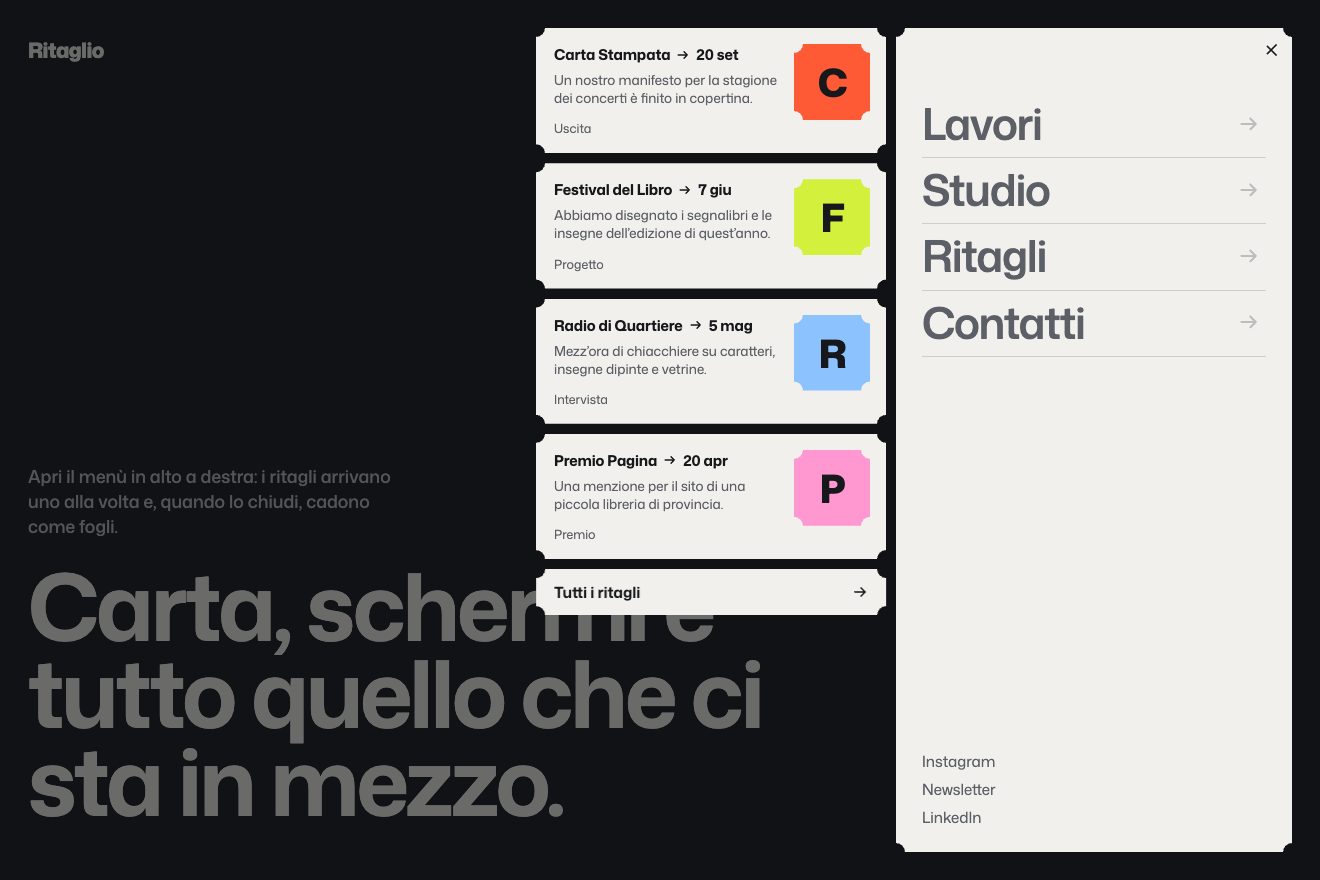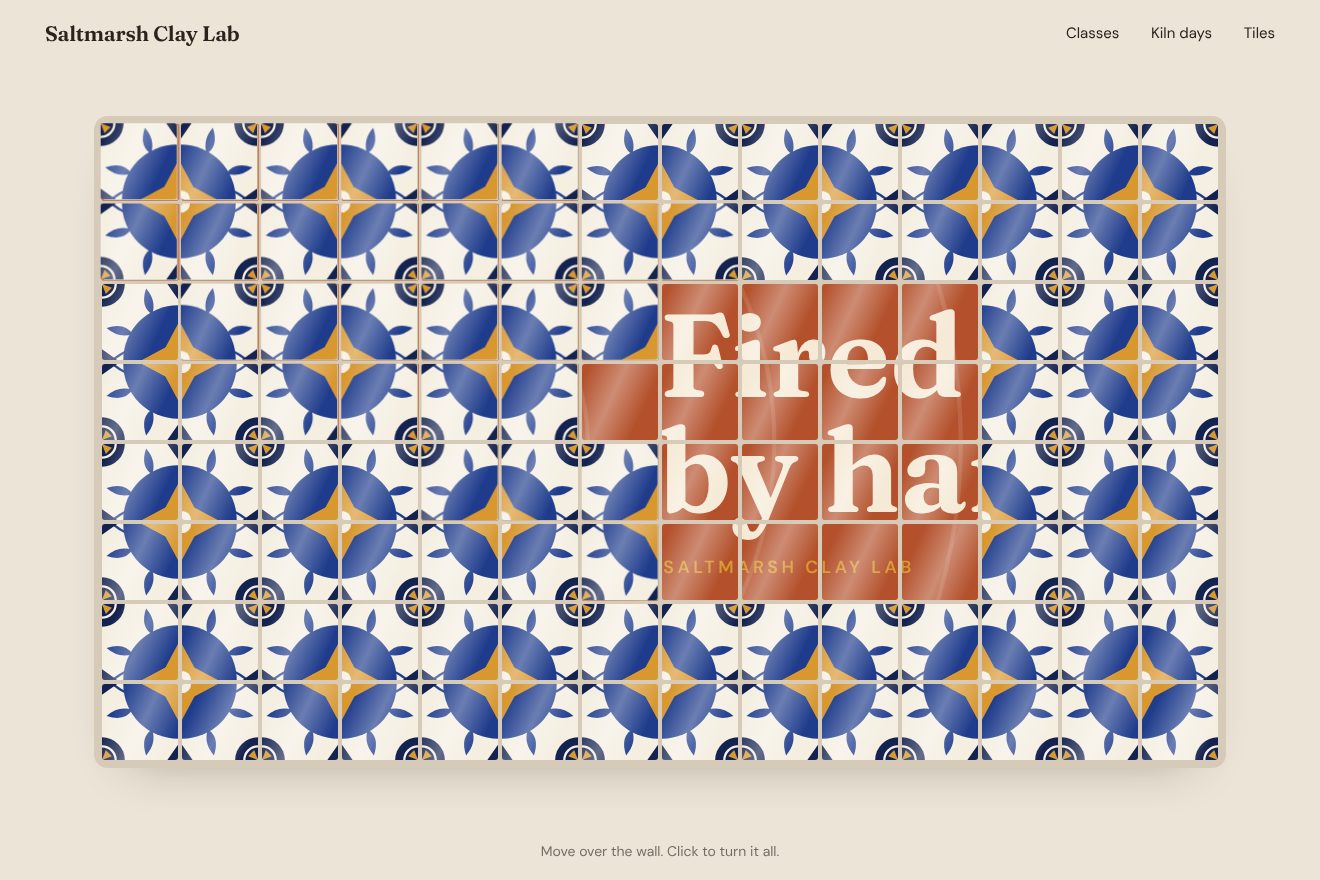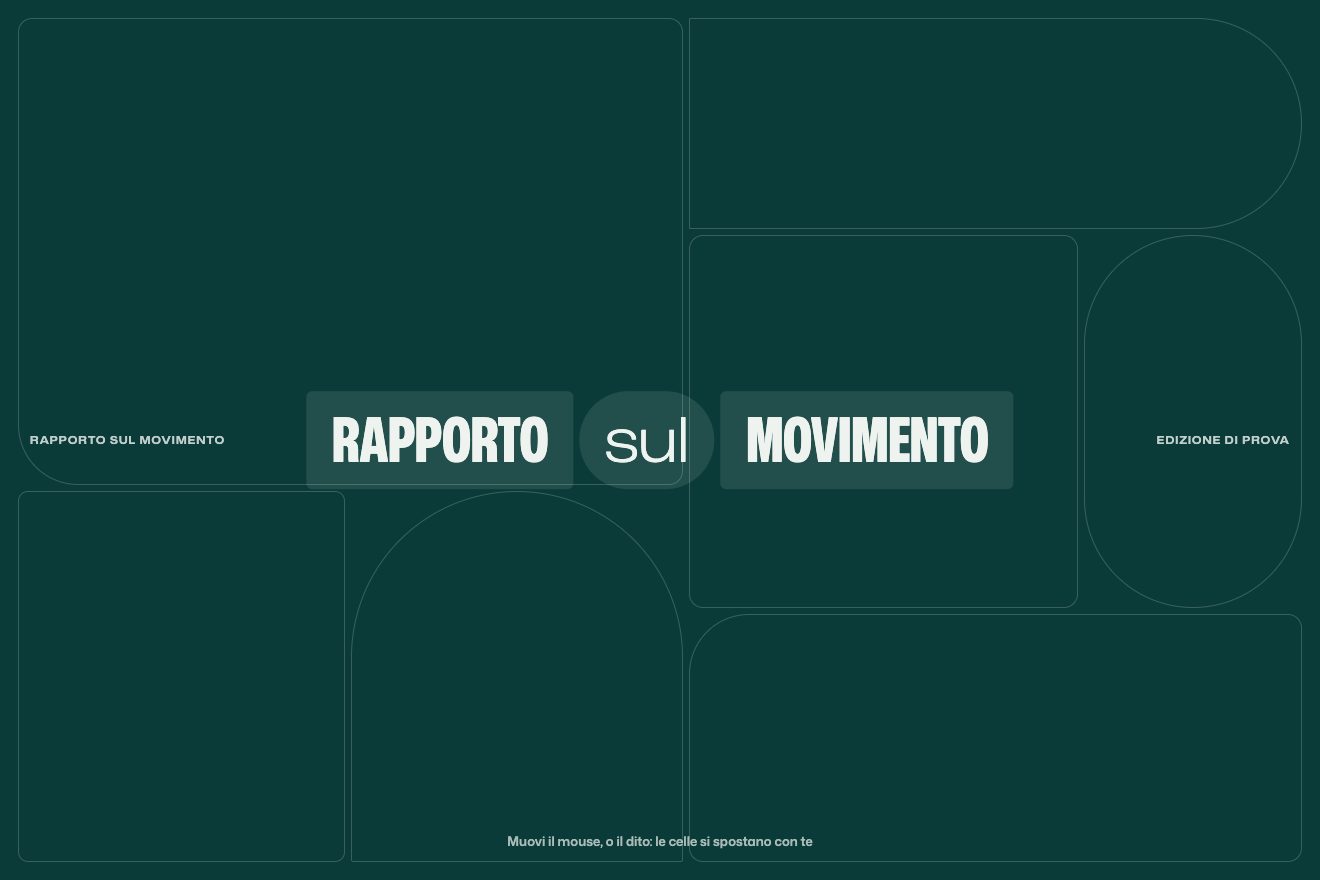
The liquid grid
Hover, Transitions
A hover animation in the premium style of real product interface pieces: the feature bento grid of an analytics app with an AI assistant, on a grainy ink page. The card under the pointer swells a little and leans toward it, its thin edge catches a light that follows it and its little live piece wakes up: the chart draws its line and shows the point, the AI writes its answer, the uptime bars ripple, the team's faces fan out, the funnel fills. The neighbouring cards step aside on a spring, the nearer ones more, and catch the reflected light on the side facing the pointer.
A folder that runs on its own: index.html, style.css, script.js and the libraries from a CDN. The React and Vue tabs hold the same demo as a ready component, which switches its animations off when it leaves the page.
<!doctype html>
<!--
  "Make-way bento grid" from Animorio · https://animorio.com
  License: free on your own sites and your clients’ sites, paid work included.
  Not for resale, redistribution, templates or code collections · https://animorio.com/en/license/
-->
<html lang="en">
<head>
  <meta charset="utf-8">
  <meta name="viewport" content="width=device-width, initial-scale=1">
  <title>The feature bento grid with the neighbouring cards that make way</title>
  <link rel="stylesheet" href="https://cdn.jsdelivr.net/npm/@fontsource-variable/mona-sans@5.3.0/wdth.css">
  <link rel="stylesheet" href="style.css">
</head>
<body>
  <main class="stage" data-stage>
    <!-- the features of Nimbra, an invented analytics app with an AI assistant, as a bento grid. The card under the
         pointer swells a little, its edge catches a light that follows the pointer and its little live piece wakes up;
         the neighbouring cards step aside on springs and catch the reflected light on the edge that faces it -->
    <section class="bento" aria-labelledby="bento-title">
      <header class="bento__head">
        <p class="bento__eyebrow">Nimbra for teams</p>
        <h1 class="bento__title" id="bento-title">Every number, one calm place</h1>
      </header>

      <div class="grid" data-grid>
        <!-- revenue: the big card, a line chart with a point that lights up -->
        <article class="tile tile--rev" data-tile="rev" tabindex="0">
          <div class="tile__body">
            <p class="tile__label">Revenue, last 30 days</p>
            <p class="rev__num"><span data-rev>$48,210</span><span class="chip chip--up" data-rev-chip>
              <svg viewBox="0 0 12 12" aria-hidden="true"><path d="M3 7.6 6 4.6l3 3"/></svg>12.4%</span></p>
            <div class="rev__chart">
              <svg class="rev__svg" viewBox="0 0 300 120" preserveAspectRatio="none" aria-hidden="true">
                <defs>
                  <linearGradient id="rev-fill" x1="0" y1="0" x2="0" y2="1">
                    <stop offset="0" stop-color="var(--accent)" stop-opacity="0.32"/>
                    <stop offset="1" stop-color="var(--accent)" stop-opacity="0"/>
                  </linearGradient>
                </defs>
                <path class="rev__grid" d="M0 30H300M0 60H300M0 90H300"/>
                <path class="rev__area" d="M0 96 C20 92 32 84 50 86 S84 98 104 82 S136 58 156 64 S190 80 210 56 S244 30 262 38 S290 22 300 18 V120 H0Z" fill="url(#rev-fill)"/>
                <path class="rev__line" d="M0 96 C20 92 32 84 50 86 S84 98 104 82 S136 58 156 64 S190 80 210 56 S244 30 262 38 S290 22 300 18"/>
                <path class="rev__hot" data-rev-hot pathLength="1" d="M0 96 C20 92 32 84 50 86 S84 98 104 82 S136 58 156 64 S190 80 210 56 S244 30 262 38 S290 22 300 18"/>
              </svg>
              <span class="rev__cross" data-rev-cross aria-hidden="true"></span>
              <span class="rev__dot" data-rev-dot aria-hidden="true"></span>
              <span class="rev__tip" data-rev-tip>Oct 28<b>$2,140</b></span>
            </div>
          </div>
        </article>

        <!-- the AI assistant: a question and the answer that writes itself -->
        <article class="tile tile--ask" data-tile="ask" tabindex="0">
          <div class="tile__body">
            <p class="tile__label"><svg class="spark" viewBox="0 0 16 16" aria-hidden="true"><path d="M8 1.6c.5 3.3 1.8 4.9 5.4 5.4-3.6.5-4.9 2.1-5.4 5.4-.5-3.3-1.8-4.9-5.4-5.4 3.6-.5 4.9-2.1 5.4-5.4z"/></svg>Ask Nimbra</p>
            <div class="ask__field" data-ask-field>
              <span class="ask__beam" data-ask-beam aria-hidden="true"></span>
              <span class="ask__q">Why did churn dip in May?</span>
            </div>
            <div class="ask__out">
              <span class="ask__skel" data-ask-skel aria-hidden="true"><i></i><i></i></span>
              <p class="ask__a" data-ask-a><span>Annual</span> <span>plans</span> <span>launched</span> <span>May 4.</span> <span>Churn</span> <span>fell</span> <span>2.1</span> <span>points.</span></p>
            </div>
          </div>
        </article>

        <!-- uptime: thirty days of small bars -->
        <article class="tile tile--up" data-tile="up" tabindex="0">
          <div class="tile__body">
            <p class="tile__label">Uptime</p>
            <p class="tile__big" data-up-num>99.98%</p>
            <div class="up__bars" data-up-bars aria-hidden="true"></div>
          </div>
        </article>

        <!-- seats: the faces of the team that fan out -->
        <article class="tile tile--team" data-tile="team" tabindex="0">
          <div class="tile__body">
            <p class="tile__label">Team seats</p>
            <p class="tile__big"><span data-team-num>16</span><span class="tile__of"> of 20</span></p>
            <div class="team__row" aria-hidden="true">
              <span class="face" data-face style="--h: 252">AK</span>
              <span class="face" data-face style="--h: 162">MR</span>
              <span class="face" data-face style="--h: 32">JS</span>
              <span class="face" data-face style="--h: 300">EL</span>
              <span class="face face--more" data-face>+12</span>
            </div>
          </div>
        </article>

        <!-- the funnel: four steps that fill from the bottom -->
        <article class="tile tile--fun" data-tile="fun" tabindex="0">
          <div class="tile__body">
            <p class="tile__label">Signup funnel</p>
            <div class="fun__cols" aria-hidden="true">
              <div class="fun__col" data-fun style="--v: 1"><span class="fun__bar"><i data-fun-fill></i></span><b data-fun-num="100">100%</b><small>Visit</small></div>
              <div class="fun__col" data-fun style="--v: 0.42"><span class="fun__bar"><i data-fun-fill></i></span><b data-fun-num="42">42%</b><small>Sign up</small></div>
              <div class="fun__col" data-fun style="--v: 0.18"><span class="fun__bar"><i data-fun-fill></i></span><b data-fun-num="18">18%</b><small>Trial</small></div>
              <div class="fun__col" data-fun style="--v: 0.07"><span class="fun__bar"><i data-fun-fill></i></span><b data-fun-num="7">7%</b><small>Paid</small></div>
            </div>
          </div>
        </article>
      </div>
    </section>

    <!-- the pointer drawn for the walk on its own -->
    <svg class="ghost" data-ghost viewBox="0 0 24 24" aria-hidden="true"><path d="M5.5 3.2v15.6l4.1-3.9 2.6 5.9 2.6-1.1-2.6-5.8h5.6z"/></svg>
    <p class="sr" aria-live="polite" data-live></p>
  </main>

  <script src="https://cdn.jsdelivr.net/npm/gsap@3.15.0/dist/gsap.min.js"></script>
  <script src="script.js"></script>
</body>
</html>Change values, colours and text with the controls and watch the animation respond live. Or write in the code yourself. Then download the folder with your changes.
58 values to change
With the Animorio connector, Claude Code, ChatGPT, Cursor or VS Code take it from here, guide included, and fit it into your project. Paste this request:
Take “Make-way bento grid” from Animorio and fit it into my siteFive cards in a CSS grid of four columns and three rows, with the rows measured on the window's height too (clamp with vh); below 560 px the grid switches to two columns and the title goes, so it all fits the phone's box.
Each card has its own spring for x, y and scale, integrated by hand in two steps per frame inside gsap.ticker (stiffness 260, damping 19). The card under the pointer aims at a scale of 1.035 and leans 4 px; the others aim at a shift along the direction they lie in, 9 px divided by 1 plus the distance over 60.
The edge is a pseudo-element with a radial gradient at the pointer, clipped to a one pixel ring with mask-composite. The variables --mx and --my tell each card where the light is relative to it: for the neighbours the centre falls outside, so only the side facing the pointer lights up, with a strength that drops with distance.
Each card has two functions, on and off, made of GSAP tweens with overwrite: the chart line with strokeDashoffset on pathLength 1, the figures counting, the answer's words coming out of a blur with a stagger, the bars with a wave of scaleY and back.out, the faces with staggered x.
Pressing a card takes 0.9 off the velocity of its scale: the spring does the rest, gives and comes back with overshoot. The walk on its own is a timeline taking a drawn pointer from card to card and pressing; the real pointer stops it and, on leaving, starts it again after two and a half seconds with gsap.delayedCall.
| Name | File | Default | What it changes |
|---|---|---|---|
PUSH | script.js | 9 | How many pixels the neighbouring cards step aside. |
SWELL | script.js | 1.035 | How much the card under the pointer swells. |
LEAN | script.js | 4 | How many pixels it leans toward the pointer. |
REFLECT | script.js | 0.55 | How much reflected light the neighbours catch on their edge. |
DIM | script.js | 0.62 | How bright the other cards stay while one is hovered. |
RING | script.js | 200 | How big the light on the edge is, in pixels. |
STIFFNESS | script.js | 260 | The cards' springs: higher is quicker. |
DAMPING | script.js | 19 | Lower lets the cards pass the mark and come back. |
SPEED | script.js | 1 | 2 = the walk on its own twice as fast, 0.5 = half. |
LOOP | script.js | true | Repeats the walk on its own. |
For the features section of a SaaS homepage, an analytics app or an AI product, or for the plans page showing what each plan includes: a bento grid you explore with the pointer.
The same animation with adapted sizes: below 560 px the grid switches to two columns and the title goes, the rows are measured on the box's height and a finger taps a card to wake it and push the others aside.
The cards do not move or swell: the light on the edge and the reflected one fade in and out, and the live pieces appear already in place with a fade (the line, the point, the answer), with the figures changing.
GSAP 3.15.0, Mona Sans (font variabile) 5.3.0.
Compressed with gzip, the three demo files weigh 11 KB; the libraries: GSAP 28 KB.
Tested on 1 November 2026
Use it in your own projects and in your clients’ projects. Do not resell it or redistribute it as is. GSAP stays under its own Standard license. Full license.
Support Animorio
Animorio stays free thanks to the people who support it. If you like, buy us a coffee: it helps us make the next animations.
You asked for
We made it for you: it’s in the library, with the preview, the Playground and the code to copy.
An animation you can’t find, or a site to take apart in the journal: tell us which. We pick the next ones from here.
With your account’s email and password.
or with your email
You’re signed in as .
With your account, you can download the zip of every animation and every pack, for free.