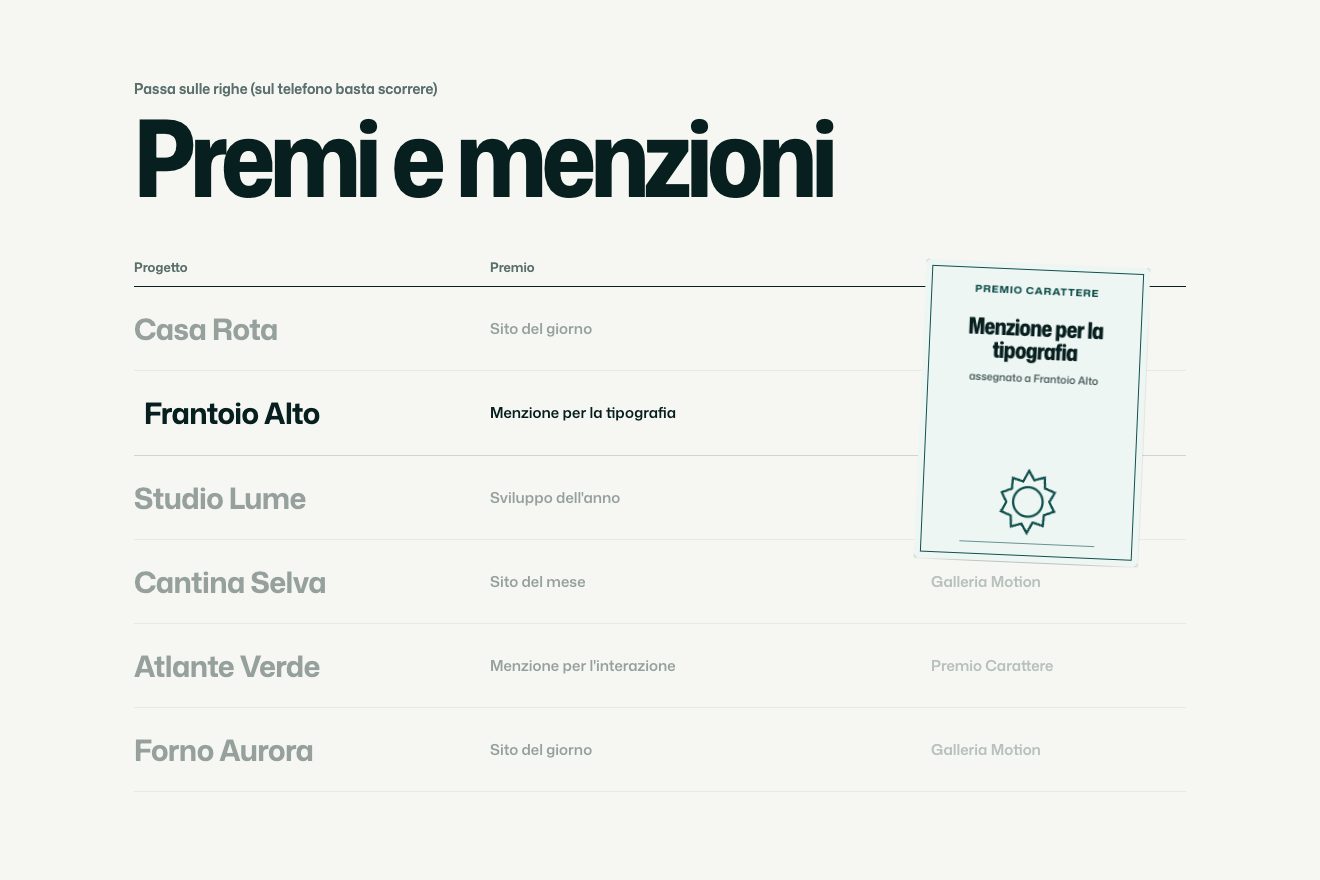
Stacking certificates
Hover, Images
The card of an art print by Mendwell, a made-up stationery shop, held to the wall by three strips of oat paper tape: in turn each strip peels from its loose end, folds back on itself showing its back and lies down again pressing in by one pixel. With the pointer over it, it peels further; with a click it comes off altogether and the card swings on the other two. From the peeling tape strips of the Sweet Tape site, Awwwards Site of the Day on 17/11/2026.
Rebuilt from scratch studying sweet-tape.com by bikebear: the idea is theirs; code, copy and images are ours. Read how it’s made
A folder that runs on its own: index.html, style.css, script.js and the libraries from a CDN. The React and Vue tabs hold the same demo as a ready component, which switches its animations off when it leaves the page.
<!doctype html>
<!--
  "Peeling tape card" from Animorio · https://animorio.com
  License: free on your own sites and your clients’ sites, paid work included.
  Not for resale, redistribution, templates or code collections · https://animorio.com/en/license/
-->
<html lang="en">
<head>
  <meta charset="utf-8">
  <meta name="viewport" content="width=device-width, initial-scale=1">
  <title>Mendwell, an art print held with oat paper tape</title>
  <link rel="stylesheet" href="https://cdn.jsdelivr.net/npm/@fontsource-variable/fraunces@5.3.0/index.css">
  <link rel="stylesheet" href="https://cdn.jsdelivr.net/npm/@fontsource-variable/instrument-sans@5.3.0/index.css">
  <link rel="stylesheet" href="style.css">
</head>
<body>
  <!-- a product card of Mendwell, a made-up stationery and tape shop: an art print held to the wall by three strips of
       oat paper tape. Every few seconds a strip peels from its loose end, folds back on itself showing the matte back,
       and lies down again with a one-pixel press. Hover a strip (or tap it) and it peels further; click it (or tap it
       again) and it comes off altogether: the card swings a little on the two strips left, then the strip comes back -->
  <main class="stage" data-stage>
    <div class="board" data-board>
      <div class="piece" data-piece>
        <article class="card" data-card aria-label="Lemons and Orange, art print">
          <div class="print">
            <img src="limoni.webp" alt="A painting of two lemons and an orange with green leaves on a white cloth" width="1024" height="745" draggable="false">
            <span class="print__shade" aria-hidden="true"></span>
          </div>
          <div class="caption">
            <div class="caption__text">
              <p class="kicker">Mendwell Print Room</p>
              <h1 class="title">Lemons and Orange</h1>
              <p class="spec">Cotton rag, A4, held with Oat paper tape</p>
            </div>
            <p class="price"><span class="price__cur">$</span>24</p>
          </div>
          <span class="card__grain" aria-hidden="true"></span>
        </article>

        <div class="tape tape--tl" data-tape style="--r: 38deg">
          <div class="tape__move" data-move>
            <span class="mark"></span>
            <span class="face"><span class="skin"></span></span>
            <span class="lift"></span>
            <span class="flap"><span class="skin skin--back"></span></span>
            <span class="fold"></span>
          </div>
          <button class="tape__hit" type="button" data-hit aria-label="Lift the top left strip of tape"></button>
        </div>

        <div class="tape tape--tr" data-tape style="--r: 142deg">
          <div class="tape__move" data-move>
            <span class="mark"></span>
            <span class="face"><span class="skin"></span></span>
            <span class="lift"></span>
            <span class="flap"><span class="skin skin--back"></span></span>
            <span class="fold"></span>
          </div>
          <button class="tape__hit" type="button" data-hit aria-label="Lift the top right strip of tape"></button>
        </div>

        <div class="tape tape--b" data-tape style="--r: 176deg">
          <div class="tape__move" data-move>
            <span class="mark"></span>
            <span class="face"><span class="skin"></span></span>
            <span class="lift"></span>
            <span class="flap"><span class="skin skin--back"></span></span>
            <span class="fold"></span>
          </div>
          <button class="tape__hit" type="button" data-hit aria-label="Lift the bottom strip of tape"></button>
        </div>
      </div>
    </div>
    <p class="hint">Hover a strip, click to lift it</p>
    <span class="wall__grain" aria-hidden="true"></span>
  </main>

  <script src="https://cdn.jsdelivr.net/npm/gsap@3.15.0/dist/gsap.min.js"></script>
  <script src="script.js"></script>
</body>
</html>Change values, colours and text with the controls and watch the animation respond live. Or write in the code yourself. Then download the folder with your changes.
24 values to change
With the Animorio connector, Claude Code, ChatGPT, Cursor or VS Code take it from here, guide included, and fit it into your project. Paste this request:
Take “Peeling tape card” from Animorio and fit it into my siteAs on the site, every strip has a CSS variable registered with @property (--peel, a number from 0 to 1) and everything comes from it: the fold line --peel-cut is --peel times --peel-to (32% of the length). The script only changes this number, every frame, once per strip.
The face is cut with clip-path from the fold on. The flap is a copy of the strip turned with scaleX(-1), moved by calc(-100% + 2 * cut) and cut before the fold: it is the exact mirror of the peeled part, a 180 degree fold. The flap shows the back, lighter and matte, which brightens a little the higher it is lifted.
Between the face and the flap, a blurred rectangle is the flap's shadow: the higher it is lifted, the softer and farther. The strip is rotated, so the shadow's offset is worked out with the sine and cosine of the rotation, and it always falls down the wall. The fold is a 4 pixel line with a light and a dark side; where the tape came off a pale film of glue stays.
Every strip has a repeating timeline: 0 to 1 in 0.5 s power2.out, a 0.9 s hold, 1 to 0 in 0.8 s power3.inOut, then 3.4 s of rest, with 1.3 s between one strip and the next. When the number goes back to zero the strip presses toward the wall by one pixel in 0.07 s and comes back in 0.34 s.
The real value is the larger of the loop's and the pointer's (1.35 times the loop), plus the click's: so the pointer and the loop never fight. The click peels the strip to the end, takes it away and swings the card around the opposite corner with an elastic.out, then the strip comes back already half lifted and lies down.
| Name | File | Default | What it changes |
|---|---|---|---|
PEEL_TO | script.js | 32 | How far a strip peels in the loop, in % of its length (the site uses 32%). |
HOVER_PEEL | script.js | 1.35 | How much further it peels under the pointer, as a multiple of the loop. |
PEEL_IN | script.js | 0.5 | Seconds to peel up (the site uses 0.5 s). |
HOLD | script.js | 0.9 | Seconds it stays up (the site uses 0.9 s). |
PEEL_OUT | script.js | 0.8 | Seconds to lie down again (the site uses 0.8 s). |
EVERY | script.js | 3.4 | Seconds of rest before the same strip peels again (the site uses 3.4 s). |
STAGGER | script.js | 1.3 | Seconds between one strip and the next (the site uses 1.3 s). |
SWING | script.js | 2.4 | Degrees the card swings when a strip comes off. |
LIFT_SHADOW | script.js | 0.32 | How dark the shadow under the lifted flap is. |
For a product card that should feel like a real paper object: the print of an art shop, a postcard, a fabric or paper swatch in a shop, a ticket or an invitation, a portfolio photo pinned to the wall. The tape moving now and then brings the page to life without distracting.
The same. The card is sized on the smaller of 78% of the width and 58% of the height, and the strips with it. Without a pointer the first tap on a strip peels it further (it lies down again by itself after a couple of seconds), the second tap takes it off.
No loop and no swinging: the card fades in and the strips stay down. Under the pointer the strip shows already peeled, without motion; on click it fades away and comes back.
GSAP 3.15.0, Fraunces (font variabile) 5.3.0, Instrument Sans (font variabile) 5.3.0.
Compressed with gzip, the three demo files weigh 7.0 KB; the libraries: GSAP 28 KB.
Tested on 17 November 2026
Use it in your own projects and in your clients’ projects. Do not resell it or redistribute it as is. GSAP stays under its own Standard license. Full license.
Support Animorio
Animorio stays free thanks to the people who support it. If you like, buy us a coffee: it helps us make the next animations.
You asked for
We made it for you: it’s in the library, with the preview, the Playground and the code to copy.
An animation you can’t find, or a site to take apart in the journal: tell us which. We pick the next ones from here.
With your account’s email and password.
or with your email
You’re signed in as .
With your account, you can download the zip of every animation and every pack, for free.