Sweet Tape, by bikebear
Sweet Tape, how it’s made: the tape strip that peels, the curved curtain between tapes and the rolls that fall into the footer
Sweet Tape makes adhesive tape in Malaysia, six tapes and one for every job, and its site is lime and forest green, with a roll that pulls out its strip as you scroll. The strips of tape on the photos peel off and stick back, a curved curtain brings the new colour when you change tape, and in the footer the rolls fall, bounce and can be thrown with the mouse. We take it apart with three demos rebuilt from scratch.
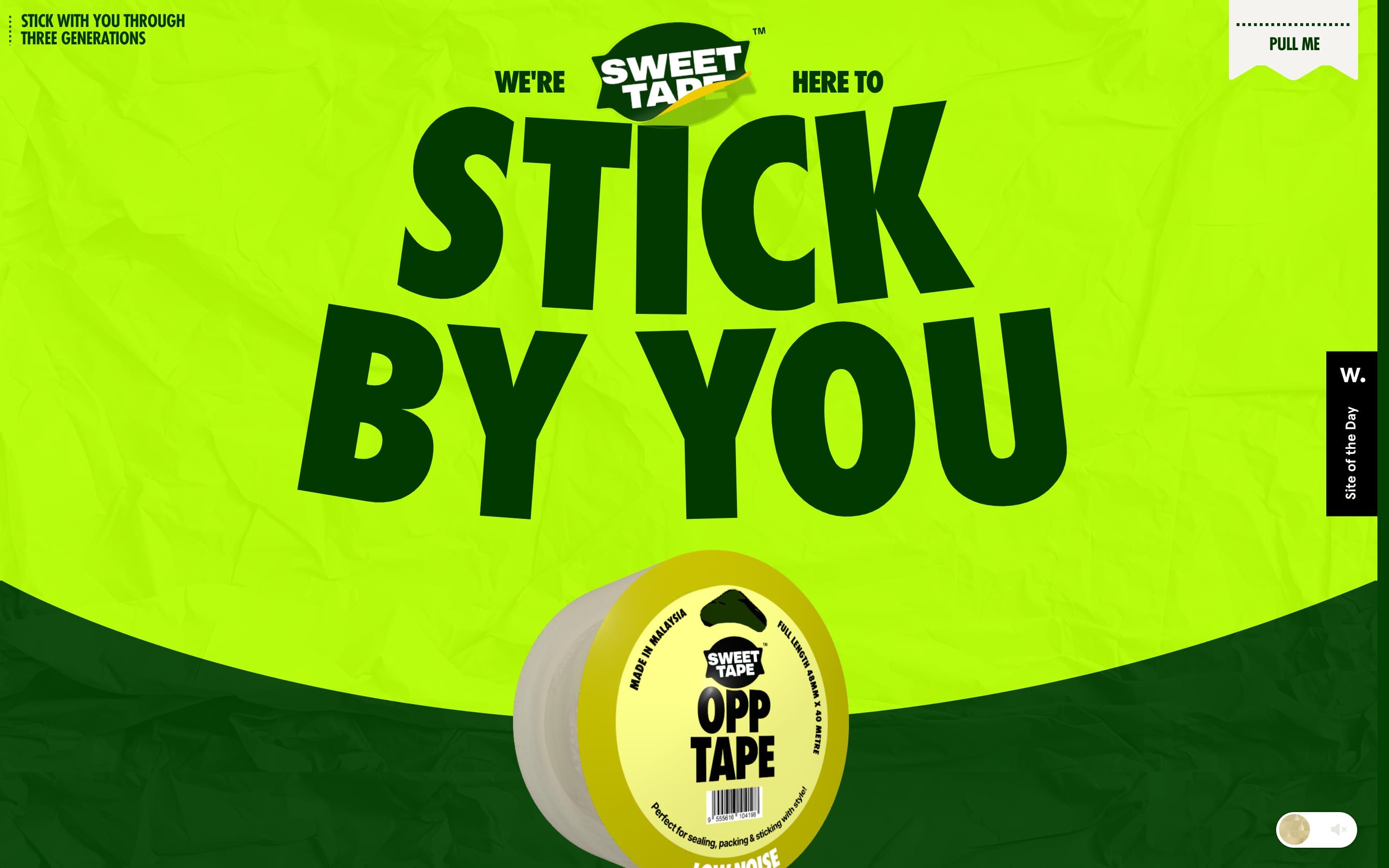
The palette
- #B6FE00the brand’s lime green: the ground of the hero, the wave ribbon, the social discs and the OPP tape
- #013900the dark green of the headlines, the text and the band under the hero
- #FF7E00the stage orange, behind the tapes
- #FA8005the orange of the masking tape, the word «creative»
- #50CBFFthe sky blue of the double-sided tape, the word «trusty»
- #FF7B5Fthe coral of the stationery tape, the word «buddy»
- #2E3EACthe blue of the cloth tape, the word «fixer»
- #F7D000the yellow of the low-noise tape, the word «silent», and the back of the peeling brand mark
Tap a colour to copy its code.
Sweet Tape is the adhesive tape brand of SB Tape Group, a Malaysian company that has been making it for three generations: «Six tapes made in Malaysia, one for every job», says the description. They are cloth tape, masking, double-sided, stationery, clear OPP and its quiet version, which doesn’t screech when you pull it. A product people usually buy without looking at it, and the site does everything to make you look: «We’re here to stick by you», in huge letters, on a bright lime green. Each tape has its own colour, a word that describes it (creative, trusty, buddy, fixer, reliable, silent) and even a character with a name, like Handy Andy for the masking tape. Headlines are in futura-pt-condensed, the only family in the Typekit kit, body text in Inter Tight, and the handwritten notes in Nothing You Could Do. The site credits nobody; on Awwwards the credit goes to bikebear. It was Site of the Day on Awwwards on 17 November 2026, with 7.36 from the jury and 7.48 from the developers, who gave the animations 8.2.
Underneath there’s Next.js 16.2 with Turbopack and React 19, and the content comes from Payload, a CMS you can already read in the response headers. The motion is GSAP 3.15.0, with ScrollTrigger only (React splits the letters, no SplitText), and Lenis 1.3.25 with a duration of 1.8 seconds, longer than usual. For the 3D rolls there’s three.js r185, with the models loaded only when needed; for the footer physics Matter.js 0.20.0. And there’s sound, written by hand on the Web Audio API with no library: fourteen effects, from the tape being stretched to the cut, and background music that only starts if you switch it on.
We take it apart in three moments, with a demo rebuilt from scratch for each. The text, the brands and the code are ours; from the site we took the ideas and, where we say so, the numbers.
The tape strip that peels
The page has photos of everyday things, a lemon, a sticky note, a box, and here and there strips of tape holding them. Every now and then a strip lifts from one side, folds back on itself showing its back, stays up for a moment and goes back down. Others peel only as you scroll down the page, tied to the scroll.
The nice part is that there’s no WebGL and almost no JavaScript: it’s all CSS, driven by a single number, --peel, declared with @property so the browser knows how to animate it. The strip is made of two copies of the same image. The first, the stuck face, is clipped with a clip-path at a line that moves with the number, up to 32% of the strip. The second, the flap, is the same image flipped with scaleY(-1) and shifted by calc(-100% + 2 * var(--peel-cut)): the exact mirror of the peeled part, which is just what a tape folded at 180 degrees does. The back has its own colour, and a direction variable turns everything so the strip can peel from any side, with sin() and cos() written in the CSS to work out the footprint. The JavaScript only keeps time: the strip peels in half a second with power2.out, stays up 0.9 seconds, goes back down in 0.8 with power3.inOut, and starts again after 3.4 seconds; each strip starts 1.3 seconds after the one before, and only while it’s on screen.
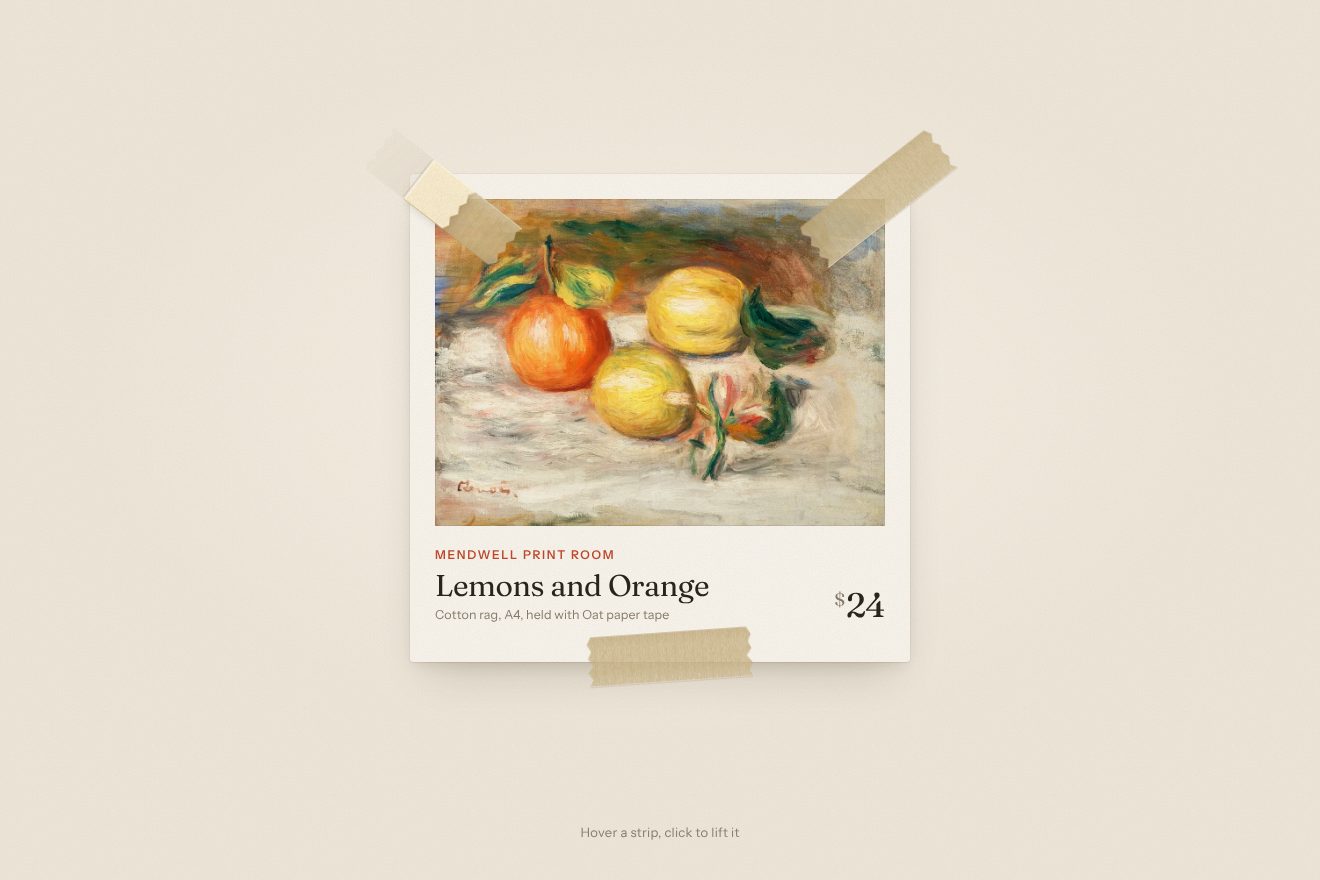
In our demo the card is an art print from a made-up shop, Mendwell Print Room: the real, copyright-free photo of Renoir’s «Lemons and Orange», the title, the paper and the price, stuck to a cream wall with three strips of oat-coloured paper tape, semi-transparent, with grain, fibres and zigzag torn ends. From the site come the --peel number declared with @property, the face clipped with clip-path at the fold line up to 32% of the strip, the flap that mirrors the peeled part, shifted by twice the fold, with a lighter back, and the timing: half a second to peel with power2.out, 0.9 seconds up, 0.8 to go back with power3.inOut, a 3.4-second pause and 1.3 seconds between one strip and the next. In ours the fold runs along the strip instead of across it. Ours are the rounded edge of the fold catching the light, the shadow that grows under the flap and always falls towards the bottom of the wall, worked out from the sine and cosine of each strip’s rotation, the film of glue left where the tape was stuck, the one-pixel press when the strip goes back down; and the gestures: with the pointer on it the strip peels further, on click it comes off completely and the card swings 2.4 degrees on the opposite corner, then the strip comes back, smooths down and the card straightens. On a phone the first tap peels it, the second takes it off. With reduced motion the strips stay stuck and changes are fades.
The curved curtain between the tapes
Halfway down the home is the showcase of the six tapes, «Meet the one who sticks». In the middle a 3D roll, around it a ring with the six little rolls to choose from, and above the name of the tape in big letters. When you change tape everything changes colour, but not all at once: a new background comes down from the top with a bellied edge, like a curtain, and the text changes colour at the exact moment the edge passes over it. Meanwhile the letters of the headline dive under their line one after another, and come back up in the new colour.
The curtain is a layer as tall as the stage plus the curve, and the curve is the same one that closes every section of the site, a 1456 by 150.5 path: the belly is always a little over a tenth of the width. It comes down in 0.85 seconds with power2.out, and the subtitle inside the curtain moves the opposite way by the same amount, so it stays still while the curtain uncovers it. For the text outside, the code searches the animation’s curve for the instant the edge reaches its height, and changes the colour right there. The letters drop by their full height plus two pixels in 0.32 seconds with power2.in, change colour under the edge and rise again in 0.42 with power3.out, 0.08 seconds apart. Meanwhile the ring turns the short way round, the 3D roll spins ninety degrees, swaps model and comes back, the labels run off to the left and come back, and a sound plays. You can also change tape with the arrow keys.
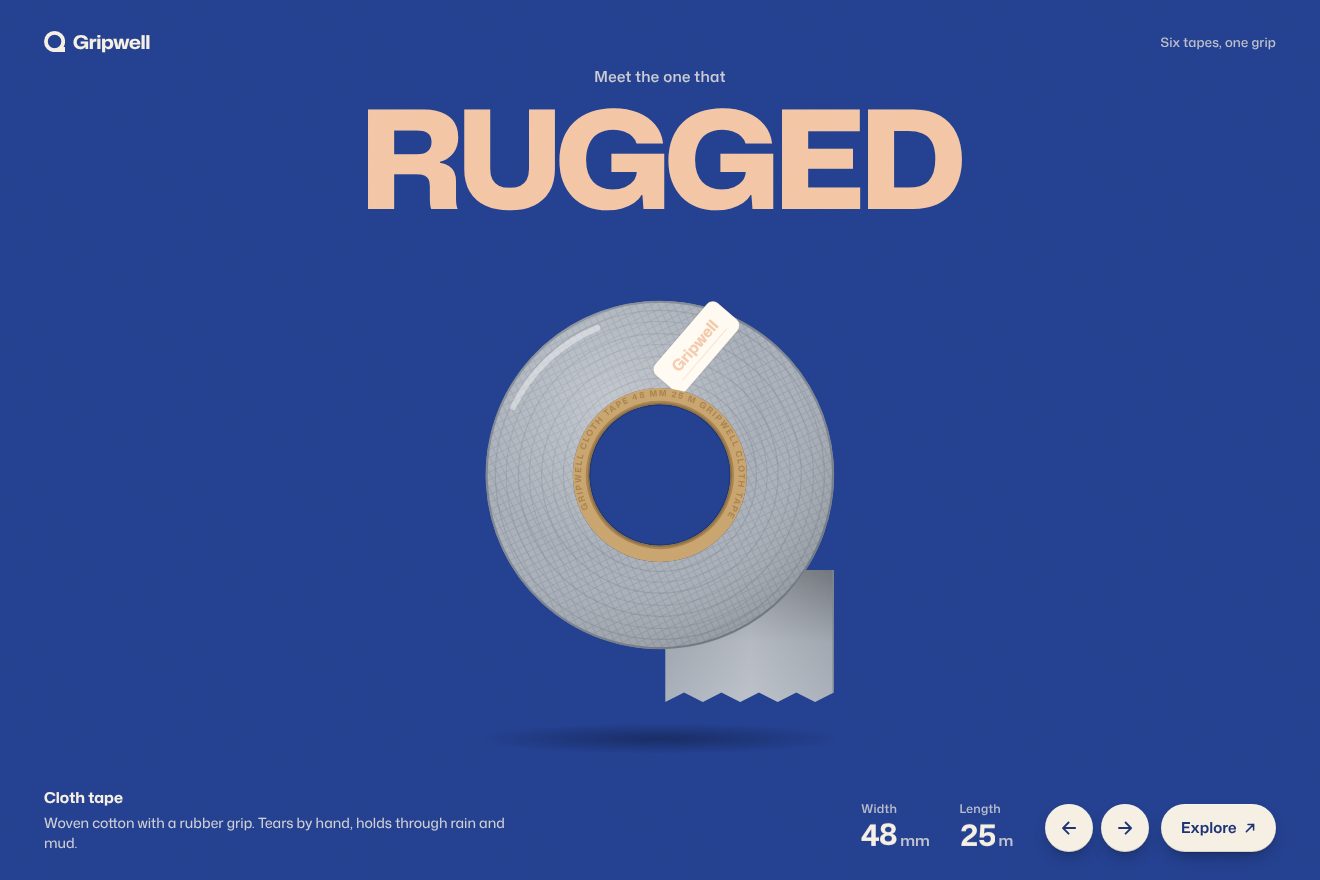
In our demo the tapes belong to a made-up brand, Gripwell, and there are six of them like on the site, each with its colour, its word, its line, its width and length: the cloth tape is Rugged, the masking Tidy, the clear one Clear, the double-sided Twofold, the stationery one Playful and the quiet one Hushed. From the site come the curtain as tall as the stage plus the curve, with the same 1456 by 150.5 path, the 0.85-second drop with power2.out, the subtitle moving the other way inside the curtain and staying still, the colours changing at the moment the edge passes, found in the curve as the site does, the letters dropping by their full height plus two pixels in 0.32 seconds and rising in 0.42, 0.08 apart, and the arrow keys. Instead of the 3D roll there’s a flat one, drawn by us in SVG: the wound layers, each tape’s texture (the cloth, the crêpe paper, the clear film, the red liner of the double-sided), the cardboard core with the text running round it, the label, the highlight and the loose end with a zigzag cut. And it really rolls: it turns by the distance it moves divided by its radius, rolls out accelerating and comes in one pixel too far before settling, while the loose end swings on a spring against the speed. Also ours are the width and length turning like a counter and settling by one pixel, the buttons that press down and swell, and dragging with a finger. Left alone, the showcase moves to a new tape every 2.4 seconds. With reduced motion the colour and text change in a fade and the roll doesn’t move.
The rolls that fall into the footer
At the bottom of every page, under a giant «Stick by you» and the links, there are seven balls: four drawn rolls of tape and three lime discs with the socials. When the footer comes on screen they roll in, half from the left and half from the right, bounce and settle on top of each other. You can push them by moving the mouse over them, grab them and throw them, and every hit makes a small «pop», louder when the hit is harder.
It’s Matter.js. The bodies are circles with a bounce of 0.32, friction of 0.16 and air friction of 0.004, and the rolls are 18.7 hundredths of the page wide, the discs 12.7. They come in one every 0.26 seconds, at 55 hundredths of the width per second, spinning; until they’re all in, a force pushes them towards the centre and the side walls ignore them, so they don’t bounce back off screen. The mouse pushes bodies within 5 hundredths of the page in the direction it moves, and a spring (stiffness 0.06, damping 0.08) holds them when you grab one; if the drag goes past 6 pixels the click on the link doesn’t fire. The pop’s volume goes from an impact speed of 10 to one of 70, with at least 90 milliseconds between two pops. The bodies are plain divs, moved by GSAP’s ticker, and when the window changes size the world is rebuilt keeping positions, speeds and rotations.
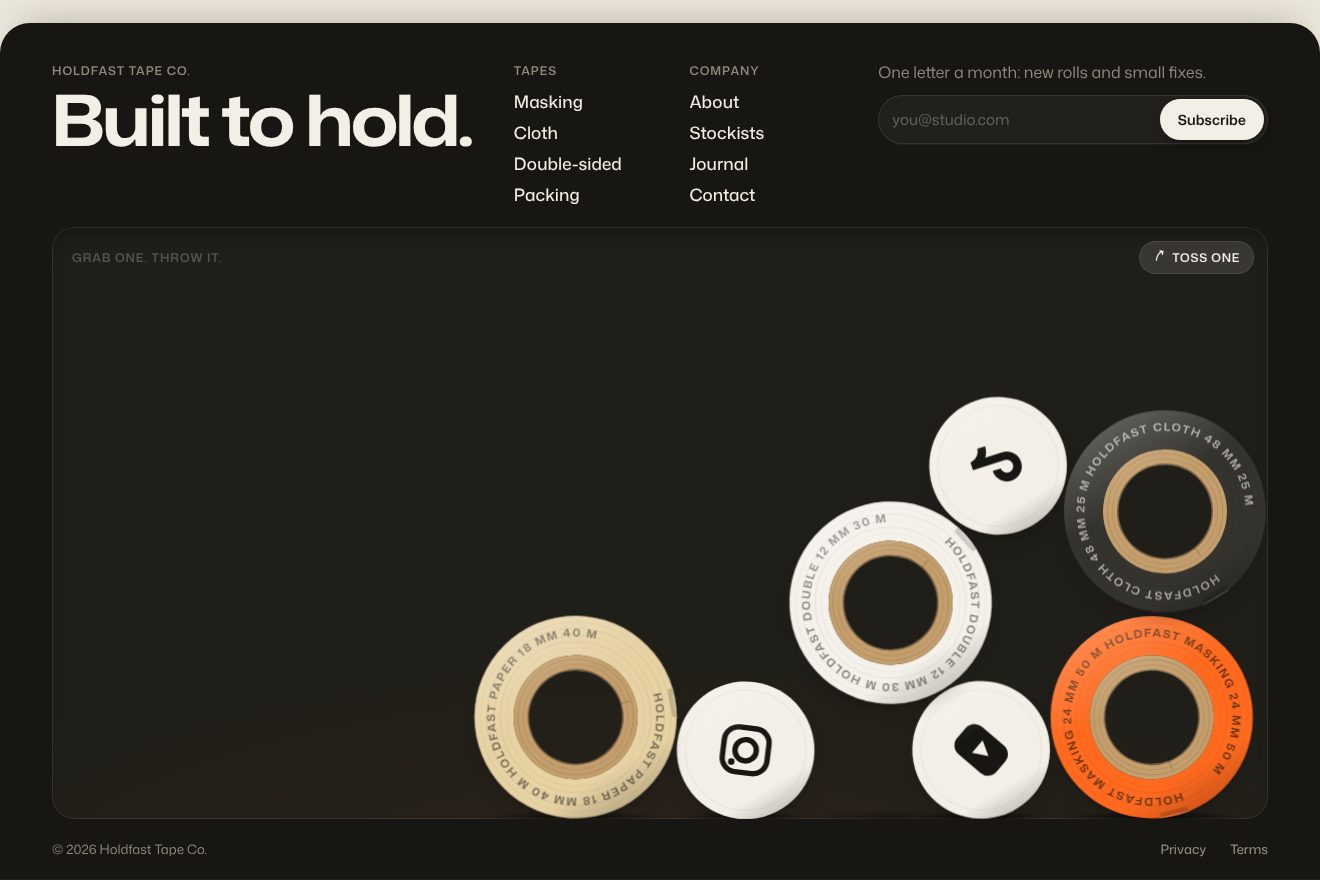
In our demo the footer belongs to a made-up tape brand, Holdfast Tape Co., in warm black, with a big «Built to hold.», two columns of links, the monthly letter sign-up and the legal line; below, a dark tray where four rolls and three social discs come in. The rolls are drawn by us in SVG, seen from the front: the ring in the tape’s colour with its layers, the loose end sticking out, the cardboard core with a real hole and the label turning with the roll. From the site come all the physics numbers: the 0.32 bounce, 0.16 friction and 0.004 air friction, the gravity, the top speed, the proportions between rolls and discs, the alternate entry from left and right every 0.26 seconds with the push towards the centre and the walls that let through whatever isn’t in yet, the pointer push within 5 hundredths, the grab spring, the 6 pixels that tell a click from a drag, the world rebuilt keeping positions and speeds, and the drawing on GSAP’s ticker. Instead of the pop, which the demo doesn’t have, on every hit the body squashes along the direction of the blow, more for a harder hit, with the same thresholds as the sound, and springs back with an elastic.out. Also ours are the soft glow that doesn’t turn with the roll and the contact shadow that tightens as the roll rises, the grabbed roll lifting one pixel with a wider shadow, the links that get a strip of orange tape with torn edges laid behind them on hover, the «Toss one» pill and the rolls all jumping together when you subscribe. Left alone, after four quiet seconds it throws a roll towards the emptier side. With reduced motion the rolls and discs are already resting in a row and the physics doesn’t start.
The other details
The loader is the brand mark, a sticker-shaped label, that unrolls like a curled sticker. It isn’t WebGL: the script cuts it into 64 columns of divs in CSS 3D, each with its piece of the drawing, a highlight and the green back, and on every frame works out each column’s angle like the links of a chain, with a fold, a bend and a wave. The mark arrives small and tilted back 78 degrees, unrolls in 0.74 seconds, bounces, and the wave dies down in two seconds with an elastic.out. Then the coloured curtains, one per tape, rise with the same curve as the whole site, 0.09 seconds apart with a small variation taken from the golden ratio. The same curtains make the page change, coming down in reverse order, and if you go to a tape’s page they all take its colour.
The menu is a tab at the top right that says «Pull me»: the panel drops from above with a back.out(1.9), and the letters of the items rise in random order. Almost all the text on the site comes in this way, letter by letter but shuffled, and on the headline the letters near the mouse lift, grow and lean the other way, going back with an elastic.out in 0.9 seconds. Under the hero a 190-pixel thick lime ribbon waves across the screen with a sentence scrolling along it at 120 pixels per second; scroll down and it runs faster, scroll up and it goes backwards. In the hero the 3D roll pulls out its strip as you scroll down, with the sound of the stretching tape tied to the speed, until a cut takes it off; the brand mark lifts at one corner like a sticker, and a sticky note flutters in the wind and with the scroll. The «Why we exist» section is a canvas bigger than the screen that a camera travels across, pinned while you scroll, with the corners rounded by small Bézier curves. The handwritten notes appear one letter every six hundredths of a second, after two lines draw themselves, as if someone were really writing. And there’s a cursor of its own, a drawn arrow tilted seven degrees.
The site looks after people who prefer less motion: every function checks prefers-reduced-motion, Lenis doesn’t start, the loader is skipped, and there are 35 blocks for it in the CSS. Words split into letters keep the whole text for screen readers, the menu closes with Esc and the showcase works with the arrow keys; sound starts off. And everything that moves stops when it leaves the screen.
Where it stumbles
The site is heavy: the home’s scripts are 1.47 MB before compression, the hero roll alone is a 629 KB model, the stretching tape sound is a 229 KB WAV and the music, if you switch it on, almost 2 MB. The page is never cached. The loader lasts at least 2.9 seconds even when everything has arrived, and reloading halfway down takes you back to the top, because the loader resets the scroll to zero. A testing variable was left in production, window.peelLab, and many values have tuning-bench names like TUNE and CONFIG. The drawn cursor replaces the system one on every computer, and on the about page the numbers 01, 02 and 03 are used as graphics. In the copy you can read «Last-minutes fixes» and «Three generation one shared belief».
The effects
- Peeling tape cardThe card of an art print by Mendwell, a made-up stationery shop, held to the wall by three strips of oat paper tape: in turn each strip peels from its loose end, folds back on itself showing its back and lies down again pressing in by one pixel. With the pointer over it, it peels further; with a click it comes off altogether and the card swings on the other two. From the peeling tape strips of the Sweet Tape site, Awwwards Site of the Day on 17/11/2026.Free
- Tape curtain showcaseThe tape carousel «Meet the one who sticks» from Sweet Tape, rebuilt in 2D with a made-up brand, Gripwell, and six tapes: changing tape, the new colour comes down from the top with a curved belly edge, the colours of the words change as the edge passes over them, the line under the roll stays still while the curtain uncovers it and every letter of the big word dives under its line and comes back up in the new colour. The flat SVG roll rolls away and the new one rolls in, while width and length turn like a counter.Free
- Tape roll footerThe tape roll footer of Sweet Tape, rebuilt with a made-up brand, Holdfast: under the links, the newsletter sign-up and the legal line, four rolls of sticky tape and three social discs roll into a dark tray from the left and the right, bounce and squash on every hit; the pointer pushes them, and they can be grabbed and thrown. Physics with Matter.js and the site's real numbers.Free