Kavimada, by Adam Aidemirov
Kavimada, how it’s made: the star that changes shape, the lines you pull and the train of stars
The site of two people who make web and mobile products end to end, drawn with flat cut-out shapes: a star that falls and becomes an embrace, names that open and lines you pull with the mouse, stars that come down a trail as you scroll. We take it apart with three demos rebuilt from scratch.
The palette
- #1A1A1Athe black of the opening and the text
- #F5F8E2the cream of the pages and the figures
- #EE5F5Athe coral of the arch, the pill and the stars
- #FCFCFAthe white of the open menu
- #7E7E7Ethe grey of the form fields
- #EDB200the yellow of the typewriter
Tap a colour to copy its code.
adammount.org is the site of Kavimada, a «full-stack developer building web and mobile products end to end»: Adam Aidemirov, who writes the code, and Vika, who runs the projects. The page puts it like this: «Two people, no layers of management, direct communication». The home page has five of their projects, ADAMIX, SAVEFOOD, CLOSETLY, THECLUB and DETAL, a ticker of logos, their way of working in five steps and a form to get in touch. The site is in English and Russian.
It is drawn with a few flat shapes, as if cut out of paper: eight-pointed stars, pixel clouds, a coral arch, two cream figures holding each other. There are three colours: a warm black, #1A1A1A, a cream, #F5F8E2, and a coral, #EE5F5A. The titles are in Wetware, a puffy, rounded typeface by Andrew Young; the menu, the steps and the running text in PP Talisman Compact by Pangram Pangram; the long texts in Anonymous Pro, a monospace. One trick holds it all together: the root of the style sheet is 0.0694445 hundredths of the window width, exactly one pixel at 1440, and every size is written in those units. So the whole page grows and shrinks with the window like a picture; below 768 pixels the same unit is one pixel at 375.
Underneath there is Next.js 16 with React 19, in two languages. The animations come from GSAP 3.15, with ScrollTrigger, MorphSVG and MotionPath, from Motion for the React parts and from Matter.js, the physics, loaded only when it is needed. Three pieces come from Fancy Components, Daniel Petho’s component library, adapted: the elastic lines, the typewriter and the gravity. No WebGL and no smooth scrolling: the page scrolls the way the browser wants. The site has an Awwwards Honorable Mention from 10 September 2026, but the award page shows only community votes and none from the jury: no score to report.
We take it apart in three moments, with a demo rebuilt from scratch for each, for three invented brands: drawings, copy and code are ours. From the site we took the ideas and, where we say so, the numbers.
The star that turns into a cloud
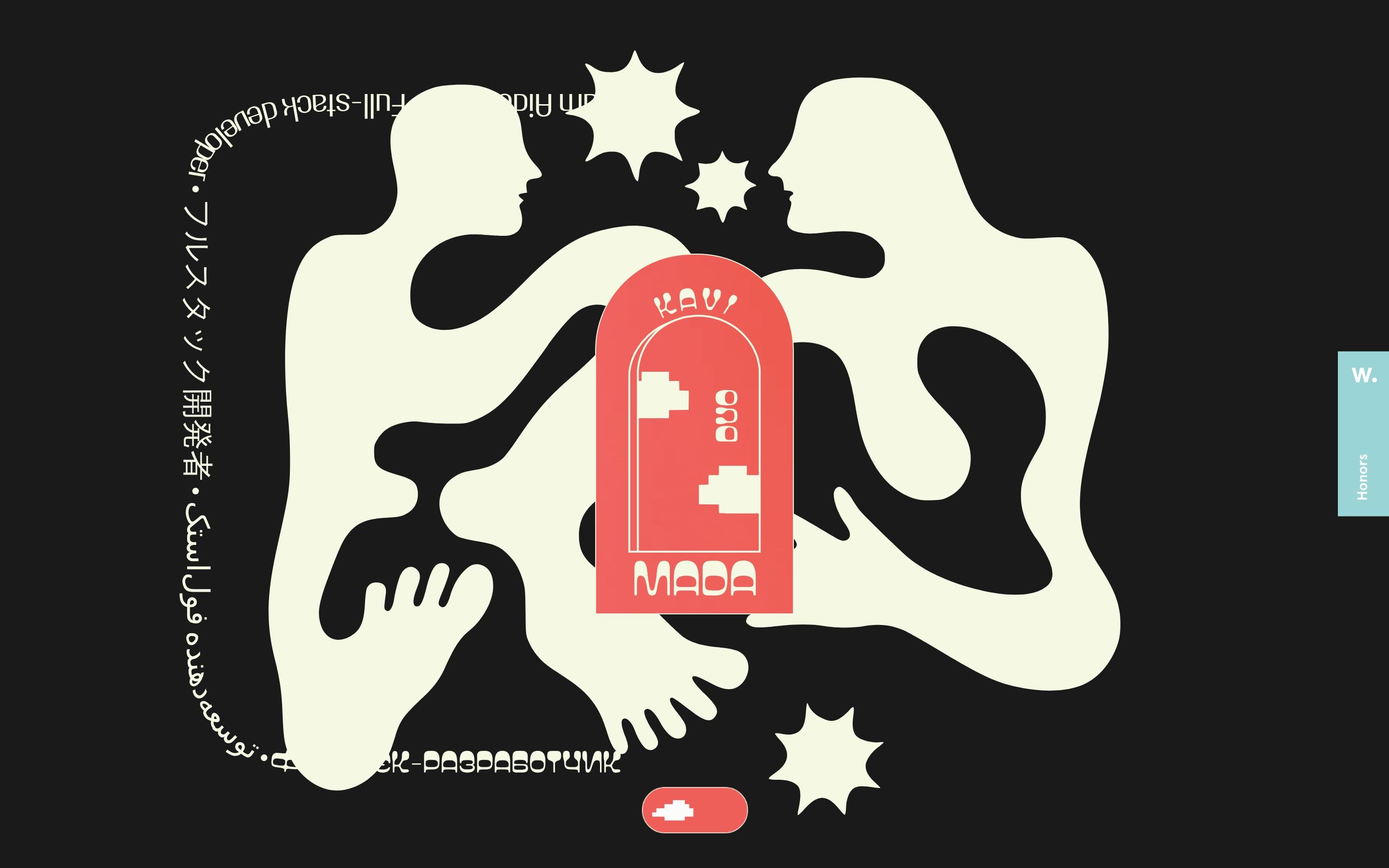
After the loader, a cream star drops onto the black. It bounces like a rubber band and, while it is still bouncing, it stretches and folds until it becomes two figures holding each other. A coral arch with the name pops up in the middle, KAVI above and MADA below, and a line of text starts running around it.
The star sits in a drawing 884 by 740 that starts 70 hundredths of the screen higher and comes down in three seconds on GSAP’s elastic.out curve. At eight tenths of a second, before the fall is over, MorphSVG turns the star’s path into the two figures’ path, in one second, with map: «size». The two shapes do not share a centre, so on every frame of the change the script measures the box of the new shape and brings it back to the point 442, 370. Then the arch grows from zero to 1.15 in 0.55 seconds, drops to 0.96, goes back up to 1.06 and settles at 1, in steps of two tenths: a bounce made by hand. Last, in one second, the running text, the menu button and three stars appear. The code also has a duration for floating the clouds in the arch, sixteen seconds, that nothing uses: the clouds stay still.
The text, «Adam Aidemirov • Full-stack developer •» and then the same in Japanese, Persian and Russian, runs on a rectangle with round corners: along the bottom it reads straight, along the top upside down. It is two copies of the same text on the same path, one a whole turn behind the other, and they go round once in twenty seconds. Motion moves them, updating React’s state on every frame. On a phone the path becomes a wave and a turn takes thirty seconds.
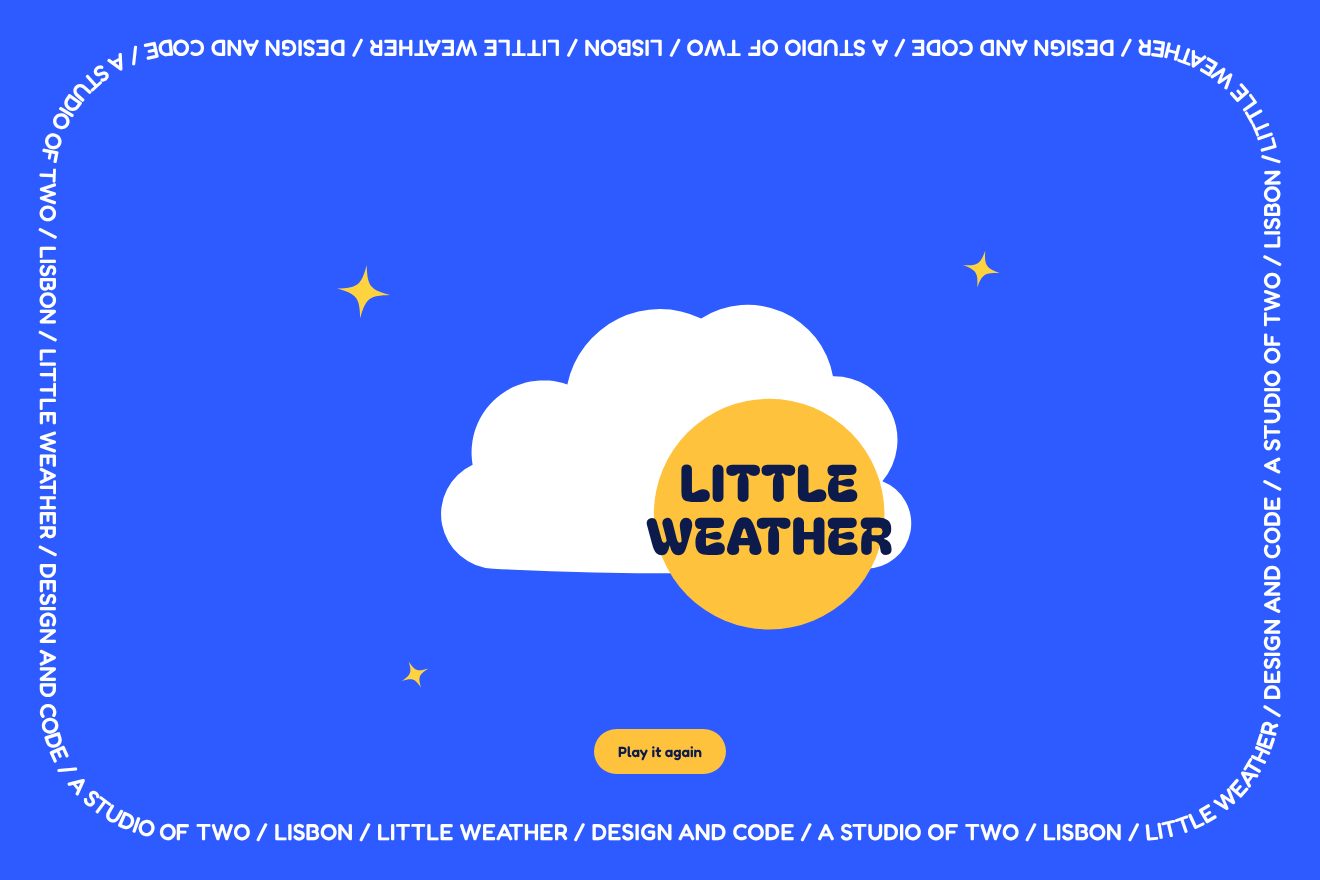
In our demo the studio is Little Weather, the star is yellow with ten points and turns into a cloud, and the arch is a sun. The timings and sizes are the site’s. We work out the frame of the text from the page, and spread the letters by a hair so that the repeated line ends exactly where it starts; the turning is done by GSAP’s ticker, without going through React.
Projects with elastic lines
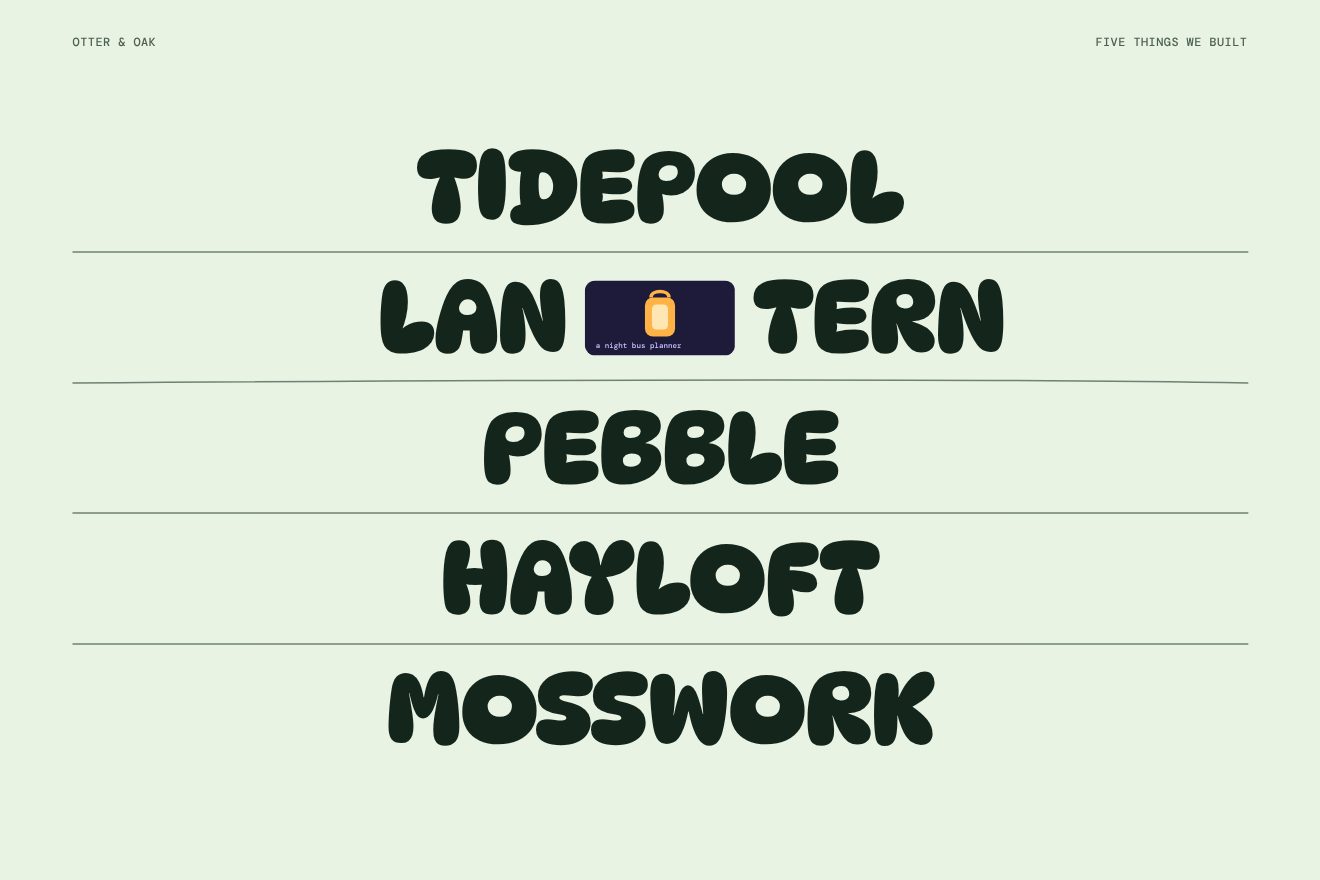
The list of projects is five huge names, one per row. Over a name, the word opens at its own point, SAVE and FOOD, CLOSE and TLY, and a collage of the product appears in the gap. Between one name and the next runs a thin line: if the mouse passes close to it, the line catches it and bends along.
The names are in Wetware at 128 pixels. On hover the two halves move in half a second on the curve 0, 0, 0.2, 1, each by its own distance written by hand row by row: 118 and 118 for ADAMIX, 122 and 100 for SAVEFOOD, 182 and 44 for CLOSETLY. The picture, 186 by 92, goes from 0.95 to 1. The lines are Fancy Components’ ElasticLine: an SVG as tall as the row, with a curve from one side to the other and a single control point. The line catches on when the mouse passes less than 20 pixels away, and from then on the control point sits under the mouse, 2.2 times further from the middle. It lets go past 25 pixels and comes back on a spring with stiffness 200 and damping 30: with those numbers it stops without swinging, just past the point where it would start to quiver. At the start each line draws itself with another spring, 300 and 30, after fifteen hundredths of a second. On a phone the lines are switched off and the names do not open.
In our demo the products belong to a made-up studio, Otter & Oak, and we draw the pictures. We do not write the halves’ distances by hand: the script works them out from the width of the picture. We lower the damping to 10, so a line that is let go quivers a few times, and we make it work with a finger and with the keyboard too.
Stars along the trail
The «How we work» section has five steps, Initial Call, Concept, Design & Prototyping, Developing and Review & Support, one on the left and the next on the right. As you scroll, a row of small black stars comes down between one step and the next, as if following a trail. Over each step there are some bars, and a small star hops on them.
There are 24 stars, five different drawings in turn, on an S-shaped path drawn by hand and never shown. A single number goes from 0 to 1 while the section scrolls, from when its 20% reaches the middle of the screen to when its 80% reaches the 35% mark. Star i sits at the point of the path given by that number minus i/24, kept between 0 and 0.999: at first they are all heaped at the top, at the end they are strung out along the whole way. Step N has N black bars. The star hops from one to the next up to the last and then back: sideways in 0.8 seconds, up in 0.28 and down in 0.36, and after every round a rest of 0.35.
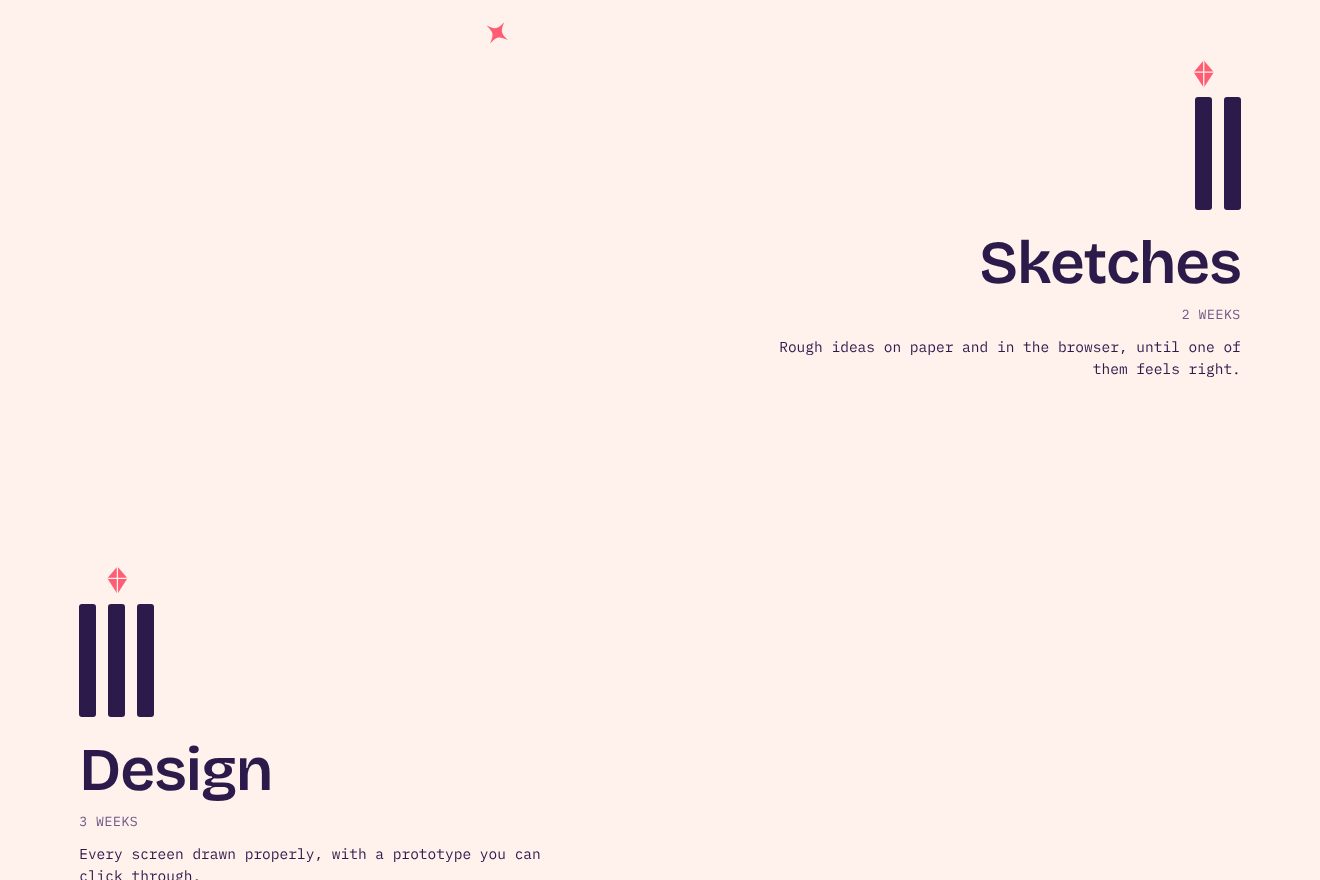
In our demo the studio is Paper Kite, the script works out the trail between the steps and the shapes spin as they come down. The bars do not count the steps, which would be numbering turned into a drawing: they are each step’s weeks of work, and the number is written next to them. Instead of the star, a kite does the hopping.
The other details
The loader plays once per browser tab. Two stars cross the screen spinning, one from the left and one from the right, and five words, Strategy, Branding, Design, Motion and Engineering, rise one after another every quarter of a second. Then they squash down to nothing, and the black veil goes at just over three seconds, while the stars are still half way across.
The menu is the coral pill at the bottom in the middle. It sits there, fixed, at 0.4 of its size, and grows to 1 as the last section arrives, where it stops in its place; opened from there, it shows the contact form instead of the items. Opened anywhere else, it spreads in 1.2 seconds into a box 1392 by 617 pixels with huge corners, with the background blurred from 10 to 24 pixels. The items sit on an arc, each turned by its own angle, and a coral star turns towards the one under the mouse in eight tenths of a second. You can also choose with the wheel and the arrow keys.
In the section with the two people, once 15% of it shows, coral and black stars rain down and stop at the figures’ feet: it is Matter.js, with friction and bounce at 0.1, and with the mouse the stars can be grabbed and thrown. At the bottom, after «kavimada.», a yellow typewriter types «duo» in seven languages, 70 milliseconds a letter, and deletes it faster.
Where it stumbles
On the home page there is no reduced motion. With less motion requested, the loader, the fall, the logo ticker, the running text and the raining stars play exactly the same; only the CSS hovers and the single project pages respect it.
Opened from a wrong address, the error page is white. Until the loader has finished, a style sheet hides everything; the 404 page has no loader, so it stays hidden forever.
Some curves written in the code are not the ones you see. The menu and the hopping star use the string «cubic-bezier(0.22,1,0.36,1)», which is the CSS way of writing curves: GSAP does not read it, gives no error and uses its usual curve, power1.out. We tried it with the same version as the site.
It weighs more than it needs to where you cannot see it. The previews that show when you pass over the projects, 186 pixels wide, are downloaded 3840 wide, about 295 KB in all. And some things keep working all the time: the physics redraws its two canvases even when its section is far away, and the running text updates React on every frame, in two copies mounted together, the computer’s and the phone’s.
In our tests, also, the menu opened with the keyboard did not take the focus: the arrow keys and Esc did nothing.
What we take away
A site can be made of very few pieces, if they come back everywhere: here the star is in the loader, in the fall, in the menu, in the steps and in the physics, and every time it does something different. And the unit worth one pixel at 1440 is a simple, strong idea: you draw once, at the size of the design, and the page stays the same at every width.
The effects
- Star into cloudA yellow star drops from above and lands with an elastic bounce, and while it is still bouncing it turns into a white cloud. Then the studio’s sun pops up in front of the cloud, swelling and settling in four beats, and a line of text starts running around the whole page.Free
- Elastic project linesA list of products with one big name per row. Over a name the word opens in two and a picture of the product appears in the gap; the lines between the names catch on the pointer, bend with it and, when it pulls too far, slip away and spring back straight, quivering.Free
- Stars along the trailA studio’s “how we work” page: as you scroll, a little train of shapes runs down an invisible trail that winds between the steps, bunched up at first and then strung out along the whole way. Over each step the bars are its weeks of work, and a kite hops across them and back.Free