Max Mara Jacket Circle, by Adoratorio Studio
Max Mara Jacket Circle, how it’s made: the page that tears open from the centre, the title that boils like pencil and the dictionary entries that rise
Max Mara’s game for its jackets is a city drawn in pencil: you enter from a red cover with letters that slide in, every room opens by tearing the page from the centre, and every jacket has an invented word with its own dictionary entry. We take it apart with three demos rebuilt from scratch.
The palette
- #D45054the red of the opening screen
- #68142Bthe burgundy of the title, the logo and the thread of the tear
- #FE7589the pink of the Discover panel
- #E0FFF8the aqua background of a dictionary entry
- #00018Dthe blue border of another entry
- #2C2E2Cthe ink of the stamped shadows, at 25 per cent
Tap a colour to copy its code.
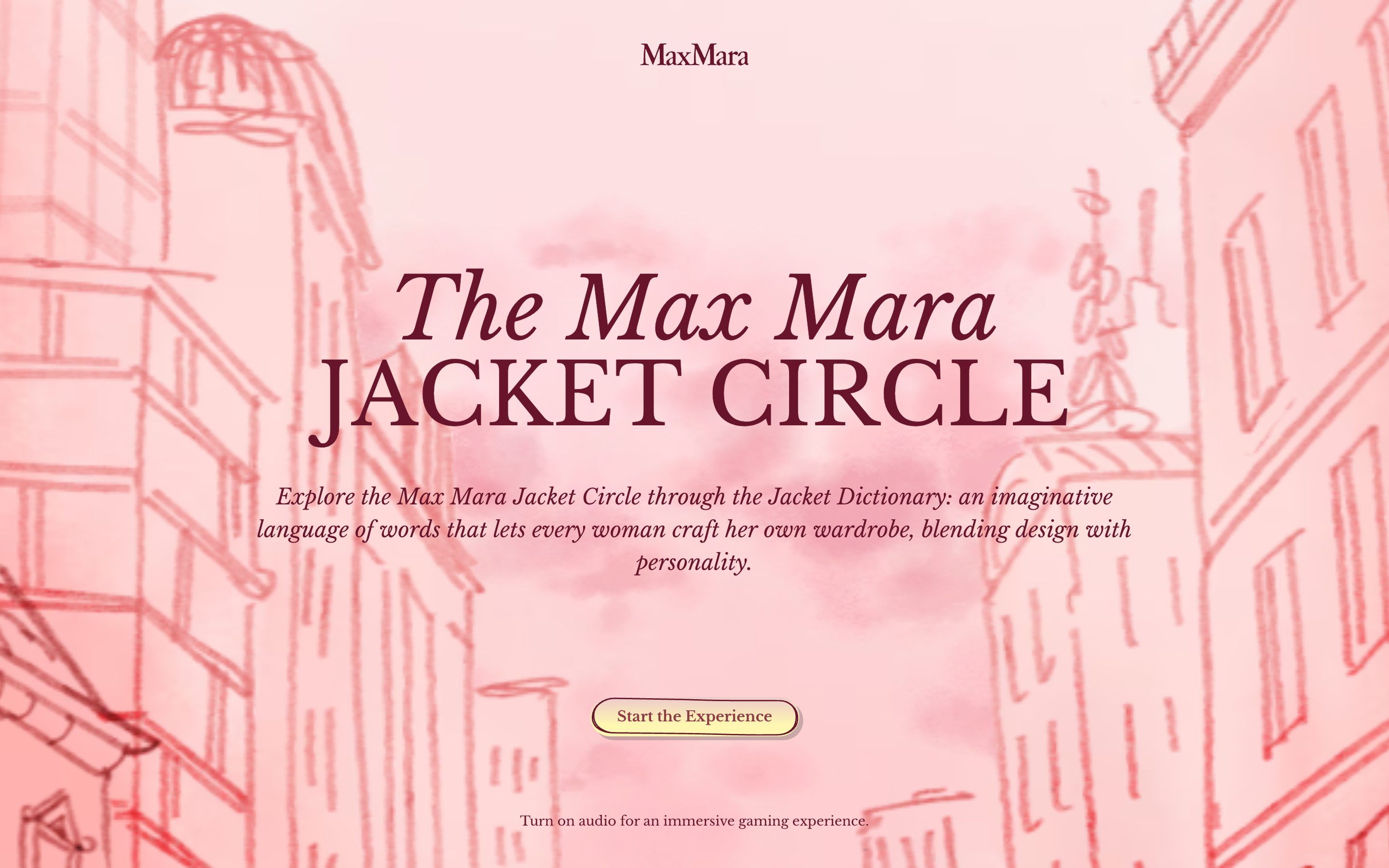
Max Mara Jacket Circle is not a shop but a small game: Max Mara tells the story of its jackets through a «Jacket Dictionary», five invented words, Movefreeness, Sartoriality, Unperfectness, Futurebuilder, Remarkablessence, and each one is a room in a city drawn in pencil. You enter from a solid red cover, #D45054, with the title in burgundy, #68142B, half in italics and half in capitals, set in Libre Baskerville; small text and forms are in Inter. Then the city appears: a street in perspective, drawn by hand on a watercolour pink, with five spots lit in yellow, an arched window, a small window, a taxi, a café awning, a balcony. Each spot opens a room in another colour, and in every room there is a jacket to touch and a monogram to collect. It was made by Adoratorio Studio; on Awwwards it was Site of the Day on 16 April 2026, with 7.34 from the jury, where the highest mark is creativity, 7.75, and the developer award, 7.05.
Underneath there is Vue 3.5.18 with its router, Pinia for state and translations in ten languages, built with Vite. The city is not made of images in the page but is a PixiJS 8.15.0 scene, with two filters written by hand in GLSL. The animation is GSAP 3.13.0 with SplitText, the music of each room is howler.js 2.2.4, which fades one track into the next, and the cursor with inertia comes from a library of the studio. ScrollTrigger is in the package but never used: here you do not scroll, you play.
We take it apart in three moments, with a demo rebuilt from scratch for each, for an invented fashion house, ARDELLE, with its coats, its words and its drawings: the text, the shapes and the code are ours. From the site we took the ideas and, where we say so, the numbers.
The page that tears open from the centre
You tap a spot on the street and the city does not fade and does not slide: it tears. A hole with ragged edges opens from the centre, like paper pulled apart with your fingers, and inside it the new room is already there, the blue restaurant, growing as the hole widens until it swallows the whole street. The room arrives grey first and only takes its colour at the end.
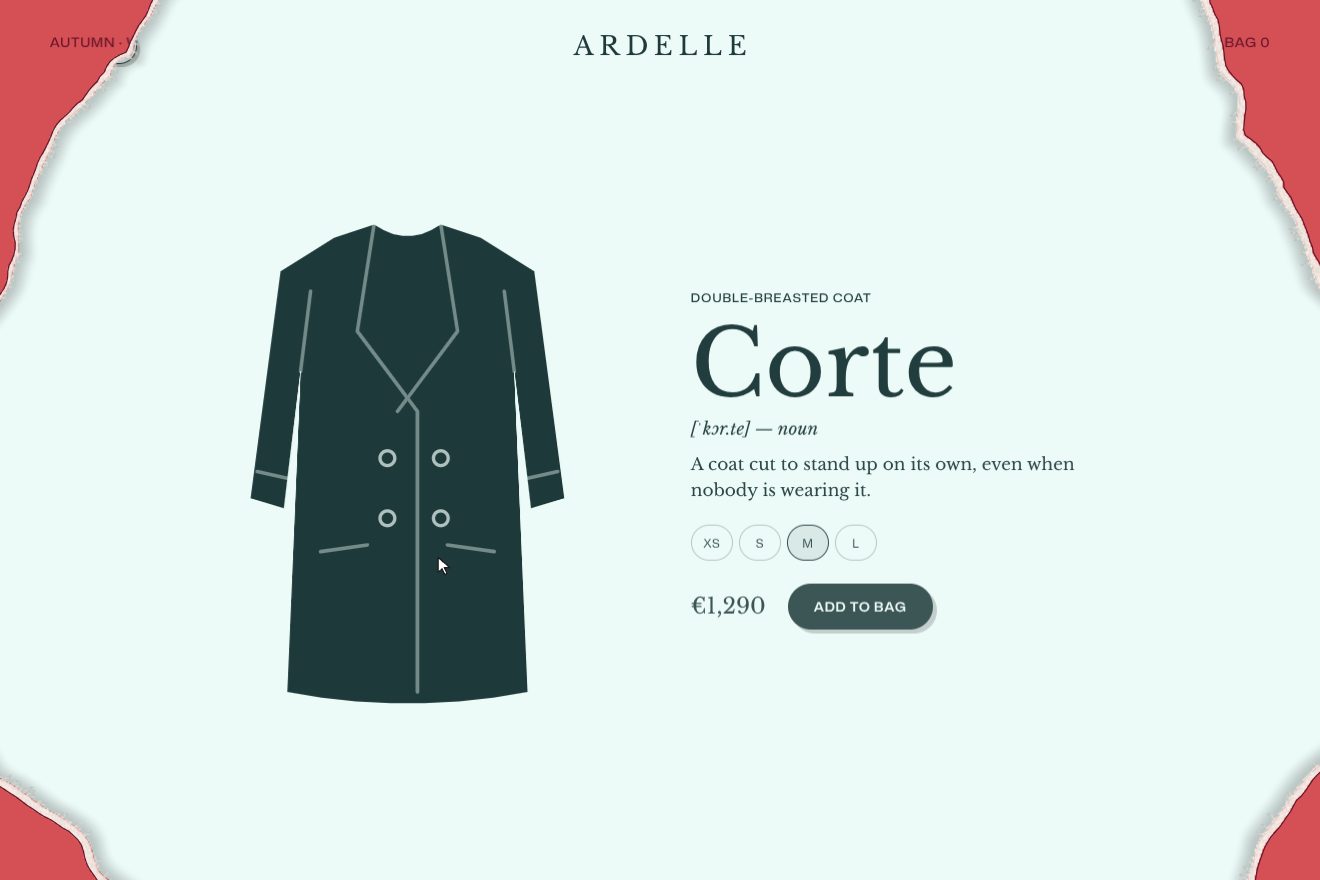
It is a PixiJS filter placed on the old scene, while the new one waits underneath. For every point the shader measures the distance from the centre, divided by half the diagonal, so the hole reaches the corners at the same moment it reaches the sides. The torn edge is a four-octave fractal noise computed on the angle, not on the position: the centre sees around itself a single ragged line that widens, always the same one, and its strength grows with the progress, up to 0.3. Where the distance is below the threshold the old scene disappears; on the edge a thread one thousandth wide remains, in the burgundy of the title. The progress goes from 0 to 1 in four seconds with power3.inOut. Meanwhile the new scene starts from scale zero and reaches one in three seconds with power3.out, two tenths later; its colour layers and the jacket go from transparent to full in another three seconds, starting at the third, and at 1.8 seconds the rest of the room comes in.
In our demo you go from the ARDELLE collection, on red, with three coats drawn by us in the colours of the dictionary, to the page of one coat, with the pronunciation of its name, the size and the price; and Back takes you home, tearing again. From the site come the threshold made of the progress plus the fractal noise on the angle, with its strength of 0.3, the distance measured on half the diagonal, the four seconds with power3.inOut, the burgundy thread on the edge, and the new page that arrives grey and takes its colour in three seconds. In ours the new page does not start from zero but from 0.94, because it is a page and not a scene. We compute the noise once for 720 angles and it feeds three layers: a clip-path that cuts the old page, a hand-written WebGL shader that draws the fibre and an SVG path that is the thread. Ours are the white paper fibre along the edge, with its grain and its changing width, the threads sticking out into the hole and a second, finer noise that frays the edge, the soft shadow inside the hole, the old page moving slightly closer as it tears, the lines of the new page rising one after another, the cards with their stamped shadow springing back, the size that bounces and the bag counter that rolls.
The title that boils like pencil
The opening is a cover: on the red, the title arrives letter by letter, each letter sliding 25 pixels from the left and lighting up, and behind it, barely visible, there is the drawn city, enlarged two and a half times. When everything has loaded the red dissolves, Start the Experience appears, and on click the title leaves in reverse while the city settles into place. And from then on the whole drawing never stands still: the lines tremble, like a cartoon drawn by hand.
The title is split by SplitText into lines and letters. Each letter starts 25 pixels to the left and transparent, and arrives in one second with power3.out, 75 thousandths after the one before; each line starts 45 hundredths after the one above. The lines of the sentence rise from under their mask, a tenth apart, in 1.2 seconds with power4.out. When the game is ready the red background disappears in 1.2 seconds and the button comes in from 1.15 times its size. The exit mirrors the entrance: the letters go 25 pixels to the right starting from the last one, with power3.inOut, the lines of the sentence rise away, and the canvas of the city, which was at scale 2.5 with its origin at the top, comes down to 1 in two seconds with power4.inOut.
The boil is the second filter, placed on the whole scene. It takes a noise texture repeated ten times and shifts every point horizontally by three thousandths at most; but it does not use one noise, it uses three, the red, green and blue channels of the same texture, and it jumps from one to the next at a third and at two thirds of a four-tenths loop, repeated forever. Three drawings every four tenths: the lines tremble at seven and a half frames per second, the rhythm of hand-drawn animation. On arrival the strength of the boil starts at half and rises to full together with the city coming down.
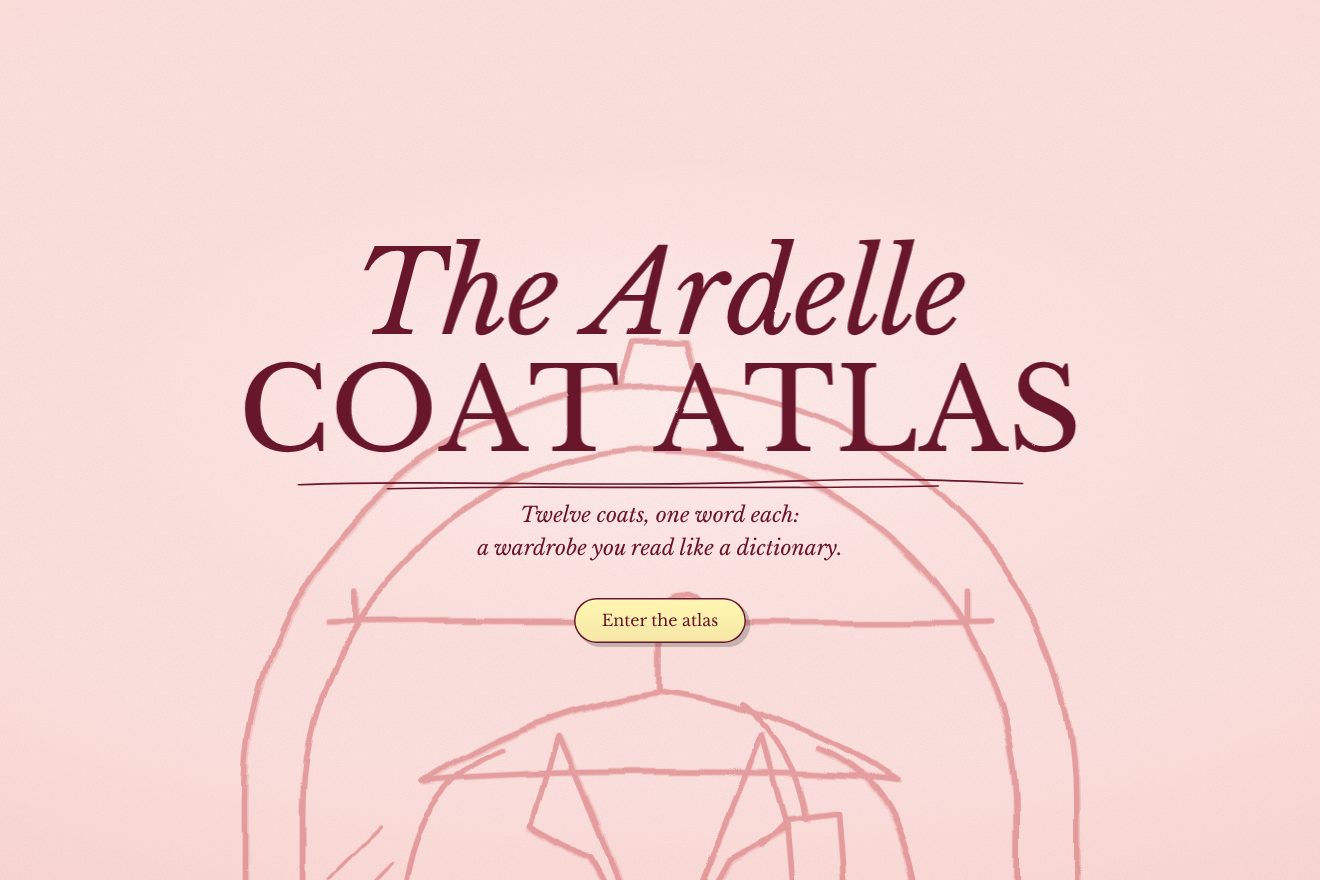
In our demo the cover is that of the ARDELLE coat atlas, and behind the red veil there is not a city but a drawing of ours in red pencil: an arch, a rail, a coat on a hanger with its belt tied, the pockets and the tag. From the site come the letters sliding with their 25 pixels and their timings, the lines 45 hundredths apart, the rising sentence, the background that dissolves, the button coming in from 1.15, the exit starting from the last letter, the drawing coming down from 2.5 with its origin at the top and the three-state boil in four tenths. Ours is done in SVG: three turbulence filters with different seeds, swapped in turn. Ours are the boil, lighter, on the title too, the pencil that calms down when the pointer is over the button, the underline drawn twice, the lines that darken as the drawing comes down, the coat swaying slightly on its hook, the stamped shadow on the button taken from the site’s entries, and at the top the name ARDELLE writing itself letter by letter with the name of the room.
The dictionary entries that rise and unfold
In every room, at the bottom left, a card rises: the dictionary entry for the word of the room, with the phonetic transcription, «noun», the etymology, explaining which real words it was born from, and the definitions. It is closed on the word and its pronunciation; a round plus, with a hard shadow like a stamp, opens it.
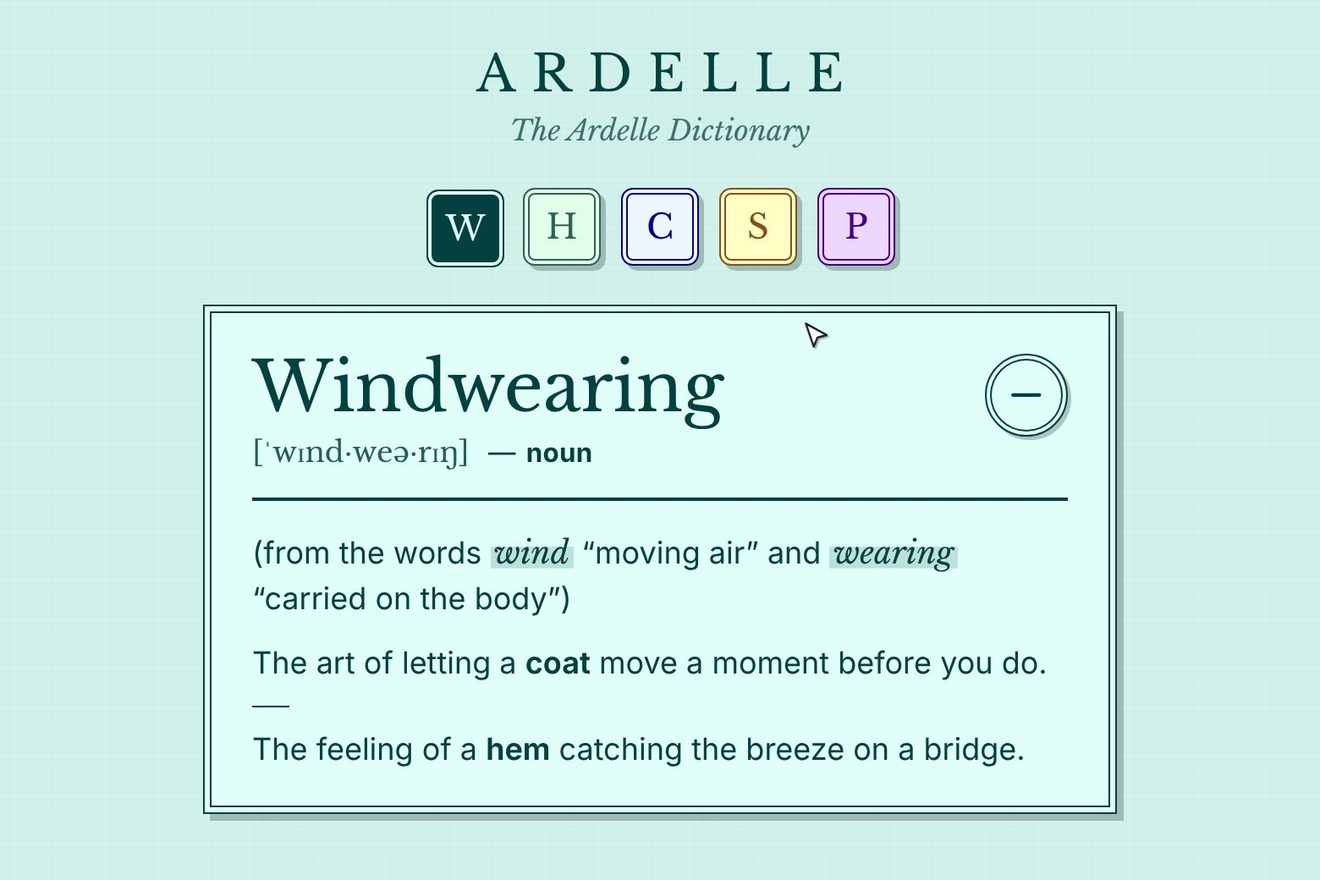
The card starts below the edge, shifted by 110 per cent of its height (100 on phones), and rises in a second and a quarter with power3.out, fifteen hundredths after the button that closes the room has appeared with elastic.out(1, 1). Each word has its own pair of colours, a very light background and a dark border: aqua and teal, green and forest green, sky and blue, yellow and brown, lilac and violet. The plus is an SVG with the background and outline in the colours of the entry and a solid shadow, a drop-shadow of 4 pixels down and to the right in the ink at 25 per cent, which on mouse hover goes to zero in half a second with cubic-bezier(.215, .61, .355, 1): the button seems to press itself onto the paper. When open, the vertical bar of the plus closes and the minus remains, in three quarters of a second with the same curve, and the content opens by stretching its maximum height in one second.
In our demo the dictionary is ARDELLE’s, with five words invented by us, Windwearing, Hemlightness, Collarcourage, Softstride and Pocketquiet, each with its pronunciation, its etymology and two definitions, with no numbers in front. From the site come the entry rising from 110 per cent in a second and a quarter, the button coming in on a spring, the plus turning into a minus in three quarters of a second, the content opening in one second with the same curve, the stamped shadow pressing down in half a second and the five pairs of colours, one per word. In ours you change word with five small squares at the top, each with its initial and its colours, and the page takes the tint of the chosen word. Ours are the transcription typing itself letter by letter behind a thin cursor, the line under the title stretching out, the card that once arrived lifts by one pixel and settles, the roots of the etymology in italics marked by a veil, the stamped shadow on the squares too and the chosen one staying pressed.
The other details
The header assembles itself in a second and a quarter: the backgrounds of the counter and of Discover stretch out from opposite sides, the icons pop out of nothing on a spring, elastic.out(1, 1), a tenth apart starting from the last, and the word Discover rises into place. The same button becomes Close by rolling the two words as if on a cylinder, ninety degrees on the horizontal axis, in three quarters of a second. The city follows the pointer with a light parallax, five hundredths of the offset, and shrinks a little when the pointer moves far from the centre; the clouds are a texture that drifts on its own. When you find a monogram, a copy of it grows to 1.2 and fades in eight tenths, and the coloured one replaces the grey one with a push in scale. The audio button is a drawn wave that scrolls, and when it is switched off it stretches out into a line.
Where it stumbles
On a phone held upright the game does not start: it asks you to turn the phone, and the opening stays still without the button to enter. There is no check for reduced motion anywhere in the code: the four-second tear, the city that never stops trembling and the parallax run for everyone. Two things go against the rules we set ourselves: the circle of every room pulses all the time, and the tutorial waits with three bouncing dots. On Awwwards the lowest marks are accessibility, 6.4, and usability, 6.86: the spots to tap in the city are drawn inside the PixiJS scene, which would have a system to make them reachable by keyboard and screen readers, but here it is not switched on, so they can only be reached with a mouse or a finger. The jackets, on the other hand, have their names as alternative text. A slip also remains in the code: the parallax computes the vertical position of the city starting from the horizontal one, and it only goes unnoticed because both are zero; and the jackets component still writes to the console when it mounts.
What we take away
Max Mara Jacket Circle sells coats without showing a price tag: it makes you find them. The pencil city, the cartoon boil, the page that tears instead of sliding all say the same thing, that here the jackets are drawn by hand. And the simplest piece is the most fitting: an invented word with its dictionary entry, which gives each jacket a character before you even see it.
The effects
- Tear-open transitionThe page transition of an invented fashion house: you pick a coat from the collection and the page tears open from the centre, a hole with a ragged edge growing to the corners, with the white fibre of the paper and a bordeaux thread along the edge. Underneath, the page of the coat waits, grey first and then in its own tint; Back tears it the other way.Free
- Pencil boil coverThe intro of an invented fashion house: on a red veil the title arrives letter by letter, each sliding 25 pixels, and behind it a red pencil drawing, an arch with a coat on its hanger, boils like hand-drawn animation. The veil dissolves, on the button the pencil calms down, and on click the letters leave from the last one while the drawing comes down from two and a half times to its real size.Free
- Fashion dictionaryThe dictionary of an invented fashion house: five new words, each one a card with its light colour, its dark border and a hard stamped shadow that flattens as you pass over it. The card rises from the edge, the transcription writes itself, the round button springs in and, when pressed, the plus becomes a minus and the entry unfolds with its etymology and its two meanings. A minimal style, as an accordion.Free