Trevor Noah, by OFF+BRAND
Trevor Noah, how it’s made: the head that opens up, the torn paper and the sticker that follows the words
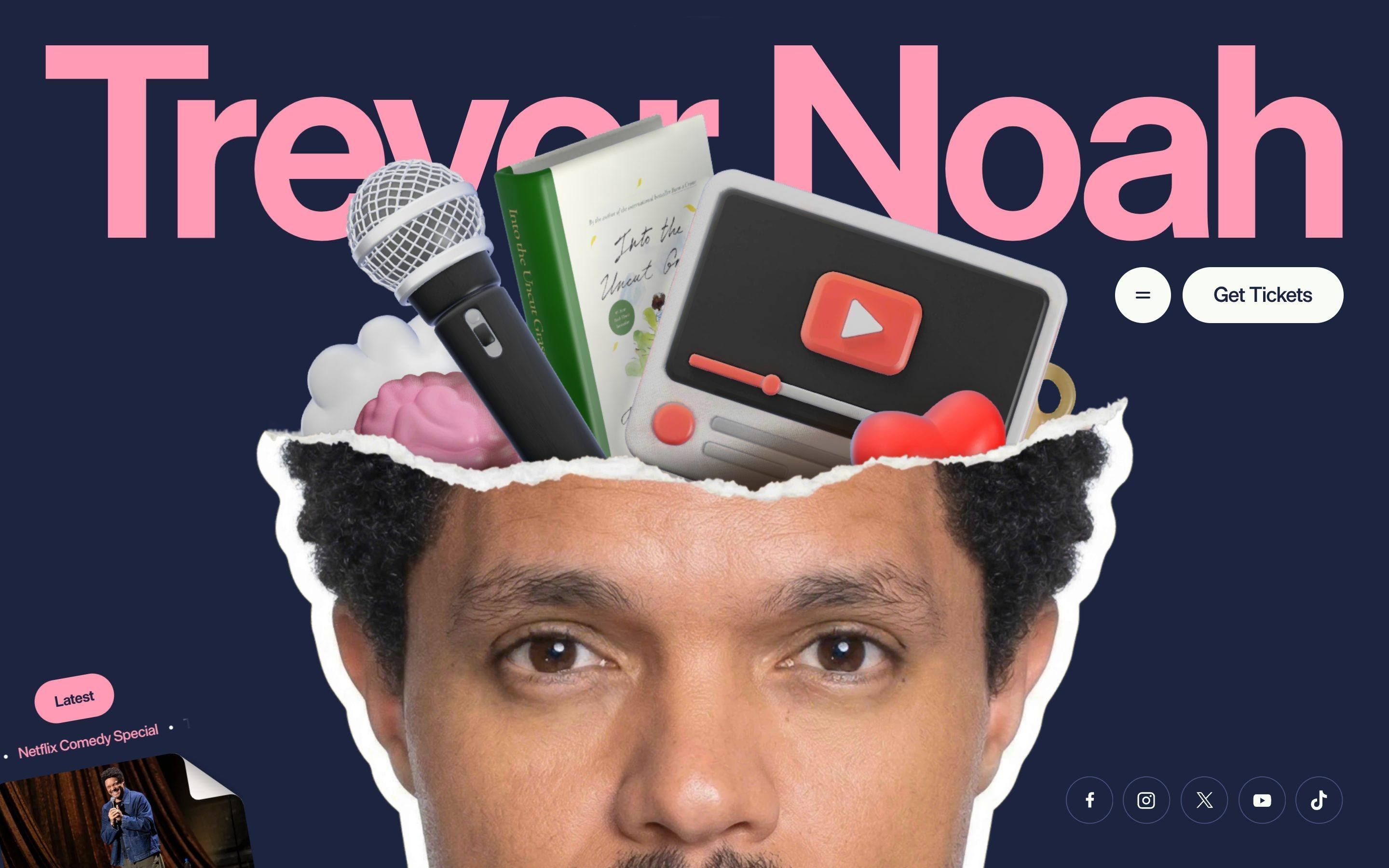
Trevor Noah’s site is a paper collage: a cut-out photo of Trevor Noah’s head tears across the forehead and out come a microphone, a book and a video in 3D, the sections part with a tear that follows the scroll, and a sticker head pops up on the pink words. We take it apart with three demos rebuilt from scratch.
The palette
- #1D2440the night blue of the pages
- #2B2B2Bthe charcoal of the dark sections
- #FF9BB4the pink of the name and the highlighted words
- #F9FCF4the white of the text and the buttons
- #DDE3F9the lilac of the text on the blue
Tap a colour to copy its code.
trevornoah.com is the official site of Trevor Noah, comedian, host and author: the shows, the videos and the podcast, the books, the tour dates. It was made by OFF+BRAND, a studio that signs the site at the bottom of every page and says hello in the browser console: «Curious how this was built?». So were we.
The idea is a collage. Trevor Noah’s head is a photo cut out like a sticker, with a white rim, and paper comes back everywhere: torn across the forehead, torn between one section and the next, stuck onto words. There are few colours: a night blue, #1D2440, a charcoal, #2B2B2B, for the dark sections, a pink, #FF9BB4, for the name and the highlighted words, and a warm white, #F9FCF4. All the text is in Die Grotesk by Klim, in three widths.
Underneath there is Webflow, but the movement is not Webflow’s: the page loads an outside script, served from Vercel, that brings GSAP 3.14 with SplitText and ScrollTrigger, Three.js release 183, Locomotive Scroll with Lenis for smooth scrolling and Taxi.js for the passages between pages. There are many WebGL scenes, one for each piece that moves: the head, the torn paper, the microphone, the books, the world of tour dates, the quotation marks of the quote. The site was Awwwards Site of the Day on 3 September 2026, with 7.45, and got 7.23 in the developers’ vote.
We take it apart in three moments, with a demo rebuilt from scratch for each one, for three made-up characters: drawings, text and code are ours. From the site we took the ideas and, where we say so, the numbers.
The head that opens up
At the start the head comes from far away, small, and meanwhile spreads out on the screen like a sheet that was rolled up. It comes closer, sinks towards the bottom of the page, and the top of the head, torn across the forehead, curls up from one side and goes away. Out of it come a cloud, a pink brain, a microphone, a book, an old screen with a play button and a heart.
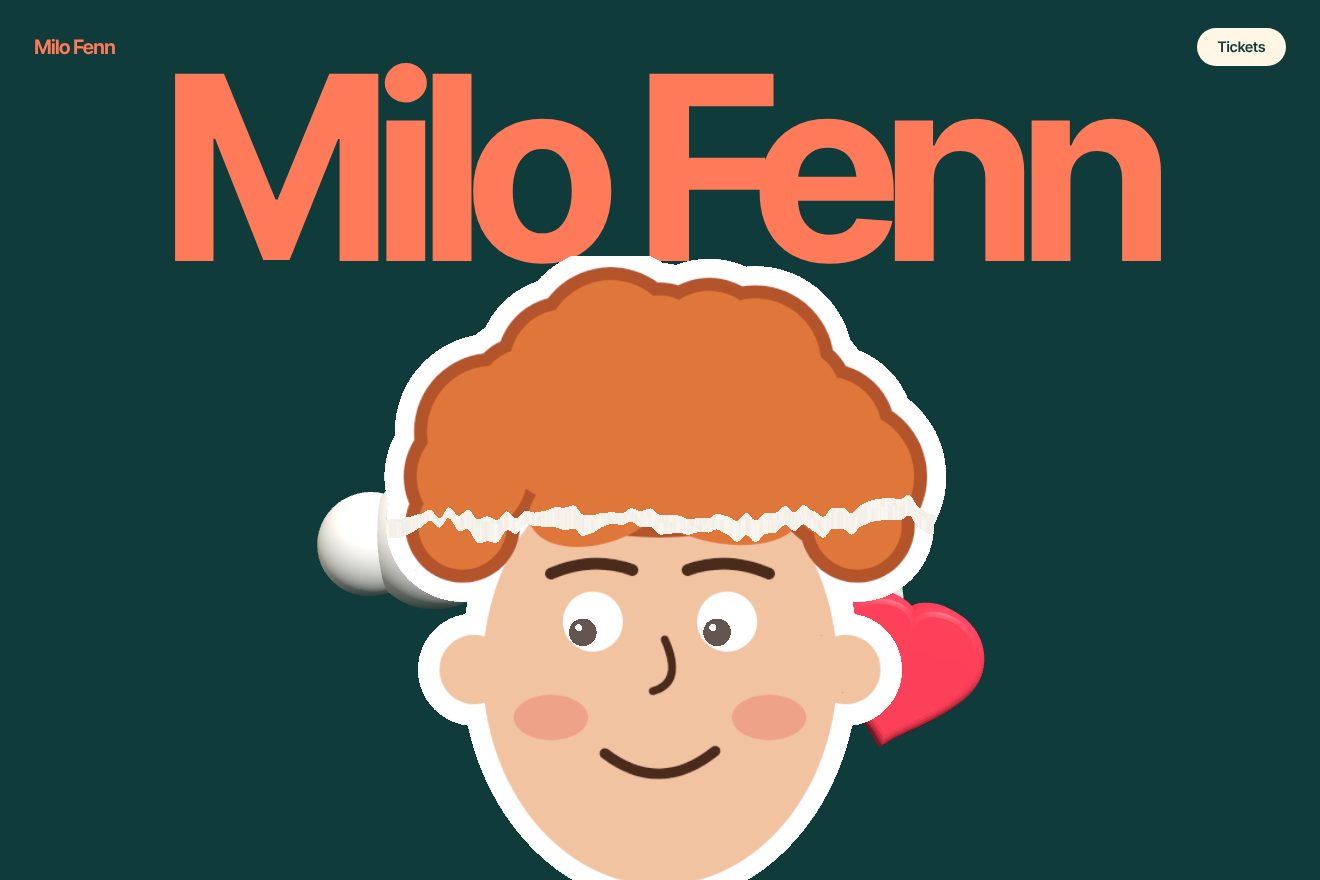
The head is not a video: it is pieces of a single photo on Three.js planes, bent in the vertex shader. Every point beyond a line wraps around a cylinder towards the viewer, with a curvature of 4.71, and past half a turn it carries on flat, folded back. The rest is done by the line, which moves. Three quarters of a second after loading, the line crosses the head in 2 seconds on power1.inOut, and the sheet unrolls; from 1 second the camera goes from 30 to 10 away in 2 seconds on expo.inOut, and the head sinks by one unit. At 3 seconds the line of the top turns the other way and crosses it again in 2 seconds: that is the tear. The things come up from below in 1.25 seconds on back.inOut(2), one every tenth of a second, and they start a moment earlier, at 2.85.
Then the eyes look around: down to the left, then up to the right in three quarters of a second. It is not the pupils that move: from a picture with several glances, the shader picks the one that goes towards the mouse; if the mouse stays still for a second, they look ahead again. The microphone, the book and the screen do a Mexican wave: they rise by 0.25 in 0.7 seconds, one every 0.15, on a curve that dips a little first, and start again after half a second. Point at a thing and it rises by 0.3, the wave stops and starts again two seconds after you leave; a click takes you to its section, the microphone for instance leads to the shows. When scrolling, the rest of the head peels off with the same fold, and as soon as you start the face switches to a surprised photo. On a phone the timings are shorter, there is no wave, and instead of the mouse a carousel picks a thing every 4.5 seconds.
In our demo the comedian is Milo Fenn, drawn by us on a canvas: red hair, a white sticker rim. The pupils are drawn by the shader, so they move without a set of pictures, and the things are plain Three.js shapes instead of models made separately. The fold lines start and end outside the head, with numbers that suit our size.
The tear between two sections
Between sections the site has no straight borders. As you scroll, the sheet above tears from one side to the other along a ragged, sloping line, and under the edge a band of white paper is left. At the tip of the tear the strip coming away curls over, with its shadow.
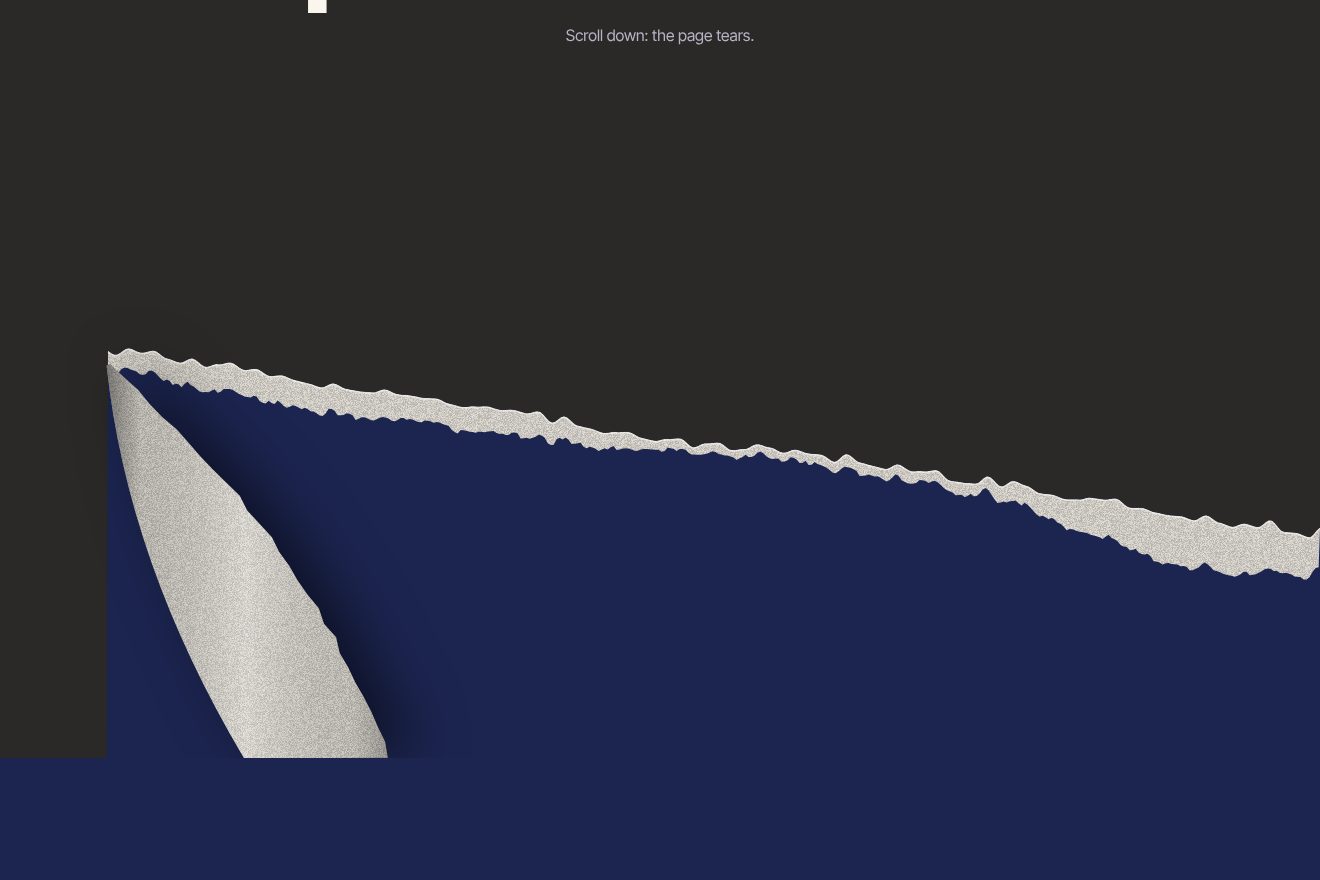
This is a shader too, on a plane 1.7 times as tall as the band. The curling strip is not computed: it comes from two pictures made separately, one for the colour and one for the shape of the fold, and the edge from a noise texture used at two sizes, mixed at 0.25; the paper from a fourth picture. The line slopes by an eighth of a right angle and strays from straight by up to 0.04. Everything depends on one number, how far the tear has gone, which ScrollTrigger takes from 0 to 1.15 on power3.in: it starts very slowly and ends in a rush, and past 1 the strip is already gone. The shadow is 0.66 strong and fades in the last tenths. The mouse near the tip moves it a little and twists the fold. The scene is only drawn when the band is half a screen away, and there is also a reversed tear, with the two colours swapped.
In our demo the tour is The Small Hours Tour and the tear is painted on a 2D canvas, with no pictures: the edge is noise worked out once per width, the white fibre a second noise, the curl a frayed tongue of paper with a shading that makes it look rolled. The numbers for the slope, the edge, the fibre, the shadow and the curve are the site’s.
The sticker that follows the words
In the quote, «I watch horror movies. I wait for people to make stupid decisions», the word horror is pink. Point at it and, right where you are, a small sticker head pops up and stays above the pointer, a little late, leaning the way you move it. In the About section the same trick brings out a beating heart.
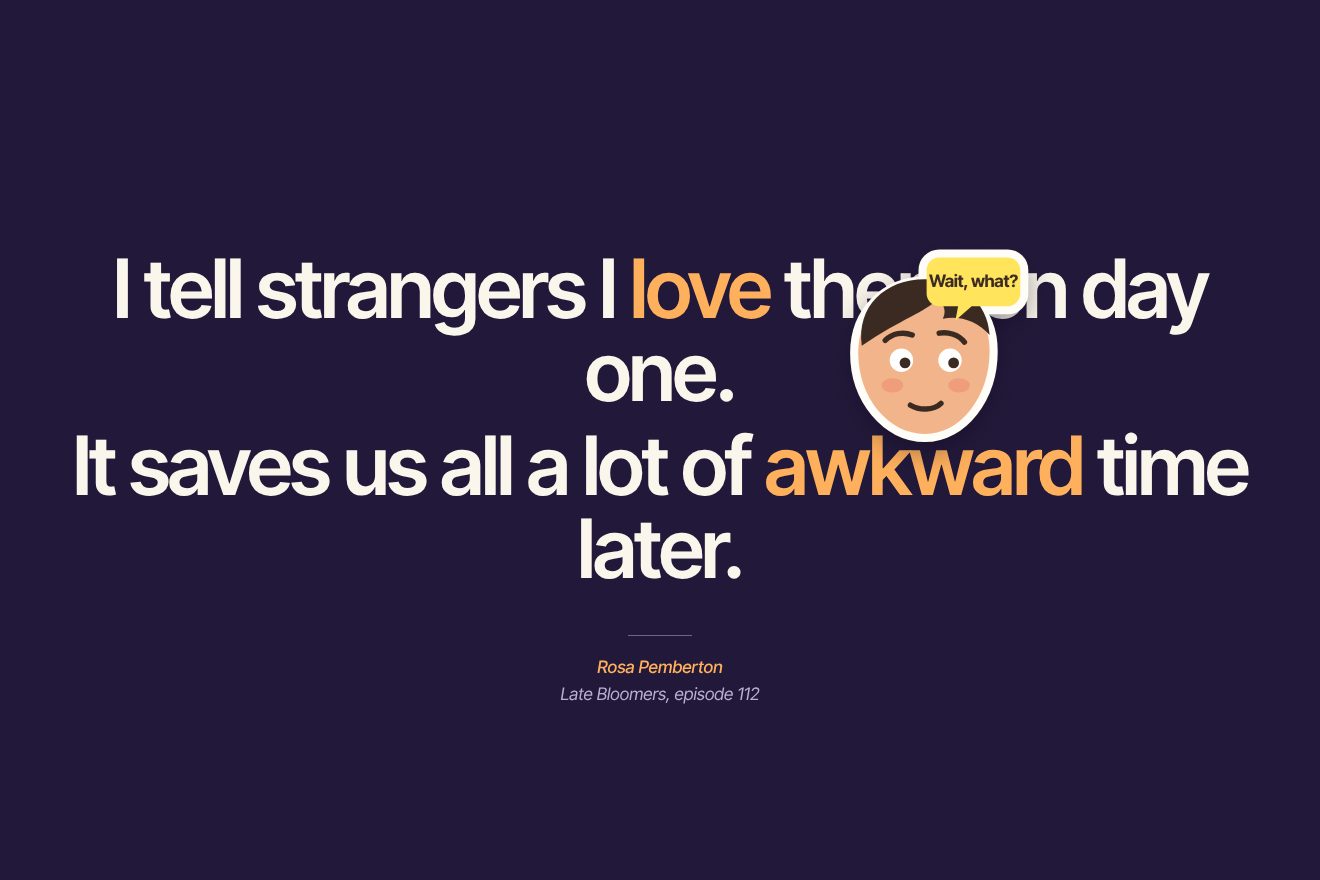
It is a module of a few lines. The pointer events write the point to reach; on every frame the head covers 0.22 of the distance left. The speed is how many pixels the pointer went sideways since the previous event, held within 90 degrees; the lean catches up with it by 0.18 and meanwhile the speed keeps 0.82 of itself on every frame, so if you stop the head straightens up by itself. The script only writes three CSS variables; the entrance is a CSS transition of 0.45 seconds on the curve cubic-bezier(0.4, 1.65, 0.3, 1), which overshoots and comes back. The heart opens like a round window instead, from inset(50% round 50%) to inset(-100% round 50%), and beats every 0.7 seconds, a tenth bigger and turned five degrees.
In our demo the quote comes from a made-up podcast, Late Bloomers, and there are two words: one brings out a startled face with a speech bubble, the other the heart. The numbers are the site’s, but the share of the way is worked out from the real time between frames, so a 120 Hz screen does not go twice as fast; the entrance is done by GSAP, the eyes look the way it moves, and the sticker also comes out with the Tab key and with a finger.
The other details
The huge pink name is an SVG with one piece for each of its ten letters. Once loading is over, the letters do a wave, one every six hundredths of a second; point at one and it drops 28 pixels and turns white in 0.28 seconds, then comes back up on an elastic, elastic.out(2, 0.45), in one second, and goes pink again.
The headings are split into lines with SplitText, and each line rises from 120% of its height in 1.2 seconds. At the bottom left there is a card, Latest, with a curled corner, that moves with the scroll. At the bottom of the page, next to the menu items, another cut-out head asks «Leaving so soon?», and the passages between pages are run by Taxi.js. Scrolling is smooth, with Lenis at 0.1.
Where it stumbles
Reduced motion only half works. The style sheet respects it: with the request for less motion every transition lasts zero and the lines are not split. But the WebGL scenes do not check it: the head comes from far away and tears exactly as always, and the tear between sections follows the scroll. We tried it with Chromium.
It is a heavy page. In our tests the home page made 82 requests for about 11 MB: 4.6 of 3D models, 1.6 of compressed textures, 0.4 of EXR pictures for the tear, almost a megabyte of photos. The script, once downloaded, is 1.3 MB, plus a second piece of 440 KB.
The lean of the head on the words arrives with a double delay: the script eases it on every frame, but in the style sheet the same rotation sits inside a transform with a 0.45-second transition and a bouncing curve, and every new value starts it again.
The name at the top is a drawing: the real heading, an h1 with Trevor Noah, is hidden and is there only for screen readers and Google. It is not a mistake, but it is worth knowing: in the Awwwards developers’ vote the lowest marks are for accessibility, 6.8, along with performance.
What we take away
A single idea, paper, can carry a whole site if you really use it: the head that tears, the sections that tear and the stickers on the words are three different things, but you can tell at once they come from the same table. And the fold of the sheet is a small, powerful trick: a line that moves and a cylinder to wrap whatever lies beyond it around. With that one function the head unrolls, opens and goes away.
The effects
- The head that opens upA paper sticker of a face unrolls onto the screen, then the top of the head tears off, rolls up and goes away, and out of it pop a microphone, a book, a video, a heart and a cloud. The eyes follow the pointer, the things do a Mexican wave and rise when you point at them.Free
- The tear between two sectionsBetween one section and the next the page tears as you scroll: the tear runs from one side to the other along a ragged line, a band of white fibre is left under the edge and the strip coming away curls over, showing the grey of its back.Free
- Word-following stickerA big quote with two coloured words: point at one and a sticker comes out of it, follows the pointer a little late and leans the way you move it. The face pops up from below with a bounce, the heart opens like a round window and beats.Free