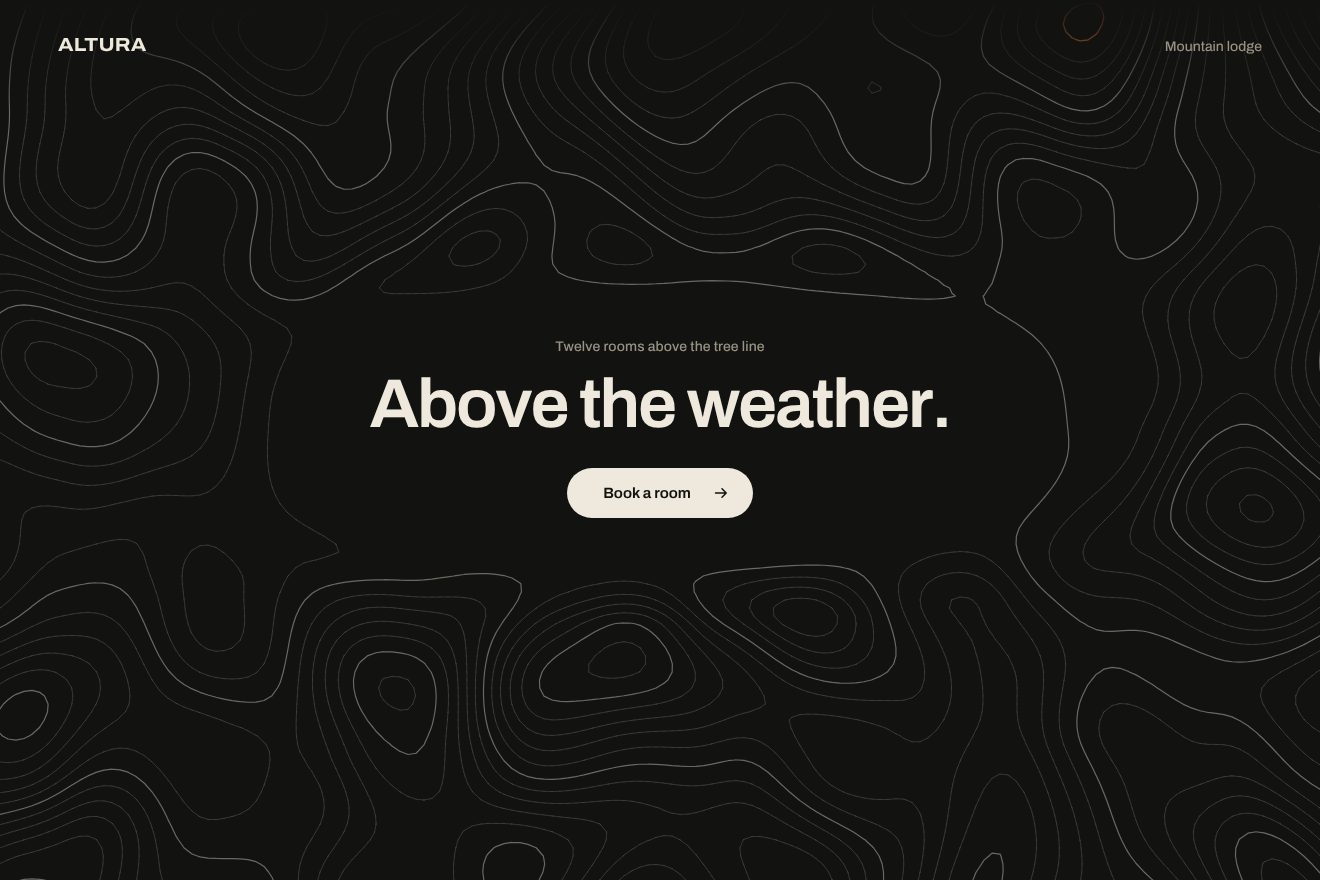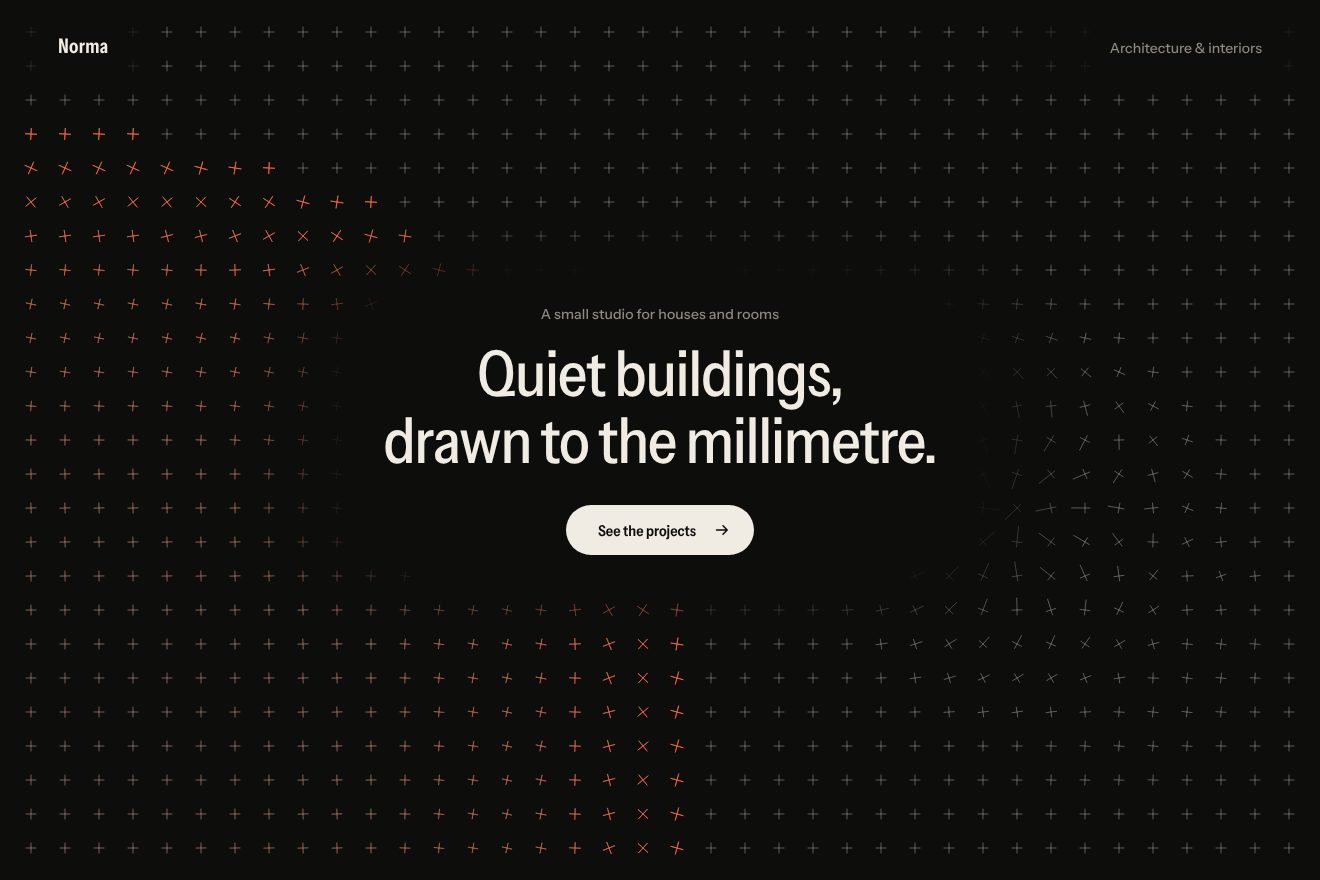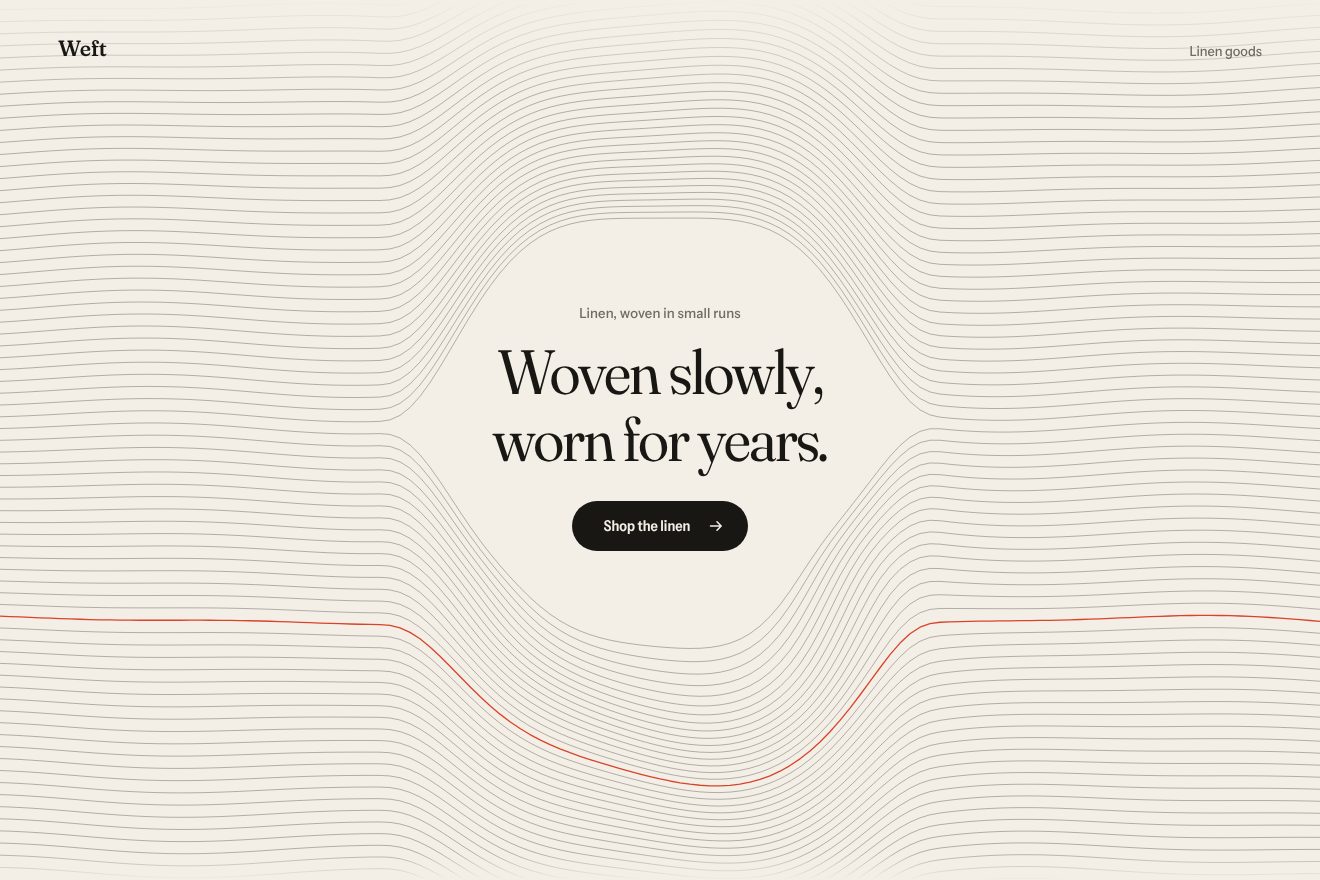
Woven thread background
Backgrounds, Hover
An animated background for an AI app’s hero, on near black: a thin white beam comes in from above, crosses a small glass prism and opens into a soft spectrum, from red to violet, that fans down behind the headline to the floor. The fan breathes, turns towards the pointer on a spring and gathers into a bright focus on the button, leaving a ring of colour round its edge. In the Libraries.dev style: light as a material on a real piece of interface.
A folder that runs on its own: index.html, style.css, script.js and the libraries from a CDN. The React and Vue tabs hold the same demo as a ready component, which switches its animations off when it leaves the page.
<!doctype html>
<!--
  "Prism spectrum background" from Animorio · https://animorio.com
  License: free on your own sites and your clients’ sites, paid work included.
  Not for resale, redistribution, templates or code collections · https://animorio.com/en/license/
-->
<html lang="en">
<head>
  <meta charset="utf-8">
  <meta name="viewport" content="width=device-width, initial-scale=1">
  <title>The background with a spectrum of light from a prism behind the headline</title>
  <link rel="stylesheet" href="https://cdn.jsdelivr.net/npm/@fontsource-variable/mona-sans@5.3.0/wdth.css">
  <link rel="stylesheet" href="style.css">
</head>
<body>
  <!-- the hero of an invented AI research app, Spectrel, on near black: a thin white beam comes in from above, crosses a
       small glass prism and opens into a soft spectrum that fans down behind the words to the floor; the fan turns after
       the pointer, breathes, and narrows into a bright focus when the pointer reaches the button -->
  <main class="stage" data-stage>
    <canvas class="light" data-light aria-hidden="true"></canvas>
    <span class="grain" aria-hidden="true"></span>

    <section class="hero" aria-labelledby="hero-title">
      <p class="pill" data-in>
        <span class="pill__tag">New</span>
        <span class="pill__text">Spectrel now reads your whole drive</span>
        <svg class="pill__arrow" viewBox="0 0 16 16" aria-hidden="true"><path d="M6 3.5 10.5 8 6 12.5"></path></svg>
      </p>
      <h1 class="title" id="hero-title" data-in data-title>Every angle,<br>one answer</h1>
      <p class="lede" data-in>Ask one question. Spectrel splits it, reads every source and brings the light back together.</p>
      <div class="actions" data-in>
        <button class="cta" type="button" data-cta>
          <span class="cta__rim" aria-hidden="true"></span>
          <span class="cta__shine" aria-hidden="true"></span>
          <span class="cta__label">Ask Spectrel</span>
          <svg class="cta__arrow" viewBox="0 0 16 16" aria-hidden="true"><path d="M3 8h9.5M8.5 4 12.5 8l-4 4"></path></svg>
        </button>
        <span class="note">50 questions a month, free</span>
      </div>
    </section>

    <svg class="ghost" data-ghost viewBox="0 0 20 20" aria-hidden="true"><path d="M4 2.5v13.2l3.5-3.3 2.4 5.3 2.3-1-2.4-5.2 4.8-.2z"></path></svg>
  </main>

  <script src="https://cdn.jsdelivr.net/npm/gsap@3.15.0/dist/gsap.min.js"></script>
  <script src="script.js"></script>
</body>
</html>Change values, colours and text with the controls and watch the animation respond live. Or write in the code yourself. Then download the folder with your changes.
21 values to change
With the Animorio connector, Claude Code, ChatGPT, Cursor or VS Code take it from here, guide included, and fit it into your project. Paste this request:
Take “Prism spectrum background” from Animorio and fit it into my siteThe bands of the spectrum are drawn on a canvas at just over a fifth of the size, with a blur filter, then scaled up onto the big canvas in lighter mode: the colours melt into each other like real light and the work costs little even on a phone.
BANDS thin wedges all start from the same point on the base of the prism and reach the floor, each with its own angle and its own colour taken from seven stops between red and violet. Each band has a gradient fading downwards and a slow shimmer of its own; the middle ones are a little stronger.
The prism is a triangle drawn on the big canvas, after the blurred light: faintly bright glass, the beam bending inside (cut to the triangle with a clip), three edges with three different lights and a glint running along them one after another. It turns with the fan, and the points where the light enters and leaves are worked out again every frame.
The turn of the fan, the focus on the button and the kick of a press are three hand-written springs. The breathing is the sum of two slow waves; on the button the opening narrows by FOCUS and the light rises, and the button’s ring of colour is a conic-gradient with a mask that leaves only the edge.
On arrival the light rises, the spectrum opens out of the prism with a back.out and the words rise staggered. After a few seconds without a pointer a looping timeline moves a drawn pointer and presses the button; the first real movement stops it.
| Name | File | Default | What it changes |
|---|---|---|---|
SPREAD | script.js | 17 | How wide the fan of colours opens, in degrees on each side. |
BANDS | script.js | 42 | How many bands the spectrum is split into (more bands, softer). |
TILT | script.js | 10 | How many degrees at most the fan turns towards the pointer. |
FOCUS | script.js | 0.6 | How much the fan narrows when the pointer is on the button (0 not at all, 1 fully). |
BREATH | script.js | 1 | How much the spectrum breathes (0 still). |
GLOW | script.js | 1 | How strong the light is. |
AUTO_PILOT | script.js | 4 | After how many seconds without a pointer the drawn one starts moving (0 never). |
As the background of the first screen of an AI app, a research or analysis tool, a product that brings many sources together, or a launch on a dark page: light that splits and gathers says on its own what the product does.
The same prism and the same spectrum with adapted sizes: the prism is smaller, the fan comes down the tall narrow page, the headline goes on two smaller lines and the finger turns the light like the pointer; tapping the button gathers the spectrum and widens it with the kick.
The light is already in and the spectrum is already open and still: no breathing, no shimmer, no turning and no drawn pointer. On the button the spectrum narrows without a spring and the ring of colour fades in; the words are already in place.
GSAP 3.15.0, Mona Sans (font variabile) 5.3.0.
Compressed with gzip, the three demo files weigh 9.2 KB; the libraries: GSAP 28 KB.
Tested on 28 October 2026
Use it in your own projects and in your clients’ projects. Do not resell it or redistribute it as is. GSAP stays under its own Standard license. Full license.
Support Animorio
Animorio stays free thanks to the people who support it. If you like, buy us a coffee: it helps us make the next animations.
You asked for
We made it for you: it’s in the library, with the preview, the Playground and the code to copy.
An animation you can’t find, or a site to take apart in the journal: tell us which. We pick the next ones from here.
With your account’s email and password.
or with your email
You’re signed in as .
With your account, you can download the zip of every animation and every pack, for free.