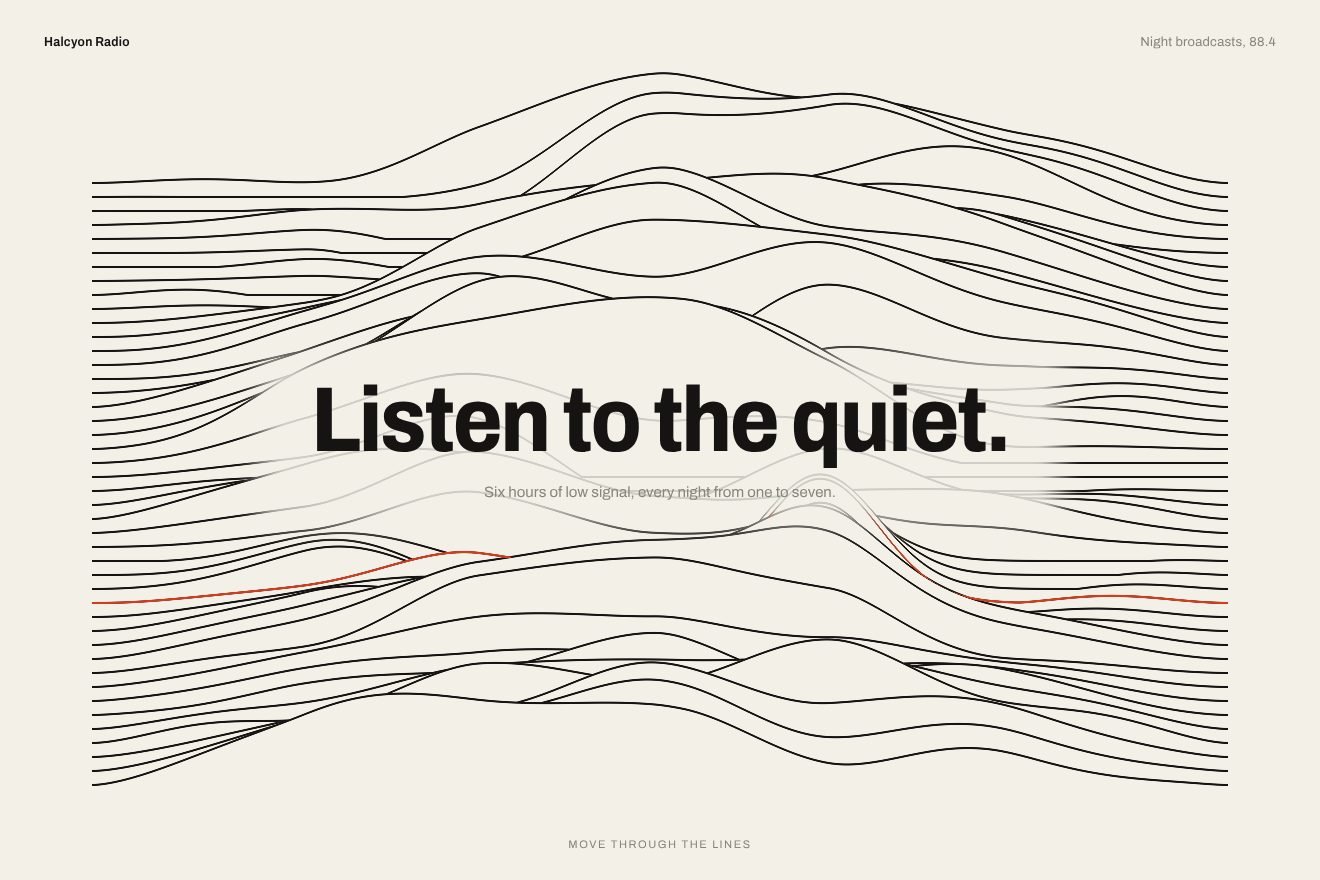
Ridge line background
Backgrounds, WebGL, Hover
An animated background for an AI platform’s hero, on a sheet of lacquered carbon fibre: the stepped 2x2 twill catches the light of a distant lamp, and the fibre tows light up and go dark like a checkerboard as the light follows the pointer. Where the pointer passes the sheet dips and the weave flips in a ring around it; press the button and a flex wave runs across the whole sheet. A hand-written WebGL shader.
A folder that runs on its own: index.html, style.css, script.js and the libraries from a CDN. The React and Vue tabs hold the same demo as a ready component, which switches its animations off when it leaves the page.
<!doctype html>
<!--
  "Carbon fibre background" from Animorio · https://animorio.com
  License: free on your own sites and your clients’ sites, paid work included.
  Not for resale, redistribution, templates or code collections · https://animorio.com/en/license/
-->
<html lang="en">
<head>
  <meta charset="utf-8">
  <meta name="viewport" content="width=device-width, initial-scale=1">
  <title>The carbon fibre background with the weave that bends under the pointer</title>
  <link rel="stylesheet" href="https://cdn.jsdelivr.net/npm/@fontsource-variable/mona-sans@5.3.0/wdth.css">
  <link rel="stylesheet" href="style.css">
</head>
<body>
  <!-- the hero of an invented AI inference platform, Plait, over a sheet of lacquered carbon fibre: a 2x2 twill whose
       tows catch a distant light one way or the other, a soft dent that follows the pointer and flips the weave around
       it, and a flex wave that runs across the sheet when the button is pressed -->
  <main class="stage" data-stage>
    <canvas class="weave" data-weave aria-hidden="true"></canvas>
    <span class="grain" aria-hidden="true"></span>

    <section class="hero" aria-labelledby="hero-title">
      <p class="pill" data-in>
        <span class="pill__tag">New</span>
        <span class="pill__text">Plait 2 routes across 40 regions</span>
        <svg class="pill__arrow" viewBox="0 0 16 16" aria-hidden="true"><path d="M6 3.5 10.5 8 6 12.5"></path></svg>
      </p>
      <h1 class="title" id="hero-title" data-in>Inference,<br>woven for load</h1>
      <p class="lede" data-in>Every model call spread across a mesh of GPUs that bends under traffic and never drops a thread.</p>
      <div class="actions" data-in>
        <button class="cta" type="button" data-cta>
          <span class="cta__face" data-face>
            <span class="cta__shine" aria-hidden="true"></span>
            <span class="cta__row cta__row--idle" data-row="idle">
              <span class="cta__label">Deploy a model</span>
              <svg class="cta__arrow" viewBox="0 0 16 16" aria-hidden="true"><path d="M3 8h9.5M8.5 4 12.5 8l-4 4"></path></svg>
            </span>
            <span class="cta__row cta__row--busy" data-row="busy" aria-hidden="true">
              <svg class="cta__spin" viewBox="0 0 16 16"><circle cx="8" cy="8" r="5.6"></circle></svg>
              <span class="cta__label">Weaving cluster</span>
            </span>
            <span class="cta__row cta__row--done" data-row="done" aria-hidden="true">
              <svg class="cta__tick" viewBox="0 0 16 16"><path d="M3.6 8.4 6.6 11.2 12.4 4.9"></path></svg>
              <span class="cta__label">Cluster live</span>
            </span>
          </span>
        </button>
        <span class="note">First million tokens free</span>
      </div>
    </section>

    <svg class="ghost" data-ghost viewBox="0 0 20 20" aria-hidden="true"><path d="M4 2.5v13.2l3.5-3.3 2.4 5.3 2.3-1-2.4-5.2 4.8-.2z"></path></svg>
  </main>

  <script src="https://cdn.jsdelivr.net/npm/gsap@3.15.0/dist/gsap.min.js"></script>
  <script src="script.js"></script>
</body>
</html>Change values, colours and text with the controls and watch the animation respond live. Or write in the code yourself. Then download the folder with your changes.
26 values to change
With the Animorio connector, Claude Code, ChatGPT, Cursor or VS Code take it from here, guide included, and fit it into your project. Paste this request:
Take “Carbon fibre background” from Animorio and fit it into my siteThe WebGL canvas draws a single triangle bigger than the screen; the fragment shader splits the page into cells TOW pixels wide, one for each stretch of tow.
In each cell the vertical tow is on top if (column + row) modulo 4 is 0 or 1, otherwise the horizontal one: two over and two under, shifted by one, that is the diagonal steps of carbon. The position along the stretch tells where the tow rises and where it dives under the other, and those spots go into shadow.
Every tow has a tangent, the direction of its fibres, tilted where it rises or dives. The light is Kajiya-Kay: the tow shines the more its tangent is perpendicular to the half vector between light and eye, raised to SHARP. The light has a different direction for every pixel, so vertical and horizontal tows light up in turn across the sheet.
Under the pointer the sheet has a Gaussian dip DENT deep, added as a slope to the normal and to the tangents: where the sheet bends the tows change angle to the light and the weave flips. The wave of the press is a ring of slope running out to the edge.
The lamp follows the pointer on a slow spring, the dip on a quick one; its depth grows with the pointer’s speed and slowly closes when it stops. On the button the lamp moves to its centre and the light narrows. The second, lavender light sits on the other side of the headline, with ACCENT_LIGHT.
A press sinks the sheet under the button with an elastic bounce, sends out the flex wave and moves the button through three states. After AUTO_PILOT seconds without a pointer a looping timeline moves a drawn pointer; the first real movement stops it.
| Name | File | Default | What it changes |
|---|---|---|---|
TOW | script.js | 9 | Width of one fibre tow of the weave, in pixels. |
SHARP | script.js | 14 | How narrow the glint along the fibres is (higher, crisper). |
SHINE | script.js | 1 | How strong the lamp light is. |
ACCENT_LIGHT | script.js | 0.55 | How strong the second, lavender light is (0 off). |
DENT | script.js | 1 | How deep the sheet dips under the pointer (0 flat). |
FOLLOW | script.js | 0.9 | How much the light follows the pointer (0 not at all, 1 fully). |
AUTO_PILOT | script.js | 4 | After how many seconds without a pointer the drawn one starts moving (0 never). |
For the hero of an AI platform, a developer service, a SaaS or a hardware brand: when you need a dark background that feels like a real technical material, reacts to the pointer and leaves the headline in front.
Same animations: the weave keeps its size in pixels, the lamp follows the finger and the sheet dips under the finger; text and button fit inside the box.
With reduced motion the carbon is already lit and still, with the lamp in place and no dip, the words only fade in and the button goes straight to «Cluster live».
GSAP 3.15.0, Mona Sans (font variabile) 5.3.0.
Compressed with gzip, the three demo files weigh 10.0 KB; the libraries: GSAP 28 KB.
Tested on 10 November 2026
Use it in your own projects and in your clients’ projects. Do not resell it or redistribute it as is. GSAP stays under its own Standard license. Full license.
Support Animorio
Animorio stays free thanks to the people who support it. If you like, buy us a coffee: it helps us make the next animations.
You asked for
We made it for you: it’s in the library, with the preview, the Playground and the code to copy.
An animation you can’t find, or a site to take apart in the journal: tell us which. We pick the next ones from here.
With your account’s email and password.
or with your email
You’re signed in as .
With your account, you can download the zip of every animation and every pack, for free.