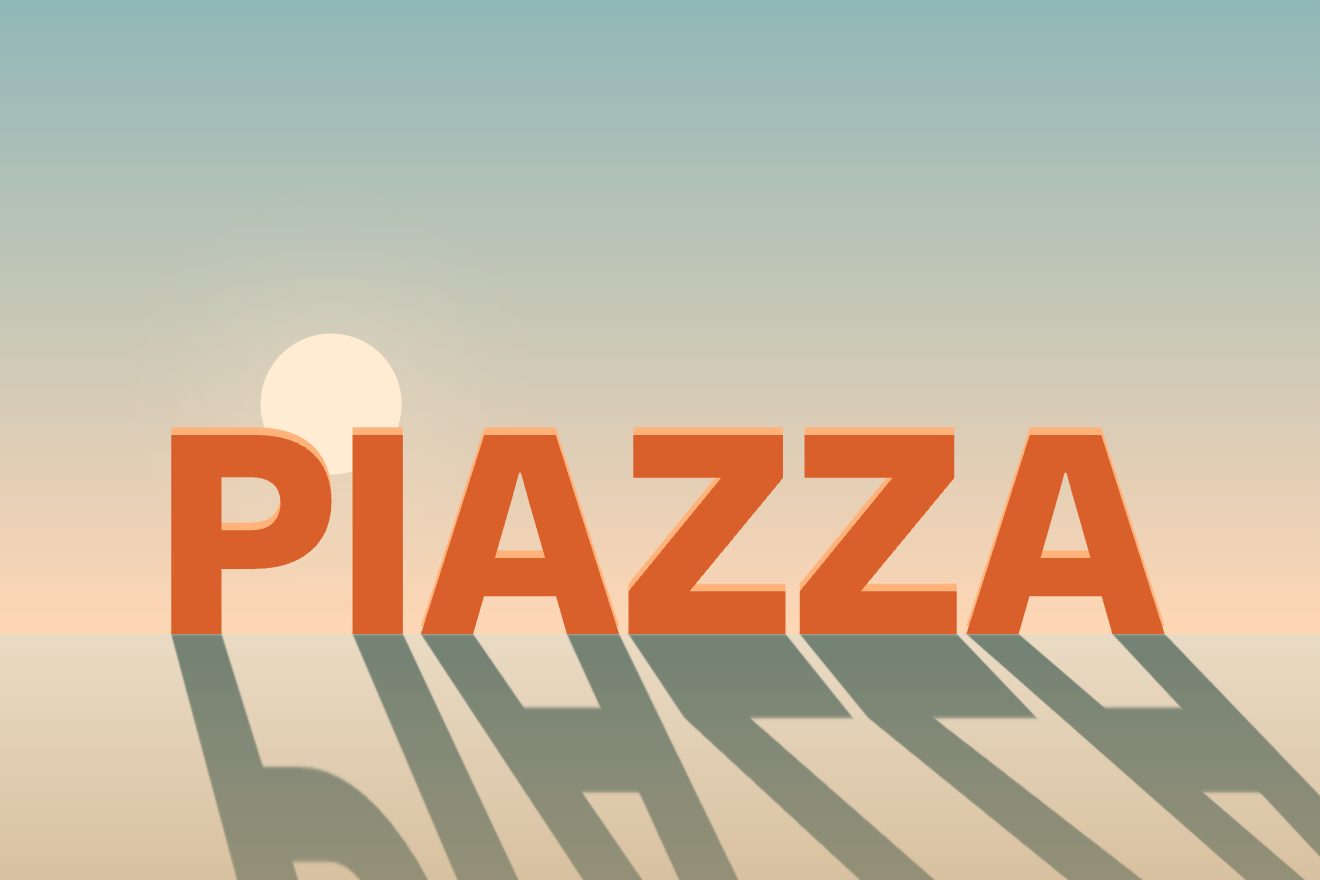
Standing letters with a long shadow
Text, Scroll, 3D
NewFree
Every letter of the title is a ribbon of coloured paper that writes itself by folding: the ribbon runs out straight, stops, and the stretch it has just run out flips over in 3D on its crease and lands flat with a bounce, showing its paler back. Under the pointer the paper lifts and tilts like a spring; then the ribbons unfold backwards and it all starts again. A click folds it again.
A folder that runs on its own: index.html, style.css, script.js and the libraries from a CDN. The React and Vue tabs hold the same demo as a ready component, which switches its animations off when it leaves the page.
<!doctype html>
<html lang="en">
<head>
  <meta charset="utf-8">
  <meta name="viewport" content="width=device-width, initial-scale=1">
  <title>The folded ribbon title</title>
  <link rel="stylesheet" href="https://cdn.jsdelivr.net/npm/@fontsource-variable/archivo@5.3.0/wdth.css">
  <link rel="stylesheet" href="style.css">
</head>
<body>
  <main class="scena" data-scene>
    <!-- the title, for screen readers: the paper ribbons only draw it -->
    <h1 class="leggibile" data-reader>Fold Works. Paper goods, folded by hand</h1>

    <!-- the stage: the script sizes it to the window and draws the ribbons, their folds and their shadows -->
    <canvas class="palco" data-stage aria-hidden="true"></canvas>

    <p class="sotto" data-sub>Paper goods, folded by hand</p>
    <p class="nota" data-hint>Click to fold it again</p>
  </main>

  <script src="https://cdn.jsdelivr.net/npm/gsap@3.15.0/dist/gsap.min.js"></script>
  <script src="script.js"></script>
</body>
</html>Change values, colours and text with the controls and watch the animation respond live. Or write in the code yourself. Then download the folder with your changes.
25 values to change
With the Animorio connector, Claude Code takes it from here, guide included, and fits it into your project. Paste this request:
Take “The folded ribbon title” from Animorio and fit it into my siteThe letters do not come from a typeface: they are square capitals drawn for the demo, A to Z, 10 units tall. Every letter is one or more ribbons, and every ribbon is the line through the middle of the paper: at every corner the ribbon turns by folding. A fold that turns the ribbon by an angle is a line across the strip at half that angle, so the corners come out chamfered by themselves, as with real paper. Turns that are too tight (under fifty degrees or so) would make very long folds: the letters use right angles, diagonals and U-turns.
Every ribbon lives in two frames. Laid flat, it is a straight strip: u along the strip, v across it, and every piece is the stretch between two folds, cut by the two lines and by the end as it runs out (a polygon clipped by three half planes). Folded, every fold is a 3D rotation round its own line, and the place of a piece is the product of the rotations of all the folds before it, like the joints of a robot arm. With every fold at half a turn the drawing lands exactly on the letter; half way, the piece is in the air.
On every frame the pieces go from their 3D matrices to the screen with a light perspective (closer means bigger). The normal of each piece says which face we see, the colour or the paler back, and how much light it gets, so a flap that flips darkens and brightens. The shadows are the same polygons projected onto the card along the light, drawn on two small canvases and then stretched: the one at a third of the size is the contact shadow, the one at a ninth the soft shadow of the flaps in the air.
For every ribbon a paused GSAP timeline runs the end out (power2.out) and then turns the fold by half a turn with a hand-written curve: it starts briskly, speeds up as it falls, bounces once and settles. The main timeline drives the folding timeline with a tween on its progress, then the line underneath, the draught, and at the end the same tween backwards (power2.in), which unfolds everything like a rewound film. A callback on every landing gives the paper underneath a little knock.
Every piece has two springs, its height and its tilt round its middle line, updated on every tick with real physics (force, damping, steps of 1/120 of a second). How close the pointer, or the draught, is decides how far to rise and which way to tilt: the nearer edge goes up. The lower edge never sinks under the card. With reduced motion the folded title fades in and out and the paper stays still.
| Name | File | Default | What it changes |
|---|---|---|---|
TITLE | script.js | 'Fold Works' | The title the ribbons write: letters A to Z and spaces (it is written in capitals, other signs are skipped). With several words, if that makes the letters bigger, each word gets its own line. |
SUBTITLE | script.js | 'Paper goods, folded by hand' | The line under the title, which rises letter by letter (empty = no line). |
SPEED | script.js | 1 | How fast the ribbons run and fold: 2 twice as fast, 0.5 half. |
RIBBON | script.js | 1 | How wide the paper ribbon is: 1.2 wider and bolder, 0.8 thinner. |
LIFT | script.js | 1 | How far the paper lifts and tilts under the pointer and in the draught (0 = it stays flat). |
SPRING | script.js | 0.6 | How springy the paper is: 1 it wobbles for a long time before settling, 0 it settles at once. It also sets the jolt when a flap lands. |
REST | script.js | 2 | How many seconds the folded title stays, after the draught, before the ribbons rewind. |
To open the site of a stationery shop, a bookbinder or a packaging studio, an origami or gift-wrap shop, a children's workshop, a design school; for a playful title that shows up and leaves again, on a holding page, for an event or in a post.
The same animation with the sizes adapted: the two words go on two lines as wide as the screen, and the ribbons, folds and shadows shrink with it. Dragging a finger over the title lifts the paper as the pointer does; a tap folds it again.
Nothing moves: the title, already folded, fades in with the line underneath, stays for a few seconds and fades out; then it starts again. The paper does not lift under the pointer and there is no draught. A click makes it fade at once.
GSAP 3.15.0, Archivo (font variabile) 5.3.0.
Compressed with gzip, the three demo files weigh 10 KB; the libraries: GSAP 28 KB.
Tested on 13 October 2026
Use it in your own projects and in your clients’ projects. Do not resell it or redistribute it as is. GSAP stays under its own Standard license. Full license.
With your account’s email and password.
or with your email
You’re signed in as .
With your account, you can download the zip of every animation and every pack, for free.