The star rating
Ratings, SVG, Hover
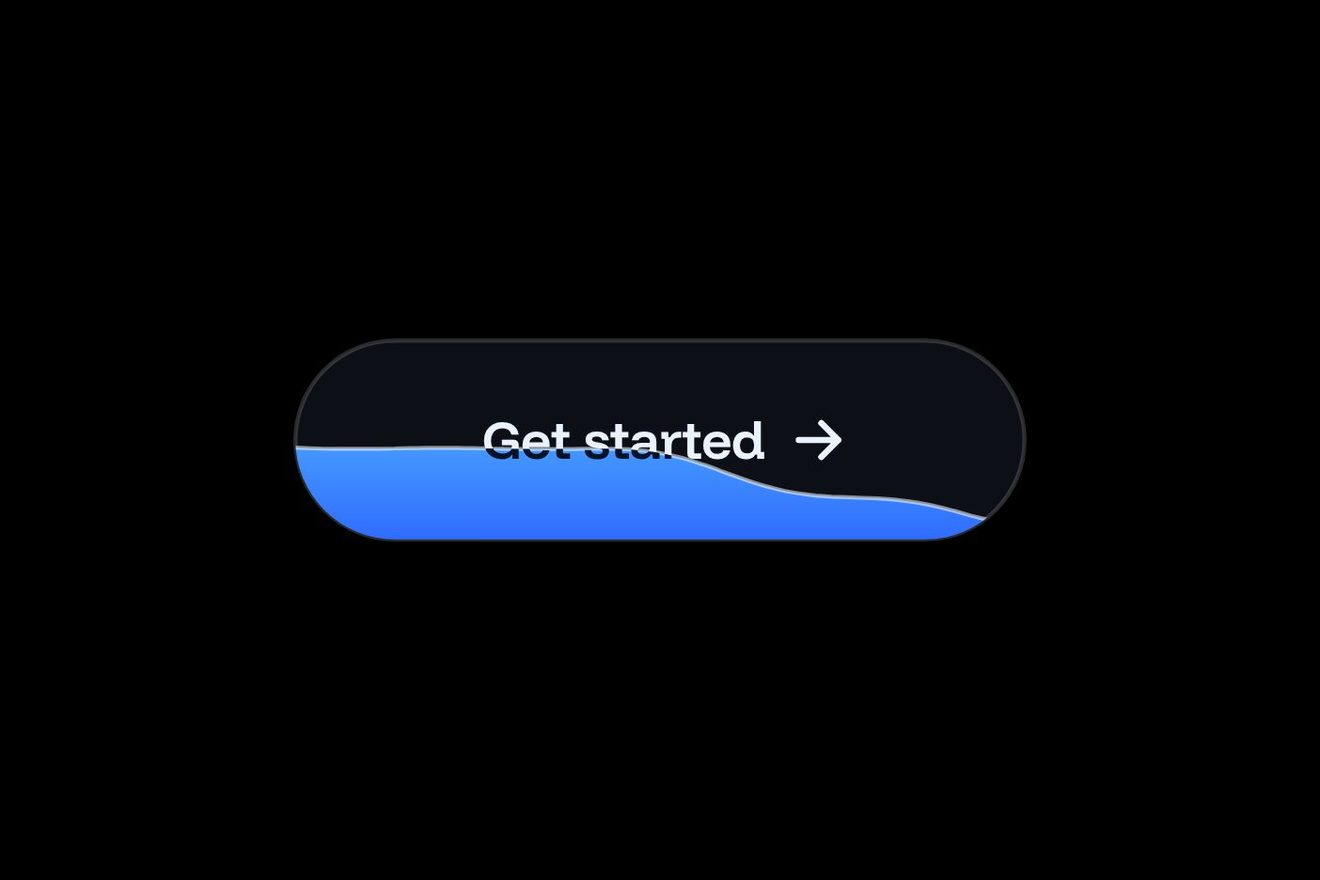
The button to buy concert tickets, made of frosted glass on a violet black, like a Dribbble shot: behind the glass two stage lights, one lilac and one rose, sway slowly and come out of the top edge as faint rays. On hover the lights turn towards the pointer; pressed, they dim like the house lights; while it finds the seats they sweep across each other and a line of light fills the stage edge; when the seats are held the two beams cross over the middle, the ticket turns into a check and the price rolls to the total.
A folder that runs on its own: index.html, style.css, script.js and the libraries from a CDN. The React and Vue tabs hold the same demo as a ready component, which switches its animations off when it leaves the page.
<!doctype html>
<!--
  "Get tickets stage button" from Animorio · https://animorio.com
  License: free on your own sites and your clients’ sites, paid work included.
  Not for resale, redistribution, templates or code collections · https://animorio.com/en/license/
-->
<html lang="en">
<head>
  <meta charset="utf-8">
  <meta name="viewport" content="width=device-width, initial-scale=1">
  <title>The get tickets button with the stage lights behind the glass</title>
  <link rel="stylesheet" href="https://cdn.jsdelivr.net/npm/@fontsource-variable/mona-sans@5.3.0/wdth.css">
  <link rel="stylesheet" href="style.css">
</head>
<body>
  <main class="stage">
    <!-- the ticket button of a concert venue: a pill of frosted glass with two stage lights behind it, one lilac and one
         rose, that sway slowly and come out of the top of the glass in faint rays. On hover they turn to follow the
         pointer; pressed, they dim like the house lights; while the seats are found they sweep across each other and a
         line of light fills the stage edge; when the seats are held they cross on the middle and the glass lights up -->
    <div class="tk" data-wrap>
      <span class="tk__rays" aria-hidden="true">
        <span class="tk__ray tk__ray--a" data-ray></span>
        <span class="tk__ray tk__ray--b" data-ray></span>
      </span>
      <span class="tk__spill" data-spill aria-hidden="true"></span>
      <button class="tk__btn" type="button" data-btn data-autoclic aria-label="Get tickets">
        <span class="tk__glass" data-glass>
          <span class="tk__base" aria-hidden="true"></span>
          <span class="tk__lights" data-lights aria-hidden="true">
            <span class="tk__beam tk__beam--a" data-beam></span>
            <span class="tk__beam tk__beam--b" data-beam></span>
            <span class="tk__spot" data-spot></span>
            <span class="tk__haze" data-haze></span>
          </span>
          <span class="tk__shine" data-shine aria-hidden="true"></span>
          <span class="tk__frost" aria-hidden="true"></span>
          <span class="tk__rim" data-rim aria-hidden="true"></span>
          <span class="tk__floor" aria-hidden="true"><span class="tk__floor-fill" data-floor></span></span>
          <span class="tk__row">
            <span class="tk__well" data-well aria-hidden="true">
              <span class="tk__lit" data-lit></span>
              <svg class="tk__icon" viewBox="0 0 24 24">
                <g data-ticket>
                  <path class="tk__ticket" d="M4.5 7.2A1.7 1.7 0 0 1 6.2 5.5h11.6a1.7 1.7 0 0 1 1.7 1.7v2.1a2.7 2.7 0 0 0 0 5.4v2.1a1.7 1.7 0 0 1-1.7 1.7H6.2a1.7 1.7 0 0 1-1.7-1.7v-2.1a2.7 2.7 0 0 0 0-5.4z"/>
                  <path class="tk__perf" d="M14.6 6.6v10.8"/>
                  <path class="tk__lines" d="M7.6 10.2h4.3M7.6 13.8h2.9"/>
                </g>
                <path class="tk__check" data-check d="M7.4 12.4l3.1 3.1 6.2-6.6" pathLength="1"/>
              </svg>
            </span>
            <span class="tk__words">
              <span class="tk__stack" aria-hidden="true">
                <span class="tk__label" data-label>Get tickets</span>
                <span class="tk__label" data-label>Finding seats</span>
                <span class="tk__label tk__label--done" data-label>Seats held</span>
              </span>
              <span class="tk__stack" aria-hidden="true">
                <span class="tk__sub" data-sub>Nova Arena · Fri 14 Nov</span>
                <span class="tk__sub" data-sub>Best available · 2 seats</span>
                <span class="tk__sub" data-sub>Row F · Seats 12, 13</span>
              </span>
            </span>
            <span class="tk__chip" data-chip aria-hidden="true">
              <span class="tk__cur">€</span><span class="tk__num" data-num><span class="tk__val" data-val>48</span></span>
            </span>
          </span>
        </span>
      </button>
    </div>
    <p class="sr" aria-live="polite" data-live></p>
  </main>
  <script src="https://cdn.jsdelivr.net/npm/gsap@3.15.0/dist/gsap.min.js"></script>
  <script src="script.js"></script>
</body>
</html>Change values, colours and text with the controls and watch the animation respond live. Or write in the code yourself. Then download the folder with your changes.
24 values to change
With the Animorio connector, Claude Code, ChatGPT, Cursor or VS Code take it from here, guide included, and fit it into your project. Paste this request:
Take “Get tickets stage button” from Animorio and fit it into my siteThe button is a single box moved only by GSAP; inside, absolute layers with overflow hidden and the same radius: a dark base, the lights with the haze, the light under the pointer (a radial-gradient on two CSS variables moved by gsap.quickTo), a pane with a feTurbulence grain and three inner shadows for the one pixel edge, and on top the edge that takes the colour of the lights.
Each light is a div with its transform-origin at the bottom centre and mix-blend-mode screen, so where they cross the light adds up; the cone is two conic-gradients starting from the pivot, a wide coloured one and a narrow lighter one for the core of the beam, with soft sides given by the degrees of the gradient itself, and a mask-image that fades it towards the top. The pivot sits 14 pixels under the bottom edge, so the glass only shows the part that opens. A longer copy of each light sits behind the button, with a mask-image that shows it only above the top edge: those are the rays.
Where each light aims, how much it sways and how bright it is live in a single object; GSAP moves its numbers (quickTo for the pointer, a looping timeline for the seat search, a back.out for the cross on the middle) and a single gsap.ticker adds two sines per light and writes the rotation of the lights and the rays, the opacity and two CSS variables for the edge.
The point where the axis of a light crosses the top edge is worked out on every frame with the tangent of the angle times the distance from the pivot; it becomes a CSS variable in percent and a radial-gradient two and a half pixels tall lights the edge of the glass there, so it follows the beams.
On hover the angle of each light is atan2 between the pivot and a point 30 pixels above the pointer, limited to 46 degrees, so the two beams reach it from below like two follow spots. The price is a grid stack: the old number leaves with yPercent minus 100 and the new one comes from 100 with a back.out, the other way round when it goes back to the price of one.
| Name | File | Default | What it changes |
|---|---|---|---|
EVENT | script.js | Nova Arena · Fri 14 Nov | The small line under Get tickets. |
PRICE | script.js | 48 | The price of one ticket, in euro. |
SEATS | script.js | 2 | How many seats are held. |
FIND | script.js | 1.6 | How many seconds it takes to find the seats. |
HOLD | script.js | 3.2 | How many seconds the held seats stay on the button. |
GLOW | script.js | 1 | How strong the stage lights are. |
SWAY | script.js | 1 | How much the lights sway at rest: 0 still, 2 restless. |
SPRING | script.js | 1 | How springy the press and the words are: 0.4 calm, 2 very bouncy. |
AUTO | script.js | true | The button goes round by itself until someone touches it. |
For the buy button of a site for concerts, theatres, festivals and box offices: the event page or the summary before paying, with the search for the best seats and the held seats told inside the button itself. It also works for a club, a cinema or a live music night in a hotel.
On the phone the button is at most 88% of the screen wide and the rest is the same; there is no hover, so the lights stay in their place and the light under the finger turns on at the touch.
The lights stay still and do not sway: they only change in brightness, the haze does not drift, the stage line fills, the pool of light, the check and the ticket swap with a fade, the words and the price change in place.
GSAP 3.15.0, Mona Sans (font variabile) 5.3.0.
Compressed with gzip, the three demo files weigh 9.7 KB; the libraries: GSAP 28 KB.
Tested on 3 November 2026
Use it in your own projects and in your clients’ projects. Do not resell it or redistribute it as is. GSAP stays under its own Standard license. Full license.
Support Animorio
Animorio stays free thanks to the people who support it. If you like, buy us a coffee: it helps us make the next animations.
You asked for
We made it for you: it’s in the library, with the preview, the Playground and the code to copy.
An animation you can’t find, or a site to take apart in the journal: tell us which. We pick the next ones from here.
With your account’s email and password.
or with your email
You’re signed in as .
With your account, you can download the zip of every animation and every pack, for free.