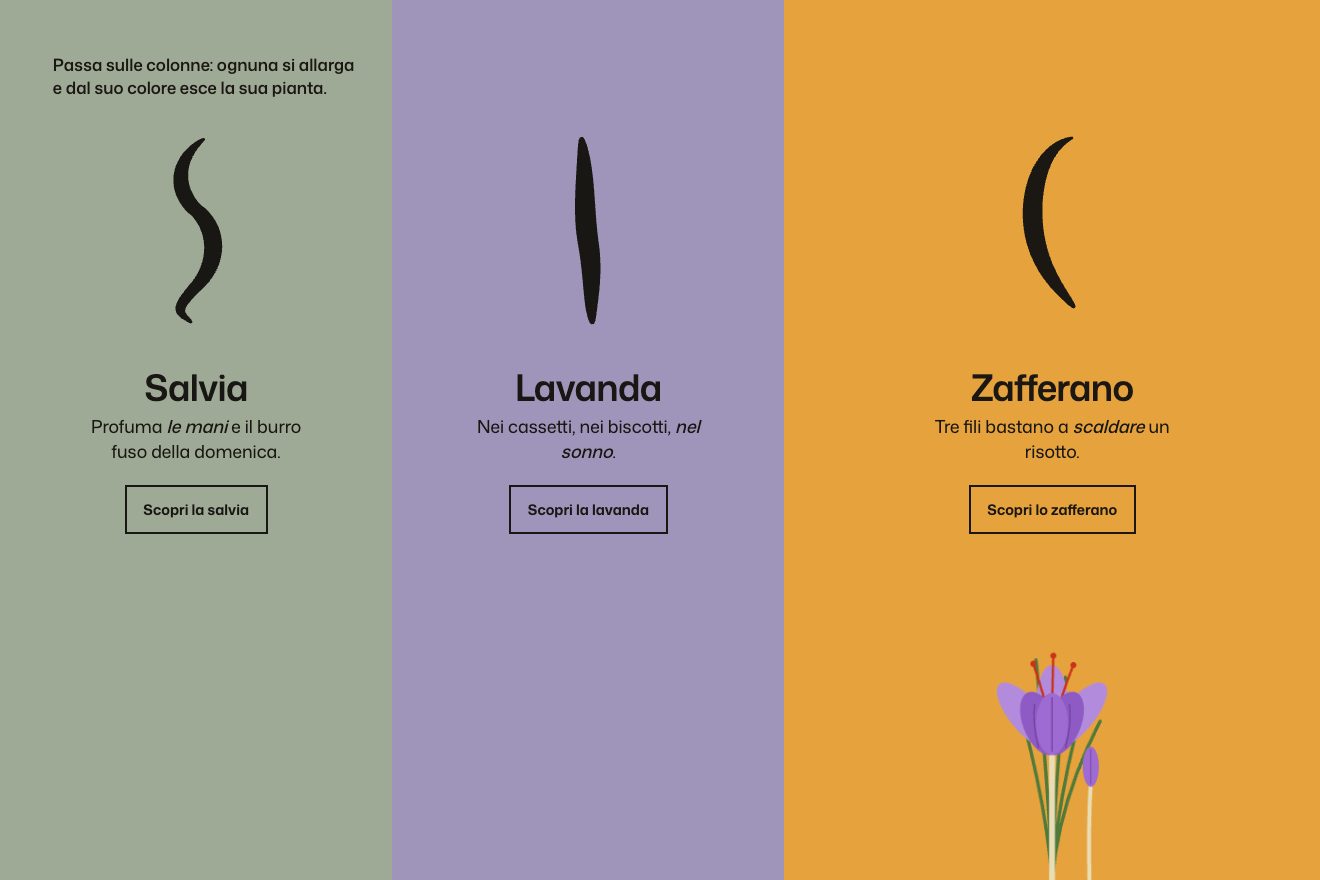
The colour columns
Hover, SVG
The live map in a robot vacuum’s app: the floor plan of a home with four rooms, the robot leaving its dock and cleaning one room after the other back and forth, leaving the cleaned stripes behind it. Each room counts its own percentage, below the square metres and the minutes climb and the battery drops; touching a room the robot leaves what it is doing and goes there first.
A folder that runs on its own: index.html, style.css, script.js and the libraries from a CDN. The React and Vue tabs hold the same demo as a ready component, which switches its animations off when it leaves the page.
<!doctype html>
<!--
  "Robot vacuum map" from Animorio · https://animorio.com
  License: free on your own sites and your clients’ sites, paid work included.
  Not for resale, redistribution, templates or code collections · https://animorio.com/en/license/
-->
<html lang="en">
<head>
  <meta charset="utf-8">
  <meta name="viewport" content="width=device-width, initial-scale=1">
  <title>Robot vacuum cleaning map with the rooms cleaned in stripes</title>
  <link rel="stylesheet" href="https://cdn.jsdelivr.net/npm/@fontsource-variable/mona-sans@5.3.0/wdth.css">
  <link rel="stylesheet" href="style.css">
</head>
<body>
  <main class="stage">
    <!-- the live map of a robot vacuum's app: the robot leaves its dock and cleans one room after the other in
         stripes; every room counts its own percentage, and touching a room sends the robot there first -->
    <section class="bot" data-bot aria-label="Robot vacuum, cleaning map">
      <header class="bot__head">
        <div class="bot__title"><span>Juno S2</span><p class="roll"><span data-status>Ready on the dock</span></p></div>
        <p class="bot__batt" aria-label="Battery"><svg viewBox="0 0 22 12" aria-hidden="true"><rect class="batt__case" x="0.75" y="0.75" width="18" height="10.5" rx="3"></rect><path class="batt__tip" d="M20.6 4v4"></path><rect class="batt__fill" data-battfill x="2.6" y="2.6" width="14.3" height="6.8" rx="1.6"></rect></svg><span data-batt>86%</span></p>
      </header>

      <svg class="bot__map" data-map viewBox="-4 -4 328 212" role="group" aria-label="Floor plan">
        <defs><filter id="botShadow" x="-60%" y="-60%" width="220%" height="220%"><feDropShadow dx="0" dy="1.5" stdDeviation="1.8" flood-color="#16181d" flood-opacity="0.35"></feDropShadow></filter></defs>
        <g data-rooms></g>
        <rect class="dock" x="6" y="178" width="20" height="20" rx="6"></rect>
        <path class="way" data-way d=""></path>
        <g class="robot" data-robot filter="url(#botShadow)"><circle r="9"></circle><circle class="robot__ring" r="5.2"></circle><path class="robot__eye" d="M5.4 -3.4A6.4 6.4 0 0 1 5.4 3.4"></path></g>
      </svg>

      <div class="bot__chips" data-chips></div>
      <p class="bot__foot"><span><strong data-area>0</strong> m² cleaned</span><span><strong data-min>0</strong> min</span></p>
    </section>
    <p class="sr" data-live aria-live="polite"></p>

    <svg class="ghost" data-ghost viewBox="0 0 24 24" aria-hidden="true"><path d="M5 3.2 19.2 11l-6.3 1.6-3.3 5.9Z"></path></svg>
  </main>

  <script src="https://cdn.jsdelivr.net/npm/gsap@3.15.0/dist/gsap.min.js"></script>
  <script src="script.js"></script>
</body>
</html>Change values, colours and text with the controls and watch the animation respond live. Or write in the code yourself. Then download the folder with your changes.
18 values to change
With the Animorio connector, Claude Code, ChatGPT, Cursor or VS Code take it from here, guide included, and fit it into your project. Paste this request:
Take “Robot vacuum map” from Animorio and fit it into my siteFor each room the script builds a serpentine path, one pass every LANE units. The same path is drawn 14 wide and semi-transparent: its stroke-dashoffset uncovers the part already cleaned, and getPointAtLength at the same fraction gives the robot’s position. Robot and stripes cannot drift apart.
Each room has a progress from 0 to 1, moved by a linear tween as long as the path divided by SPEED. From those four numbers one function rewrites percentages, button fills, square metres, minutes and battery.
Touching a room the running tween is stopped (its number stays where it is), the robot travels in a straight line to the point of the new path where it must begin, turning with atan2, and starts again. When that is done, it resumes the first unfinished room from the exact point where it left it.
| Name | File | Default | What it changes |
|---|---|---|---|
SPEED | script.js | 330 | How fast the robot runs while cleaning, in map units per second. |
LANE | script.js | 16 | The distance between one pass and the next. |
TRAVEL | script.js | 0.55 | How many seconds to move from one room to another. |
REST | script.js | 1.8 | How many seconds it stays on the dock after cleaning before starting again. |
ACCENT | script.js | #3b6cff | The colour of the cleaned stripes. |
LOOP | script.js | true | Left alone, it starts again and a pointer picks a room. |
For the app or the landing page of a robot vacuum, a robot mower or a cleaning company, and for any map showing work that advances room by room: a paint job, an inspection, a delivery by floors. In a real product the plan and the position come from the robot.
The same card, as wide as the screen minus the margins and measured on the height too; rooms and buttons are touched with a finger, and there is no edge lighting up on hover.
No running robot: the home is shown already cleaned, with the stripes in place, the percentages at 100% and the robot still on its dock.
GSAP 3.15.0, Mona Sans (font variabile) 5.3.0.
Compressed with gzip, the three demo files weigh 6.7 KB; the libraries: GSAP 28 KB.
Tested on 15 November 2026
Use it in your own projects and in your clients’ projects. Do not resell it or redistribute it as is. GSAP stays under its own Standard license. Full license.
Support Animorio
Animorio stays free thanks to the people who support it. If you like, buy us a coffee: it helps us make the next animations.
You asked for
We made it for you: it’s in the library, with the preview, the Playground and the code to copy.
An animation you can’t find, or a site to take apart in the journal: tell us which. We pick the next ones from here.
With your account’s email and password.
or with your email
You’re signed in as .
With your account, you can download the zip of every animation and every pack, for free.