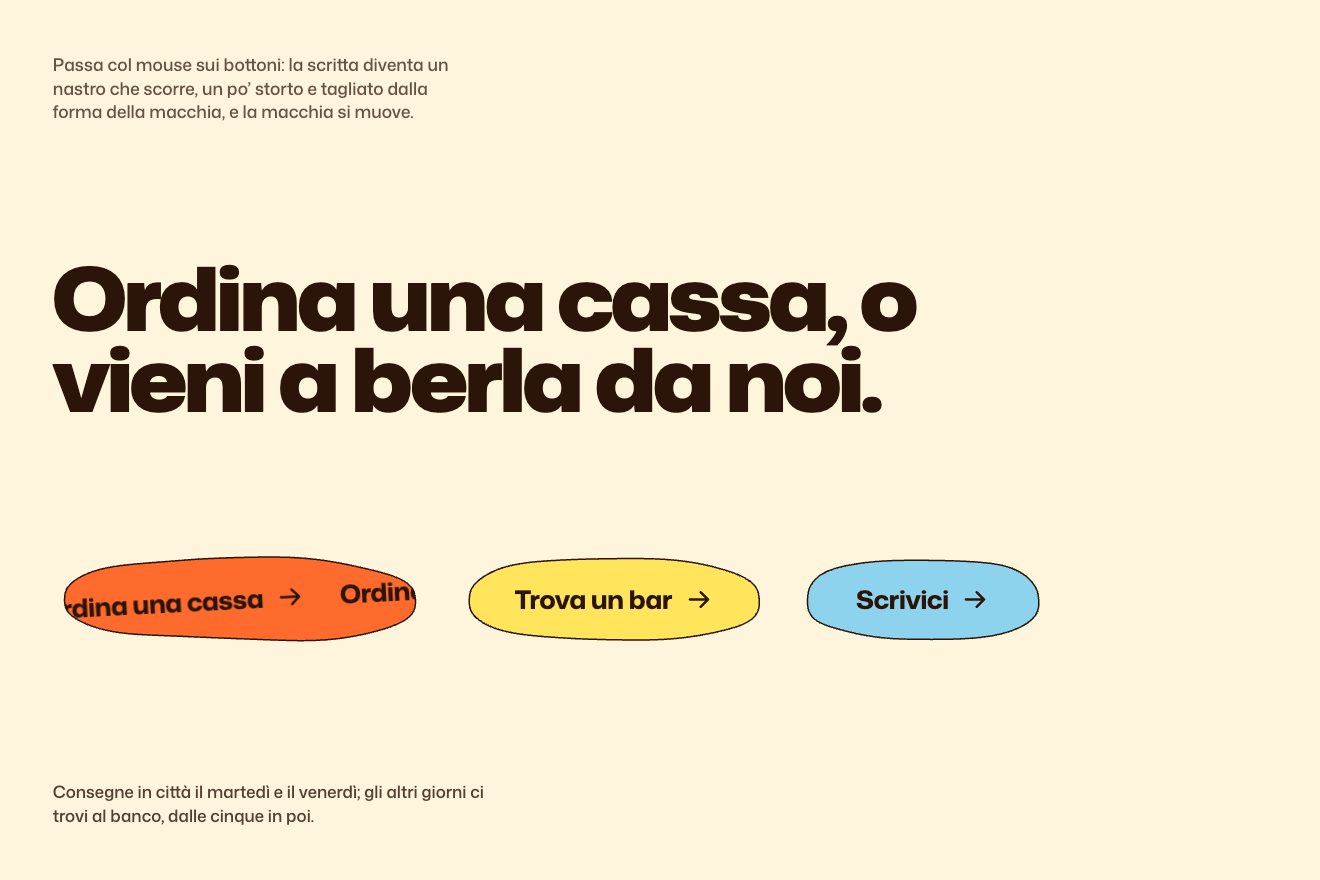
The ticker in the button
Hover, SVG, Text
Three full-height columns, each the colour of a herb, with a brush mark that draws itself. Passing over one, the column widens and its drawn plant rises out of the colour.
Rebuilt from scratch studying champohaircare.com by BAO: the idea is theirs; code, copy and images are ours. Read how it’s made
A folder that runs on its own: index.html, style.css, script.js and the libraries from a CDN. The React and Vue tabs hold the same demo as a ready component, which switches its animations off when it leaves the page.
<!doctype html>
<!--
  "The colour columns" from Animorio · https://animorio.com
  License: free on your own sites and your clients’ sites, paid work included.
  Not for resale, redistribution, templates or code collections · https://animorio.com/en/license/
-->
<html lang="en">
<head>
  <meta charset="utf-8">
  <meta name="viewport" content="width=device-width, initial-scale=1">
  <title>Colour columns</title>
  <link rel="stylesheet" href="https://cdn.jsdelivr.net/npm/@fontsource-variable/mona-sans@5.3.0/standard.css">
  <link rel="stylesheet" href="style.css">
</head>
<body>
  <main class="colonne" data-colonne>
    <h1 class="nascosto">Three herbs from the garden</h1>
    <p class="nota" data-nota>Hover the columns: each one widens and its plant rises out of its colour.</p>
    <article class="colonna colonna--salvia" data-colonna="salvia">
      <svg class="colonna__pianta" data-pianta viewBox="0 0 300 500" preserveAspectRatio="xMidYMax meet" aria-hidden="true" focusable="false"></svg>
      <svg class="colonna__segno" data-segno viewBox="0 0 120 300" aria-hidden="true" focusable="false"></svg>
      <div class="colonna__testo">
        <h2 class="colonna__nome">Sage</h2>
        <p class="colonna__frase">Scents <em>your hands</em> and the melted butter on Sundays.</p>
        <a class="colonna__bottone" href="#">Discover sage</a>
      </div>
    </article>
    <article class="colonna colonna--lavanda" data-colonna="lavanda">
      <svg class="colonna__pianta" data-pianta viewBox="0 0 300 500" preserveAspectRatio="xMidYMax meet" aria-hidden="true" focusable="false"></svg>
      <svg class="colonna__segno" data-segno viewBox="0 0 120 300" aria-hidden="true" focusable="false"></svg>
      <div class="colonna__testo">
        <h2 class="colonna__nome">Lavender</h2>
        <p class="colonna__frase">In drawers, in biscuits, <em>in sleep</em>.</p>
        <a class="colonna__bottone" href="#">Discover lavender</a>
      </div>
    </article>
    <article class="colonna colonna--zafferano" data-colonna="zafferano">
      <svg class="colonna__pianta" data-pianta viewBox="0 0 300 500" preserveAspectRatio="xMidYMax meet" aria-hidden="true" focusable="false"></svg>
      <svg class="colonna__segno" data-segno viewBox="0 0 120 300" aria-hidden="true" focusable="false"></svg>
      <div class="colonna__testo">
        <h2 class="colonna__nome">Saffron</h2>
        <p class="colonna__frase">Three threads are enough to <em>warm</em> a risotto.</p>
        <a class="colonna__bottone" href="#">Discover saffron</a>
      </div>
    </article>
  </main>

  <script src="https://cdn.jsdelivr.net/npm/gsap@3.15.0/dist/gsap.min.js"></script>
  <script src="script.js"></script>
</body>
</html>Change values, colours and text with the controls and watch the animation respond live. Or write in the code yourself. Then download the folder with your changes.
26 values to change
With the Animorio connector, Claude Code, ChatGPT, Cursor or VS Code take it from here, guide included, and fit it into your project. Paste this request:
Take “The colour columns” from Animorio and fit it into my siteEach mark is a single SVG line. The script measures it with getPointAtLength at 120 points and, for each, moves one point left and one right along the normal: the thickness is width × (0.12 + 0.88 × sin(πt)^0.55) × (0.42 + 0.58 × |dy|), that is thin at the tips and full where the stroke goes down, like a nib held at an angle. The left points and the right ones, reversed, close the outline.
A filled outline cannot be drawn with stroke-dashoffset. The trick is a mask: the same centre line, 1.8 times as wide as the brush, with pathLength 1 and a dashoffset going from 1.02 to 0 in 1.3 seconds with power2.inOut. It uncovers the filled mark as it runs, and the leading edge is a clean cut, like the brush coming down.
The columns are flex: 1 1 0, and the active one goes to flex-grow 1.5 with a 0.7-second CSS transition. The others get filter: saturate(0.72) brightness(0.95). The plant, under the text, starts at opacity 0, 5% lower and scale 1.06, and settles in 1.1 seconds: it seems to rise out of the colour and come to rest.
Instead of pointerenter on each column, a single pointermove listener on the window asks which column is under the pointer and lights only that one. With the keyboard, the column of the focused button lights up; on phones the columns stack, the plants stay visible and the marks draw themselves when each column reaches the screen.
| Name | File | Default | What it changes |
|---|---|---|---|
SEGNI | script.js | 3 segni | The line of each mark, in 120 × 300, and the brush width: any line becomes a calligraphic stroke. |
DISEGNA | script.js | 1.3 | The seconds to draw a mark. |
--c | style.css | #A3B596, #A99BD1, #E6A23C | The colour of each column. |
flex-grow | style.css | 1.5 | How much the active column widens. |
To present three lines, three seasons, three services or three characters of a product, when each has its own colour and one gesture is enough to meet them.
The columns stack, each almost a screen tall; the plants are always visible and each mark draws itself when its column enters the screen.
The marks are already drawn, the columns keep their width and the plant appears in place with a 150-millisecond fade.
GSAP 3.15.0, Mona Sans (font variabile) 5.3.0.
Compressed with gzip, the three demo files weigh 6.2 KB; the libraries: GSAP 28 KB.
Tested on 21 October 2026
Use it in your own projects and in your clients’ projects. Do not resell it or redistribute it as is. GSAP stays under its own Standard license. Full license.
Support Animorio
Animorio stays free thanks to the people who support it. If you like, buy us a coffee: it helps us make the next animations.
You asked for
We made it for you: it’s in the library, with the preview, the Playground and the code to copy.
An animation you can’t find, or a site to take apart in the journal: tell us which. We pick the next ones from here.
With your account’s email and password.
or with your email
You’re signed in as .
With your account, you can download the zip of every animation and every pack, for free.