Altitude 101, by Metabole Studio
Altitude 101, how it’s made: a site you look at through a headset
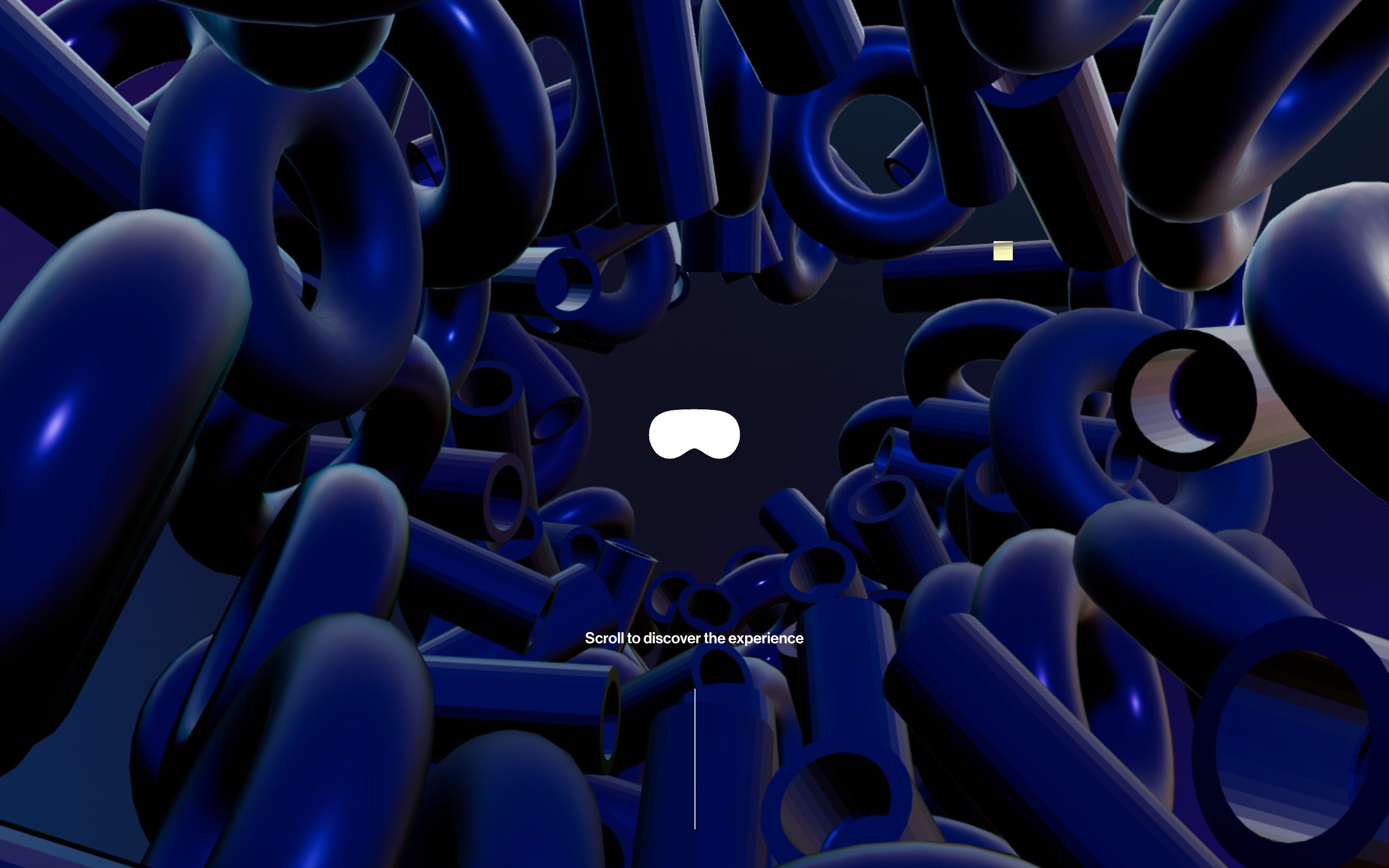
The site of a Paris studio that shoots films for the Apple Vision Pro: a tunnel of shapes that make room for the pointer, a headset that is a hole in the night and widens until the page comes in, three words on three walls of a turning room. We take it apart with three demos rebuilt from scratch.
The palette
- #F1F1F1the light pages
- #08070Fthe night of the opening
- #1A1450the shapes of the tunnel
- #0A1E5Cthe bluest shapes
- #000DFFthe blue of the 3D letters
- #CBC7FFthe lavender in the middle of the letters
- #B200FFthe violet of the letters
- #62A6FBthe blue of the footer
Tap a colour to copy its code.
How others rated it
CSSDAWebsite of the Day, 17 January 20267.98/10the jury scorealtitude101.com is the site of Altitude 101, a Paris production studio that shoots immersive films for the Apple Vision Pro with Blackmagic’s immersive cameras. It was designed and coded by Metabole Studio, also in Paris. It opens on black with the word «alt» and a counter; then comes a blue and violet night, full of rings and tubes of blue metal floating around a white headset, and the line «Scroll to discover the experience». The pages after it are light, #F1F1F1, with black text in Neue Haas Grotesk Display and the big words in Ivy Presto Display Light Italic, an italic with hairline serifs, coloured from electric blue to violet through lavender.
Underneath there is Next.js, with React Three Fiber on top of Three.js r183, GSAP with ScrollTrigger, SplitText and Observer, Lenis for the smooth scrolling and Rapier, a physics engine compiled to WebAssembly (Matter.js comes along in the files too). The reflections on the metal come from a Poly Haven HDR image, the 3D models arrive compressed, and over the light scene there is a fluid the pointer stirs. The first load is 6.5 MB in 52 requests; scrolling to the bottom takes it to 9.4 MB in 73.
The site was Website of the Day on CSS Design Awards on 17 January 2026, with 7.98 from the jury; on Awwwards it was nominated. We take it apart in three moments, with a demo rebuilt from scratch for each, for three invented brands: drawings, copy and code are ours. From the site we took the ideas and, where we say so, the numbers.
The tunnel that makes room
The first scene is a tunnel seen from inside: a hundred and twenty metal shapes, half rings and half tubes, float without weight in a ring around the middle, which stays empty and holds the headset. The pointer pushes them away, they knock into each other, turn slowly and come back.
On the site it is real physics, with Rapier and gravity at zero. Every shape is a body with a box collider, and at every step it gets impulses. Outside a ring with a radius of 3 it is pulled back in with 2 · (d − 3); inside, after a second and a half, it is pushed out with 5 · (0.9 · 3 − d) and, closer still to the axis, with 15 · (3 − d). A cylinder along the axis keeps the middle clear. The pointer pushes with 180 for every unit it gets inside its reach, 3.5 units plus the shape’s size; meanwhile every shape sways in depth, drifts a little and gets small random twists. The damping is 0.95, for movement and for rotation alike. The shapes start between 15 and 25 units from the middle, off screen, and while they arrive the lens widens from 18 to 40 degrees: that is what gives the rush at the start. The materials are pure metal, with a random roughness between 0.05 and 0.6 and a blue between #1A1450 and #0A1E5C.
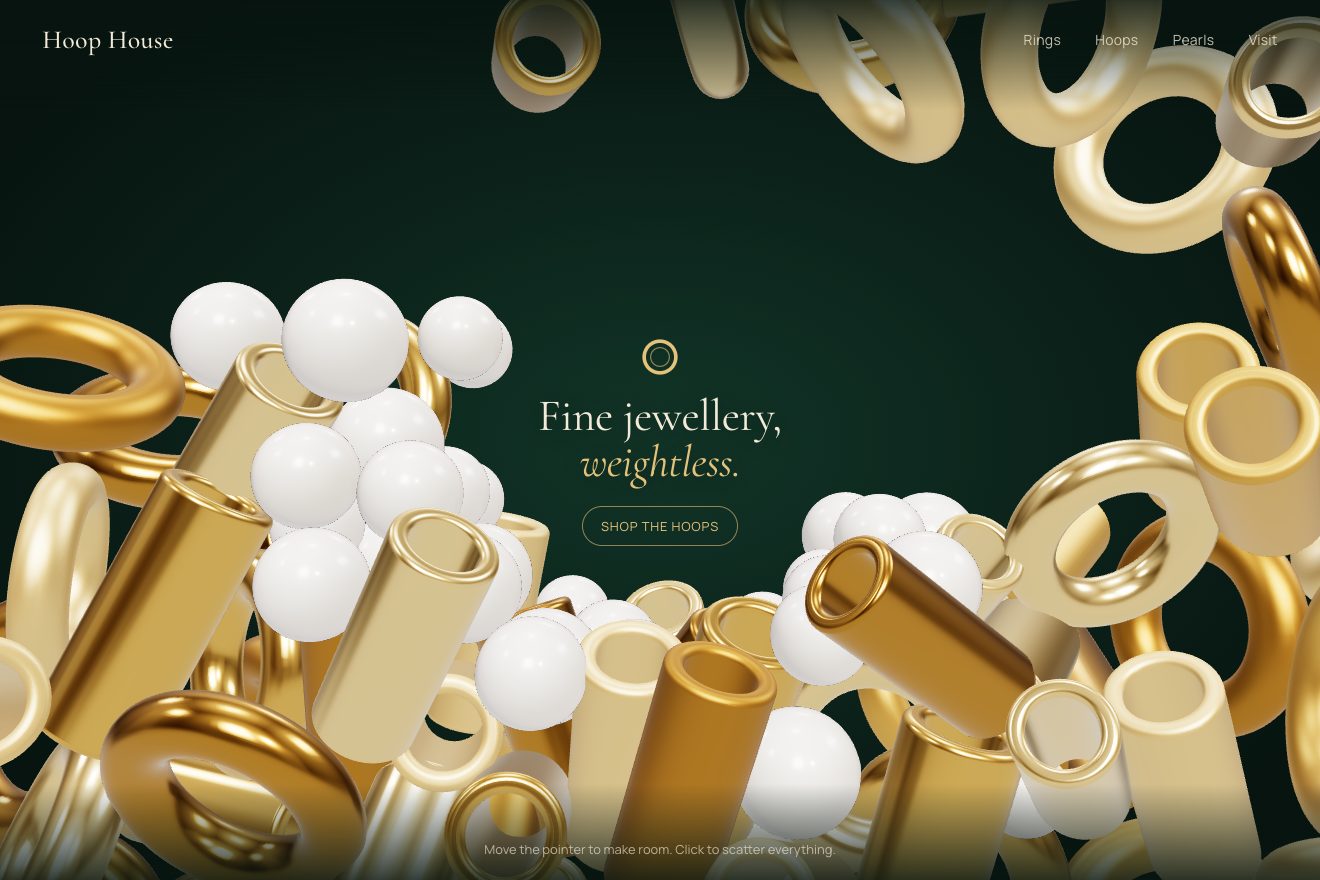
In our demo the tunnel is the window of an invented jeweller, Hoop House: gold rings, gold tubes and pearls on forest green, with the name in the empty middle. We wrote the physics ourselves, without Rapier: every object is a ball or a capsule, the closest points of two capsules come from Ericson’s method and knocks push them apart in proportion to their masses. The forces are the site’s, impulses divided by the mass with the same numbers. We changed two things. The depth is held by a real spring, because with the original’s weak one our knocks pushed objects all the way behind the lens. And a click opens the wall out to the edges and lets it come back. With reduced motion the tunnel arrives already settled and holds still.
The mask that opens
The night of the first scene has a hole shaped like the headset, and the white headset in the middle is a drawing laid over the hole. Behind the night the light page is already there. When you start scrolling the white headset fades and the page shows through the hole, while the whole night grows from the middle and blurs; the hole widens until it fills the screen, and you are in.
On the site the opening does not scroll the page: a GSAP Observer listens to the wheel and adds 0.001 for every pixel, and a separate listener adds 0.003 for every pixel of a finger, until it reaches 1. Meanwhile the dark layer, an SVG with the hole and the white headset on top, takes a scale of 1 + 19 times the progress and a blur of 10 times the progress in pixels. The white headset fades (1 minus the progress), the words of «Scroll to discover the experience» rise into their masks one after the other, the tunnel scatters (its radius goes from 3 to 40) and the lens opens from 40 to 80 degrees. At 1 the layer vanishes in 0.3 seconds and the page starts scrolling.
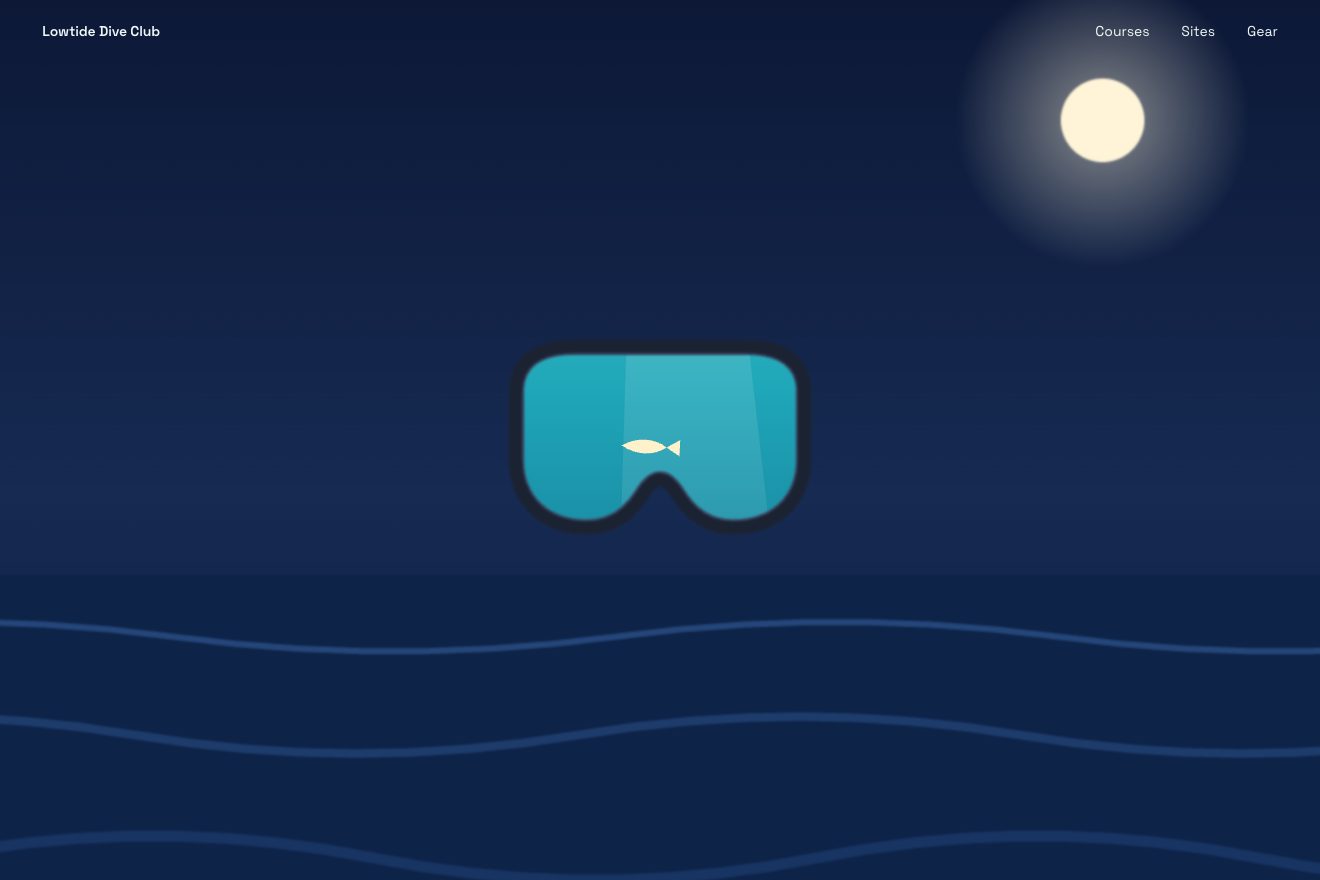
In our demo the night is the sea’s, for an invented dive club, Lowtide Dive Club, and the hole is shaped like a diving mask with a rubber frame: inside you see turquoise water with fish going by. The surface is an SVG with a mask that draws everything except the glass, and it grows and blurs with a transform and a filter. Instead of the intercepted wheel we use a ScrollTrigger with the screen pinned, so the scrollbar and the keyboard work too. The blur is the site’s; the growth is not. In a straight line, with a window as big as ours, the screen would be full after a quarter of the scroll and the rest would show nothing. So it grows by the same factor at every step, twenty to the power of the progress, and the window opens at the same pace all the way.
The word prism
After the manifesto the page stops on three questions, WHAT, HOW and WHERE, one at a time. As you scroll the word in front slides away to one side and the next arrives from the other, in perspective, as if you were turning round in a room; when you stop the page settles on the word, and its lines come in underneath.
On the site the three words are extruded 3D letters, on three sides of a square 22 units wide, mirrored because they are seen from inside. The group turns a quarter for each third of the scroll, and it turns only in the first 30% of that third, with power1.out; the rest of the third holds still. ScrollTrigger keeps the section pinned with a 1.5 second scrub and a snap that settles on 0.2, 0.5 and 0.8, the middle of each still part, and goes free after 0.8. The lines under each word come in from blurred to sharp. On the right a ruler marks how far you have come.
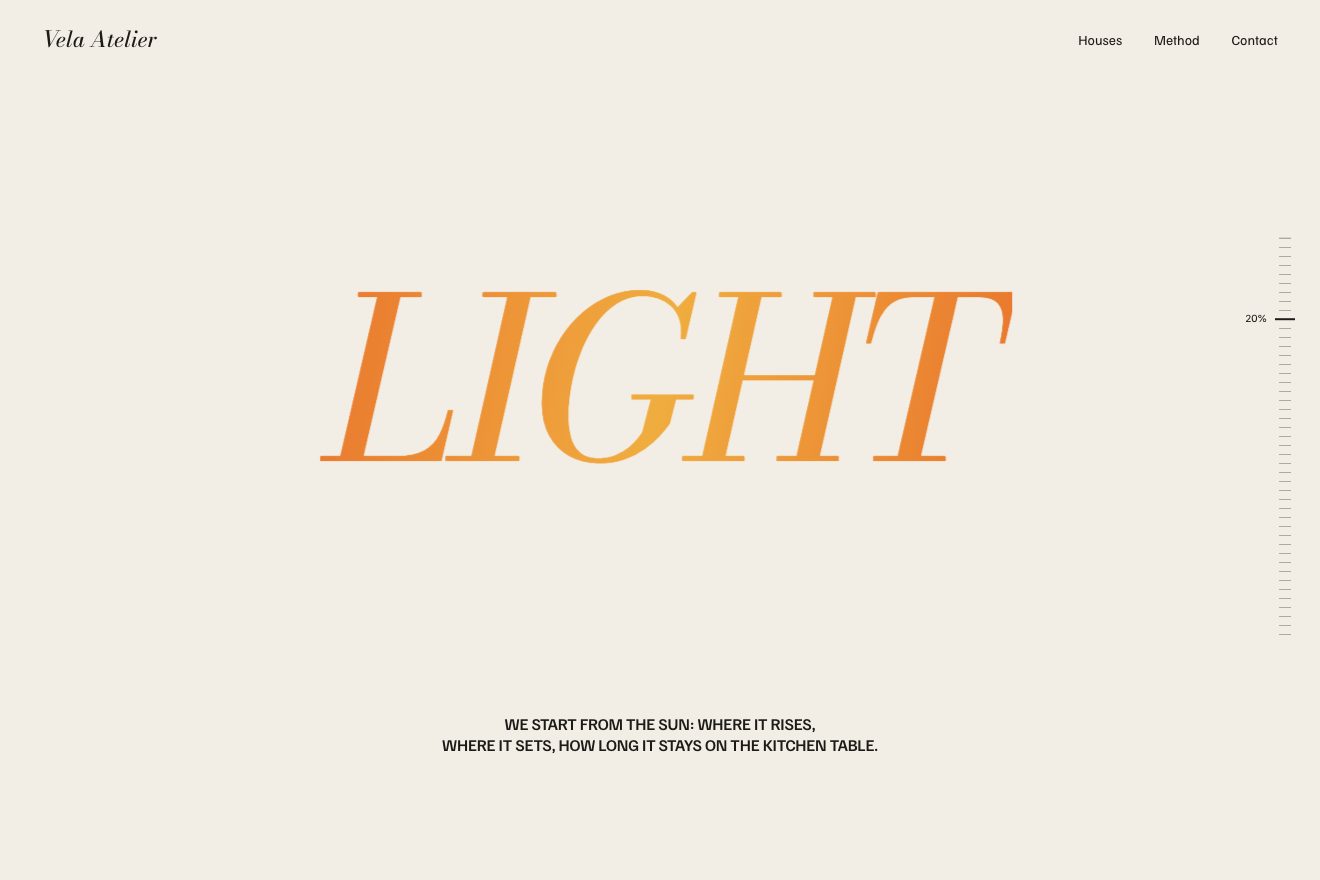
In our demo the words are LIGHT, SHADE and AIR, the method of an invented architecture studio, Vela Atelier, in an italic Bodoni from brick red to saffron. The turn and the snap have the site’s numbers, but the room is CSS 3D instead of WebGL: the stage’s perspective is the eye, every word stands on a wall of a circle that touches the screen, and the eye stays just outside the room, because in CSS an element that passes behind the point of view is drawn upside down. While a word turns, the colour runs across it, and between 35 and 75 degrees it fades.
The other details
«IMMERSIVE», the first word after the opening, is made of nine 3D letters extruded one by one, with a hand-written table of tighter spacing for the difficult pairs: between two I’s the gap shrinks by 1.8, between S and I by 0.8. The colour is a shader: a diagonal gradient in scene space, from blue #000DFF to lavender #CBC7FF, which holds still in the middle, and then to violet #B200FF. As you scroll the letters rise one after the other, each a little after the one before, with a sine.inOut.
In front of the words turns a glass Möbius strip: a physical material with transmission, an index of refraction of 1.2, a thickness of 1 and a dispersion of 5, which splits the light at the edges into a thin rainbow. It turns on its own, it can be dragged, and for every section it has a set position and rotation that it reaches at its own pace.
The manifesto, «at altitude.101, we believe stories deserve depth, space, presence.», writes itself word by word as you scroll, from grey to black, with three words in blue.
On the light pages the pointer stirs a fluid, a simulation with vorticity and pressure that bends the image slightly and tints it with a light rainbow: it is the distortion effect of a React Three Fiber library, with a blend of 0.35, an intensity of 0.5 and a distortion of 0.2. And the system cursor is gone: in its place there is a small square.
Where it stumbles
The page has no h1 heading, so for a screen reader and a search engine the most important line is missing.
The footer background, a gradient from violet to light blue, is a 3.9 MB PNG, and it arrives with the very first load, although the footer is thirteen thousand pixels further down: that is more than half of the initial 6.5 MB. Then, while scrolling, three project photos are downloaded twice, almost a megabyte more.
The opening only listens to the wheel and the finger. With the keyboard the page underneath scrolls all the way down, but the opening stays in front, and all you see is the dark with the headset. And the reduced motion setting changes nothing: the shapes keep turning and running away from the pointer; in the site’s code the only check is the one in the opening counter’s library.
In the console, finally, two small slips: the strip’s glass has «transparent» as its colour, a word Three.js does not know, and a GSAP tween uses autoAlpha on an object that is not an element of the page.
What we take away
A logo laid over a hole is a scene change that explains itself: the next page is already there underneath, all it takes is for the logo to go and for you to come closer. A physics with a few well-chosen numbers, a ring that pulls and a pointer that pushes, is enough to make a heap of shapes feel alive. And three words on three walls turn a list into a place to turn around in.
The effects
- The tunnel that makes roomGold rings, gold tubes and pearls float without weight in a thick ring around the middle of the screen: a tunnel seen from inside, with the name in the empty middle. The pointer pushes them away and they turn as they move; a click opens the wall out to the edges and lets it come back. At the start they rush in from outside while the view widens.Free
- The mask that opensThe sea at night fills the screen, and in the middle there is a window shaped like a diving mask: inside you see the water, with its fish and its light. As you scroll the whole surface grows from the middle of the mask up to twenty times its size and blurs, until the window is the screen and you are under water.Free
- The word prismThree huge words stand on three walls of a square room around you. As you scroll the room turns a quarter at a time: the word in front leaves to the left, growing and fading, the next comes in from the right, and when you stop the scroll settles on the word. Underneath, two lines for each word come in, coming into focus.Free