Grande Charte, by Grande Charte Digital
Grande Charte, how it’s made: a charter in glass
The site of Grande Charte Digital, a Casablanca agency: glass calligraphy that melts as you scroll, pictures that swell under the pointer, a loader that says hello in nine languages. We take it apart with three demos rebuilt from scratch.
The palette
- #DFDBD8the page and the glass scene’s background
- #556B5Bthe brand green, pills and buttons
- #181818the black cards
- #D2FF3Athe lime of the play button
- #B9CBBDthe glass’s sage tint
- #DD6013the orange
Tap a colour to copy its code.
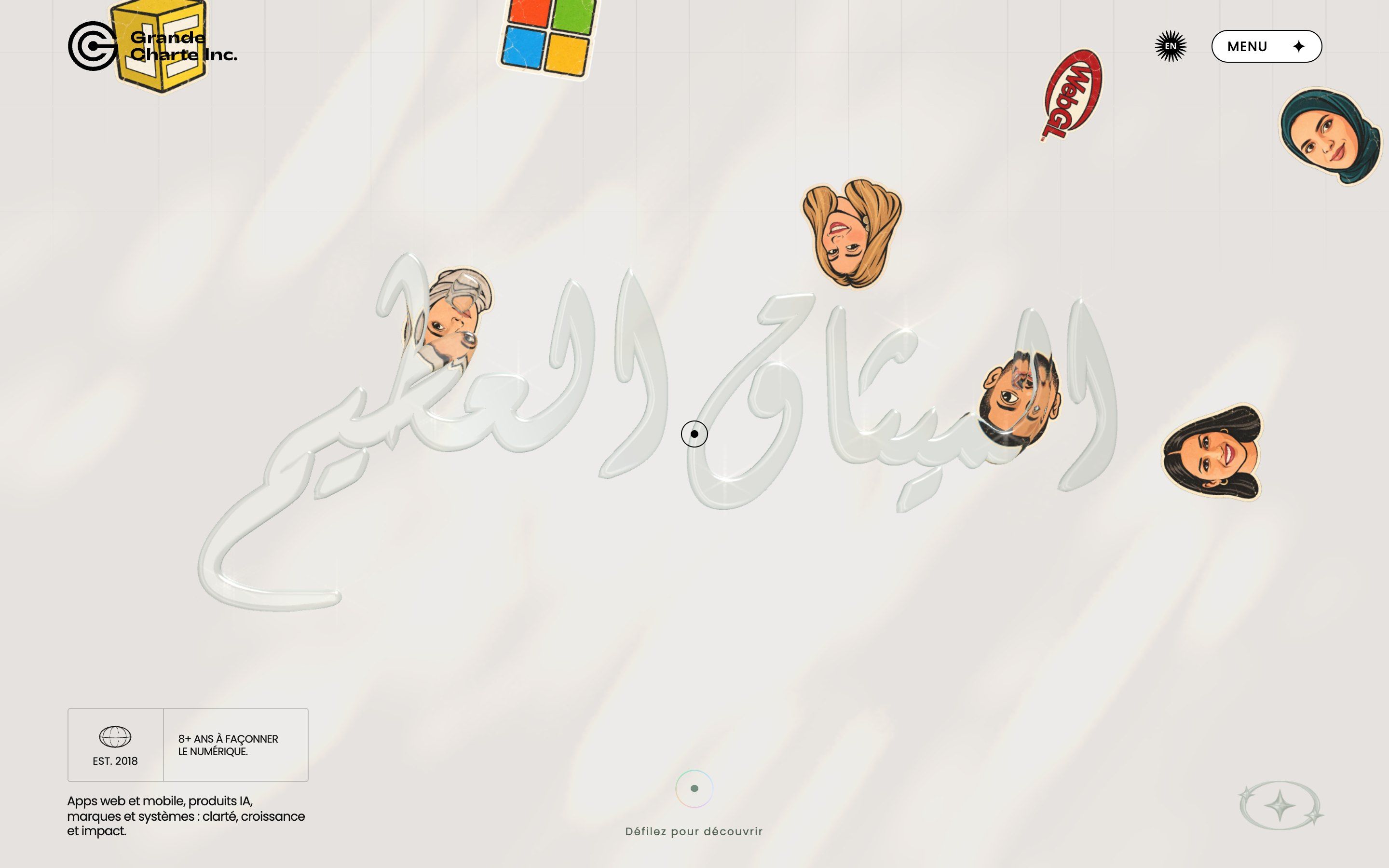
Grande Charte is the site of Grande Charte Digital, a Casablanca agency that has been making sites, apps, AI products and brands since 2018; next to Morocco, the page also names Toronto. The home is in French, with English kept apart. It opens on a warm grey, #DFDBD8, covered in pale brush strokes, and over it a glass inscription flies in: الميثاق العظيم, the Great Charter, the agency’s name in Arabic calligraphy. As you scroll the glass melts into the background, 3D stickers rain down, drawn faces, a cube with the logo, a coin, and next to the text a pink Game Boy with the initials GC turns. Sage green, #556B5B, makes the pills, the black cards are #181818 and a lime, #D2FF3A, lights up the play button.
Underneath there is Next.js with images from Sanity, GSAP with ScrollTrigger and Flip, and Lenis with a lerp of 0.09 and the wheel at 60%. The glass scene and the flying saucer at the end are two separate Three.js apps, served in two iframes; the service pictures are drawn by OGL, the award cards by curtains.js. We take it apart in three moments, with one demo rebuilt from scratch for each, for an invented studio we called Mirage: texts, pictures, numbers and code are ours. From the site we took the idea and, where we say so, the timings.
The glass inscription
The opening is 220 svh tall, and inside it a full-screen sticky stage holds an iframe: the glass scene, an app of its own. The page and the iframe talk through postMessage on their own channel, gc-scroll, with a session number and layout revisions; if the scene breaks, the error comes back to the page, and until the scene arrives there is a picture of its first frame.
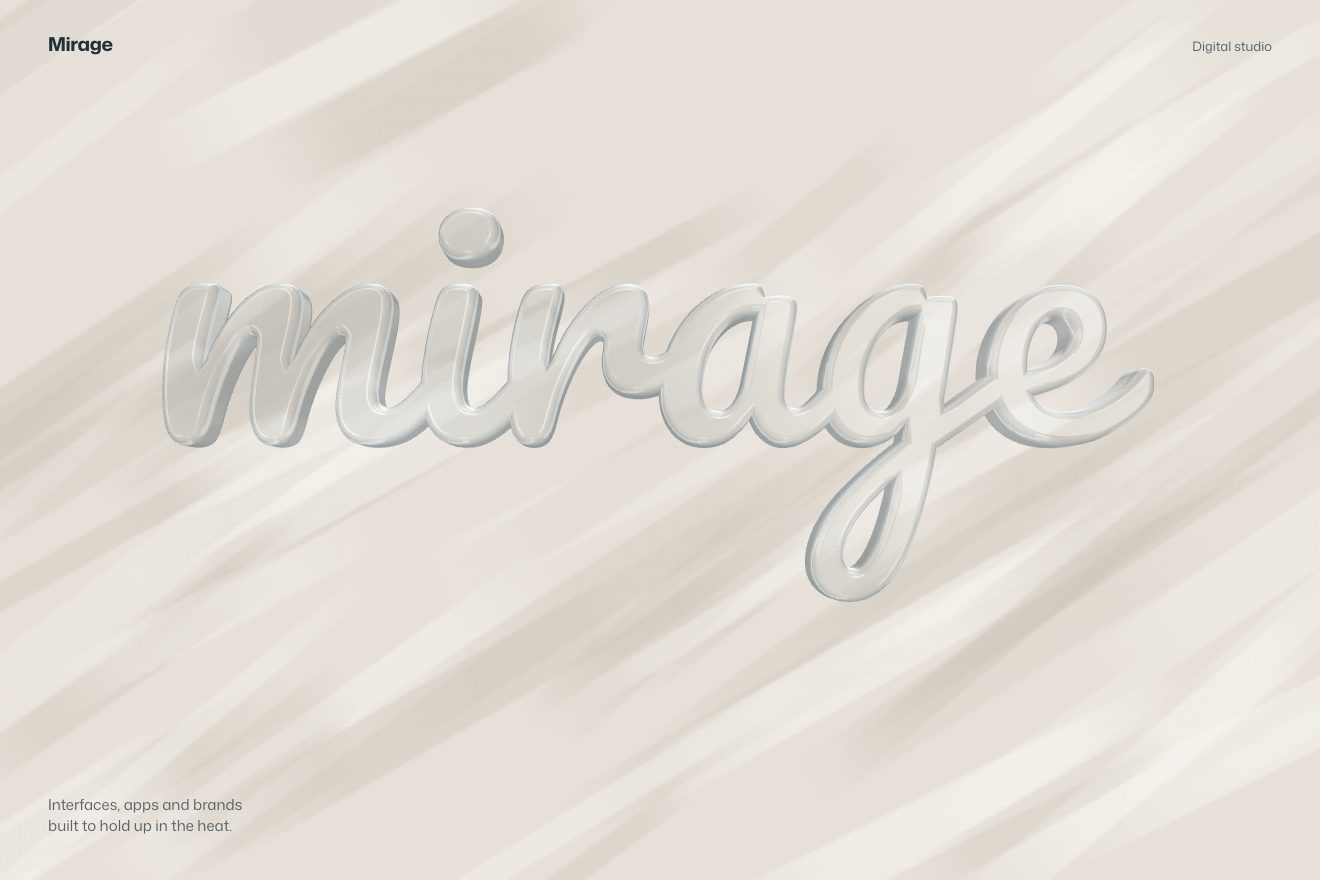
On the site the inscription is a glTF model compressed with Meshopt, turned slightly so the curves catch the light. The glass is not a ready-made Three.js material: it is a hand-written shader. The brush-stroke background is drawn first into a texture of its own, and the glass reads it three times with refract, with indices 1/1.43, 1/1.46 and 1/1.49 and an offset of 0.035, one channel at a time: at the edges the colours part slightly. The rim darkens towards an almost black green, where the glass is thick the colour leans towards sage, #B9CBBD, a raking light brightens the edges facing it, and the curves reflect studio panels drawn by a function, two strips and a ceiling, with edges filtered even on the bevels and a hint of prism. As you scroll, a scrollFade value mixes the glass into the background until it disappears, and the part below comes in once scrolling passes 35%.
In our demo the word is mirage, in script, and the glass is Three.js with a ShaderMaterial as on the site, but on a single page, with no iframe. The outline comes from Pacifico, extruded with a bevel that grows inwards so the small counters stay open. The brush-stroke wall is painted by the script on a canvas at a third of the size, and wall and glass read it at the same screen position, so they line up to the pixel. The indices are 1.42, 1.45 and 1.48; the word flies in along a curve, leans towards the pointer, and from 35% to the end of the opening melts into the wall.
The lens on the services
Further down come the services, Design UI/UX, Développement, Marketing Digital and Production de contenu, with the active line in a dark pill, and beside them the service picture in a WebGL canvas.
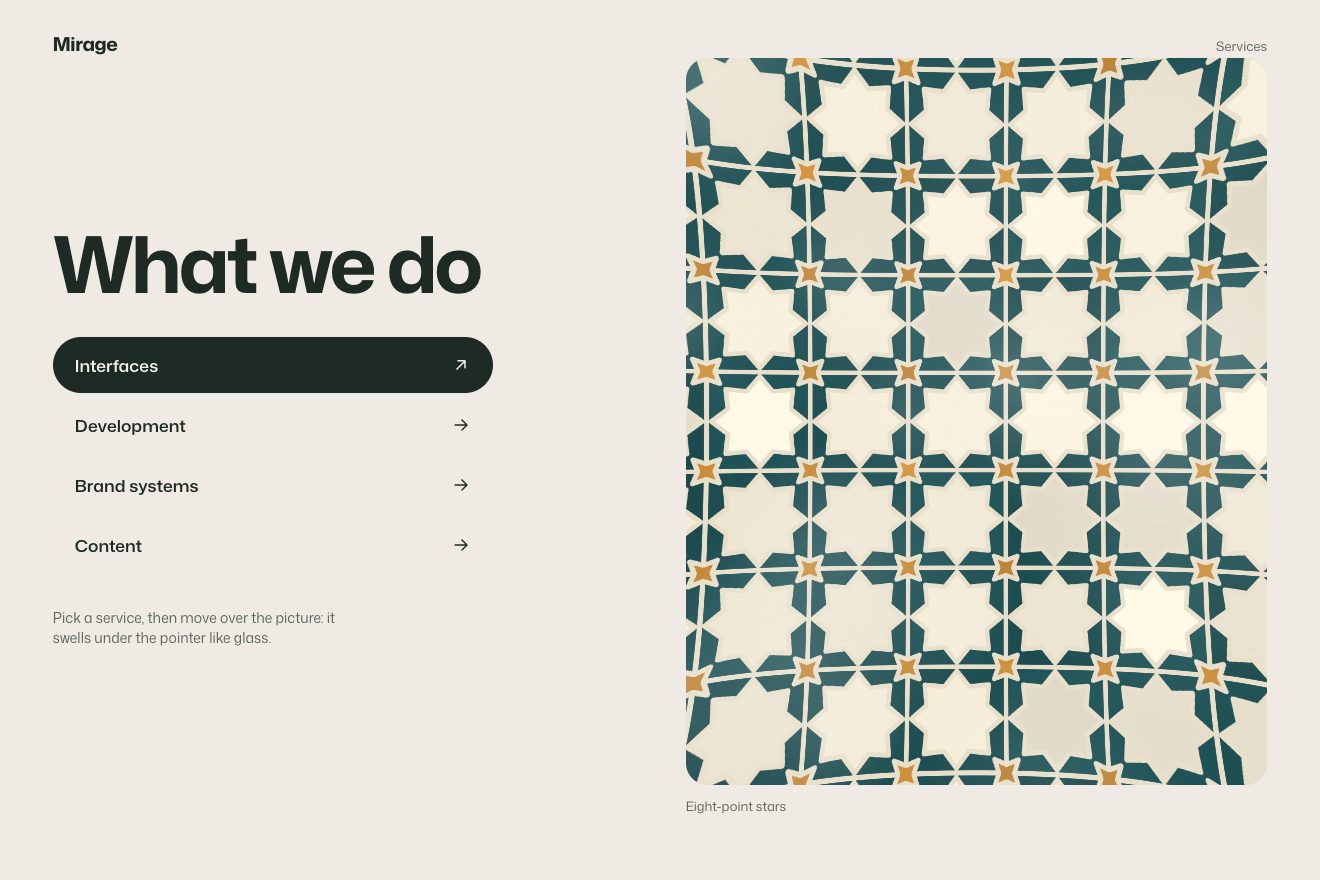
On the site the shader is short. A bulge function takes the distance from the pointer divided by the radius, 0.98, and moves every point by a push of 1.23 / (1 + d⁴), mixed with the strength of the swell. When the picture arrives, opacity rises over 0.4 seconds, size goes from half to full over 2 seconds of power3.out, the swell starts at 1.5 and melts away over 2.2, and its centre travels from the bottom of the picture to the pointer over 2.5. When the pointer comes in the swell rises to 1.2 over 0.6 seconds and settles at 1; when it leaves, it deflates over 1.2. The canvas is scaled 1.3 inside a frame that crops it, with a small parallax on scroll, and it only redraws while something moves.
In our demo the services are Mirage’s and the pictures are zellige mosaics painted by the script, one per service. The lens is the same function, with a radius of 0.9 and a push of 1.2, and the timings are the site’s. We added two things: the new picture blooms over the old one, which stays visible around it while the new one grows, and the pill is a window on a light copy of the list, so the label changes colour exactly at the edge even while the pill bounces.
The loader that says hello
Before all this comes the loader: one word at a time, Bonjour., ⴰⵣⵓⵍ in Tamazight, Hola., Hello., Ciao., مرحبا, やあ, Hallå., and underneath a two-digit counter with a small % and the line Préparation de l’expérience.
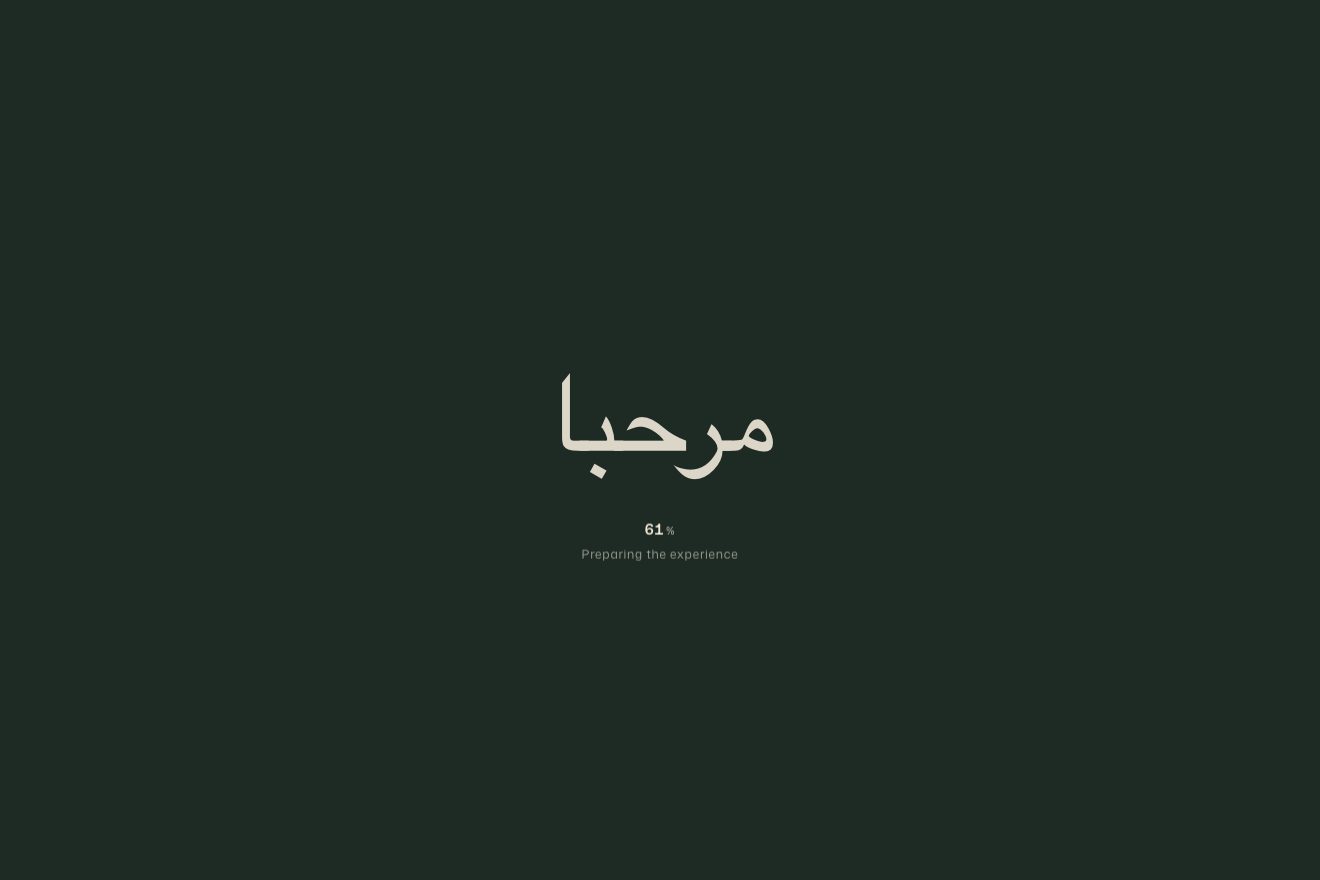
On the site, words with Latin letters get a typeface of their own and the others take the system one: a regular expression decides. The loader goes away half a second after the glass scene is ready. The same game returns in the page transitions, made with framer-motion: one word at a time, Guten tag among them, a waiting opacity pulsing between 0.72 and 0.9 over 0.9 seconds, and a curtain exit that rises by the whole screen on the curve 0.76, 0, 0.24, 1.
In our demo there are nine words and the last is Hello., the page’s language, which lights up when the counter reaches a hundred. The counter climbs in bursts towards uneven stops, the word breathes between 0.72 and 0.9 as in the site’s transitions, and the curtain rises on the same curve, with two touches of ours: the bottom edge bows with the speed and the words lag a little behind.
The other details
The text block under the opening mixes a serif and a condensed face in the same sentence, with the Get Connected and Learn More buttons inside the line and a green pill around the last words. The award cards ripple under the pointer: a plane of 40 by 40 segments where a wave spreads from the pointer and fades with distance, lighter where it rises and darker where it sinks; curtains.js only loads with a mouse and never with reduced motion. There is a black band reading Construisons votre projet, an iridescent card made with Inigo Quilez’s cosine palettes, and at the end a chrome 3D flying saucer, with bloom, above a huge email address whose at sign is iridescent inside a seal.
Where it stumbles
Three WebGL libraries work on the same page: Three.js twice, one per iframe, with about 870 KB of code each; OGL for the service pictures; curtains.js for the award cards. Each keeps its own context, its own shaders and its own drawing loop.
The loader only goes away once the glass scene is ready: on a slow network the greetings keep turning until a whole app has arrived, model included.
And pale glass on a pale background is hard to read. Up close the inscription is beautiful; from a distance, or on a small screen, it is grey relief on grey, and the agency’s name stays an impression.
What we take away
Believable glass does not need a physical material: read the background three times, once per colour, and reflect something simple on the curves. And a name can become a gesture: the Great Charter written in glass, and a hello in nine languages before you even say who you are.
The effects
- The glass wordA word in thick glass floats over a wall of brush strokes: through its curves the wall shows bent three times, once per colour, and as you scroll the glass melts back into the wall.Free
- The swelling lensA list of services and, beside it, a picture that swells under the pointer like a drop of glass; pick a service and the new picture blooms from half size while the swell rises from the bottom to the pointer.Free
- Greetings while it loadsA loader that says hello in nine languages, one word at a time, while a counter climbs in bursts; at a hundred the word lights up, the curtain lifts with its edge bowing and the page underneath rises line by line.Free