Jesper Landberg
Jesper Landberg, how it’s made: a black hole where the profile should be
The portfolio of Jesper Landberg, Swedish design engineer: a strip of projects bent in space, a page drawn entirely in WebGL over a real HTML layout, and a profile that opens like a black hole, bending the page around it. We take it apart with three demos rebuilt from scratch.
The palette
- #000000the page, and the inside of the hole
- #FFFFFFtext, loader bars, the project sheet
- #EBEBEBthe pills on the white sheet
- #D9D9D9the border of the related cards
- #D9A441the gold of the trophy and the awards
Tap a colour to copy its code.
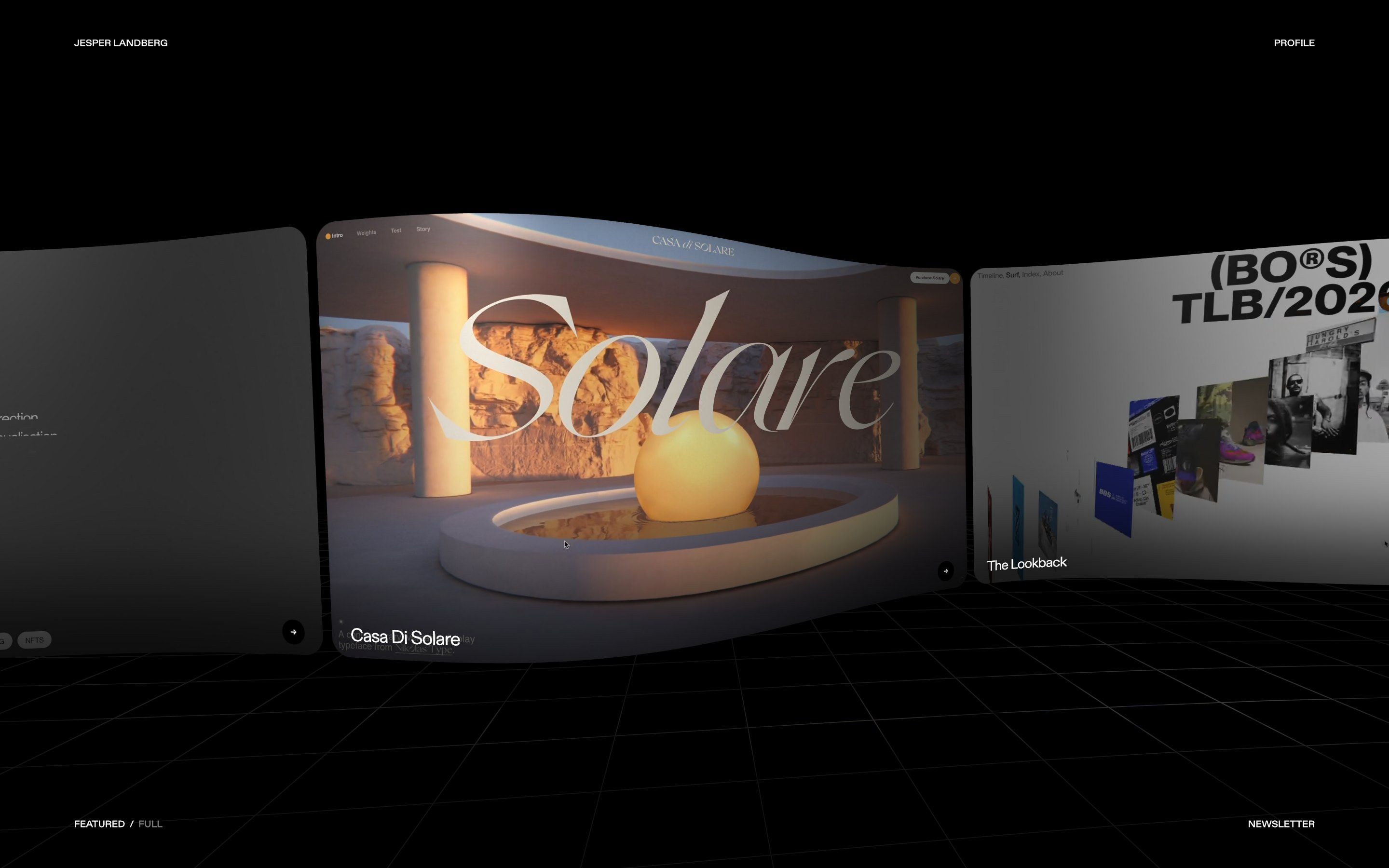
jesperlandberg.com is the portfolio of Jesper Landberg, Swedish design engineer, twice Independent of the Year for Awwwards, in 2022 and 2024. The page is black and almost empty: in the middle a strip of cards, the featured projects, each with a video inside; the strip is not flat, it comes forward on the left and recedes on the right, over a floor of squares fading into the dark. At the four corners four small white words in capitals: the name, «Profile», «Featured / Full», «Newsletter». There are two colours, black and white, plus those of the projects; and one typeface, ABC Diatype.
Underneath there is Nuxt, with the content on DatoCMS and the videos on Mux; three.js does the drawing, GSAP 3.15.0 the moving. The choice that holds everything else up is this: HTML is the layout and WebGL is the ink. The text is real HTML, but transparent; every element to be drawn carries a label, and for each one there is a plane in three.js that reads its rectangle again every frame and sits on top of it. A readable copy of the whole page stays hidden for screen readers, and every address on the site also answers in Markdown to anything that is not a browser. Inside the main file, 1.15 MB before compression, the shaders’ comments are still there: whoever wrote them explains every choice, including the discarded ones, and half of what we tell here comes from them.
There are three awards, won in a month and a half: FWA of the Day on 14 August 2026 with 84 out of 100, Website of the Day for CSS Design Awards on 31 August with 8.20, Site of the Day for Awwwards on 29 September with 7.73 and a Developer Award of 8.17, where animations score 9. We take it apart in three moments, with a demo rebuilt from scratch for each, for three invented brands: pictures, text and code are ours. From the site we took the ideas and, where we say so, the formulas and the timings.
The strip
On arrival there are only three white bars in the middle, filling up. Then each one flies, grows and becomes a card; the other cards come in from the sides, and the strip is there. Scrolling makes it run sideways, and scrolling hard makes it rear up.
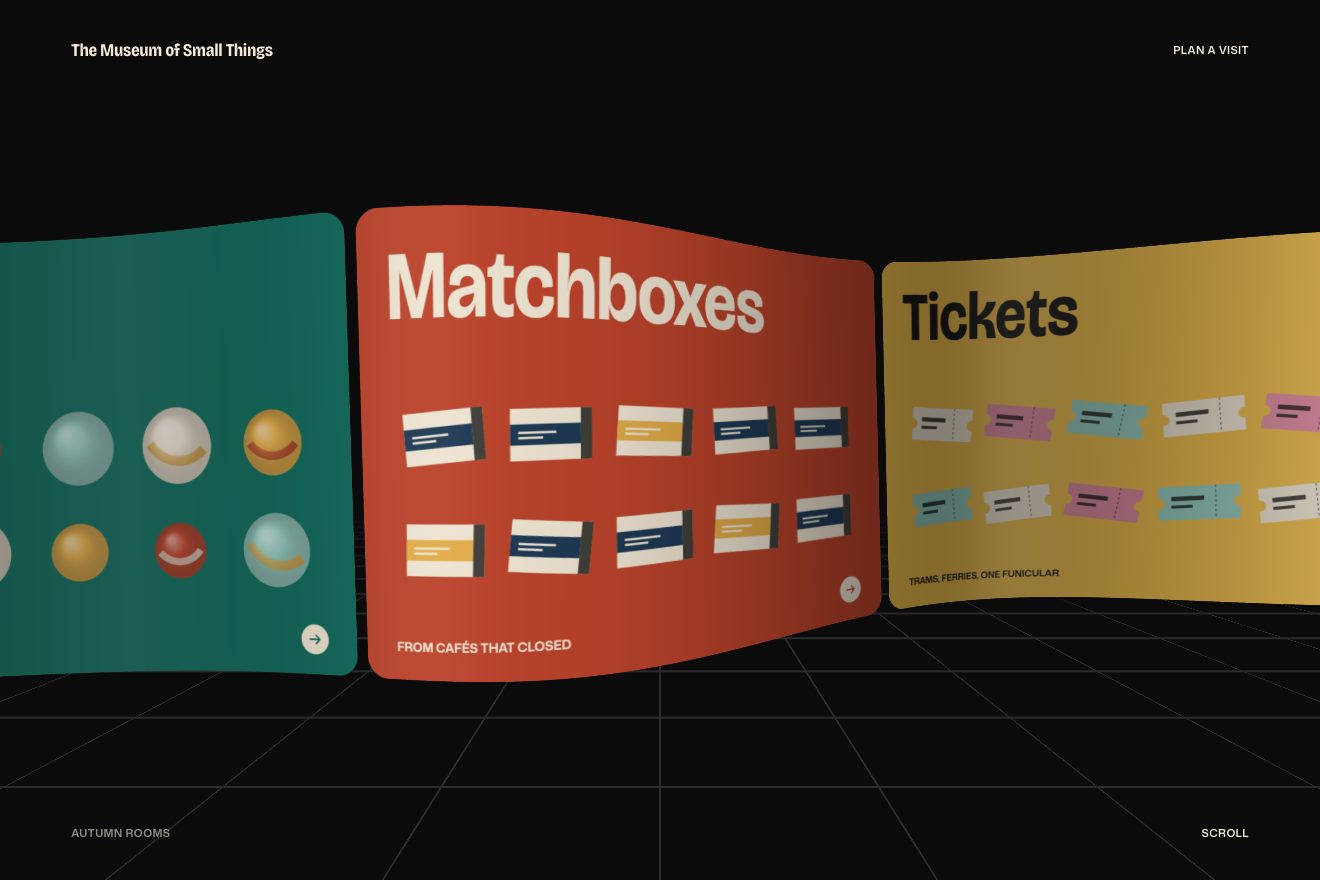
On the site the cards are HTML elements in a row, 43.5% of the screen tall and as wide as each project’s proportions. The scrolling is fake: the wheel moves a target, which can never get more than one screen width away from where the strip is, and every frame the strip covers a tenth of the distance. What is still missing, in pixels, divided by 550 and passed through a hyperbolic tangent and then squared, is the speed from 0 to 1. The shape does not belong to the cards: it is a function of horizontal position, the same for all of them, and every vertex asks it where to be. Depth is a sine times a bell, sin(π q) · e^(−q²), a fifth of half a screen deep: an S, near on the left and far on the right, that goes back to flat by itself off screen. The strip then rolls about its centre line in proportion to the slope of that same curve, 0.16 radians at the steepest point, like a banked track; the whole of it is turned like a door, and it rises slightly to the right. With speed the left side lifts by a tenth of half a screen and comes forward by two, and the two ends wring opposite ways, up to 1.8 radians. Under the pointer a card sinks in the middle by a tenth of its height in half a second, with a dome that is zero along the edges, so the outline does not move. The light has a tight sheen, and the surface’s normal is worked out from the formula, not from the mesh: the flat faces of the mesh, under a sheen like that, would turn into lines. The three loader bars are already the planes of the three central cards, washed white and clipped to the fill; when loading is over each plane goes from the bar’s rectangle to the card’s in 1.5 seconds, 0.05 apart.
In our demo the cards are the rooms of an invented museum of small things, painted on a canvas. The formulas and numbers of the curve, the rear-up and the wring are the site’s. The scrolling changes: it is the page’s real one, with the strip held in a screen that stays while the page goes by, so the scrollbar, the keyboard and a finger all work without being rewritten. A real scroll is steadier than a flick of the wheel, so 140 pixels of lag are enough to count as full speed instead of 550. On top of that a click brings a card to the middle of the page, and the floor is a single rectangle in which the shader works out, pixel by pixel, which point of the plane it is looking at.
The profile in the black hole
Top right there is «Profile». One click, and in the middle of the page a black disc opens, 40% of the screen wide; on a phone it is wider than the screen. The strip is not covered: it bends around the disc like light around a black hole, and the text appears inside.
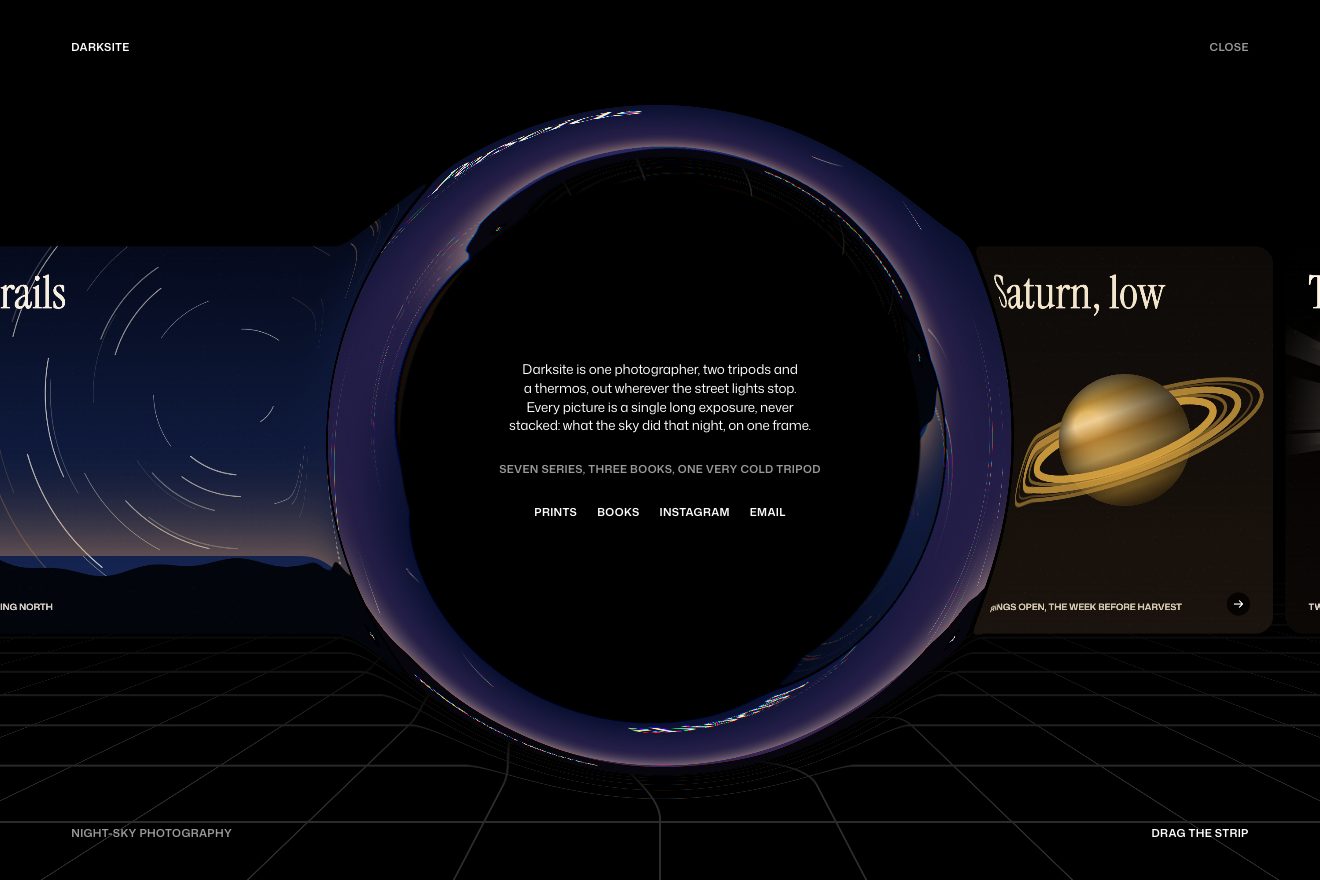
On the site it is a second pass over the whole scene, which runs only when needed. The scene is drawn into a texture; then, for every pixel at distance t from the hole’s centre, it shows what the texture holds at distance t − E² / t, where E is the disc’s radius times 1.5. It is the formula of gravitational lensing, read backwards. Far away nothing changes; near the rim the result goes to zero, and you see the middle of the scene wrapped all the way round, in a ring; closer in it turns negative, and the opposite side appears, mirrored. Left alone the bending would reach the corners, so it is multiplied by a leash that switches it off 0.09 screen widths past the rim: a comment in the code calls it «the difference between an object and a filter». The rim is not a circle while it moves: two waves along the angle are added to the radius, three lobes against five turning opposite ways, silenced by a sine when the hole is shut and when it is open. Once open the radius breathes by 1.5%. Whatever is caught near the rim goes round it, 0.3 radians a second, but only for 15 seconds: the angle grew differently from one point to the next and after a while it tore the ring into coloured streaks. Red and blue are read with a ring 0.4% bigger and smaller. Opening takes 0.85 seconds and closing 0.65, on a three-part curve that covers almost all the way in a third of the time; while closing, the hole squashes by a tenth. The text is drawn after the pass, so it does not bend: the lines rise from below, one every 0.075 seconds, 1.1 seconds each, and on closing they are pulled towards the centre and shrunk with the disc. Six glossy black llamas also fall through the disc, four behind the text and two in front; the model loads when the browser has nothing else to do.
In our demo the studio does night-sky photography and is called Darksite: seven series in a strip that drifts slowly by itself, so the ring always has something new to wrap. The lens pass is rewritten with the same formulas and the same numbers. The text, though, is HTML laid over the canvas: it can be selected, a screen reader reads it, and SplitText cuts it into lines. The hole’s centre and radius are read from the profile’s HTML box, as on the site: move that and the hole follows. No llamas.
Something under the page
With a mouse, on the site, something quieter happens as well: where the pointer passes the page swells, as if a ball were rolling under a rubber sheet, and a trail is left behind that flattens out.
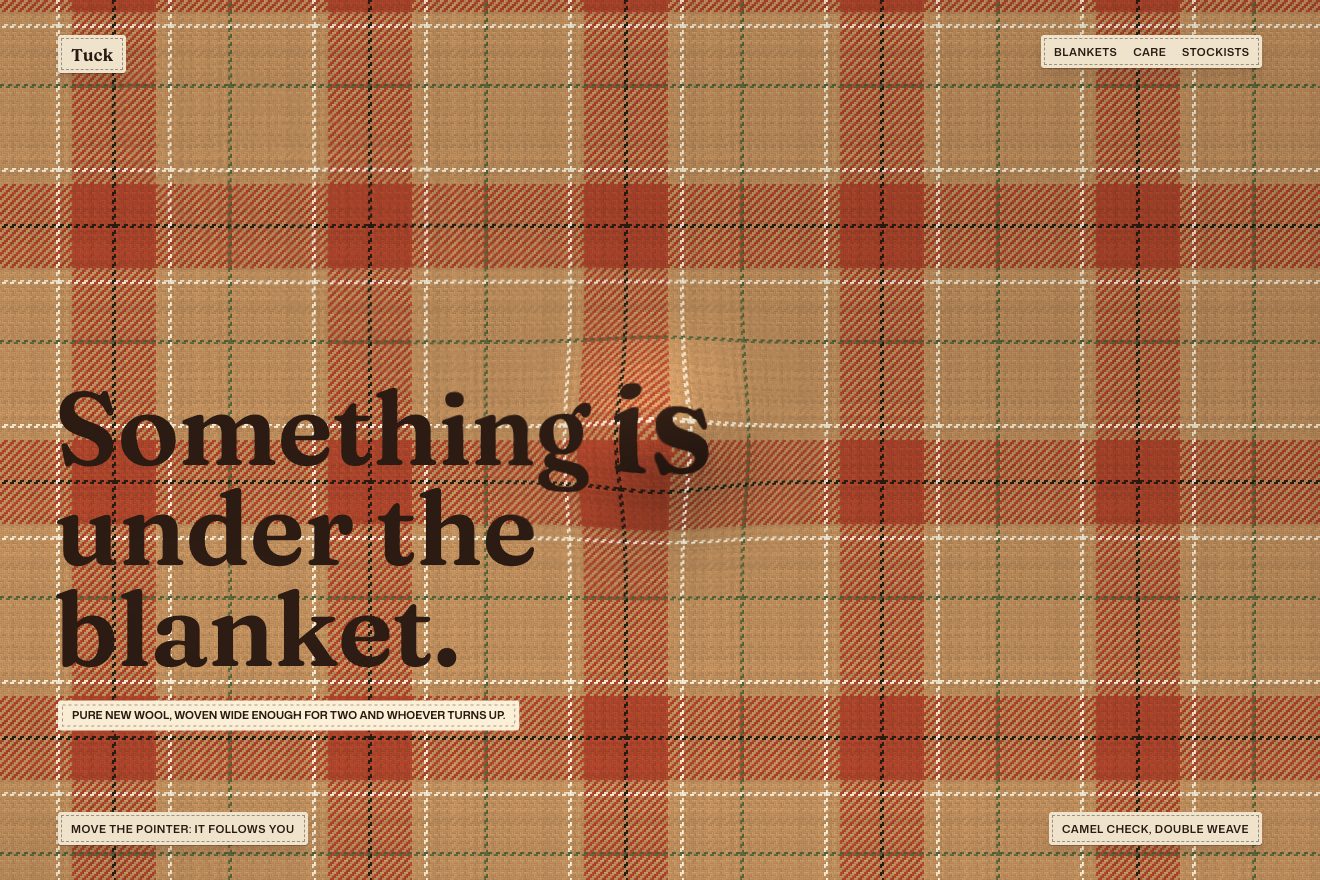
On the site the ball is not a shape but a field of heights: a texture 256 pixels wide that rewrites itself every frame. Every cell loses a little height, e^(−4 · dt), blends with its four neighbours, and under the pointer it receives a bell-shaped stamp with a radius of 4% of the screen. There is no velocity and no pressure: the comments say that a version with a real fluid existed, and looked like water. Cloth has no momentum, only tension and relaxation, which is why the bump stays where it was made and dies there. How strong the stamp is depends on that tension: a point chases the pointer, and what counts is the gap between the two; standing still, nothing happens. The final pass moves every pixel along the slope of the field and lights it with a dot product, between −50% and +50%; near white the light lets go, because there the bright half would burn out and only the shadow would be left. Everything fades towards the edges, where the labels are, and drops to 3% next to the profile’s text.
In our demo the sheet is a checked wool blanket, woven thread by thread on a canvas, and under it there is a cat, or at least something that behaves like one. The field’s numbers are the site’s. But the field lives on the CPU, in a grid of numbers: it is so small that it costs less than a millisecond, and no extension is needed to write into a floating-point texture. We added a constant push that keeps the bump under a pointer at rest, a walk when nobody touches anything and a wave that crosses the blanket on arrival. The headline and the label are painted into the same picture, so they lift too.
The other details
The site does not draw if nothing has changed: every frame it folds the position, scale, rotation and every value of each visible plane into a single number, and if the number is the same as before it skips the draw. At rest, the graphics card rests.
The move to the «Full» page uses the same disc as the profile, opened until it swallows the corners, with the new page inside. When the new page is made of HTML, the disc is written a second time as a clip-path, a polygon of 128 points worked out with the same formula as the lobes: the two versions match because they are the same sum done twice.
In «Full» the projects are a list of names in the middle. Under the pointer a card appears with the preview, tilting with the mouse’s speed, and the lines around make room for it. Opening a project, the card flies out of the strip in one second, straightens up and becomes the head of a white sheet; next to the awards there is a golden 3D trophy.
The text is not a picture: it is drawn from the typeface’s curves, one rectangle per letter, with the coverage worked out in the shader. The curves are in two files of 401 KB.
Where it stumbles
Test messages were left in production. The strip writes a warning to the console at every scroll event: ten notches of the wheel, 64 warnings. And at every measurement it builds an error trace just to print it.
There is no reduced motion. The preference never appears in the code or the style sheets, and with the setting on the hole opens with its whole animation.
The first load is heavy: 18.2 MB and 84 requests before the home is still, of which 11.5 MB are the videos of the first three cards and almost 6 MB are textures, typeface curves and a decoder. The bars stay until the material for the first cards has arrived.
On a phone, finally, there is no ball, because it needs a mouse, and the page cannot be zoomed with two fingers: gestures are switched off on the whole document.
What we take away
Keeping HTML as the layout and leaving only the drawing to WebGL is hard work, but it is what makes it possible to bend a whole page around a hole: the page is already a texture. And it pays to think of a curve as a place, not a movement: the strip does not animate its cards, it lets them pass through a shape that stays still. Last, the leash: a formula taken from physics, left free, warps the whole screen; held nine hundredths of a width from the rim, it becomes an object.
The effects
- The rearing ribbonEight cards on a ribbon curved in depth: scroll the page and the ribbon runs sideways, and the faster it goes the more its left side rears towards you while the two ends wring. At the start three loader bars become the cards.Free
- Black hole profileA button opens a black hole in the middle of the page: the disc grows with a wobbling rim, the strip of pictures around it bends like light around a heavy star, and the profile’s lines rise inside it.Free
- The cat under the blanketA wool blanket covers the page and something under it follows the pointer: the blanket lifts where it passes, the check bends over the bump, the light catches one side of it, and the trail stays raised for a moment before it settles.Free