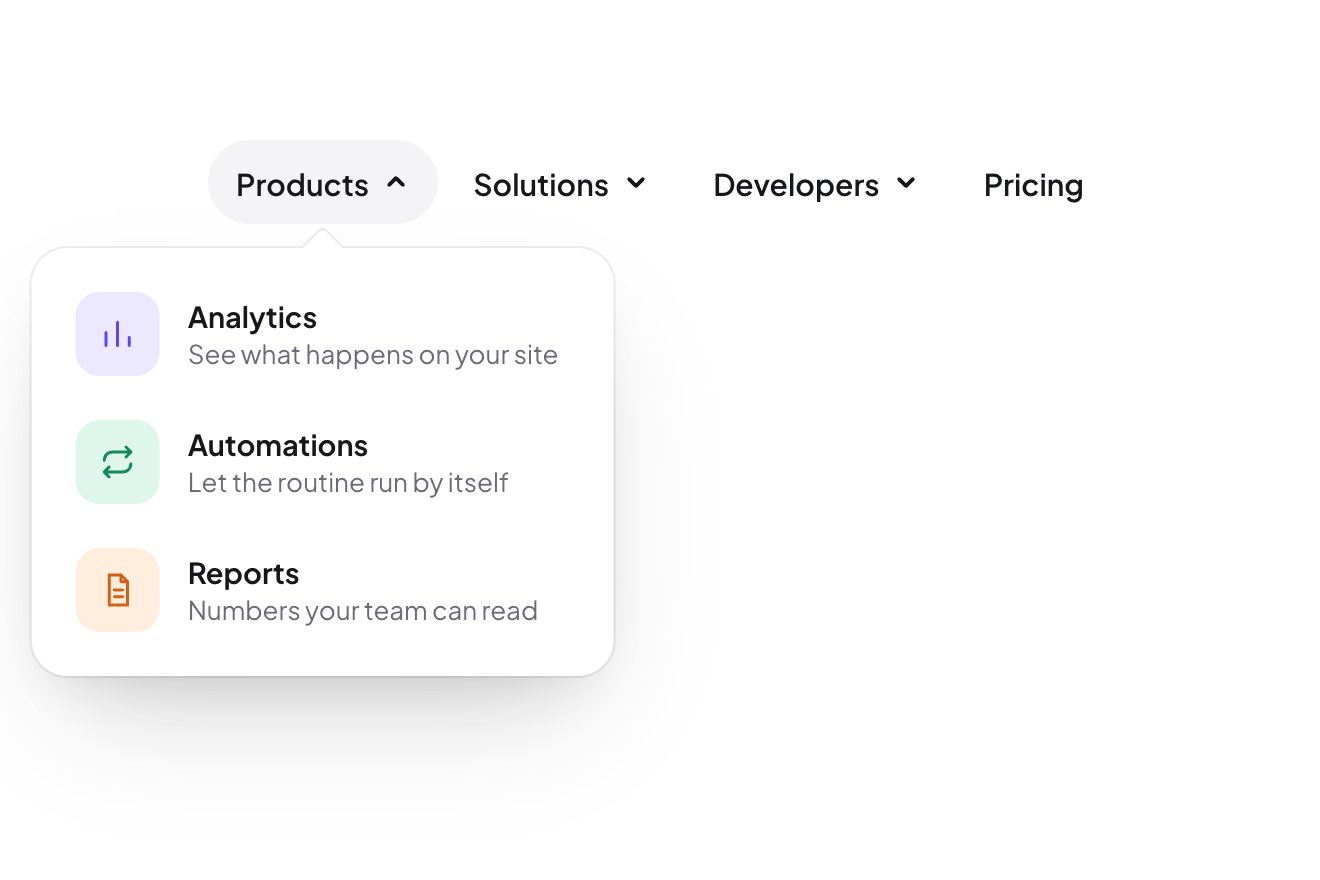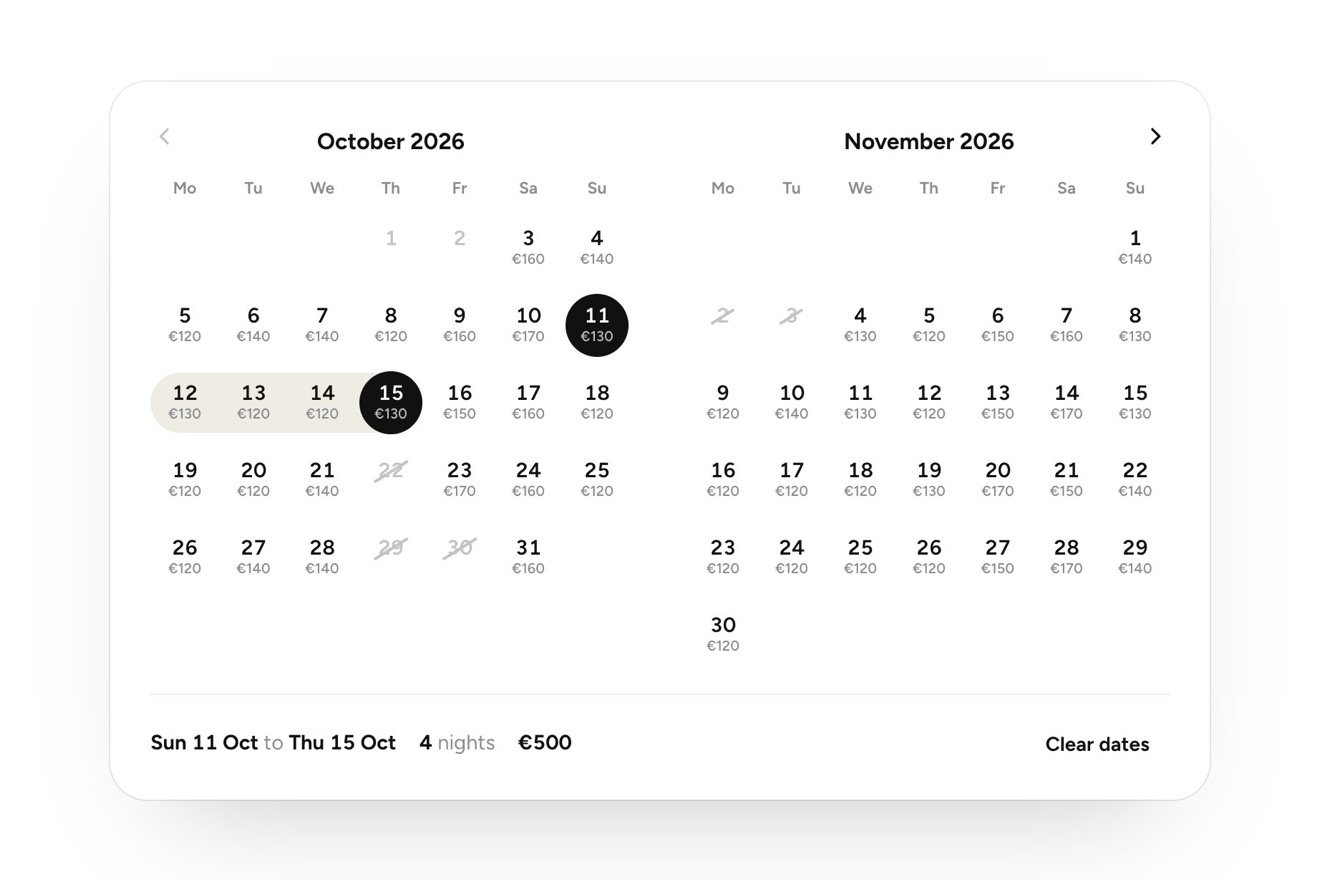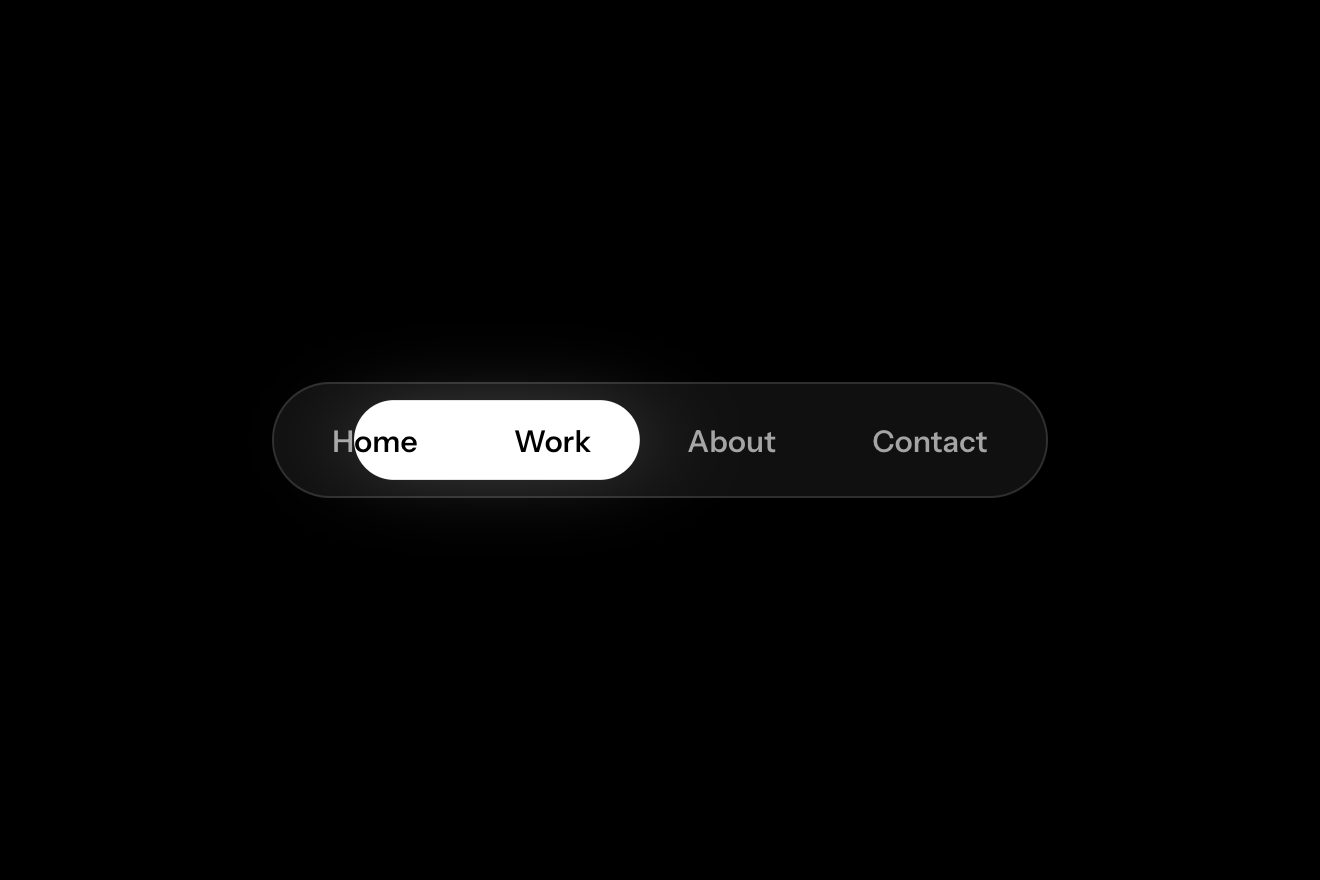
The inchworm menu
Menus, Hover, Transitions
The model selector of Quill Studio, an AI writing app, like a Dribbble shot: three glass cards side by side, Swift, Balanced and Deep, each with a small tick chart of speed and depth, its tokens per second and its cost per 1K tokens. The chosen card has a rim of liquid metal whose reflections flow like molten metal; choosing another, the rim pours onto it on two springs, the leading side first and the trailing one after, and the numbers roll up. On hover the cards lean slightly toward the pointer with a reflection.
A folder that runs on its own: index.html, style.css, script.js and the libraries from a CDN. The React and Vue tabs hold the same demo as a ready component, which switches its animations off when it leaves the page.
<!doctype html>
<!--
  "AI model selector" from Animorio · https://animorio.com
  License: free on your own sites and your clients’ sites, paid work included.
  Not for resale, redistribution, templates or code collections · https://animorio.com/en/license/
-->
<html lang="en">
<head>
  <meta charset="utf-8">
  <meta name="viewport" content="width=device-width, initial-scale=1">
  <title>The AI model selector with the liquid metal light</title>
  <link rel="stylesheet" href="https://cdn.jsdelivr.net/npm/@fontsource-variable/mona-sans@5.3.0/wdth.css">
  <link rel="stylesheet" href="style.css">
</head>
<body>
  <main class="stage" data-stage>
    <span class="stage__grain" data-grain aria-hidden="true"></span>
    <!-- the model picker of an AI writing app: three glass cards side by side. The chosen one wears a rim of liquid
         metal whose reflections flow around it; choosing another, the rim pours across on two springs -->
    <section class="picker" data-wrap aria-labelledby="picker-title">
      <header class="picker__head">
        <p class="picker__title" id="picker-title">Choose a model</p>
        <p class="picker__meta"><svg viewBox="0 0 16 16" aria-hidden="true"><path d="M8 1.8l1.5 4.2 4.3 1.5-4.3 1.5L8 13.2 6.5 9 2.2 7.5 6.5 6z"/></svg>Quill Studio</p>
      </header>

      <div class="picker__row" role="radiogroup" aria-labelledby="picker-title" data-row>
        <span class="rim" data-rim aria-hidden="true">
          <span class="rim__glow"><span class="rim__metal"></span></span>
          <span class="rim__metal" data-metal></span>
          <span class="rim__sheen" data-sheen></span>
        </span>

        <button class="card" type="button" role="radio" aria-checked="false" data-card data-speed="184" data-depth="0.34" data-price="0.12">
          <span class="card__tilt" data-tilt>
            <span class="card__glass" aria-hidden="true"></span>
            <span class="card__shine" aria-hidden="true"></span>
            <span class="card__top">
              <svg class="card__icon" viewBox="0 0 20 20" aria-hidden="true"><path d="M11.4 2.5L4.6 11h4.6l-.8 6.5 6.8-8.6H10.6z"/></svg>
              <span class="card__name">Swift</span>
            </span>
            <span class="card__line">Quick drafts and replies</span>
            <span class="chart" aria-hidden="true">
              <span class="chart__row"><span class="chart__label">Speed</span><span class="chart__ticks" data-ticks="speed"></span></span>
              <span class="chart__row"><span class="chart__label">Depth</span><span class="chart__ticks" data-ticks="depth"></span></span>
            </span>
            <span class="card__stat"><span class="num" data-num="speed">184</span><span class="card__unit">tok/s</span></span>
            <span class="card__rule" aria-hidden="true"></span>
            <span class="card__price"><span class="num num--big" data-num="price" data-prefix="$">$0.12</span><span class="card__unit">/ 1K tokens</span></span>
          </span>
        </button>

        <button class="card" type="button" role="radio" aria-checked="true" data-card data-speed="96" data-depth="0.66" data-price="0.48">
          <span class="card__tilt" data-tilt>
            <span class="card__glass" aria-hidden="true"></span>
            <span class="card__shine" aria-hidden="true"></span>
            <span class="card__top">
              <svg class="card__icon" viewBox="0 0 20 20" aria-hidden="true"><path d="M10 3.2v13.6M4 6.6h12M4 6.6l-2.2 5.2a2.4 2.4 0 004.4 0zM16 6.6l-2.2 5.2a2.4 2.4 0 004.4 0zM6.6 16.8h6.8"/></svg>
              <span class="card__name">Balanced</span>
            </span>
            <span class="card__line">Everyday writing and code</span>
            <span class="chart" aria-hidden="true">
              <span class="chart__row"><span class="chart__label">Speed</span><span class="chart__ticks" data-ticks="speed"></span></span>
              <span class="chart__row"><span class="chart__label">Depth</span><span class="chart__ticks" data-ticks="depth"></span></span>
            </span>
            <span class="card__stat"><span class="num" data-num="speed">96</span><span class="card__unit">tok/s</span></span>
            <span class="card__rule" aria-hidden="true"></span>
            <span class="card__price"><span class="num num--big" data-num="price" data-prefix="$">$0.48</span><span class="card__unit">/ 1K tokens</span></span>
          </span>
        </button>

        <button class="card" type="button" role="radio" aria-checked="false" data-card data-speed="38" data-depth="0.96" data-price="2.40">
          <span class="card__tilt" data-tilt>
            <span class="card__glass" aria-hidden="true"></span>
            <span class="card__shine" aria-hidden="true"></span>
            <span class="card__top">
              <svg class="card__icon" viewBox="0 0 20 20" aria-hidden="true"><path d="M10 2.6l7 3.8-7 3.8-7-3.8zM3 10l7 3.8 7-3.8M3 13.6l7 3.8 7-3.8"/></svg>
              <span class="card__name">Deep</span>
            </span>
            <span class="card__line">Long reasoning and research</span>
            <span class="chart" aria-hidden="true">
              <span class="chart__row"><span class="chart__label">Speed</span><span class="chart__ticks" data-ticks="speed"></span></span>
              <span class="chart__row"><span class="chart__label">Depth</span><span class="chart__ticks" data-ticks="depth"></span></span>
            </span>
            <span class="card__stat"><span class="num" data-num="speed">38</span><span class="card__unit">tok/s</span></span>
            <span class="card__rule" aria-hidden="true"></span>
            <span class="card__price"><span class="num num--big" data-num="price" data-prefix="$">$2.40</span><span class="card__unit">/ 1K tokens</span></span>
          </span>
        </button>
      </div>

      <footer class="picker__foot">
        <p class="picker__status" data-status>Balanced answers this chat</p>
        <p class="picker__hint">Change it any time</p>
      </footer>
    </section>

    <svg class="ghost" data-ghost viewBox="0 0 24 24" aria-hidden="true"><path d="M5 3.2l13.4 8.1-6 1.1 3.4 6.9-2.6 1.3-3.4-6.9L5.4 17.8z"/></svg>
    <p class="sr" aria-live="polite" data-live></p>
  </main>

  <script src="https://cdn.jsdelivr.net/npm/gsap@3.15.0/dist/gsap.min.js"></script>
  <script src="script.js"></script>
</body>
</html>Change values, colours and text with the controls and watch the animation respond live. Or write in the code yourself. Then download the folder with your changes.
50 values to change
With the Animorio connector, Claude Code, ChatGPT, Cursor or VS Code take it from here, guide included, and fit it into your project. Paste this request:
Take “AI model selector” from Animorio and fit it into my siteThe rim is a single absolute element above the cards: inside, two chrome conic-gradients with many stops (dark, silver, white, a thread of blue) blended with background-blend-mode lighten and cut down to a 1.6 pixel ring with a content-box mask and exclude. Every frame the ticker turns the two angles in opposite directions at different speeds: where the highlights cross a flowing reflection is born, and it reads as liquid instead of a spinning light. A thicker, blurred copy makes the halo.
The rim has no position but four sides, each with its own damped spring integrated by hand at 120 Hz. Going right, the right side has a spring one and a half times stiffer and the left one a softer one: the rim stretches and then closes back on the card. The sides’ speed thins the ring at top and bottom and speeds up the reflections, and damping just under critical leaves a pixel of bounce.
Each digit is a window one line tall over a column with 0-9 twice. Choosing a card the column goes from the digit in the first copy to the same one in the second, a full turn, with a light back.out and a stagger from the left; at the end it jumps back unseen to the first copy. The lit ticks of the chart grow again one by one with scaleY.
Only the child .card__tilt moves with GSAP, the button stays still for clicks. gsap.quickTo brings rotation and y toward the pointer, two CSS variables move the radial reflection and a third turns it on. The metal rim reads rotation, y and scale of the chosen card on every frame, so it stays stuck to it even while it leans.
From the load event a timeline takes an SVG pointer to Swift, Deep and Balanced: at each step it checks which card it is over and gives it the real hover, then presses and chooses it. When the real mouse comes over the loop stops, and starts again shortly after the mouse has left; at the first click or key it stops for good. The arrow keys change the choice as in a radiogroup.
| Name | File | Default | What it changes |
|---|---|---|---|
MODEL | script.js | 1 | The card chosen when the page opens: 0 Swift, 1 Balanced, 2 Deep. |
FLOW | script.js | 1 | How fast the reflections flow along the metal rim. |
POUR | script.js | 1 | How quickly the rim pours from one card to the next. |
WOBBLE | script.js | 1 | How liquid the rim is: 0.4 tight, 1.6 it stretches and bounces more. |
TILT | script.js | 2.2 | How many degrees a card leans toward the pointer. |
TICKS | script.js | 14 | How many ticks each little chart has. |
ROLL | script.js | 0.9 | How many seconds the numbers of the chosen card take to roll. |
AUTO | script.js | true | The drawn pointer picks the cards by itself until someone touches them. |
For an AI app or site that lets you pick the model (chat, writing, code, images), for a usage-based pricing page, for a settings panel of a developer platform: it puts the three choices side by side with what they cost and how fast they are, and the choice shows from afar.
On the phone the three cards stay side by side, narrower, with smaller words and the hint at the bottom hidden; there is no hover, so the lean and the reflection come under the finger at the touch and leave shortly after.
Nothing moves: the metal rim stays still with its reflections and moves to the chosen card with a fade, the numbers change in place, the ticks light up only in strength and the cards do not lean; the drawn pointer appears directly on the cards.
GSAP 3.15.0, Mona Sans (font variabile) 5.3.0.
Compressed with gzip, the three demo files weigh 9.5 KB; the libraries: GSAP 28 KB.
Tested on 4 November 2026
Use it in your own projects and in your clients’ projects. Do not resell it or redistribute it as is. GSAP stays under its own Standard license. Full license.
Support Animorio
Animorio stays free thanks to the people who support it. If you like, buy us a coffee: it helps us make the next animations.
You asked for
We made it for you: it’s in the library, with the preview, the Playground and the code to copy.
An animation you can’t find, or a site to take apart in the journal: tell us which. We pick the next ones from here.
With your account’s email and password.
or with your email
You’re signed in as .
With your account, you can download the zip of every animation and every pack, for free.