The inchworm menu
Menus, Hover, Transitions
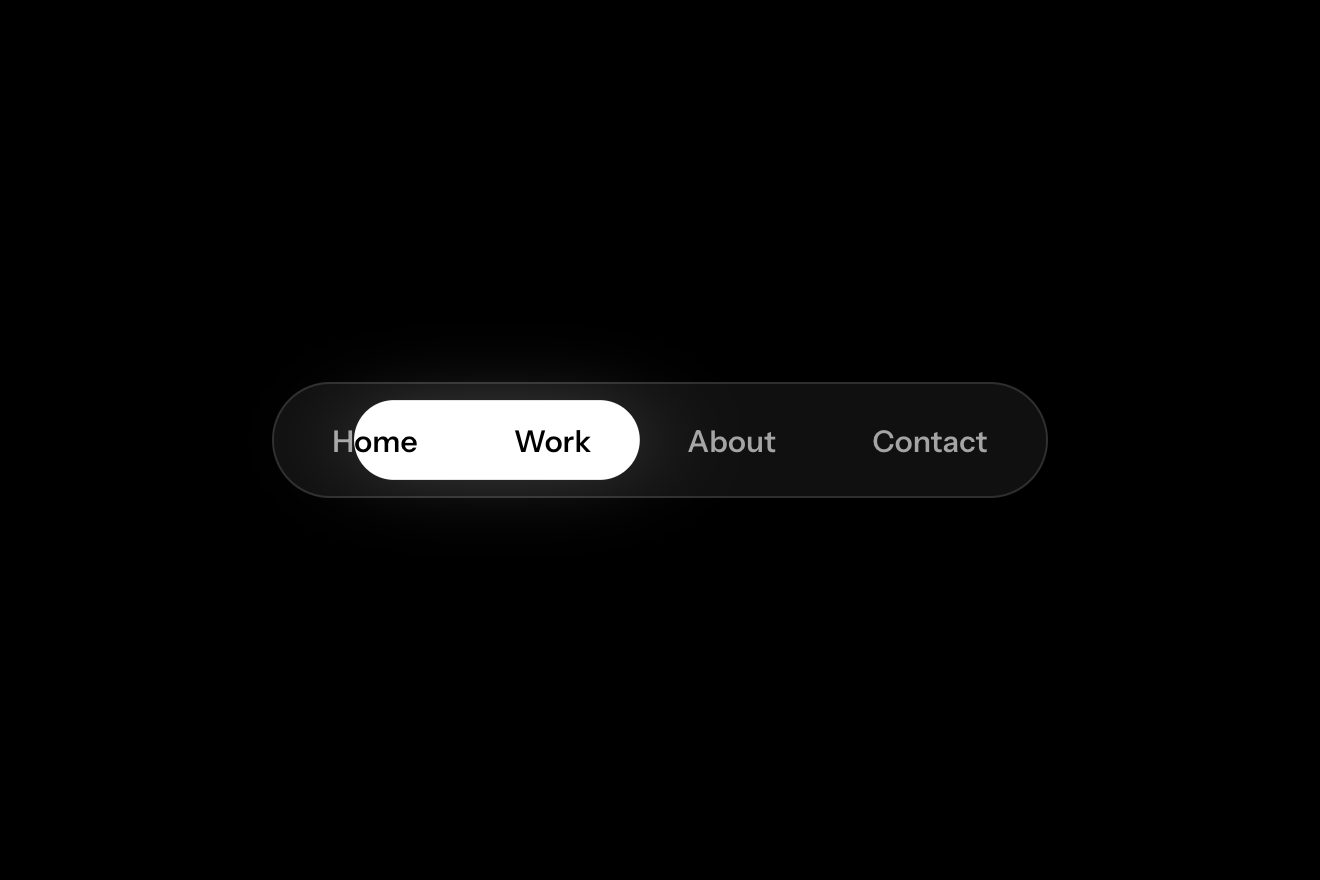
The panel for choosing the voice of Vela, an AI assistant, on black: above, a sound wave of liquid chrome drawn on a canvas, below, four voices in a row of pills, Juniper, Atlas, Wren and Sol. Each voice has its own timbre and the wave melts from the shape of one into the next: soft and round, low and wide, quick and dense, clear and even. Once chosen, a voice speaks for two seconds: the wave swells in syllables, a metal light runs along it from left to right and the words of its line light up one by one. The metal pill reaches the chosen voice on a spring that runs past by just one pixel and settles.
A folder that runs on its own: index.html, style.css, script.js and the libraries from a CDN. The React and Vue tabs hold the same demo as a ready component, which switches its animations off when it leaves the page.
<!doctype html>
<!--
  "Assistant voice selector" from Animorio · https://animorio.com
  License: free on your own sites and your clients’ sites, paid work included.
  Not for resale, redistribution, templates or code collections · https://animorio.com/en/license/
-->
<html lang="en">
<head>
  <meta charset="utf-8">
  <meta name="viewport" content="width=device-width, initial-scale=1">
  <title>The assistant voice selector with the liquid metal wave</title>
  <link rel="stylesheet" href="https://cdn.jsdelivr.net/npm/@fontsource-variable/mona-sans@5.3.0/wdth.css">
  <link rel="stylesheet" href="style.css">
</head>
<body>
  <main class="stage" data-stage>
    <!-- the voice picker of Vela, an AI assistant: a wave of liquid metal that takes the timbre of the chosen voice,
         four voices in a row of pills, and a two second preview where the metal light runs along the wave -->
    <section class="voice" data-wrap aria-labelledby="voice-title">
      <span class="voice__glass" aria-hidden="true"></span>
      <header class="voice__head">
        <div class="voice__titles">
          <p class="voice__title" id="voice-title">Voice</p>
          <p class="voice__meta"><svg viewBox="0 0 16 16" aria-hidden="true"><path d="M8 1.8l1.5 4.2 4.3 1.5-4.3 1.5L8 13.2 6.5 9 2.2 7.5 6.5 6z"/></svg>Vela assistant</p>
        </div>
        <button class="play" type="button" data-play aria-label="Preview the voice">
          <span class="play__body" data-play-body>
            <span class="play__icon" aria-hidden="true">
              <svg class="play__ring" viewBox="0 0 24 24"><circle class="play__track" cx="12" cy="12" r="10.25"/><circle class="play__arc" data-arc cx="12" cy="12" r="10.25"/></svg>
              <svg class="play__tri" data-tri viewBox="0 0 24 24"><path d="M10 8.2v7.6c0 .5.5.8.9.5l5.6-3.8c.4-.3.4-.8 0-1.1l-5.6-3.7c-.4-.3-.9 0-.9.5z"/></svg>
              <svg class="play__bars" data-bars viewBox="0 0 24 24"><rect x="8.2" y="9" width="1.6" height="6" rx=".8"/><rect x="11.2" y="7.5" width="1.6" height="9" rx=".8"/><rect x="14.2" y="9.6" width="1.6" height="4.8" rx=".8"/></svg>
            </span>
            <span class="play__label" data-play-label>Preview</span>
          </span>
        </button>
      </header>

      <div class="wave" aria-hidden="true">
        <canvas class="wave__canvas" data-wave></canvas>
      </div>

      <p class="voice__line" data-line aria-hidden="true"></p>

      <div class="pills" role="radiogroup" aria-labelledby="voice-title" data-pills>
        <span class="pills__thumb" data-thumb aria-hidden="true"><span class="pills__sheen" data-thumb-sheen></span></span>
        <button class="pill" type="button" role="radio" aria-checked="true" data-pill>Juniper</button>
        <button class="pill" type="button" role="radio" aria-checked="false" data-pill>Atlas</button>
        <button class="pill" type="button" role="radio" aria-checked="false" data-pill>Wren</button>
        <button class="pill" type="button" role="radio" aria-checked="false" data-pill>Sol</button>
      </div>

      <footer class="voice__foot">
        <p class="voice__desc" data-desc>Soft and warm, an unhurried pace</p>
        <p class="voice__hz" data-hz>164 Hz</p>
      </footer>
    </section>

    <svg class="ghost" data-ghost viewBox="0 0 24 24" aria-hidden="true"><path d="M5 3.2l13.4 8.1-6 1.1 3.4 6.9-2.6 1.3-3.4-6.9L5.4 17.8z"/></svg>
    <p class="sr" aria-live="polite" data-live></p>
  </main>

  <script src="https://cdn.jsdelivr.net/npm/gsap@3.15.0/dist/gsap.min.js"></script>
  <script src="script.js"></script>
</body>
</html>Change values, colours and text with the controls and watch the animation respond live. Or write in the code yourself. Then download the folder with your changes.
29 values to change
With the Animorio connector, Claude Code, ChatGPT, Cursor or VS Code take it from here, guide included, and fit it into your project. Paste this request:
Take “Assistant voice selector” from Animorio and fit it into my siteEach voice is a small object: three ripples along the wave with their frequency and weight, the speed they travel at, a grain of fine ripples, the height, how full the belly is (the exponent of the sine window) and the syllables per second. Changing voice GSAP takes all these numbers from the old ones to the new with power3.inOut, and the wave melts by itself from one shape into the next because it is redrawn every frame with the numbers of that moment.
The canvas draws the top edge and, coming back, the bottom one, which is a slightly different breath of the first so the ribbon does not look like a mirror. A vertical gradient fills it, from the light of the edges to the dark of the middle, measured on the height of the wave at that moment: it looks like a metal tube at any amplitude. Then, clipped to the ribbon and in lighter mode, two bands of light going opposite ways: where they cross the metal looks wet.
While it speaks, the level follows a target made of syllables (a sine to the power of 0.7 at the voice’s pace, times a slower phrase) inside an envelope that rises and falls, and follows it on a spring, so syllables swell instead of jumping. The band of light runs from left to right in PREVIEW seconds, the ticks below light up near it, and the words of the line light up as the voice reaches their part.
The pill has a damped spring integrated by hand in two half steps per frame. The damping is worked out from the distance at each choice: for a jump of d pixels the overshoot fraction is OVERSHOOT/d, and zeta is minus the log of that fraction over the square root of pi squared plus the log squared. So it runs past by one pixel for a short jump and a long one alike. Its speed stretches it and thins it in scaleY.
From the load event a timeline takes an SVG pointer to Preview, then to the other three voices and back to the first, each time waiting for the voice to finish speaking. When the real mouse comes over the loop stops and starts again shortly after it leaves; at the first click or key it stops for good. The arrow keys change voice as in a radiogroup.
| Name | File | Default | What it changes |
|---|---|---|---|
VOICE | script.js | 0 | The voice chosen when the page opens: 0 Juniper, 1 Atlas, 2 Wren, 3 Sol. |
PREVIEW | script.js | 2 | How many seconds the voice speaks in its preview. |
SPRING | script.js | 1 | How stiff the spring of the metal pill is. |
OVERSHOOT | script.js | 1 | How many pixels the pill runs past the chosen voice before it settles. |
FLOW | script.js | 1 | How fast the light drifts along the metal when the voice is quiet. |
DETAIL | script.js | 140 | How many points draw the wave. |
MORPH | script.js | 0.9 | How many seconds the wave takes to melt into the shape of the new voice. |
AUTO | script.js | true | The drawn pointer tries the voices by itself until someone touches them. |
For an app or site with an AI assistant that speaks, for the settings of a text to speech or audiobook service, for the onboarding of a voice app: it lets the eyes hear the difference between the voices before choosing, even without sound.
On the phone the panel takes almost the whole width, the wave gets lower with the screen height and the pills stay four in a row with slightly smaller words; there is no hover, so a voice is tried by tapping it.
Nothing moves: the wave stays still in the shape of the chosen voice and changes to the new one with a fade, the light does not run, the pill appears on the new voice with a fade, the words light up only in colour and the hertz change in place.
GSAP 3.15.0, Mona Sans (font variabile) 5.3.0.
Compressed with gzip, the three demo files weigh 11 KB; the libraries: GSAP 28 KB.
Tested on 11 November 2026
Use it in your own projects and in your clients’ projects. Do not resell it or redistribute it as is. GSAP stays under its own Standard license. Full license.
Support Animorio
Animorio stays free thanks to the people who support it. If you like, buy us a coffee: it helps us make the next animations.
You asked for
We made it for you: it’s in the library, with the preview, the Playground and the code to copy.
An animation you can’t find, or a site to take apart in the journal: tell us which. We pick the next ones from here.
With your account’s email and password.
or with your email
You’re signed in as .
With your account, you can download the zip of every animation and every pack, for free.